Prof. Yu LIU’s research team from the Department of Mechanics and Aerospace Engineering at Southern University of Science and Technology (SUSTech) published a review article titled “Recent advancements and challenges for eVTOL aircraft aerodynamic noise in Urban Air Mobility” in Progress in Aerospace Sciences, one of the leading review journals in aerospace science and engineering (Impact Factor around 16; approximately 40 articles published annually).
The article focuses on aerodynamic noise in electric vertical takeoff and landing (eVTOL) aircraft, a critical constraint for Urban Air Mobility (UAM), and synthesizes current understanding of noise-generation mechanisms, mitigation strategies, and engineering validation frameworks. The review serves as a comprehensive reference for low-noise aircraft design and urban operations.

With the rapid expansion of low-altitude aviation and Urban Air Mobility (UAM) initiatives, eVTOL aircraft are widely regarded as a key technological enabler of future urban air transportation. Unlike conventional aircraft, most eVTOL concepts adopt distributed electric propulsion (DEP), featuring multiple rotors and diverse vehicle configurations. The increased number of acoustic sources, their complex spatial distribution, and aerodynamic interactions between rotors and airframe components make aerodynamic noise a system-level, operating-condition-dependent challenge. In urban operations, noise affects not only passenger experience but also community acceptance and operational constraints, and it remains one of the primary barriers to large-scale deployment.
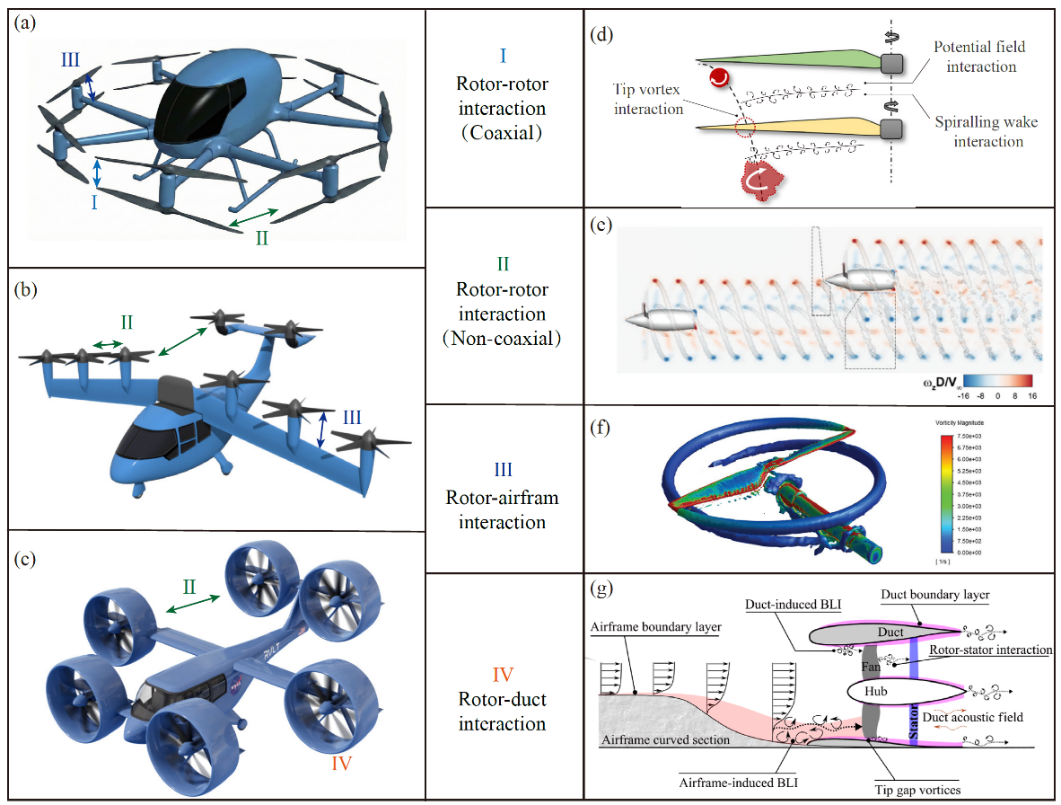
Figure 1: Representative eVTOL configurations and major categories of interaction noise sources.
The review systematically analyzes eVTOL noise in terms of rotor self-noise, component self-noise, and interaction noise. It highlights that in distributed electric propulsion (DEP) configurations, rotor–rotor and rotor–airframe interactions can significantly alter the overall acoustic signature and often dominate the noise footprint. The paper further examines how the dominant noise mechanisms evolve across flight phases, including hover, transition, cruise, and descent, and emphasizes that mitigation strategies should be assessed over the complete mission profile. Designs optimized for a single operating condition may not deliver consistent performance across the full flight envelope.
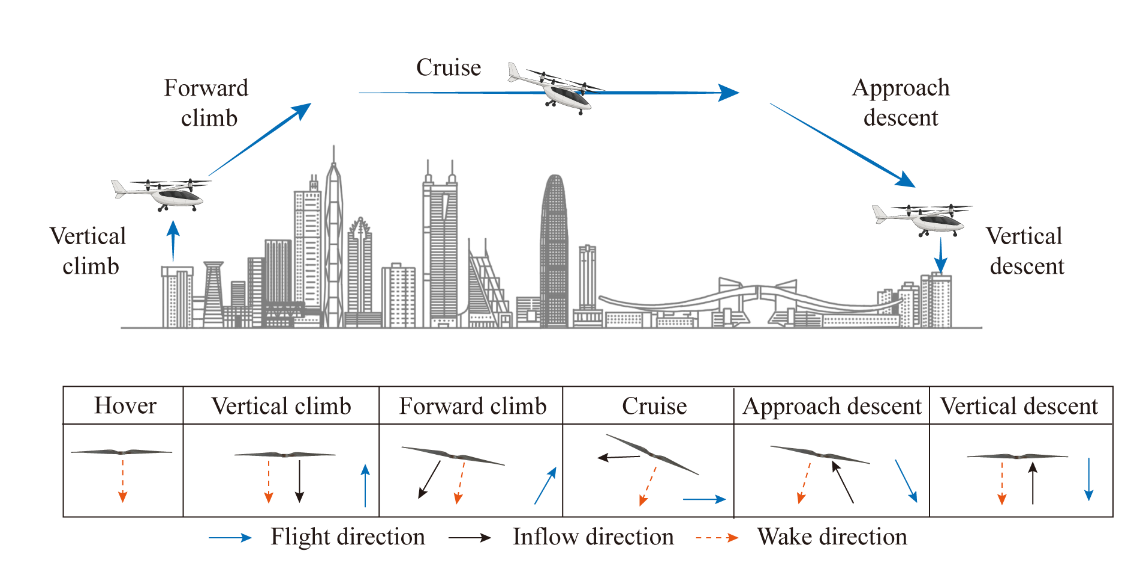
Figure 2: Vertical flight profile of a multirotor eVTOL aircraft and characteristic flow features of an isolated rotor at different flight stages.
In terms of noise mitigation strategies, the review classifies current methods into passive and active control approaches. Passive methods primarily rely on aerodynamic and structural design modifications to modify noise-generation mechanisms or disrupt coherent flow structures. Representative measures include blade-parameter optimization, tip treatments, and non-planar rotor configurations, leading- and trailing-edge modifications, surface treatments, and the use of acoustic-liner treatments. While these approaches are generally feasible in practice, they must be balanced against propulsion efficiency, structural loads, and overall system constraints. Active methods emphasize adaptive operation and system-level coordination, including blade pitch control, active flow control, and multi-rotor phase synchronization. DEP architectures provide the technical basis for phase-synchronization strategies, but their robustness and experimental validation in complex flight conditions remain open challenges.
The review also highlights the complementary roles of analytical modeling, numerical simulation, and experimental measurements in aeroacoustic prediction. It emphasizes the need for multiphysics-coupled validation frameworks to strengthen model credibility and practical engineering relevance.
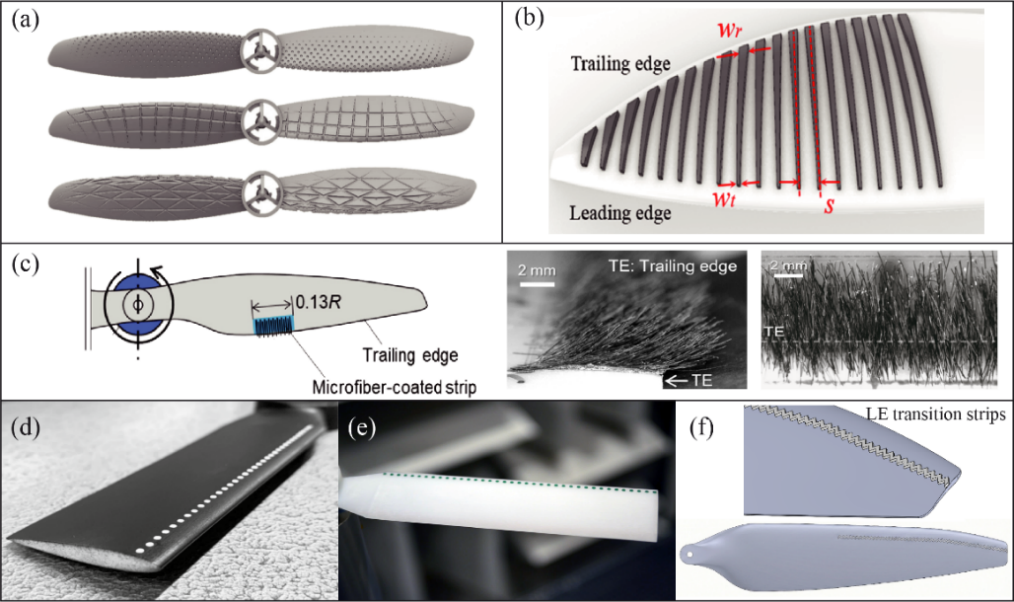
Figure 3: Representative blade surface treatments for aerodynamic noise reduction.
Overall, the article presents a unified framework connecting configuration, operating conditions, mechanisms, evaluation, control, and validation. It calls for a shift from isolated source analysis to system-level, coupled multi-source assessments across full mission profiles, enabled by reproducible evaluation standards.
Changsheng ZHAO, a Ph.D. candidate in the Department of Mechanics and Aerospace Engineering at SUSTech, is the first author of the paper. Associate Professor Yannian YANG of South China University of Technology is the second author, and Prof. Yu LIU is the corresponding author. Co-authors also include Zhiyong CHENG (Ph.D. candidate) and Tongzhen ZHANG (master’s student) from Prof. LIU’s research group at SUSTech. SUSTech is the first and corresponding institution.
Paper Link: https://doi.org/10.1016/j.paerosci.2026.101184
Proofread ByNoah Crockett, Junxi KE
Photo ByChangsheng ZHAO