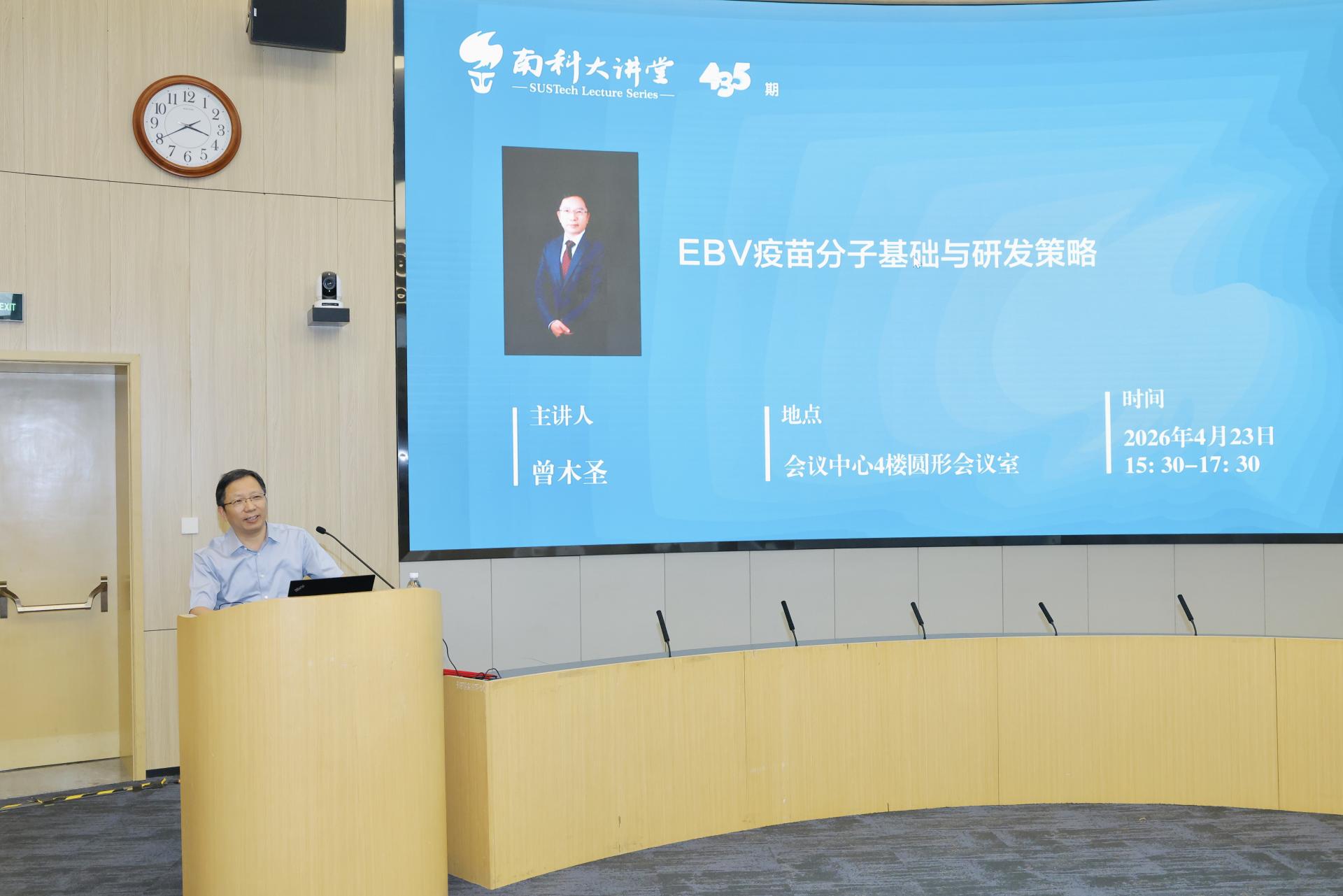
On April 23, Professor Musheng ZENG, an Academician of the Chinese Academy of Sciences, Deputy Director and Vice President of Sun Yat-sen University Cancer Center, visited the Southern University of Science and Technology (SUSTech) as a guest at the 435th session of the SUSTech Lecture Series, delivering an academic report titled “Molecular Basis and Developmental Strategies of EBV Vaccines.” The report was hosted by Songling WANG, Academician of the Chinese Academy of Sciences and Dean of the Medical School.
Musheng ZENG stated that the development of the Epstein-Barr virus (EBV) vaccine faces two major bottlenecks. First, the mechanism by which the virus infects epithelial cells has been unclear for a long time. Second, early vaccines targeting only gp350, while able to reduce the incidence of infectious mononucleosis, cannot completely prevent infection. To address these issues, Musheng ZENG’s team discovered that EBV infection operates in a “many-to-many” relationship meaning multiple viral glycoproteins interact cooperatively with multiple host receptors. The team has successively identified epithelial cell-specific receptors such as EphA2, NMHC-IIA, and NRP1, and further discovered a potential universal receptor for both B cells and epithelial cells called R9AP. This discovery provides a new theoretical basis for vaccine target selection.
In terms of vaccine development, Musheng ZENG’s team established a fully human phage display antibody library from nasopharyngeal carcinoma patients and screened over 50 fully human monoclonal antibodies. Among them, the broadly neutralizing antibody Fab5 targeting glycoprotein gB demonstrated cross-protective ability in various animal models. Considering the relatively weak immunogenicity of EBV glycoproteins, the team also developed gB nanoparticle vaccines and chimeric nanoparticle vaccines, significantly enhancing the immune response.
Musheng ZENG mentioned that in the serum analysis of high-risk populations and patients with nasopharyngeal carcinoma, only the level of gp42 antibodies was found to be a significant independent protective factor. Based on this, the team screened for high-affinity anti-gp42 antibodies and constructed a VSV-gp42 recombinant vaccine. Animal experiments showed that this vaccine can induce a rapid, lasting, and strong humoral immune response. In the field of early diagnostic technology, Musheng ZENG’s team created a highly sensitive CRISPR/Cas12a-based detection platform called SENSORS, which, combined with machine learning algorithms, can significantly improve the efficiency of early diagnosis.
During the interactive session, Musheng ZENG had in-depth exchanges with the audience of teachers and students on frontier topics such as the pathogenesis of EBV, the treatment of autoimmune diseases with EBV vaccines, and the clinical application of early diagnosis technologies.
Proofread ByJunxi KE
Photo BySchool of Medicine