A collaborative research team from SUSTech and partner institutions has made an important breakthrough in the study of infinite-layer nickelate superconductors. The team of Qikun XUE and Zhuoyu CHEN from the State Key Laboratory of Quantum Functional Materials and the Department of Physics at Southern University of Science and Technology (SUSTech), the Quantum Science Center of Guangdong-Hong Kong-Macao Greater Bay Area (QSC-GBA), and Tsinghua University, in collaboration with the Danfeng LI team from the Department of Physics at City University of Hong Kong (CityU), the High Magnetic Field Laboratory at the Hefei Institutes of Physical Science, Chinese Academy of Sciences, and the National Pulsed High Magnetic Field Science Center at Huazhong University of Science and Technology and others, discovered a novel reentrant superconducting state in infinite-layer nickelates under high magnetic fields. The findings were published in the academic journal Nature under the title “Field re-entrant superconductivity in Eu-doped infinite-layer nickelates.”
The research team discovered, for the first time, a strong magnetic field-induced “re-entrant superconductivity” phenomenon in infinite-layer nickelates (Sm0.95-xCa0.05EuxNiO2). This discovery not only reveals the complex interplay between rare-earth magnetism and high-temperature superconductivity but also overturns the established paradigm in the field, providing an entirely new experimental platform for exploring unconventional pairing mechanisms in strongly correlated oxides.
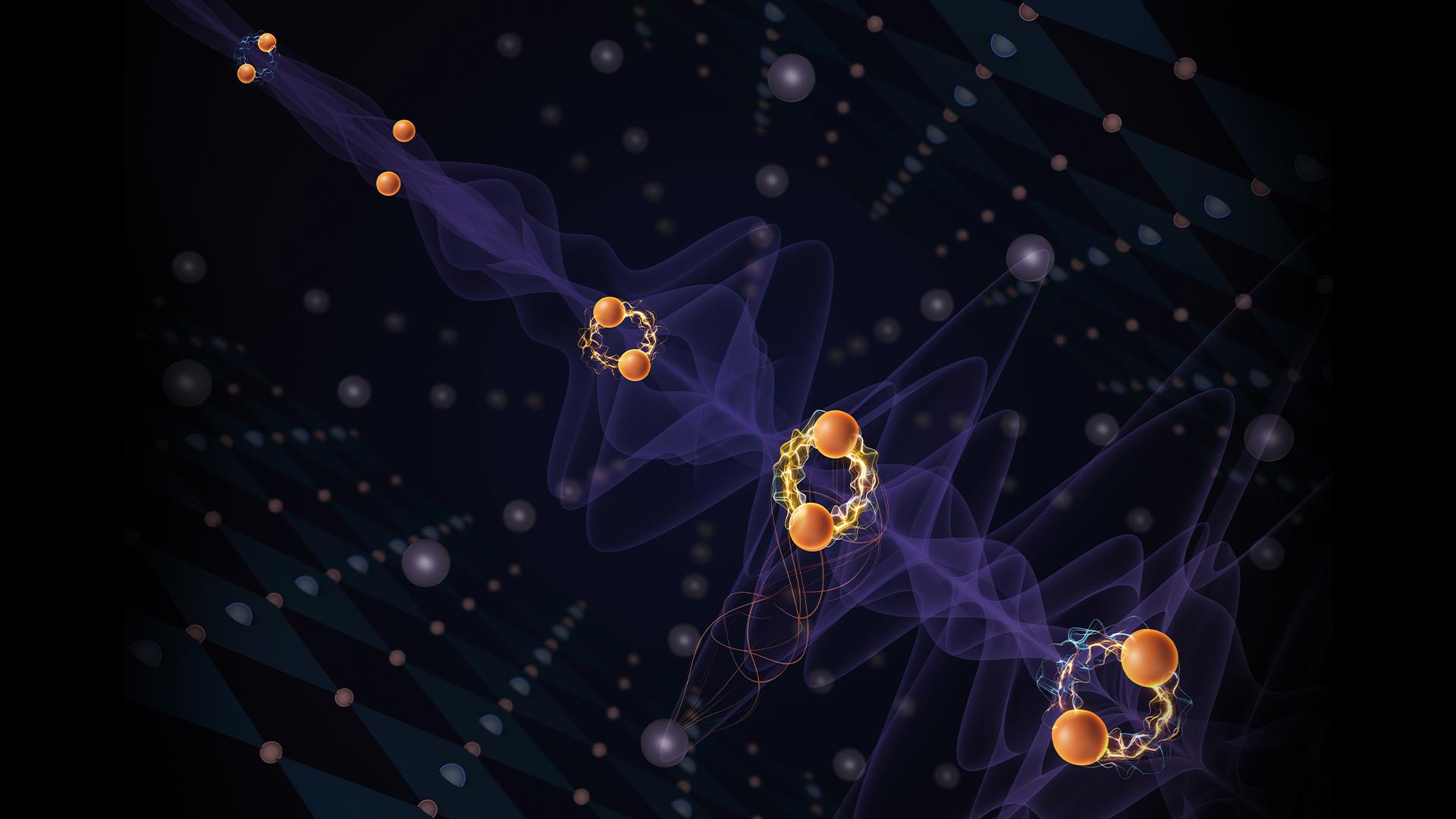
In conventional understanding, magnetic fields and superconductivity are fundamentally incompatible, strong magnetic fields destroy the superconducting state. However, in a handful of exceptional materials extremely strong magnetic fields can revive superconductivity that has already vanished. This phenomenon is known as “re-entrant superconductivity.” This quantum phenomenon had previously only been observed in systems with extremely low transition temperatures (near absolute zero), such as heavy fermion compounds. This study marks the first observation of re-entrant superconductivity in a nickelate superconducting system, extending this exotic quantum state to oxide systems with elevated transition temperatures and opening new avenues for investigating unconventional superconducting mechanisms.
By precisely tuning the Eu (europium) doping concentration, the team captured this anomalous behavior in the overdoped region. As the magnetic field increased, the material exhibited a peculiar “superconducting – normal state – superconducting” transition. The superconducting state, which had already disappeared, re-emerged and remained remarkably robust even under extreme magnetic fields reaching approximately one million times the strength of Earth’s magnetic field. Through combined experimental evidence of “zero resistance” and “diamagnetism,” the researchers confirmed the superconducting nature of this high-field state. This discovery fundamentally challenges conventional wisdom; it demonstrates that under specific conditions, magnetic interactions are no longer the “destroyer” of superconductivity; instead, they may act as a “driving force” that promotes electron pairing.
Traditional re-entrant superconductivity is notoriously sensitive to the relative orientation between the magnetic field and the sample, typically emerging only within an extremely narrow angular range. However, the research team found that re-entrant superconductivity in the nickelate-based system exhibits full-angle robustness, remaining stable across the complete range from 0° to 90°. Particularly at high doping concentrations, the high-field superconducting state proved even more robust than the low-field superconducting state. This finding implies that the classic “magnetic field compensation mechanism” (the Jaccarino-Peter effect) is insufficient to explain the underlying physics. It suggests that magnetically induced “unconventional pairing” plays a crucial role, providing a novel dimension for superconductivity physics research.
The research team also observed a series of transport signatures pointing to novel physics: in overdoped samples, the Hall resistance displayed pronounced nonlinearity and tended to saturate under strong fields; meanwhile, the magnetoresistance exhibited significant magnetic hysteresis loops, whose temperature dependence suggests that the system may exhibit time-reversal symmetry breaking. These phenomena indicate that the localized magnetic moments of Eu2+ may induce complex magnetic correlations through strong spin-orbit coupling, leading to nontrivial interactions with conduction electrons that in turn influence the stability of superconducting pairing.
Since the discovery of infinite-layer nickelate superconductors by Professor Harold Hwang’s group at Stanford University in 2019, these materials have attracted considerable attention due to their electronic structure similarities to cuprate high-temperature superconductors. This study represents the first realization of exotic quantum states akin to those in heavy fermion systems in an oxide superconductor with a relatively high transition temperature (32 K), building a bridge between high-temperature superconductivity and heavy fermion physics. This work provides fresh perspectives for understanding magnetoelectric interactions in strongly correlated electron systems. Eu-doped nickelates serve as a unique material platform, enabling researchers to explore the microscopic mechanisms of magnetic field-superconductivity coexistence in strongly correlated oxides, opening new experimental directions for high-temperature superconductivity research.
This research was conducted through collaboration among City University of Hong Kong, SUSTech, the Quantum Science Center of Guangdong-Hong Kong-Macao Greater Bay Area, the High Magnetic Field Laboratory at the Hefei Institutes of Physical Science (Chinese Academy of Sciences), the National Pulsed High Magnetic Field Center at Huazhong University of Science and Technology, Tsinghua University, and other institutions. Postdoctoral researchers Mingwei YANG and Jiayin TANG from City University of Hong Kong, and doctoral student Xianfeng WU from SUSTech, are co-first authors. Associate Professor Danfeng LI from City University of Hong Kong, Associate Professor at SUSTech, and jointly appointed Researcher of QSC-GBA Zhuoyu CHEN, and Associate Researcher Heng WANG from the QSC-GBA are co-corresponding authors. The author list also includes Academician Qikun XUE, who provided pivotal intellectual input to this study, as well as Professor Ziqiang WANG from Boston College.
Paper Link: https://doi.org/10.1038/s41586-026-10547-y
Proofread ByNoah Crockett, Junxi KE
Photo By