The team led by Qikun XUE and Shuoying YANG from the State Key Laboratory of Quantum Functional Materials and the Department of Physics at Southern University of Science and Technology (SUSTech) and the Quantum Science Center of Guangdong-Hong Kong-Macao Greater Bay Area (QSC-GBA) made progress in the intrinsic superconducting interference of two-dimensional superconductors. The research team observed, for the first time, periodic magnetoresistance oscillations, superconducting interference phenomena, and superconducting diode effects in the superconducting fluctuation regime of few-layer niobium diselenide (NbSe2). The related results were published under the title “Magnetoresistance Oscillations in Few-Layer NbSe2 in Superconducting Fluctuation Regime” in the physics journal Physical Review Letters and were selected as an “Editor’s Suggestion.”
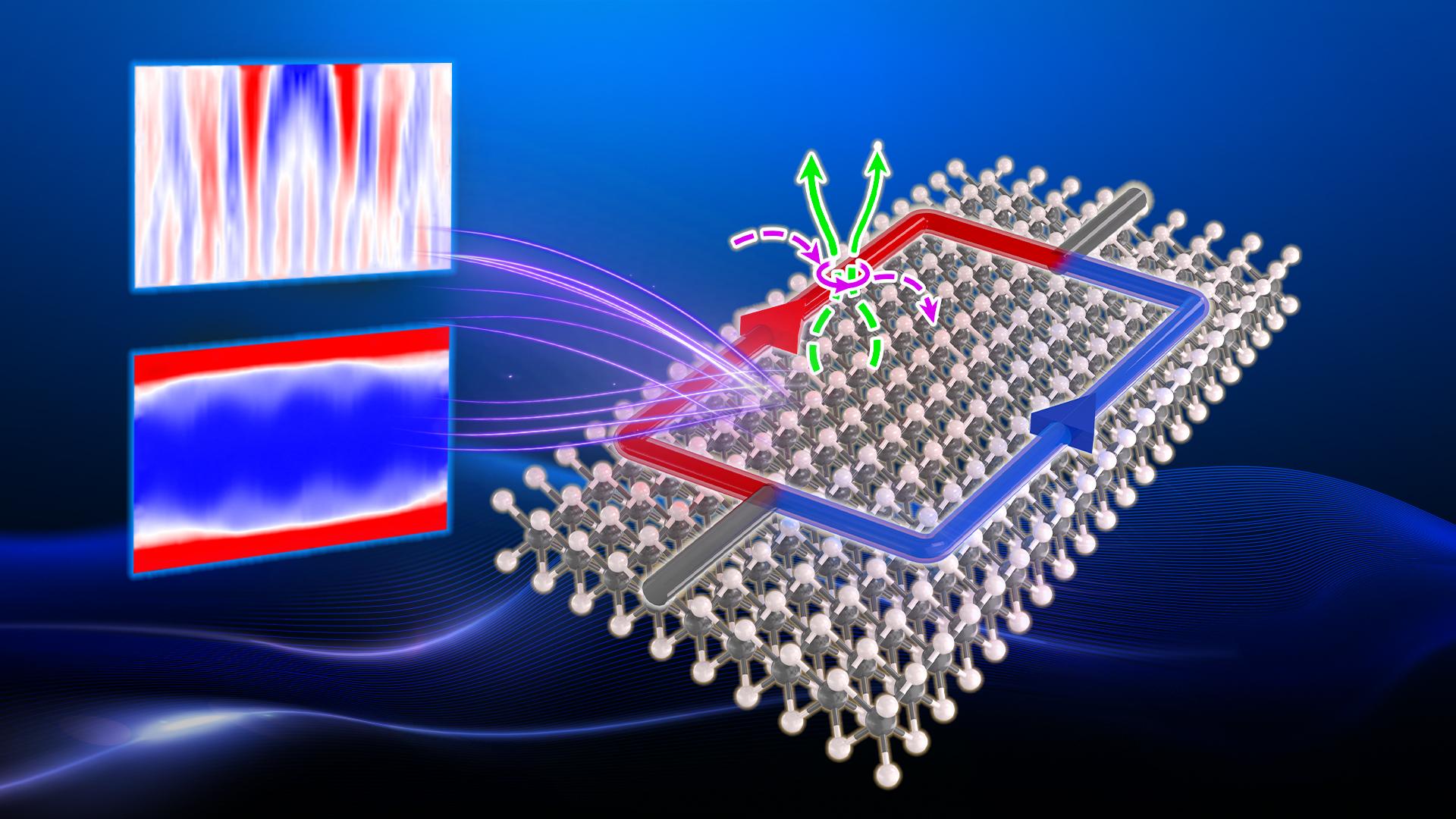
When the material is thinned down to only a few atomic layers, its superconducting behavior differs significantly from that of conventional three-dimensional superconductors. In three-dimensional superconductors, Cooper pairs can freely form a coherent macroscopic quantum state within the material, allowing the entire system to exhibit perfect zero-resistance characteristics. In the two-dimensional limit, however, Cooper pairs are constrained by the spatial dimension, and the effects of thermal fluctuations and quantum fluctuations are significantly enhanced, making the superconducting state more fragile and more sensitive to external disturbances. This fluctuation effect, which is enhanced with reduced dimensionality, not only affects the resistance and critical temperature of the superconductor but may also lead to unconventional phenomena absent in conventional three-dimensional superconductors, such as anomalous metallic states, the formation of localized vortices, and inhomogeneous distribution of the superconducting phase.
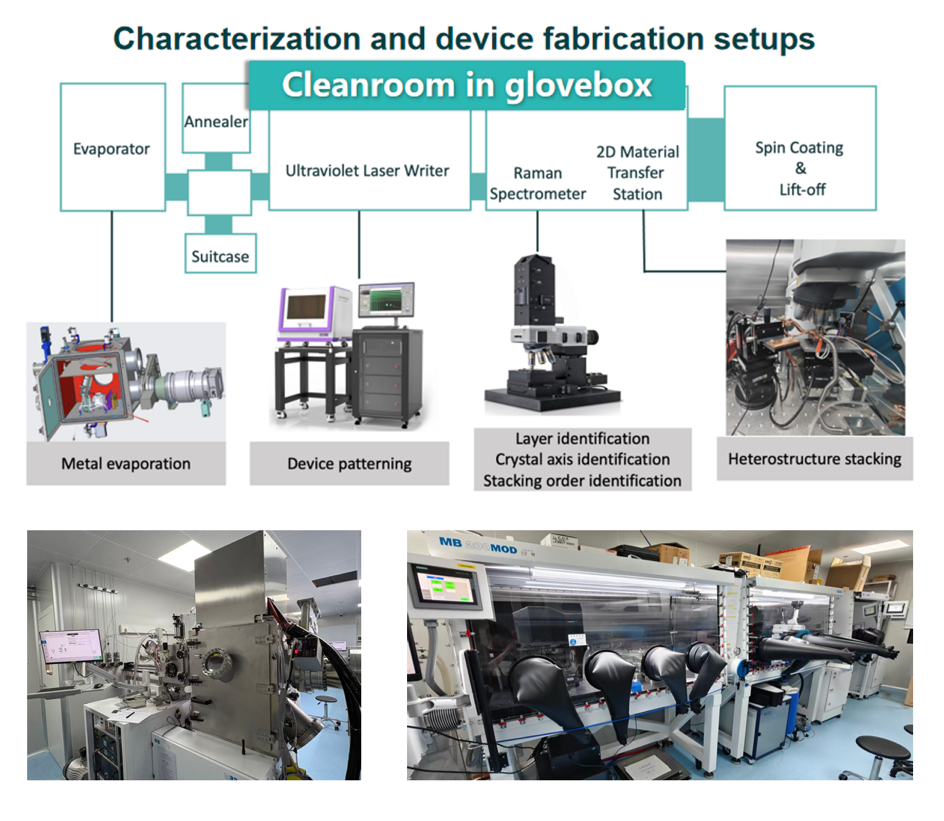
Figure 1. Micro-nano Fabrication Platform for Water- and Oxygen-Sensitive Materials
In 2024, the research team led by Qikun XUE and Shuoying YANG established a Low-Dimensional Materials Device Physics Laboratory. Relying on advanced micro-nano fabrication techniques and low-temperature quantum transport measurement methods, the laboratory focuses on the study of novel quantum phenomena emerging in low-dimensional materials and their heterostructures. After two years of efforts, the laboratory has built a glovebox interconnection system for water- and oxygen-sensitive two-dimensional materials, which allows the complete device fabrication process, including material exfoliation, characterization, stacking, and metal evaporation, to be carried out in an inert atmosphere. This provides key support for constructing high-quality quantum material heterostructures and performing low-temperature quantum transport measurements. This study was completed based on this research platform.
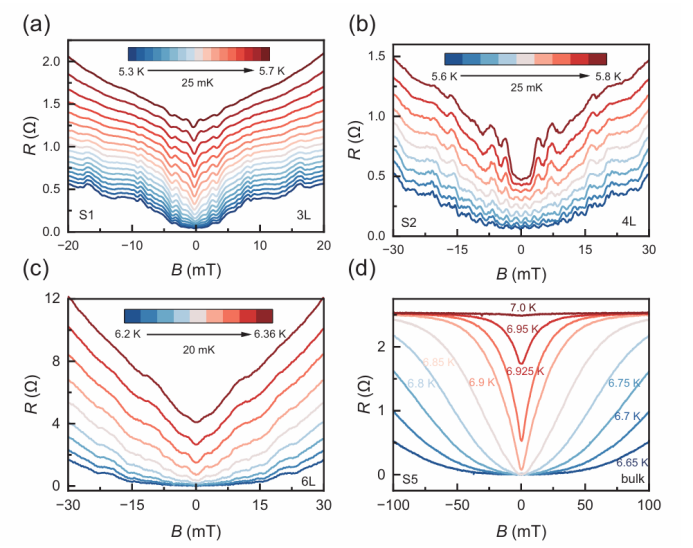
Figure 2. Periodic magnetoresistance oscillations in few-layer NbSe2. (a-c) Magnetoresistance oscillations in 3-, 4-, and 6-layer samples. As the sample thickness increases, this oscillation phenomenon gradually diminishes. (d) Magnetoresistance oscillations disappear in three-dimensional thick NbSe2 layers.
In this study, the research team first observed periodic magnetoresistance oscillations in few-layer NbSe2. These oscillations have very unique occurrence conditions: they only exist in an extremely narrow temperature range close to zero resistance and within a relatively small magnetic field range. As the sample thickness increases, the oscillation phenomenon gradually weakens and eventually disappears (Figure 2). This pronounced thickness dependence is highly consistent with the known anomalous metallic behavior: the thinner the sample, the stronger the superconducting phase fluctuations, indicating that the magnetoresistance oscillations are closely related to superconducting fluctuations rather than conventional phase coherence mechanisms. Further experiments by the researchers revealed that, within the same temperature range, the system also exhibits superconducting interference phenomena as well as superconducting diode effects modulated by the magnetic field (Figure 3). Traditional superconducting interference phenomena (such as Little-Parks oscillations or the Josephson effect) usually rely on carefully designed mesoscopic structures and global phase coherence. In this study, however, all the above phenomena appeared in intrinsic two-dimensional superconductors without micro- or nanofabrication and only persisted in the intermediate temperature range where superconducting fluctuations were most pronounced, disappearing in the low-temperature strong coherence or high-temperature normal states.
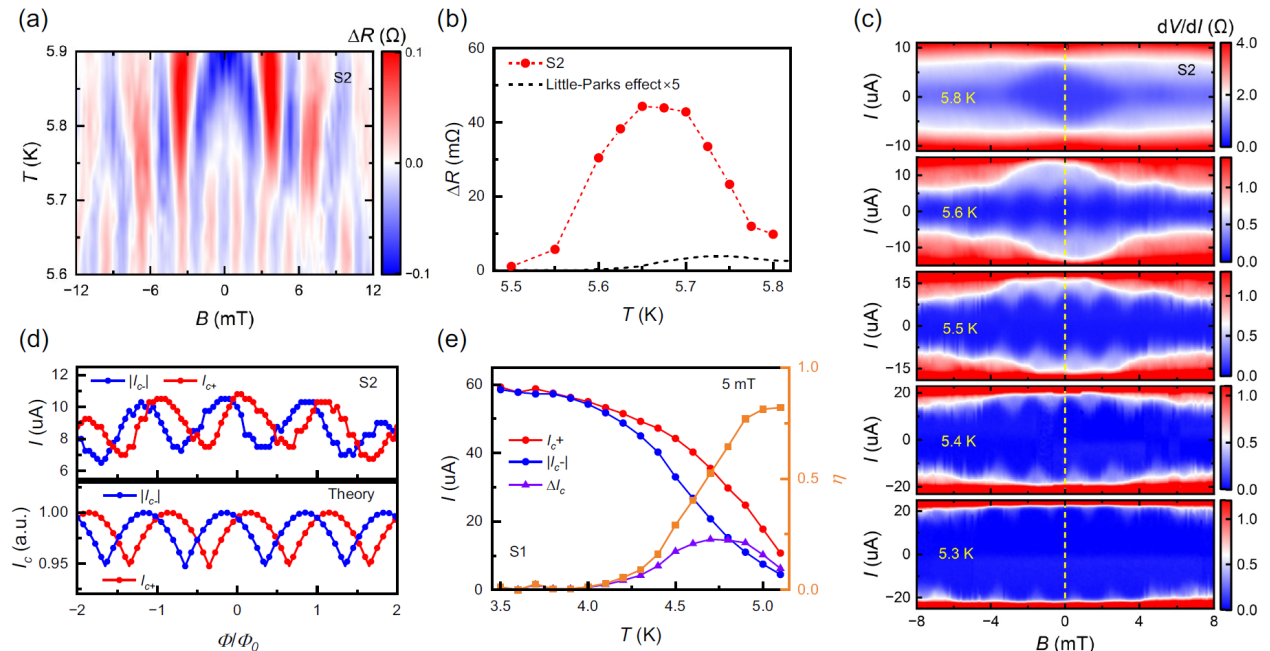
Figure 3. Temperature dependence of magnetoresistance oscillations, superconducting interference, and superconducting diode phenomena
This study proposes that interference phenomena dependent on coherence actually originate from strong superconducting phase fluctuations in thin-layer materials. To support this, the researchers constructed a concise physical model: in asymmetrical superfluid loop structures naturally present in the material, thermally excited superconducting vortices can move by overcoming the periodic potential barriers (Figure 4). At low temperatures, vortices cannot overcome the barriers to pass through the superfluid loops; at high temperatures, superconductivity disappears. Therefore, only in the intermediate temperature range can vortices be thermally excited, leading to phenomena such as magnetoresistance oscillations and superconducting interference. This finding reveals that, in the two-dimensional limit, phase fluctuations traditionally thought to disrupt superconductivity may instead give rise to new types of quantum interference behavior. This mechanism does not rely on long-range phase coherence, thus breaking the limitations of the conventional Little-Parks picture and providing new experimental evidence and theoretical perspectives for understanding novel quantum interference phenomena in low-dimensional superconductors.
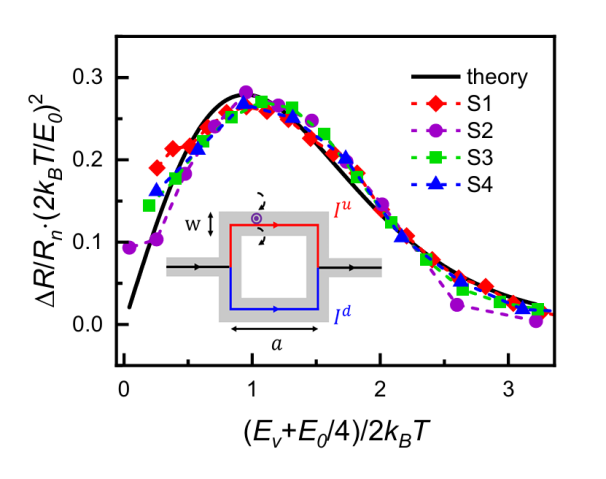
Figure 4. Physical model of a vortex passing through an asymmetric superconducting loop
Xiaolong YIN, a 2024-entry PhD candidate in the Department of Physics at SUSTech, and Congzhe CAO, a 2023-entry master’s student, are co-first authors of the paper. Academician Qikun XUE, President of SUSTech, Assistant Professor Shuoying YANG, and Associate Professor Jiawei MEI from the Department of Physics are the corresponding authors of this paper. SUSTech is the first affiliated institution of the paper.
Paper Link: https://journals.aps.org/prl/abstract/10.1103/rtxc-6tvs
Proofread ByNoah Crockett, Junxi KE
Photo ByYan QIU