Professor Qihang LIU’s research group from the State Key Laboratory of Quantum Functional Materials and Department of Physics, Southern University of Science and Technology (SUSTech) has made progress in the fundamental theory of symmetry-based magnetic classification. Their work has been published in the academic journal Nature under the title “Symmetry Classification of Magnetic Orders using Oriented Spin Space Groups”.
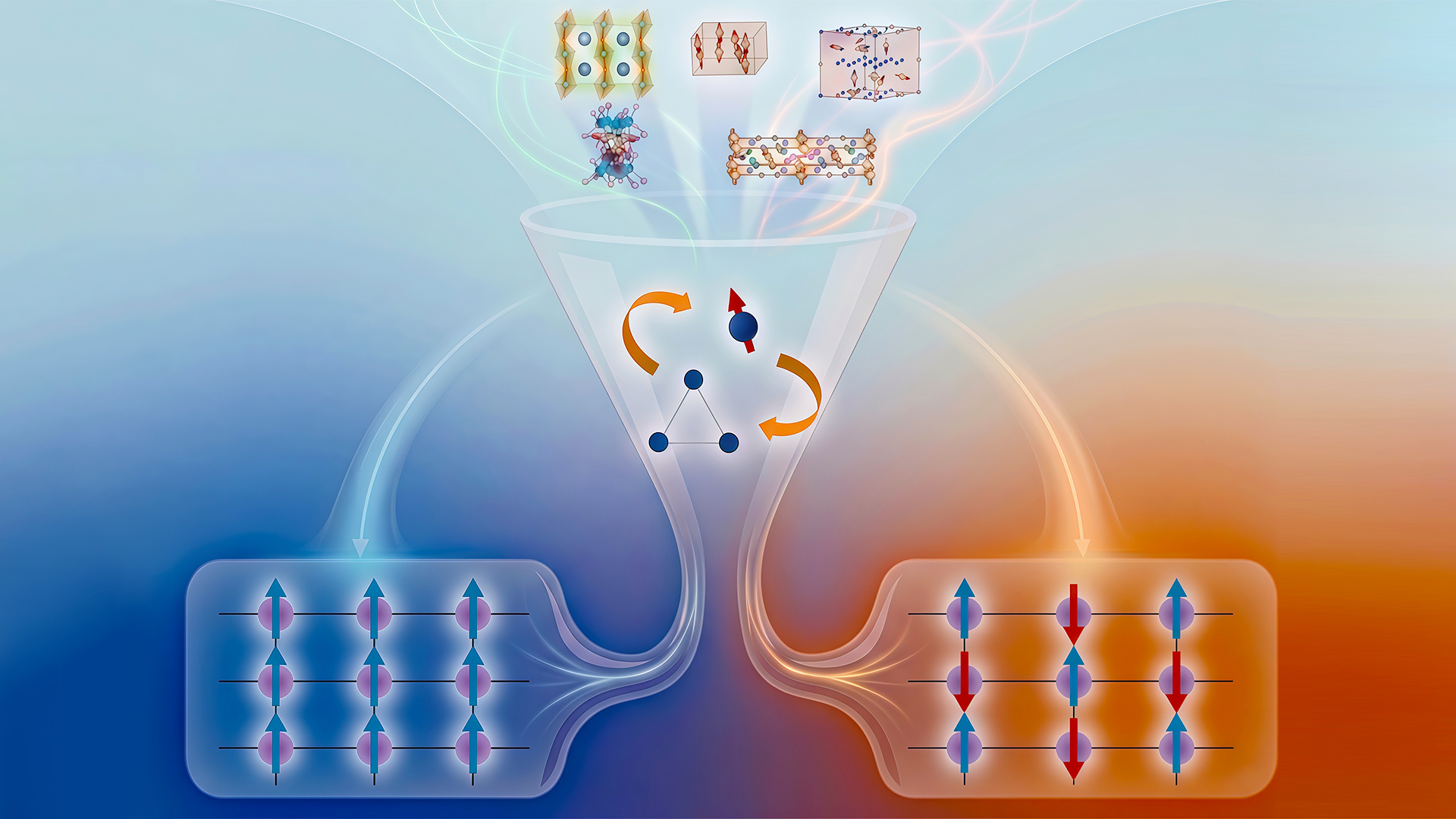
Magnetism is one of the central research areas in condensed matter physics and holds broad application potential in information storage, spintronics, and quantum materials. Magnetic order is usually classified into two major categories, ferromagnetism (including ferrimagnetism) and antiferromagnetism, depending on whether a system exhibits macroscopic magnetization. However, with the rapid development of antiferromagnetic spintronics in recent years and the discovery of unconventional magnetic materials such as altermagnets, the limitations of the traditional framework for describing magnetism have become increasingly apparent. The reason is that, for decades, the physics community has primarily relied on the magnetic space group (MSG) framework to characterize the symmetry of magnetic materials. Because MSG operations require spin rotations to remain aligned with lattice rotations, this framework cannot fully describe the geometric characteristics of magnetic order. For example, collinear ferromagnetic, collinear antiferromagnetic, and coplanar antiferromagnetic structures with completely different magnetic orders may even share the same MSG.
Accordingly, a fundamental question arises: how can the boundary between ferromagnetism and antiferromagnetism be defined rigorously from a mathematical perspective? In other words, how should antiferromagnetic order be accurately defined? Specifically, antiferromagnetic order refers to an ordered magnetic geometry in which the net spin magnetization is zero because the spins are arranged antiparallel to one another. In 1948, Louis Néel, the discoverer of antiferromagnetism, refined the definition of antiferromagnetism under the condition of zero magnetization by emphasizing that the magnetic sublattices carrying opposite spins must be crystallographically equivalent, that is, protected by symmetry. A classic example is a one-dimensional antiferromagnetic chain, in which the two magnetic sublattices are related by translational symmetry. This then leads to the next question: what kind of symmetry framework, beyond the MSG, should be used to describe such symmetry protection?
To address this issue, the research team adopted the recently developed spin space group (SSG) framework to classify magnetic order. Within this framework, the ferromagnetism-antiferromagnetism dichotomy can be rigorously defined by a symmetry criterion: whether the SSG enforces zero net spin in the unit cell. If the SSG ensures complete spin compensation within the unit cell, the system is classified as antiferromagnetic; otherwise, it belongs to the ferromagnetism or ferrimagnetism category. This result provides a clear and mathematically rigorous foundation for classifying magnetic order.
Building on this foundation, the research team further introduced the concept of the Oriented Spin Space Group (OSSG) to unify the theoretical descriptions of magnetic materials provided by the traditional MSG and the emerging SSG frameworks. By specifying the orientation of spins relative to the crystal lattice, OSSG establishes a many-to-one mapping to the spin space group and a direct group-subgroup relationship with the MSG. Figure 1 illustrates the relationships among these three symmetry descriptions. The SSG allows independent rotations in spin space and lattice space, while OSSG connects the two by fixing the direction of magnetic moments. When spin-orbit coupling is introduced, the symmetry is further reduced to the MSG. This framework clearly reveals the pathway of symmetry evolution induced by spin-orbit coupling. As a result, OSSG can incorporate the full information contained in both SSGs and MSGs, providing a new and more complete framework for describing the symmetry of magnetic materials.
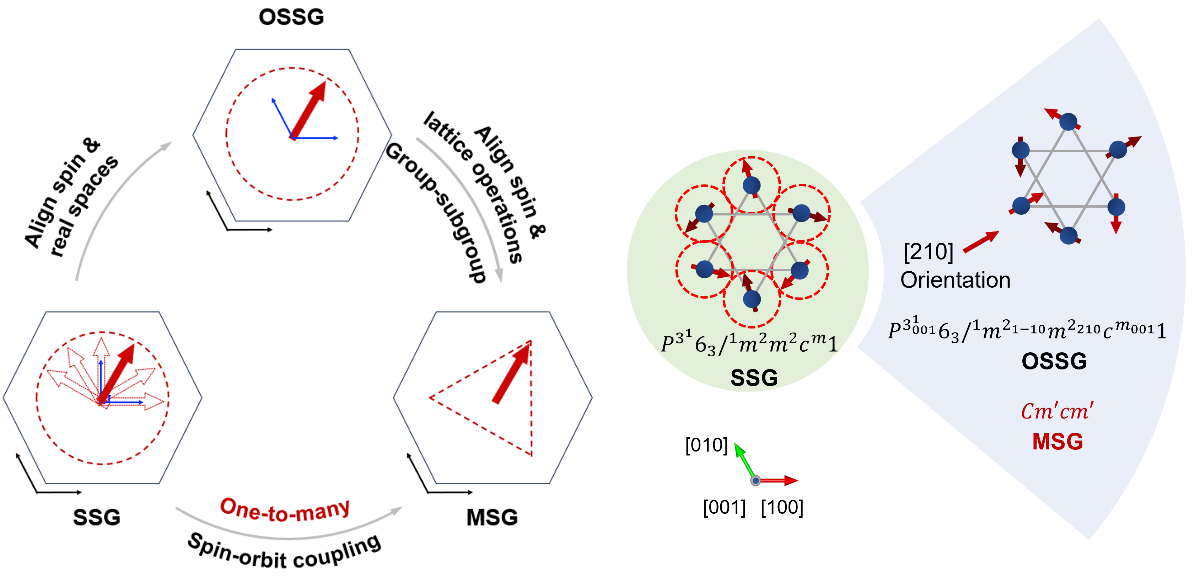
Figure 1. Schematic diagram of the relationship between OSSG, SSG, and MSG.
On this basis, within the broader category of antiferromagnetism, the researchers identified a special type of magnetism arising from spin-orbit-coupling-induced symmetry breaking, which is termed spin-orbit magnetism (SOM). In the absence of spin-orbit coupling, the SSG symmetry enforces zero net spin magnetization, so the system behaves as an antiferromagnet. Once spin-orbit coupling is introduced, the symmetry is lowered, allowing a finite magnetization to emerge. In other words, SOM materials possess an antiferromagnetic spin order yet can exhibit macroscopic physical properties more commonly associated with ferromagnets, such as the anomalous Hall effect and the magneto-optical Kerr effect. Using the noncollinear antiferromagnet Mn3Sn as an example, the team combined theoretical derivation with density functional theory calculations to demonstrate how the OSSG framework can predict SOMs that maintain an extremely small net spin magnetization while still producing pronounced magneto-transport responses. This feature could offer unique advantages for the next generation of spintronic devices, including strong robustness to interference and high information density.
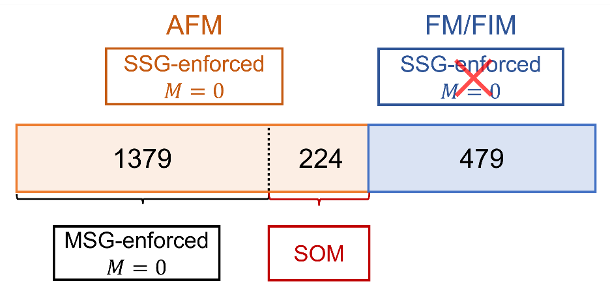
Figure 2. Magnetic classification based on SSG and MSG symmetry criteria, and statistical analysis of magnetic material classification based on the MAGNDATA database.
To further explore material realizations of this theory, the research team systematically screened 2,065 experimentally known magnetic materials in the MAGNDATA database using their developed online analysis program FINDSPINGROUP. The results indicate that 479 materials belong to the ferromagnetic category, while 1,586 belong to the antiferromagnetic category. Among the antiferromagnetic materials, 224 satisfy the criteria for spin-orbit magnetism, providing a large pool of candidate systems for future experimental studies.
This work establishes a unified conceptual foundation for systematically analyzing and understanding emerging magnets through a symmetry-based ferromagnetic-antiferromagnetic dichotomy. For example, both altermagnetism, which has recently attracted considerable attention, and the SOM proposed in this study are, in essence, distinct subclasses within the broader category of antiferromagnetism, distinguished by additional physical properties. The anomalous Hall effect observed in altermagnets, meanwhile, arises from the presence of SOM in these materials rather than from altermagnetism itself. In addition, this study unifies the symmetry frameworks of MSGs and SSGs, thereby not only reexamining the foundations of magnetism from the perspective of symmetry theory but also providing a new theoretical tool for discovering unconventional magnetic materials with exciting properties.
The first authors of the paper include Yuntian LIU, a 2019 PhD student in the Department of Physics at SUSTech (currently a postdoctoral fellow at the State University of New York at Buffalo), and Xiaobing CHEN, an associate researcher at the Guangdong-Hong Kong-Macao Greater Bay Area Quantum Science Center. Co-authors include Yutong YU, a 2025 PhD student in the Department of Physics, and Professors Jesús Etxebarria and J. Manuel Perez-Mato from the University of the Basque Country/Euskal Herriko Unibertsitatea in Spain. Qihang LIU is the sole corresponding author. SUSTech is the first affiliation of the paper.
Article Link: https://www.nature.com/articles/s41586-026-10401-1
Proofread ByNoah Crockett, Junxi KE
Photo ByYan QIU