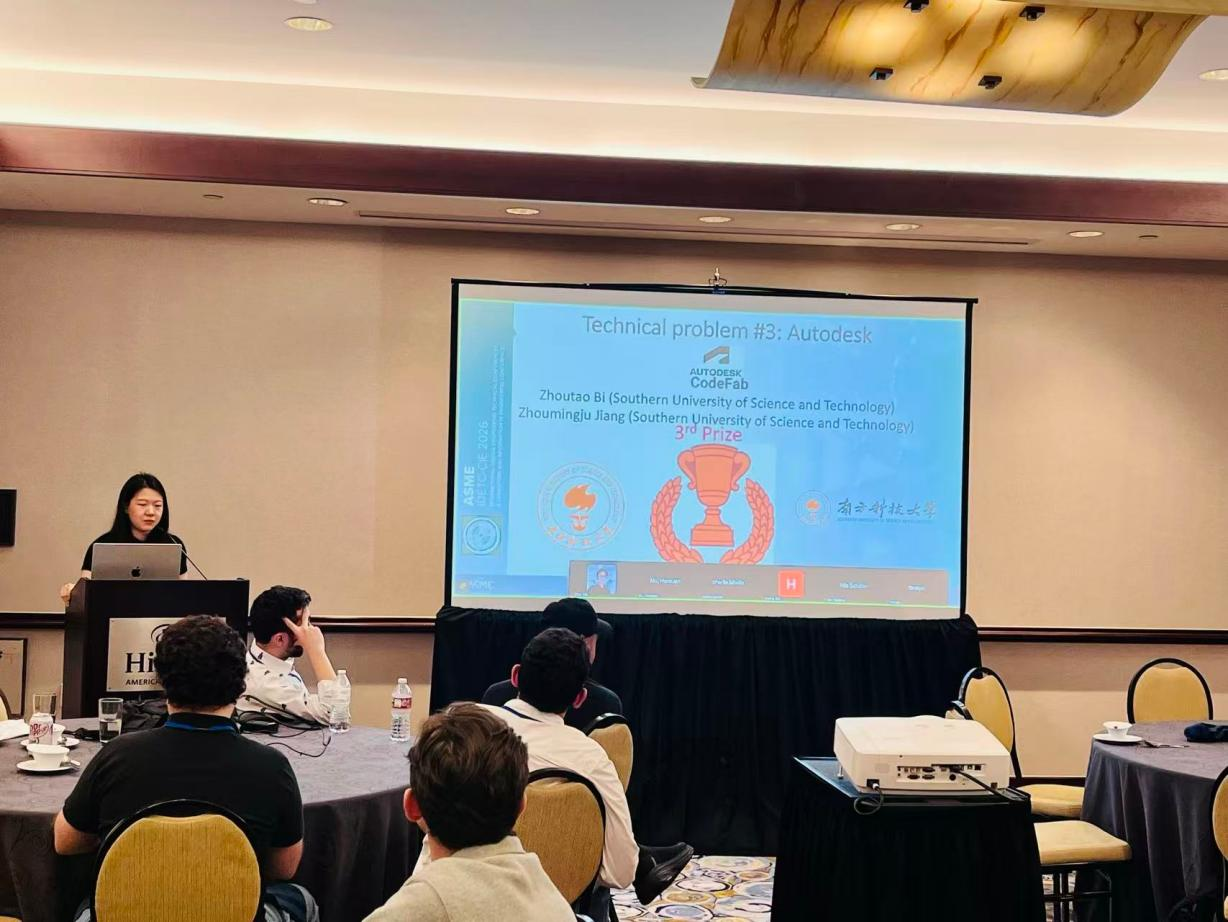
Professor Danian HU of the Center for Social Sciences at Southern University of Science and Technology (SUSTech) published a review paper titled “US-China collaboration as a catalyst for the early development of quantum physics” in the international academic journal Nature Reviews Physics.
The paper aims to systematically present and re-evaluate the key contributions of a group of Chinese physicists who have long been overlooked by the mainstream Western narratives of the history of physics. As a scholar deeply engaged in the history of modern physics and the history of science and technology, Professor Danian HU approaches the topic from the unique perspective of the social history of science, reviewing and assessing the reciprocal role that Sino-American scientific collaboration in the 1920s to 1940s played in the early development of quantum physics.
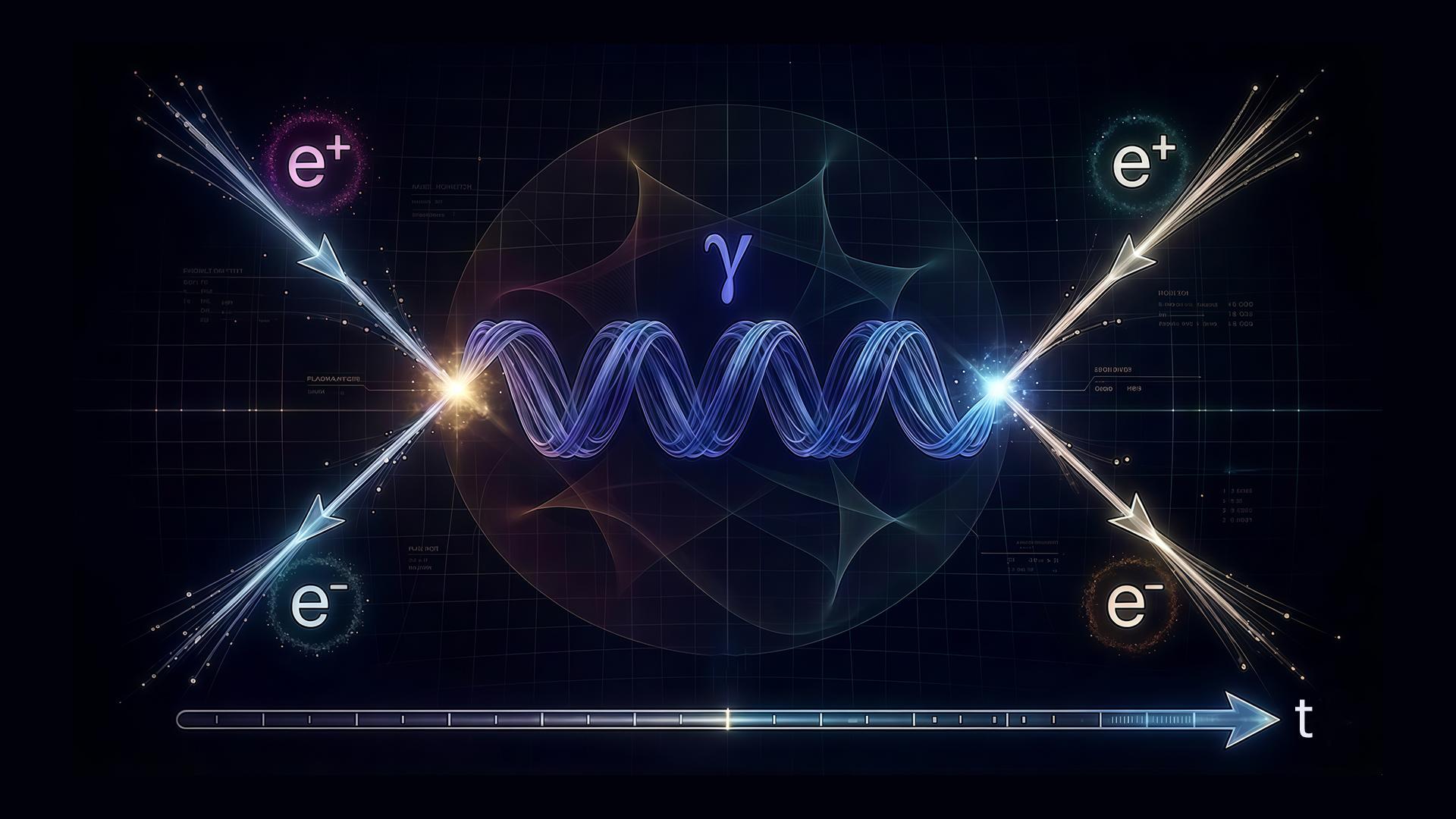
A Feynman diagram of the positron-electron pair annihilation process.
The article points out that at the time, American universities helped China cultivate its first group of modern physicists. However, the Chinese scholars who went to the U.S. were not passive recipients of a Western education. Instead, they leveraged their outstanding creativity and independent research capabilities and directly participated in the cutting-edge exploration of physics in the United States. Many of their pioneering contributions are still little known in the Western physics community. Shou-Chin WANG was one of the first five Ph.D. students in theoretical physics researching quantum mechanics in any American university, and also pioneered the solution to the energy level problem of asymmetric gyroscopes by using the matrix mechanics method. He published that formula before his European peers, which made the American physics community quite proud. Chung-Yao CHAO was the first to publish precise experimental results, laying a solid foundation for the later confirmed phenomena of electron-positron pair creation and annihilation, and also helping establish the then highly debated Dirac theory. Meanwhile, Yu-Ming HSIEH and his American colleagues’ precise measurements of the fine structure of the hydrogen spectrum revealed anomalies that were actually the precursor to the Lamb shift, exposing the shortcomings of Dirac’s theory. China’s first Nobel laureate, Chen-Ning YANG, believes that the work of Chung-Yao CHAO and Yu-Ming HSIEH represents the most important contributions made by Chinese physicists to physics in the first half of the 20th century. Unfortunately, their pioneering contributions were long overlooked due to erroneous judgments by certain Western physics authorities and did not receive fair recognition.
More importantly, after returning to China, these pioneering Chinese physicists established a systematic physics discipline and talent training system in their homeland, nurturing a group of outstanding young physicists, including Ming-Chen WANG, Cheng-Shu WANG, Ning HU, Chen-Ning YANG, and Tsung-Dao LEE. The latter then went to the U.S. for further study and made even more remarkable contributions, forming a trans-Pacific “academic cycle” and continuously promoting the advancement of global physics.
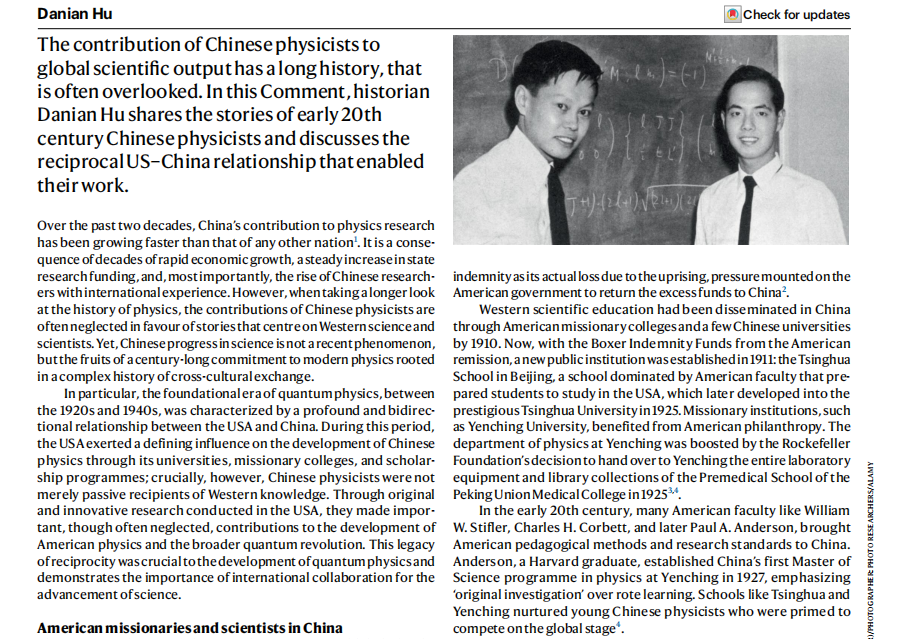
This section on the history of scientific and educational cooperation between China and the United States highlights the tremendous power and reciprocity of international scientific exchange. The outstanding research achievements of Chinese physicists in the United States demonstrate that scientific progress is never the product of solitary efforts or narrow nationalism, but rather a collective human endeavor based on open collaboration.
This study reflects the “center-periphery” bias present in the writing of the history of science. The contributions of researchers from non-Western scientific centers are often overlooked, erased, or even appropriated. Identifying these pioneers who are “missing” from mainstream narratives and re-evaluating their forgotten work not only restores historical justice but also reinforces the urgency in calls for building a truly diverse and inclusive global scientific community.
Danian HU is the first author of the paper and SUSTech is the first affiliated institution.
Paper link: https://www.nature.com/articles/s42254-026-00933-w
Proofread ByJunxi KE
Photo By