On April 13, Virginia Walbot, a member of the Mexican National Academy of Sciences, a fellow of the American Association for the Advancement of Science (AAAS), and a professor at Stanford University, visited the 433rd session of the SUSTech Lecture Series to deliver an academic lecture titled “Maize Anther Development.”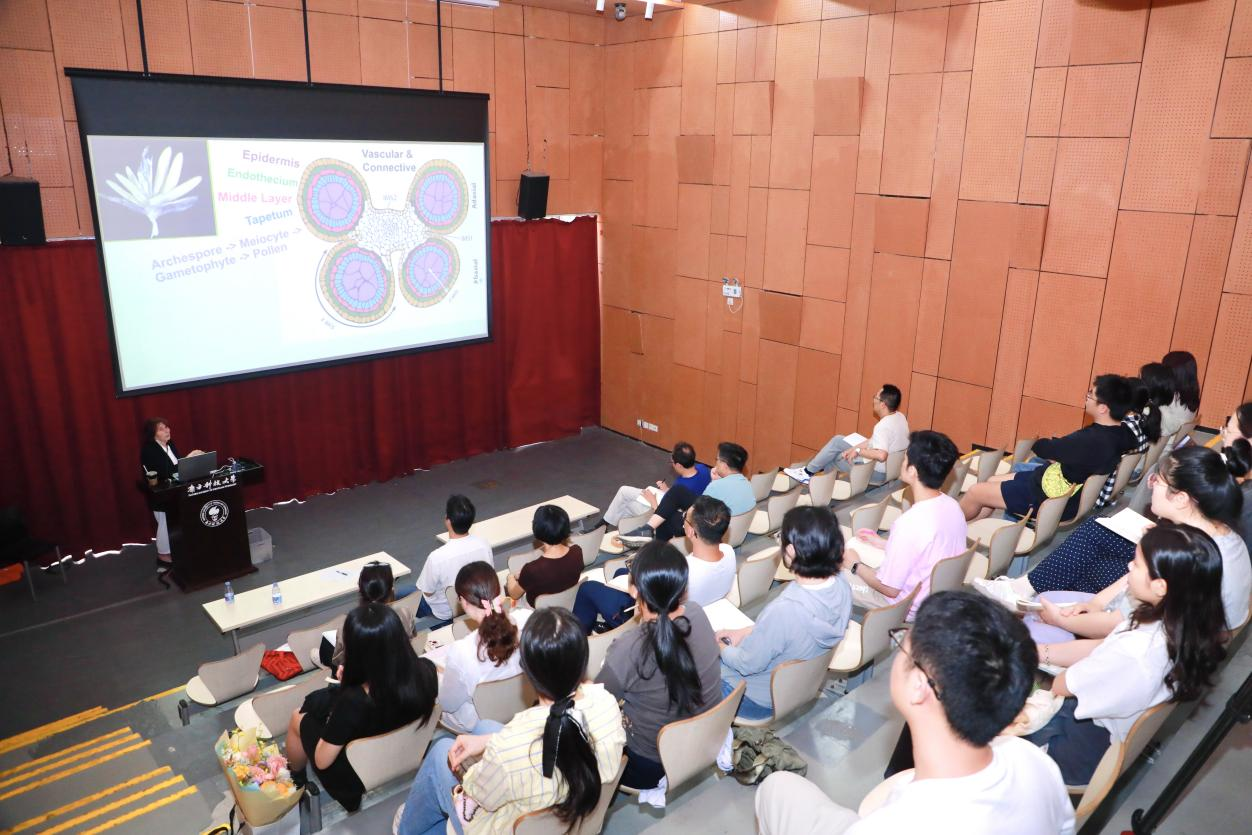
Virginia Walbot is a world-renowned plant geneticist, one of the leading authorities in maize reproductive development, and a leader in the fields of maize genomics and developmental biology. In 2023, she was awarded one of the highest honors in plant genetics, the Barbara McClintock Prize. She led the pioneering “Maize Gene Discovery Project,” making key contributions to the mapping of the maize genome. Her work on early anther development in maize has been a milestone for understanding plant sexual reproduction.
In the lecture, Professor Walbot focused on the core question in developmental biology, “How do plant cells transition smoothly from mitosis to meiosis without a pre-set germline?” She detailed how her team used single-cell RNA sequencing (scRNA-seq) to analyze the first 90 hours of maize anther development.
The study found that during the very early stages of maize anther development, archesporial cells showed significant proliferative properties and underwent dramatic transcriptome reprogramming as they differentiated into pollen mother cells (PMCs). Through pseudotime-RNA velocity analysis, researchers revealed key transcriptional state switches along the cell differentiation trajectory.
In addition, Professor Walbot focused on how bHLH transcription factors (such as MS23) regulate the development of the tapetum and collaboratively induce the production of 24-nt phased secondary siRNAs (phasiRNAs).
The lecture was met with great enthusiasm. During the interactive session, Professor Walbot had in-depth exchanges with faculty and students on the challenges of applying single-cell technologies and cutting-edge topics such as environmentally induced male sterility.
Proofread ByJunxi KE
Photo Bythe School of Life Sciences