A team led by Chair Professor Xiao Wei SUN from the Department of Electronics and Electrical Engineering and the Institute of Nanoscience and Applications at the Southern University of Science and Technology (SUSTech) has published a comprehensive review article in the internationally renowned journal ACS Energy Letters. The review systematically summarizes the latest breakthroughs in Ag-In-Ga-S (AIGS) quantum dots (QDs), an emerging eco-friendly class of I-III-VI₂ QDs. It thoroughly dissects the core technical pathways that enable narrowband emission and near-unity quantum yields in AIGS QDs, laying an important theoretical foundation for their applications in next-generation high-resolution, wide color gamut displays. These findings provide new insights for the development of cadmium-free quantum dot light-emitting materials.
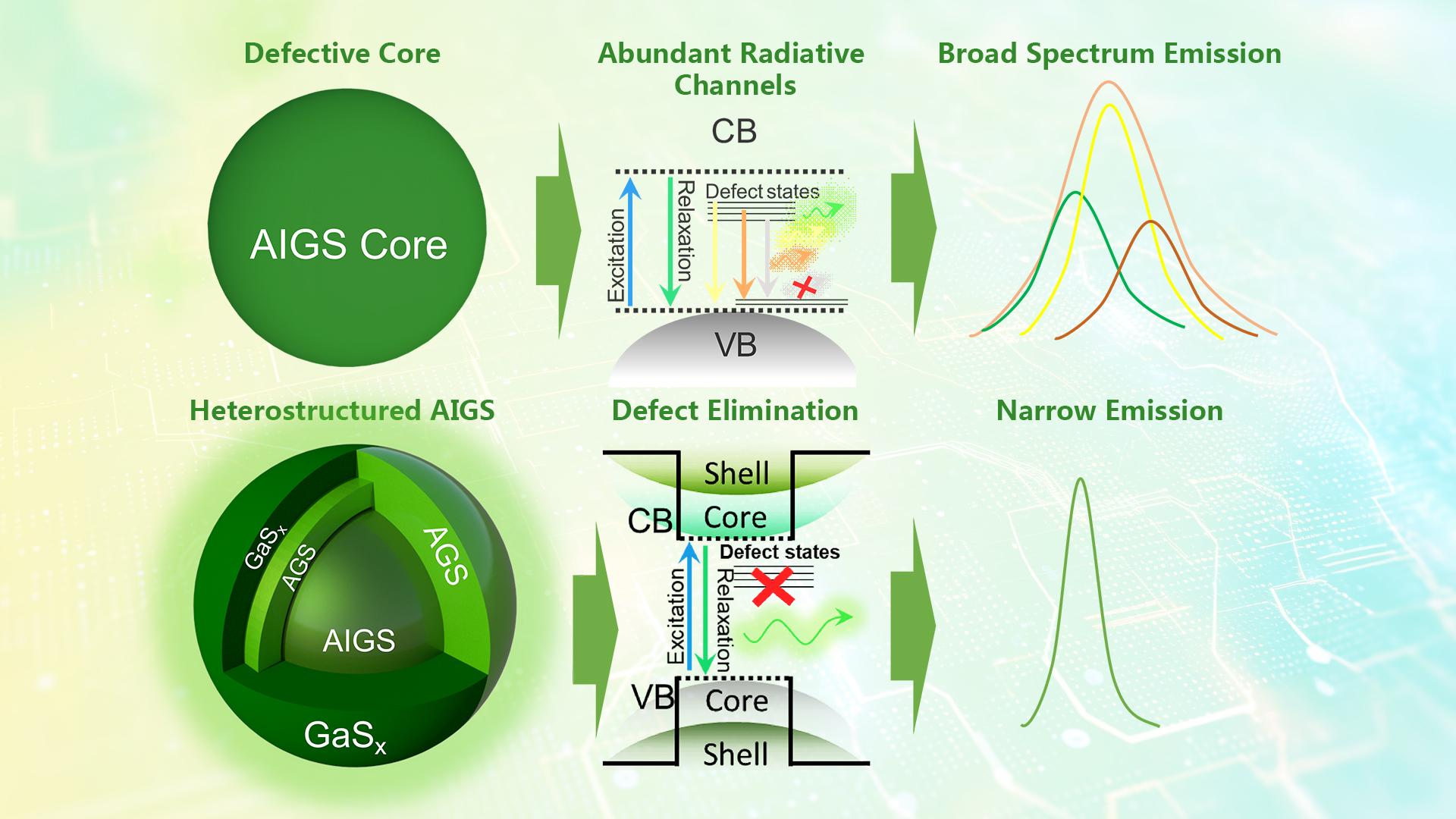
Illustration of a bare AIGS core, exhibiting a defective band structure with abundant radiative channels leading to a broad emission profile.
Colloidal I-III-VI₂ QDs have emerged as a major research direction for cadmium-free light emitters, thanks to their environmentally friendly composition, high absorption coefficients, and widely tunable emission across the visible spectrum, making them promising candidates for next-generation high-resolution displays. However, these QDs inherently suffer from broad emission linewidths and significant defect-related non-radiative recombination, which have long restricted improvements in color purity and electroluminescent efficiency, critical metrics for high-performance display devices. Despite continuous progress in related research, a systematic overview of the chemical principles and device applications underlying narrowband, high-efficiency luminescence in AIGS QDs has been lacking.
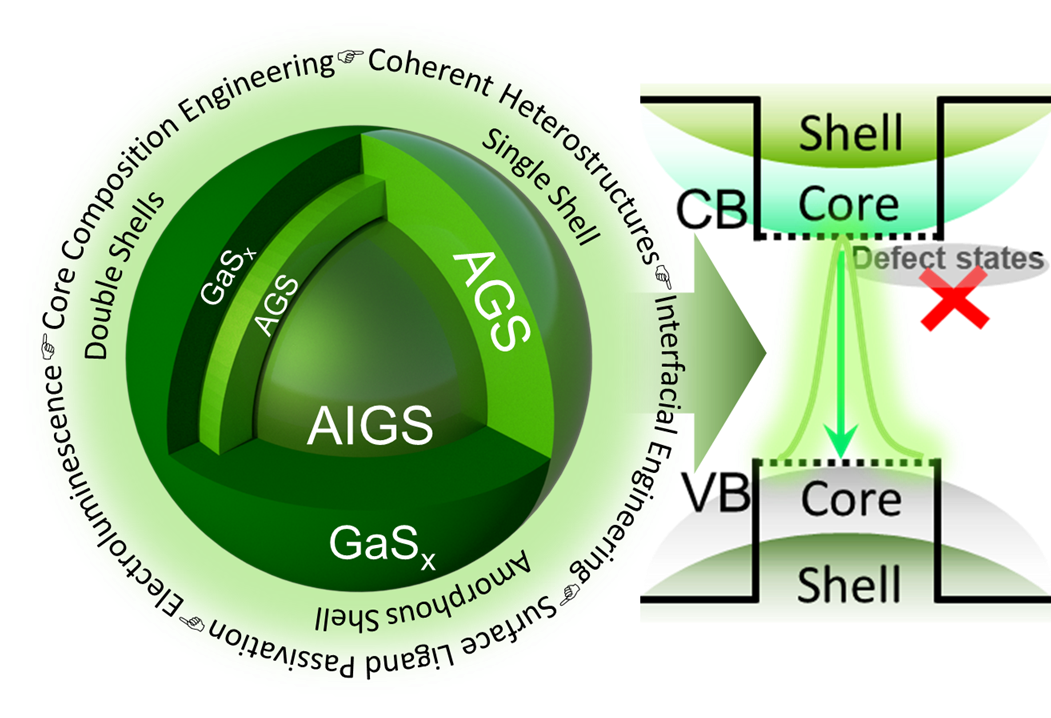
Scheme illustrating the Surface coated AIGS QD via coherent AgGaS2, GaSx or both, resulting in the elimination of unwanted radiative pathways, and a sharp narrow emission.
To address this challenge, Professor SUN’s team comprehensively integrates recent advances in AIGS quantum dot research and analyzes the key mechanisms, including composition engineering, precursor chemistry, ligand surface passivation, and rational core-shell structure design. The review clarifies how these approaches transform AIGS QDs from conventional defect-dominated broadband emitters into narrowband emitters with near-unity photoluminescence quantum yields, successfully resolving the core bottlenecks of color purity and luminescence efficiency. This greatly enhances the potential of AIGS QDs for application in quantum dot light-emitting diodes (QLEDs) for wide-color-gamut displays.
The review also provides a systematic comparison between AIGS QDs and other mainstream cadmium-free systems, such as InP and ZnSeTe QDs, clearly highlighting the unique competitive advantages of AIGS QDs in wavelength tunability, defect tolerance, and environmental sustainability. Furthermore, the team discusses key challenges in achieving balanced charge injection and high external quantum efficiency in electroluminescent devices, and proposes a proactive roadmap for future material modification and device optimization of AIGS QDs, clarifying priority research directions.
The review emphasizes the crucial roles of coherent core-shell heterostructure growth and interface engineering in driving the transition from broadband and defect-dominated to narrowband and sustainable emissions in AIGS QDs. It also elaborates on the fundamental mechanisms of post-synthesis ligand exchange in achieving near-unity photoluminescence quantum yields. This systematic clarification of key mechanisms, rarely addressed in previous studies, provides important theoretical guidance for follow-up research.
Dr. Ali Imran Channa, a postdoctoral researcher at SUSTech, is the first author of the paper, and Dr. Lei JIN, also a postdoctoral researcher at SUSTech, is the second author. Chair Professor Xiao Wei SUN is the sole corresponding author. SUSTech is the sole affiliation responsible for this work.
Paper Link: https://pubs.acs.org/doi/10.1021/acsenergylett.6c00114
Proofread ByNoah Crockett, Junxi KE
Photo ByYan QIU