A research team led by Chair Professor Jiaqing HE from the Department of Physics at Southern University of Science and Technology (SUSTech) made significant progress in the study of superionic conductors. The team discovered that in the superionic conductor AgCrSe2, Ag+ ions (previously believed to be nearly randomly distributed during fast diffusion) can dynamically form locally ordered structures with short-range correlations. This finding challenges the conventional understanding of ionic structures in superionic conductors and provides a new perspective on the mechanism of ultrafast ion diffusion. The work was published in the flagship journal Physical Review X under the title “Tracking ultrafast ion diffusion dynamics in AgCrSe2 superionic conductor.”
Superionic conductors combine liquid-like fast ionic diffusion with a crystal-like periodic lattice, making them promising candidates for applications in thermoelectric materials, solid-state electrolytes, and fuel cells. Key properties, including ionic conductivity and lattice thermal conductivity, are governed by the transient local structures of mobile ions and their dynamic coupling with the host lattice. Due to the lack of experimental techniques capable of providing both ultrahigh temporal and spatial resolution, these transient structures have remained inaccessible to direct observation.
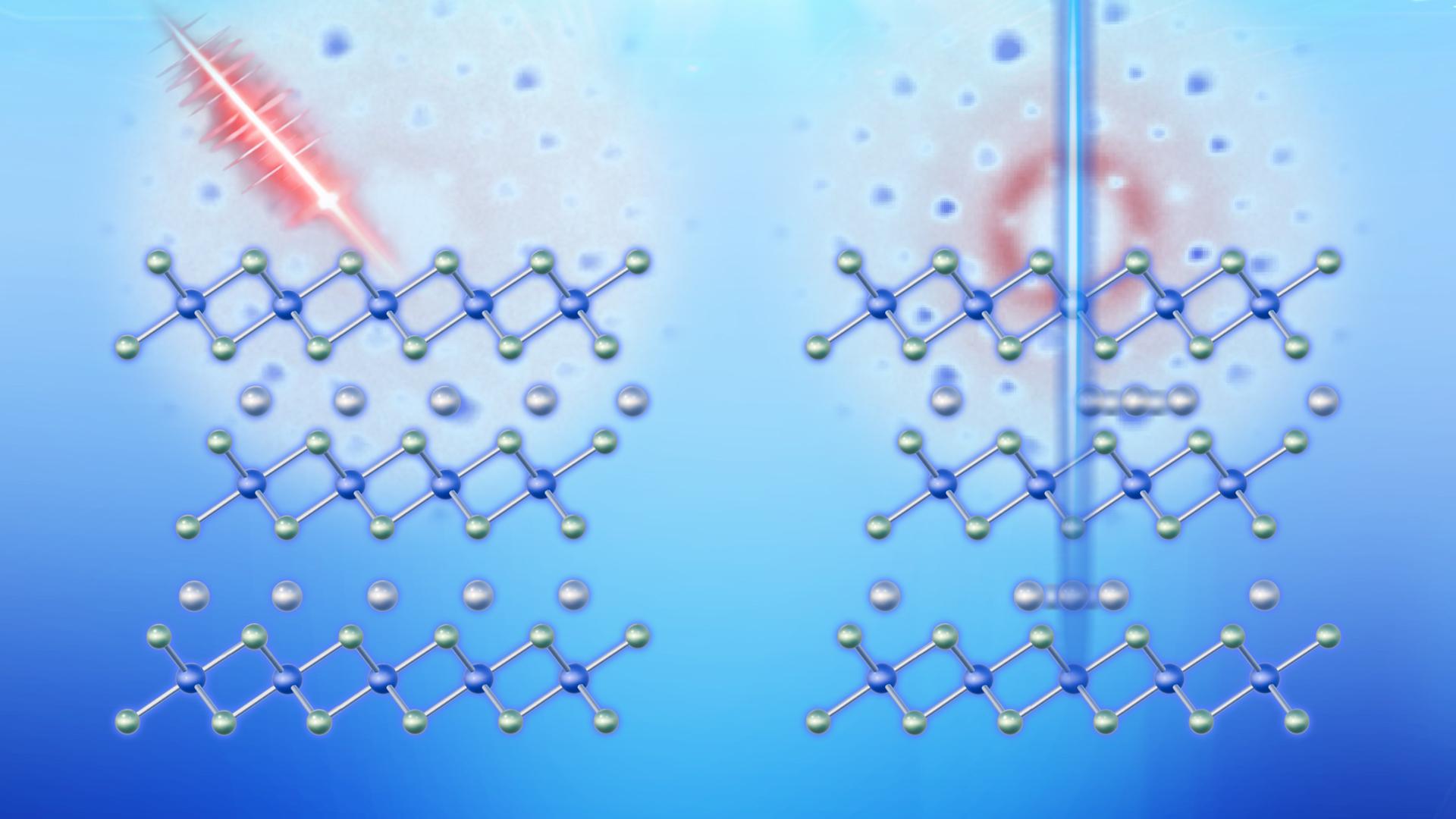
Professor HE’s team, in collaboration with Shanghai Jiao Tong University, Great Bay University, and the National University of Singapore, employed mega-electron-volt ultrafast electron diffraction (MeV UED). For the first time, they directly visualized the dynamic structural evolution of Ag+ ions in AgCrSe2 with femtosecond temporal and angstrom spatial resolution (Fig. 1). This enabled the identification of an ultrafast process involving dynamic Ag+ bond-length contraction and the emergence of short-range order, as well as a new mechanism for fast ionic diffusion.
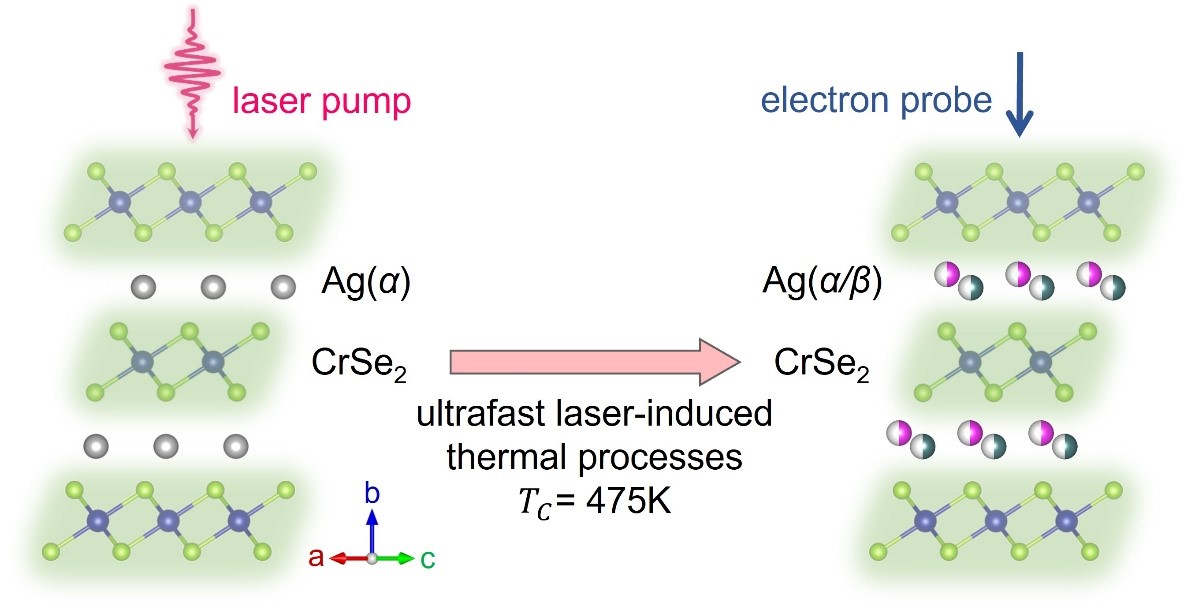
Figure 1. Tracking the ultrafast structural evolution and ionic diffusion of Ag+ ions in AgCrSe2 using femtosecond ultrafast electron diffraction.
Capturing the Full Process of Ion Diffusion with Femtosecond Electron Diffraction
In this study, femtosecond laser pulses (~30 fs) were used to pump the sample, while the structural dynamics were probed with a 3 MeV electron beam, achieving a temporal resolution of ~50 fs and a momentum resolution of 0.01 Å-1. At 340 K, the complete evolution of the characteristic diffuse scattering rings following laser excitation was tracked, directly capturing the transient structural evolution and motion trajectory of Ag+ ions as they transitioned from a “frozen” state to active diffusion (Fig. 2).
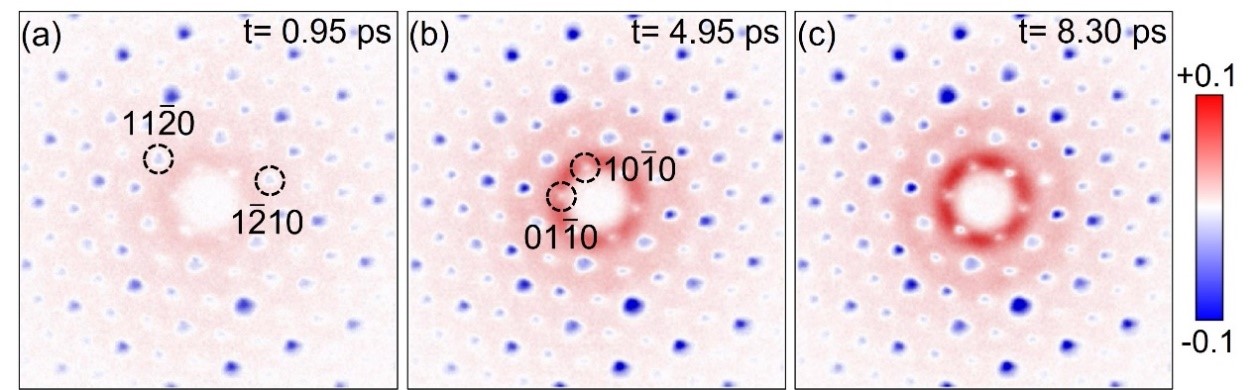
Figure 2. Differential electron diffractions at (a) 0.95, (b) 4.95, and (c) 8.30 ps, following photoexcitation with an 800 nm, 7.60 mJ cm-2 laser pulse at 340 K. Bragg diffractions are labeled by their Miller indices, with blue indicating lower intensity compared to the diffraction pattern at t=0 ps, and red indicating increased intensity.
Direct Observation of Dynamic Short-Range Ordered Trimer Structures
Quantitative analysis of the diffuse scattering peaks reveals that, within ~1.97 ps after excitation, Ag+ ions rapidly evolved from localized vibrations at long-range ordered lattice sites into short-range ordered dimer/trimer configurations. The average Ag+-Ag+ bond length contracted from ~3.68 Å in the frozen state to ~3.00 Å in the diffusive state, corresponding to an ~18% reduction. Analysis of the peak width further yielded a longitudinal correlation length of ~6.16 Å (Fig. 3), consistent with a linear arrangement of three Ag+ ions. Combined with the isotropic nature of the diffuse scattering rings, these findings confirm the formation of transient linear trimer structures, challenging the conventional assumption that mobile ions in superionic conductors are completely disordered.
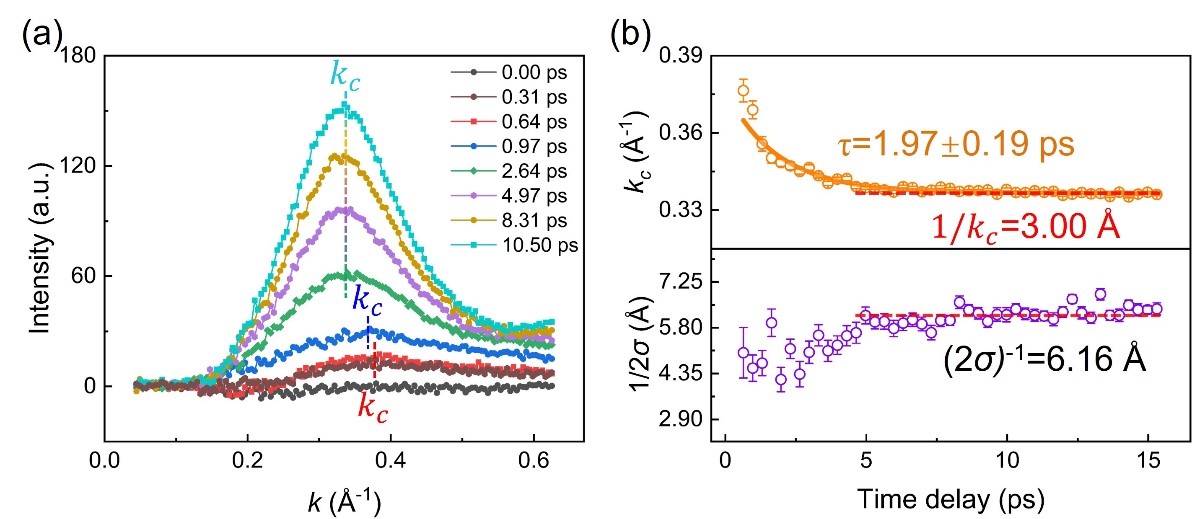
Figure 3. Quantification of diffuse ring patterns and Ag+ ion dynamics.
Multiscale Simulations Reveal the Underlying Physical Mechanism
To gain further insight into the dynamic structural evolution, real-time time-dependent density functional theory (rt-TDDFT) and nonequilibrium molecular dynamics simulations based on machine-learning potentials were performed. The rt-TDDFT results show that the laser pulse mainly excites the highly localized Cr-3d orbitals, while those around Ag+ are negligible. Thereby, the complicated photoexcitation pump process can be simplified as an excitation, or heating of the CrSe2 sublattice through electron-phonon coupling, while the Ag sublattice remains almost intact. Subsequently, the “cold” Ag sublattice is heated by the “hot” CrSe2 sublattice through phonon-phonon interactions.
Meanwhile, using a high-accuracy neural network potential, the team simulated a large system containing 11,520 atoms, successfully reproducing the experimentally observed dimer/trimer structures as well as the diffuse scattering features. The calculations reveal that the energy minimum for two Ag+ ions occurs at ~3.00 Å, making bond contraction energetically favorable (Fig. 4a). Moreover, the formation of dimers/trimers creates additional “free volume,” significantly lowering the migration barrier for neighboring ions and thereby enabling liquid-like fast diffusion.
Universality and Application Prospects
The team further introduced a lattice difference parameter to quantify bond contraction and systematically compared a range of superionic conductors, including Ag+-, Cu+-, Na+-, and Li+-based systems. A clear inverse correlation was identified between this parameter and the diffusion activation energy (Fig. 4b). Molecular dynamics simulations of the Li+–based superionic conductor Li10GeP2S12 revealed similar Li⁺ dimer structures, confirming the universality of the proposed mechanism. Furthermore, the study demonstrates that applying a 2% tensile strain to AgCrSe2 increases the room-temperature diffusion coefficient by an order of magnitude. This finding provides a new design principle for optimizing solid-state electrolytes via lattice strain engineering.
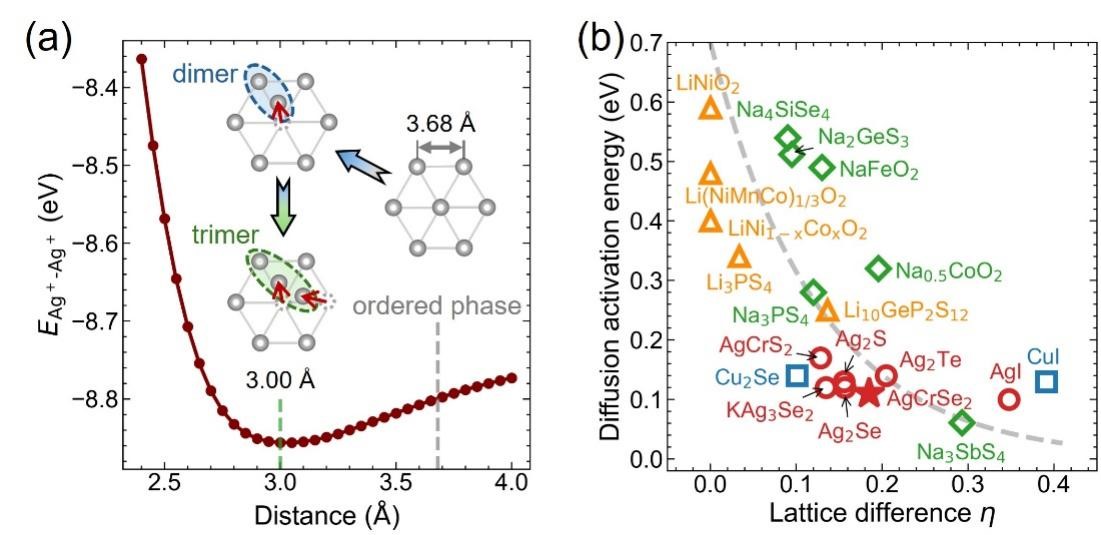
Figure 4. Origin of the dynamic short-range ordered Ag+ structure.
This study provides the first direct visualization of ion diffusion pathways at femtosecond temporal resolution and atomic spatial resolution. It reveals a new mechanism in which mobile ions spontaneously form transient dimer/trimer structures, creating free volume and thereby lowering local energy barriers for diffusion. These findings open new avenues for the future development of superionic conductors.
This work was led by the research group of Professor Jiaqing HE at SUSTech. Dr. Jianmin Yang is the first author. Professors Jiaqing HE (SUSTech), Lin XIE (Great Bay University), and Dao XIANG (Shanghai Jiao Tong University) are the corresponding authors. SUSTech is the primary affiliated institution.
Paper Link: https://doi.org/10.1103/s6rh-7219
Proofread ByNoah Crockett, Junxi KE
Photo ByYan QIU