At the invitation of the top academic journal Nature, the team led by Academician Xiao Wei SUN, Executive Director of the Institute of Nanoscience and Applications (INA), and Chair Professor of the Department of Electronic and Electrical Engineering at the Southern University of Science and Technology (SUSTech), has published a News & Views commentary article entitled “Glasses-free display switches between 2D and 3D” in Nature. The article reviews the latest progress in switchable glasses-free 2D/3D display technology achieved by a joint team from Samsung Electronics and Pohang University of Science and Technology (POSTECH).
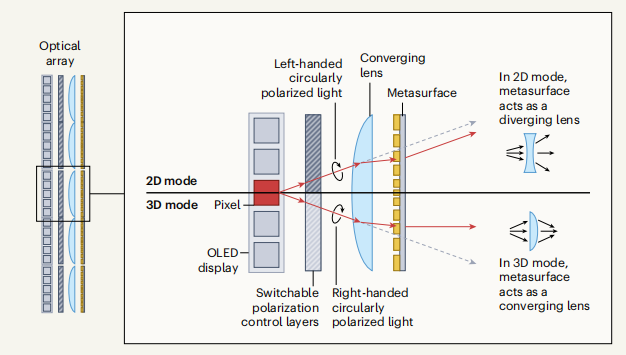
Three-dimensional (3D) display technology creates an immersive visual experience by delivering slightly different parallax images of the same scene to each eye, generating a perception of depth. However, conventional glasses-free 3D displays, which are mostly based on traditional optical components such as lenticular lenses, suffer from notable limitations. On the one hand, viewers can only achieve high-quality 3D viewing within a narrow viewing angle. On the other hand, when a lenticular-lens-based 3D display is used to deliver a 2D image, the effective image resolution drops by at least half compared with that of the display panel.
To address this long-standing technical dilemma, the joint team from Samsung Electronics and POSTECH published a research paper in Nature titled “Switchable 2D-3D display through a metasurface lenticular lens”, proposing a switchable 2D/3D light-field display scheme based on a Metasurface Lenticular Lens (MLL).
In the commentary, the team led by Xiao Wei SUN systematically explained the core optical principles, device structure, and fabrication methods of this work. The display system consists of multilayer optical structures, including a lenticular lens, an active linear polarizer, a polarization control film, and a metasurface lens. By electrically switching the polarization state of incident light, the device can rapidly switch between wide-angle 3D mode and high-resolution 2D mode within approximately 10 milliseconds.
The research team used a fabrication technique called electron-beam lithography to construct a metasurface lens that had an active area of 25 square centimeters and assembled a prototype optical stack just 1.2 millimeters thick. The prototype rendered 25 views of the image across the 100-degree viewing range, demonstrating the great application potential of metasurface optics in compact display systems.
To determine which parts of the underlying image should be displayed for each viewing angle, the research team developed an algorithm that tracked the wavelength- and angle-dependent paths taken by light through the metasurface and refractive lenses. This algorithm compensated for chromatic aberration (a distortion that occurs when different colors focus at different points in space) and for the resulting spatial misalignment between red, blue, and green color channels. This enabled the authors to closely match the images seen by the viewer to the intended views.
The commentary fully affirms the significance of this research in the field of glasses-free 3D displays. It points out that a metasurface can function as part of a complete display system built around a commercial panel, but the flexibility of its design extends beyond flat-panel 3D displays. For example, metasurfaces can be used to build compact augmented-reality displays with high image quality.
Meanwhile, the commentary also notes that the technology still faces several engineering challenges before reaching consumer-level products. For example, the 3D mode mainly provides lateral parallax, meaning that the 3D effect is only visible when the viewer moves from side to side, not up and down. Furthermore, residual polarization and chromatic effects can still produce faint duplicate ‘ghost’ images and color shifts at large viewing angles. Brightness is another concern, because the full optical stack only transmits roughly one-fifth of the panel’s luminance.
The article states that these issues are mostly engineering optimization problems rather than fundamental physical limitations. In the future, better fabrication routes, such as nanoimprint replication methods, will be crucial if these concepts are to move from laboratory prototypes to manufacturable products. Moreover, computational models, including artificial-intelligence-driven approaches, can compensate for optical aberrations that cannot be fully eliminated using hardware, as well as adapt the display’s output seamlessly as the viewer moves, without adding bulk to the optical device.
Academician Xiao Wei SUN and Zhong Tao TIAN, Joint Ph.D. student in the SUSTech-Peng Cheng Laboratory, are the corresponding authors. SUSTech is the first affiliation.
Paper link: https://www.nature.com/articles/d41586-026-01148-w
Proofread ByNoah Crockett, Junxi KE
Photo By