The team led by Chair Professor Hai-Zhou LU from the Department of Physics at the Southern University of Science and Technology (SUSTech), the State Key Laboratory of Quantum Functional Materials, Guangdong Provincial Key Laboratory of Topological Matter, Guangdong Basic Research Center of Excellence for Quantum Science, and the Quantum Science Center of Guangdong-Hong Kong-Macao Greater Bay Area, along with collaborators, published a research paper in the top international journal Science titled “Wafer-scale low-symmetry graphene moiré superlattice for integrated quantum rectifiers.” The team used surface pre-melting engineering to create wafer-scale graphene/germanium (110) moiré superlattices, achieving significant second-order nonlinear Hall responses at room temperature and zero magnetic field, and developed integrated rectifier arrays that can convert radio frequency signals into DC voltage. Hai-Zhou LU’s team focused on analyzing quantum transport mechanisms and performing first-principles calculations, providing theoretical support for revealing the microscopic origins of the strong nonlinear Hall response.

The nonlinear Hall effect is an electrical response influenced by both the quantum geometry of electronic states and scattering processes. Under suitable crystal symmetry conditions, a material can convert longitudinal AC excitation into transverse DC voltage without an external magnetic field, offering new ideas for wireless energy harvesting and low-power electronic devices. However, graphene itself has high crystal symmetry, which limits related nonlinear responses. Figuring out how to achieve controllable preparation and large-area symmetry tuning while maintaining material quality is key to pushing these devices toward integrated applications.
To tackle this challenge, the research team proposed a surface pre-melting engineering method. By controlling atomic rearrangements and the cooling process of the Ge(110) surface near its melting point, they formed ordered surface stripe structures and used these to tune the effective symmetry of the graphene/germanium heterostructure from D6h down to C1v, enabling wafer-scale fabrication of low-symmetry graphene moiré superlattices. Experiments show that this material exhibits a significant second-order nonlinear Hall effect at room temperature and zero magnetic field, with a nonlinear Hall conductivity of about 11 μm·V⁻¹·Ω⁻¹, roughly three orders of magnitude higher than some previously reported material systems.
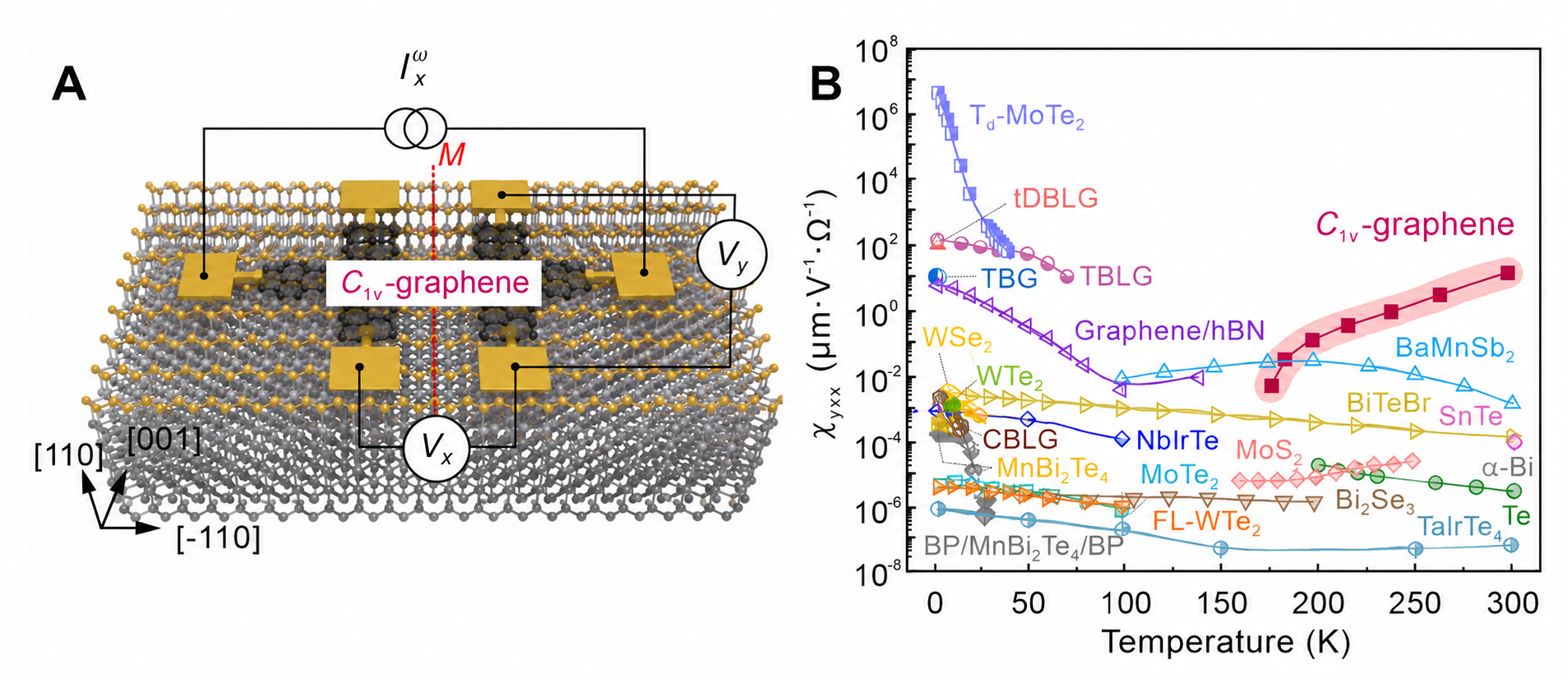
Figure 1. Schematic of the nonlinear Hall effect measurement in low-symmetry graphene/germanium moiré superlattices and comparison of its temperature-dependent response with other materials
On the microscopic level, the research team used first-principles calculations to study the band hybridization between graphene and the germanium substrate. The results show that the relevant germanium bands couple with the Dirac cone of graphene, forming an over-tilted massive Dirac-like band structure near band anti-crossings, and producing significant and unevenly distributed Berry curvature. The resulting Berry curvature dipole (BCD) provides a microscopic explanation for the strong second-order nonlinear Hall response observed in experiments. By combining the measured nonlinear Hall conductivity with the nearly linear scaling relationship to the longitudinal linear conductivity, the team further identified the dominant contribution of the BCD mechanism.
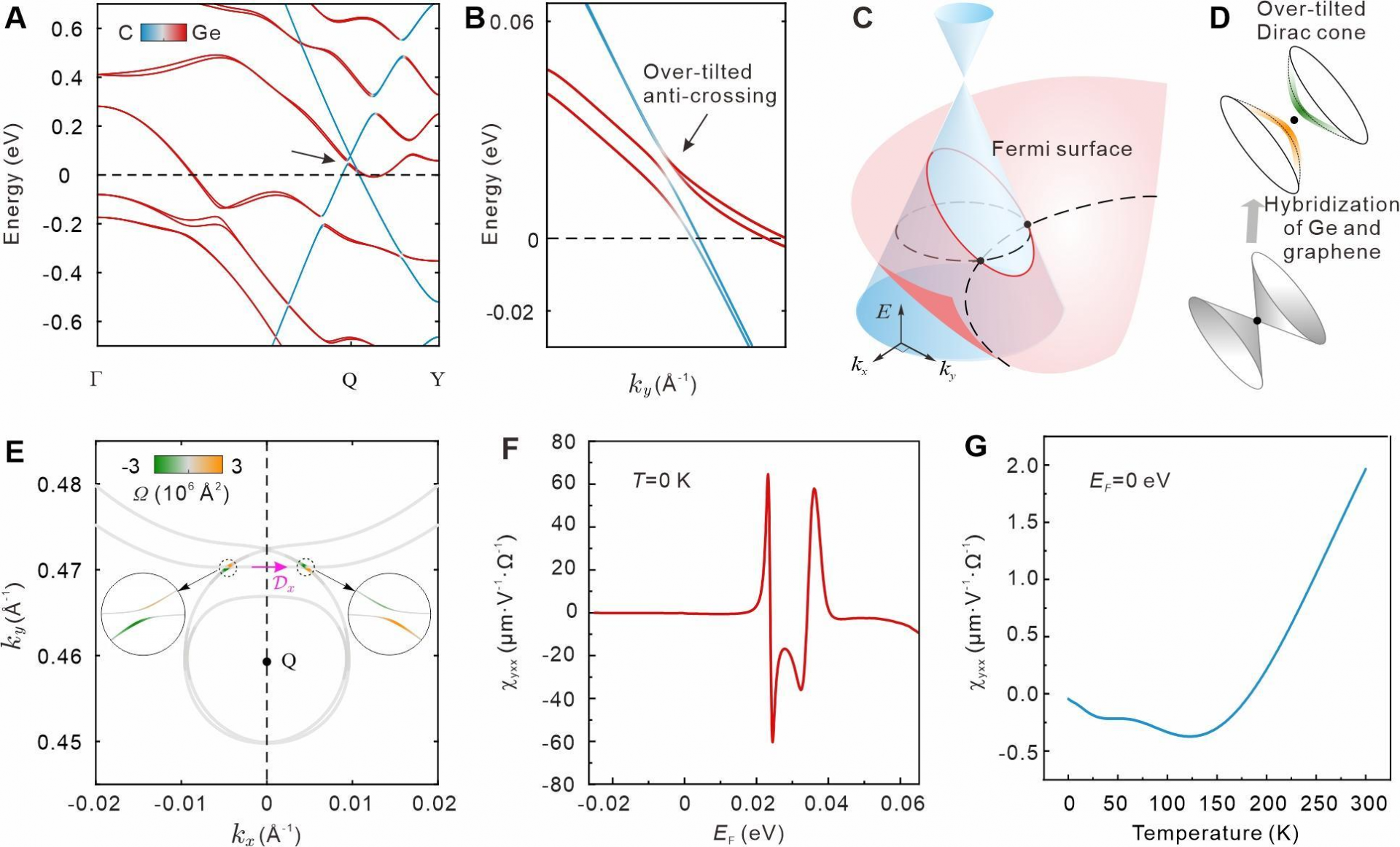
Figure 2. First-principles calculations of over-tilted band anti-crossing, Berry curvature distribution, and second-order nonlinear Hall response in graphene/germanium hybrid bands
The above experimental mechanism identification is based on the nonlinear transport scaling theory previously established by Hai-Zhou LU’s team. In their study “Scaling analysis of quantum geometry in second-order nonlinear transport” published in Science Bulletin, the team incorporated quantum geometry and disorder scattering into a unified semi-classical transport framework, systematically categorized ten microscopic mechanisms for the second-order nonlinear Hall effect, established a polynomial scaling relationship between nonlinear Hall conductivity and linear longitudinal conductivity, and proposed a method to distinguish different mechanisms using their “weight fingerprints.” This theory provides a methodological basis for analyzing experimental data and identifying BCD-dominated mechanisms in the collaborative research.
In summary, this study bridges wafer-level low-symmetry material preparation, nonlinear quantum transport mechanism analysis, and integrated rectifier device verification, offering a new research pathway for developing scalable nonlinear quantum electronic devices.
Dr. Wenhao TAN from Shanghai Institute of Microsystem and Information Technology, Master Jiuming LIU from ShanghaiTech University, PhD student Zhen-Hao GONG from SUSTech, and PhD student Yunyu HONG from Shanghai Institute of Microsystem and Information Technology are co-first authors of the paper. Professor Hai-Zhou LU, Professor Xufeng KOU from ShanghaiTech University, Researcher Ziao TIAN, and Researcher Zengfeng DI from Shanghai Institute of Microsystem and Information Technology are co-corresponding authors. SUSTech is the corresponding institution.
Paper Links:
https://doi.org/10.1126/science.aeh3915
https://doi.org/10.1016/j.scib.2026.07.062
Proofread ByNoah Crockett, Junxi KE
Photo By