The research team led by Chuanlun ZHANG, Chair Professor of the Shenzhen Key Laboratory of Marine Archaea Geo-Omics at Southern University of Science and Technology (SUSTech), Dr. Yufei CHEN and Dr. Su DING, Royal Netherlands Institute for Sea Research, and collaborators published a research paper online in the journal Nature Communications, titled “A comprehensive database for high-throughput identification of archaeal lipids using high-resolution mass spectrometry.” The study established for the first time a comprehensive database for archaeal lipid compounds, ArchLips, enabling high-throughput mass spectrometry analysis of archaeal lipid structures of interest to research communities around the world. It provides an important tool and foundation for deepening the understanding of archaeal lipid diversity and its ecological and evolutionary significance in global ecosystems.
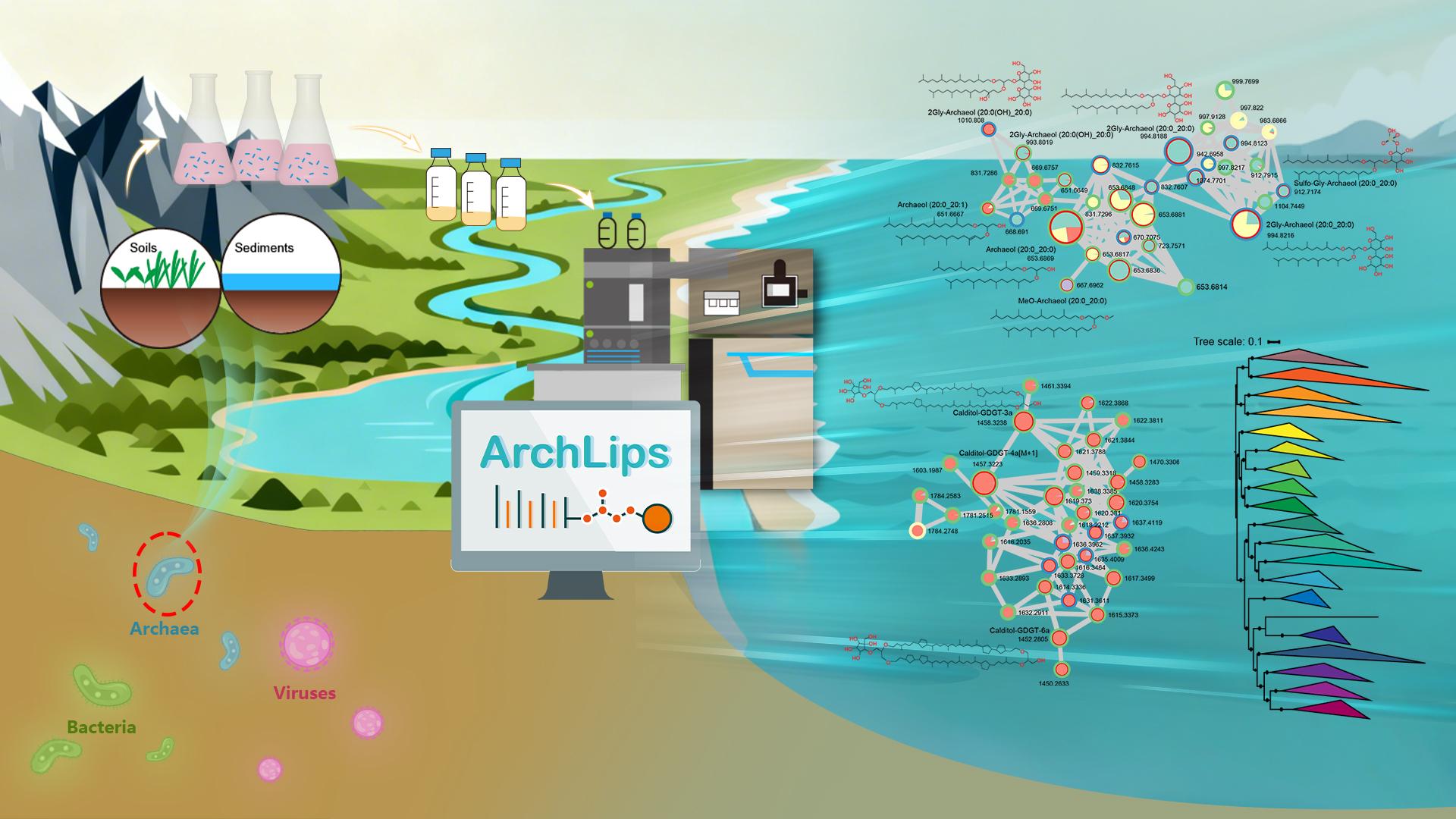
Archaea are a unique branch of life alongside bacteria and eukaryotes, and are one of the earliest microbial groups to appear on Earth. Their membrane lipids are fundamentally different in structure from those of bacteria and eukaryotes, making them important biomarkers for understanding the ecological functions and biogeochemical roles of archaea. In recent years, with the rapid development of high-resolution mass spectrometry-driven lipidomics, researchers have been able to achieve detailed characterization of lipid compounds at the cellular level. However, the lack of a comprehensive database specifically dedicated to archaeal lipids has made the structural identification of archaeal lipid compounds a significant bottleneck in the research field, limiting large-scale, high-throughput studies of archaeal lipids.
To address this bottleneck, the research team systematically compiled archaeal structures and mass spectrometry features from literature reports and existing public databases. Combining cheminformatic tools with optimized Lipidblast templates, they constructed a comprehensive computational archaeal lipid database (ArchLips). The database takes full account of the diversity of archaeal structures, covering 219,348 computationally generated molecular structures of archaeal lipid compounds (including various isomers) and corresponding tandem mass spectrometry data for 199,248 compounds.

Figure 1. Schematic diagram of the archaeal lipid database construction process.

Figure 2. Analytical procedure of Archaeal Lipid Compounds Based on High-Resolution Mass Spectrometry.
To validate the accuracy of ArchLips, the research team compared it with 148 published archaeal lipid MS2 spectra from the literature. The results showed that over 75.0% of the spectra were correctly matched; 15.5% were annotated as isomers; and 9.5% were false positives or unmatched. Furthermore, cross-searching the high-confidence spectral library and the complete spectral library against public lipid databases dominated by non-archaeal lipids yielded match rates of 0.8% and 6.6% in the GNPS database, and 0.2% and 0.6% in the LipidBlast database, respectively. The overall low match rates demonstrate the database’s high specificity for archaeal lipid compounds.
Validation using high-resolution mass spectrometry data from archaeal pure cultures and environmental samples showed that ArchLips enables automated annotation of hundreds of archaeal lipid compounds. When combined with analytical methods such as molecular networking, it further allows for comprehensive identification and structural elucidation of archaeal lipids in samples. This database will serve as an essential research tool for in-depth exploration of the diversity of archaeal lipids and their ecological and evolutionary significance in global ecosystems.

Figure 3: Application of the ArchLips Database in the Identification of Pure-Cultured Archaeal Lipids.

Figure 4: Composition and Diversity of Archaeal Lipids in Different Environmental Samples Revealed by the ArchLips Database.
SUSTech is the first and primary affiliation of the paper. The co-first authors are Fengfeng ZHENG, a research associate professor at the Department of Ocean Science and Engineering and Advanced Institute for Ocean Research at SUSTech; as well as Wenyong YAO, Ph.D. candidate at Kiel University, Germany, and Wei HE, Ph.D. candidate at the University of Freiburg, Germany; both having earned their bachelor’s and master’s degrees at SUSTech. Fengfeng ZHENG and Chuanlun ZHANG are the corresponding authors of the paper. The contributing authors include Wan ZHANG, Ph.D. candidate at the Helmholtz Centre for Ocean Research Kiel, Germany; Huahui CHEN, Class of 2020, Ph.D. candidate at SUSTech; Associate Professor Xiaolei LIU from the University of Oklahoma; Professor Yanhong ZHENG from Northwest University; Professor Linan HUANG from Sun Yat-sen University; Visiting Professor Yuanqing ZHU and Associate Professor Zhirui ZHENG, Department of Ocean Science and Engineering, SUSTech; and Dr. Yufei CHEN and Dr. Su DING, Royal Netherlands Institute for Sea Research.
Link to the paper: https://www.nature.com/articles/s41467-025-67286-3
Proofread ByNoah Crockett, Junxi KE
Photo ByYan QIU