To support technological innovation in the Guangdong-Hong Kong-Macao Greater Bay Area, the School of Artificial Intelligence at Southern University of Science and Technology (SUSTech) was officially established. This marks a new phase in the university’s systematic and disciplinary development in AI education, research, and the transformation of research achievements.
A Timely Establishment : Aligning with National Strategy and Regional Needs
Artificial intelligence is the core driving force leading a new wave of technological revolution and industrial transformation and a strategic tool for developing the nation’s “new quality productive forces.”
As a nationally innovative city and pilot demonstration zone, Shenzhen is the hub of world-class technology companies such as Huawei and Tencent, with a complete network of digital industries, providing a unique ecological foundation for technological innovation, application scenarios, and industrial transformation in artificial intelligence. With this combination of timely opportunities and locational advantages, the establishment of the School of Artificial Intelligence at SUSTech is a natural choice for the university to proactively align with national needs, deeply integrate into the development of the Greater Bay Area, and fulfill its mission as a high-level research university.
A Solid Foundation Built Over Time: Academic Strengths and Distinctive Features
Although SUSTech is a young institution, it has already built a strong foundation in the field of artificial intelligence, laying a solid groundwork for the establishment of the school. The university has gathered a top-tier group of scholars, including Turing Award and Fields Medal winners, as well as 18 academicians. There are currently more than 200 professors and chaired professors in related fields, forming a robust faculty matrix across multiple disciplines such as computer science, mathematics, engineering, and life sciences.
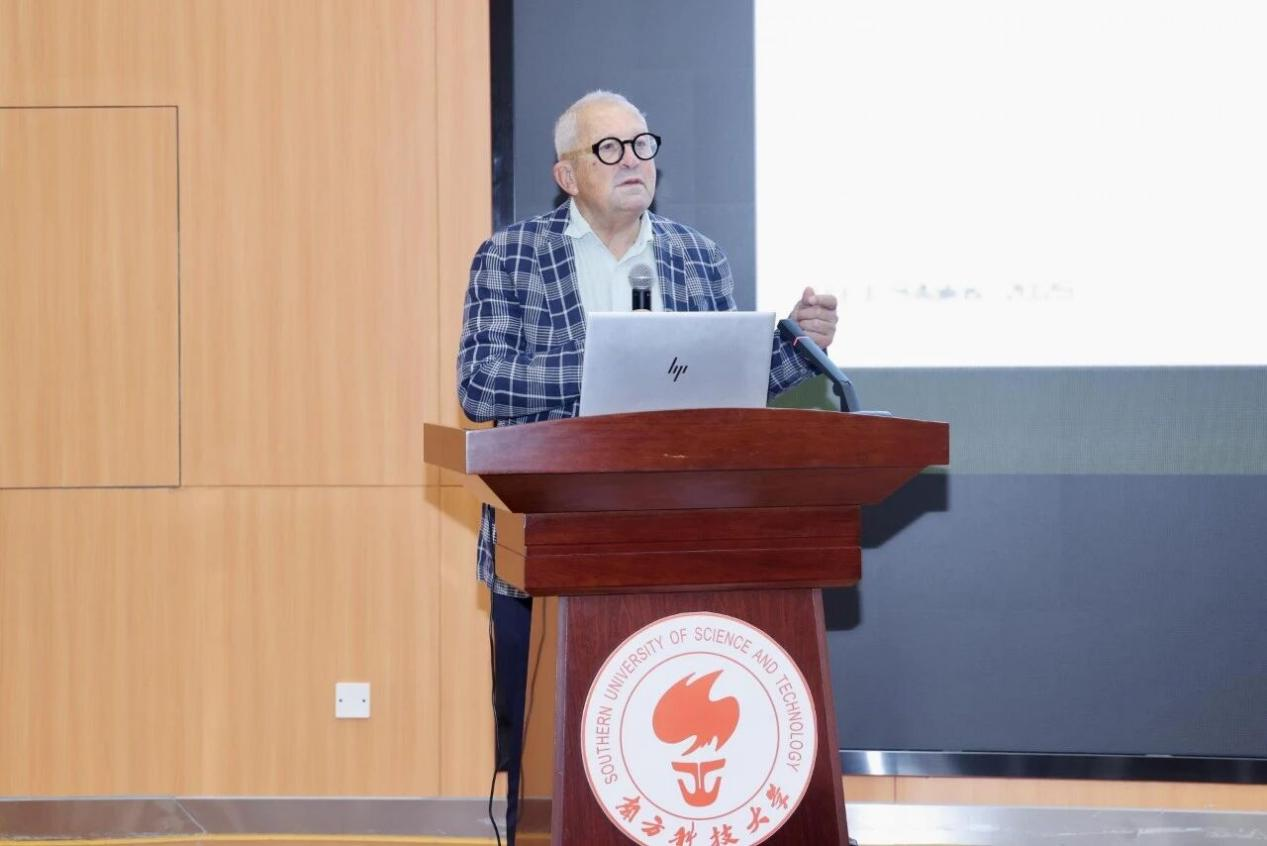
Turing Award winner Joseph Sifakis conducts academic exchanges at the university
Through long-term practice of the “AI+X” integration model, the university has built a research, teaching, and student training system that deeply intertwines AI with multiple disciplines. It offers over 40 AI-related courses covering undergraduate, master’s, and doctoral levels, distributed across 28 departments. The training concept, “solid foundation, strong interdisciplinary integration, and promoting innovation,” is deeply ingrained.
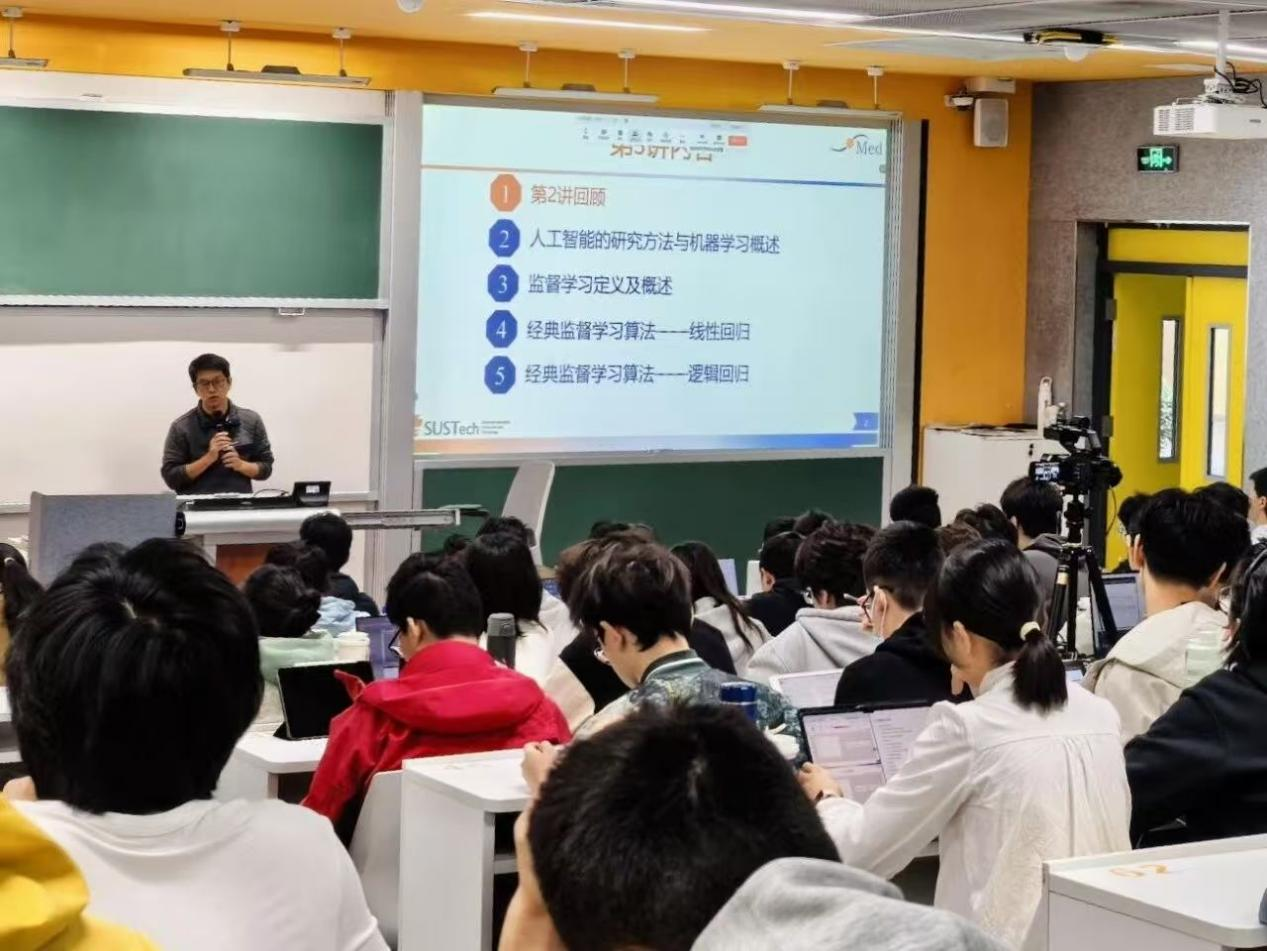
Classroom Scene of “Artificial Intelligence and Applications”
In research infrastructure, SUSTech relies on more than 30 high-level research platforms, including 3 national-level and 12 provincial or ministerial level platforms. The university took the lead in August 2024 by establishing the “Advanced Institute of Artificial Intelligence,” continuously producing significant achievements in the fields of basic AI theory, intelligent algorithms, and data science. In the past decade, SUSTech researchers have published over 1,100 top-tier journal papers in the field of AI. In the past three years, 30 invention patents have successfully been industrialized, and a number of competitive AI technology companies have been incubated, represented by LimX Dynamics (LXD).
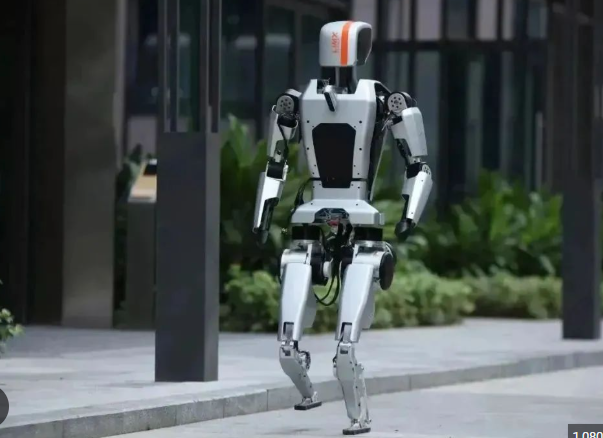
Incubated Enterprise Product Showcase—such as robots from LimX Dynamics (LXD)
In terms of industry-education integration, SUSTech has jointly established over 100 innovation platforms with leading companies such as Huawei, Tencent, and DJI, employing corporate mentors and building a collaborative mechanism of “co-developing courses, co-researching projects, and co-cultivating talent,” providing students with a complete growth path from the forefront of theory to the frontline of industry.
At the same time, in the 2025 Academic Ranking of World Universities (ARWU) by subject, the “Artificial Intelligence” discipline at SUSTech ranked 7th among mainland Chinese universities and 18th globally, demonstrating strong academic competitiveness and international influence.
Development Blueprint: Positioning, Direction, and Goals
The School of Artificial Intelligence will focus on four major directions: fundamental theory, data science, intelligent algorithms, and interdisciplinary applications. It will establish three research centers for cutting-edge technology, industrial innovation, and interdisciplinary studies, aiming to become a high-level innovation platform that integrates talent cultivation, frontier research, industrial empowerment, and social service.
The School has formulated a clear development plan: in the first phase, the focus will be on establishing its structure and forming the core team. Then, efforts will be directed toward enhancing connotations and expanding scale. The long-term goal is to build a high-level AI school with significant influence in China, creating a stable, high-quality system for talent cultivation and scientific research innovation.
In talent development, the school successfully completed the enrollment of the first batch of 25 undergraduates this fall. The school is committed to creating a talent cultivation pathway that integrates “foundations, frontiers, and applications,” emphasizing both theoretical depth and systematic practice, encouraging interdisciplinary collaboration and open innovation, with the aim of shaping future AI pioneers who possess forward-looking vision and leadership capabilities.
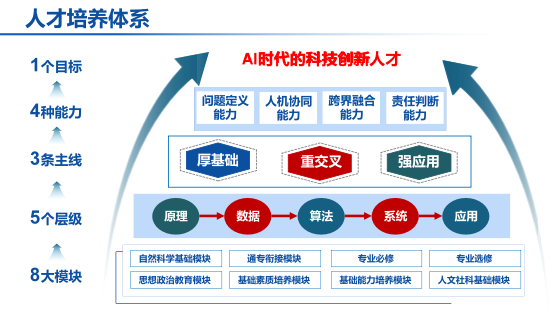
Framework of the Talent Training System at the School of Artificial Intelligence
Leading the Future: Cultivating Talent, Taking Responsibility
The rapid development of artificial intelligence brings not only enormous opportunities but also global challenges in ethics, security, and governance. The School of Artificial Intelligence at SUSTech deeply integrates ethics education and social responsibility into the entire talent cultivation process, aiming to train interdisciplinary leaders who are proficient in technology, well-versed in governance, and possess a global perspective and humanistic care.
The establishment of the School of Artificial Intelligence is a key initiative for SUSTech to align with the world’s technological frontiers, optimize the strategic layout of disciplines, and serve national and regional economic and social development. The school will fully leverage Shenzhen’s outstanding innovation ecosystem, continuously explore new heights in AI technology and application, and provide sustainable intellectual support and a talent pool for basic research, technological breakthroughs, and industrial development in China’s AI field.
Proofread ByJunxi KE
Photo BySchool of Artificial Intelligence