Recently, a research team led by Associate Professor Zhicheng JING of the Department of Earth and Space Sciences at Southern University of Science and Technology (SUSTech) published a study titled “Presence of primordial Mg can explain the seismic low-velocity layer in the Earth’s outermost outer core” in the top-tier scientific journal Nature Communications. The paper reveals the formation mechanism for the mysterious low-velocity layer at the top of the Earth’s outer core, suggesting that primordial magnesium (Mg) incorporated into the outer core during the Moon-forming giant impact in Earth’s very early history may be the primary cause of the reduced seismic wave velocities in the outermost outer core.
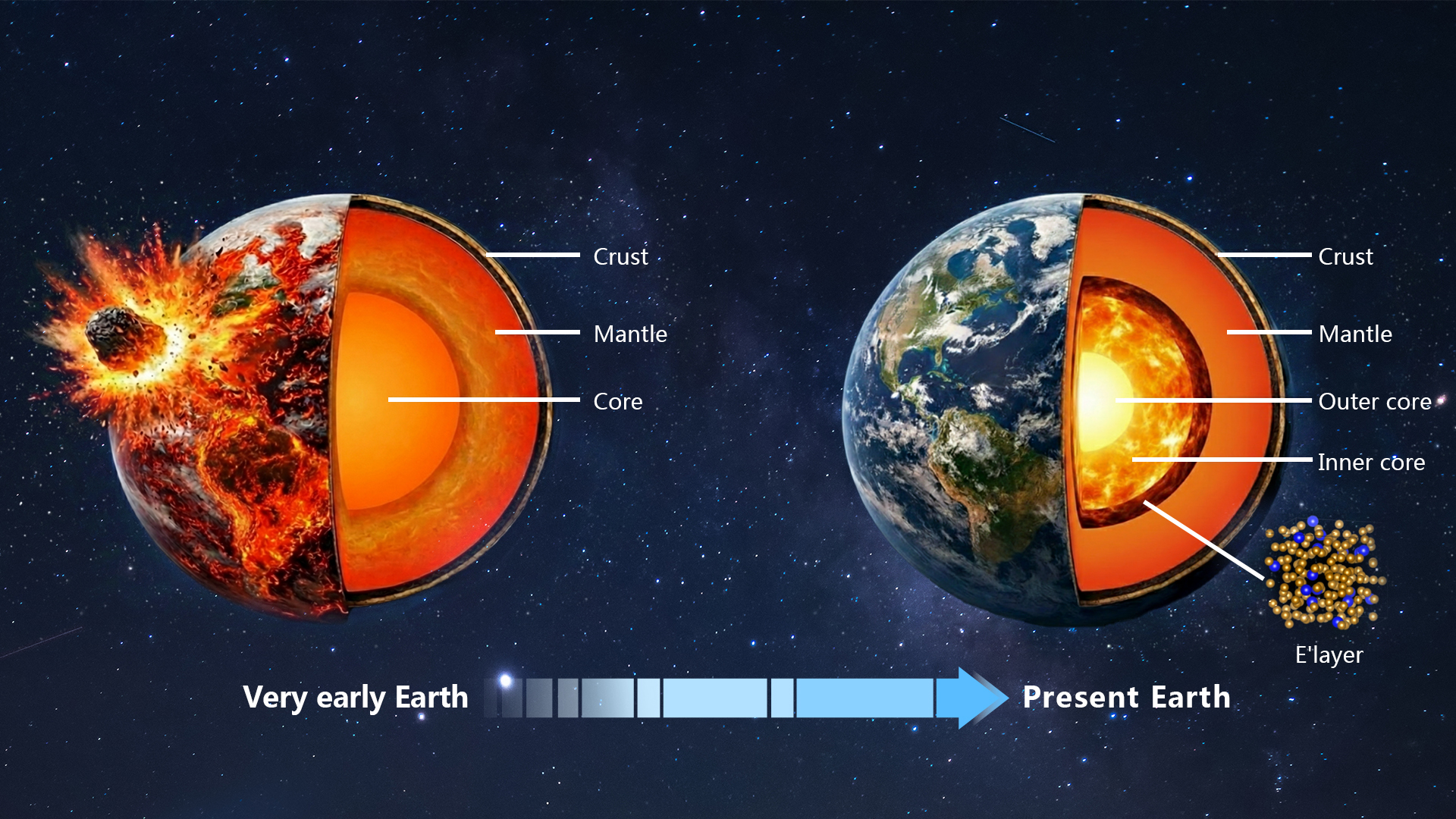
Located at depths of 2,890 km to 5,150 km, the Earth’s outer core is primarily composed of a liquid alloy of iron (Fe) and some light elements. Its convection process provides the energy source for the geodynamo that generates Earth’s magnetic field. The specific types and abundances of light elements in the liquid outer core have long been a frontier research topic in deep-Earth studies. Seismic observations have revealed an anomalous low-velocity layer, known as the E′ layer, with a thickness of approximately 150–700 km at the top of the outer core. The compressional-wave velocity in this layer is about 1% lower than that predicted by the Preliminary Reference Earth Model (PREM). However, previous studies have shown that traditional candidate light elements for the core, such as silicon (Si), oxygen (O), carbon (C), sulfur (S), and hydrogen (H), all increase the compressional-wave velocity of liquid Fe-alloys while reducing their density. Therefore, if a lower light-element content is responsible for the low-velocity feature of the E′ layer, it would imply that the E′ layer should have a higher density, leading to gravitational instability and making it difficult for such a layer to persist over geological time. This presents a challenge in explaining the origin of the E′ layer.
The research team led by Zhicheng JING has long been dedicated to studying the physical properties and chemical composition of Earth’s and planetary cores. In previous work (LIU and JING, 2024, Communications Earth & Environment, 5: 282), the team investigated chemical equilibrium between the inner and outer cores and performed joint inversions of their compositions constrained by seismic observations. They found that a core composition dominated by Si and H as light elements could well explain the density and wave velocities across most depth ranges of the outer and inner cores. However, that study also revealed that a liquid Fe-Si-H alloy could not account for the low-velocity feature of the outermost outer core.
In this new study, the research team proposes that Mg, as a light element in the outer core, may be the key to explaining the low-velocity signature of the E′ layer. Previous research has shown that the extremely high temperatures induced by the Moon-forming giant impact of a Mars-sized impactor (known as “Theia”) to proto-Earth could have enabled substantial amounts of Mg and O to dissolve into Earth’s core. As the core gradually cooled, the solubility of Mg and O in the metallic liquid decreased, causing them to exsolve in the form of magnesium oxide. This process may have provided a power source for the early geodynamo before the crystallization of Earth’s inner core. Estimates from different models suggest that a certain amount of Mg may still reside in the present-day core, but how much Mg the core contains and how Mg influences properties such as the density and wave velocity of the outer core have remained unclear.
Building on this background, the research team employed first-principles molecular dynamics simulations to model the liquid Fe-Mg alloys under high-temperature and high-pressure conditions, and systematically investigated the effects of Mg on the density and compressional-wave velocity of liquid Fe alloys. The simulation results demonstrate that, unlike traditional light elements such as Si, O, C, S, and H, the addition of Mg not only reduces the density of liquid Fe but also leads to a slight decrease in its compressional-wave velocity (Fig. 1). This unique “density-lowering and velocity-lowering” coupling effect makes Mg an ideal candidate component for explaining the low-velocity anomaly of the E′ layer.
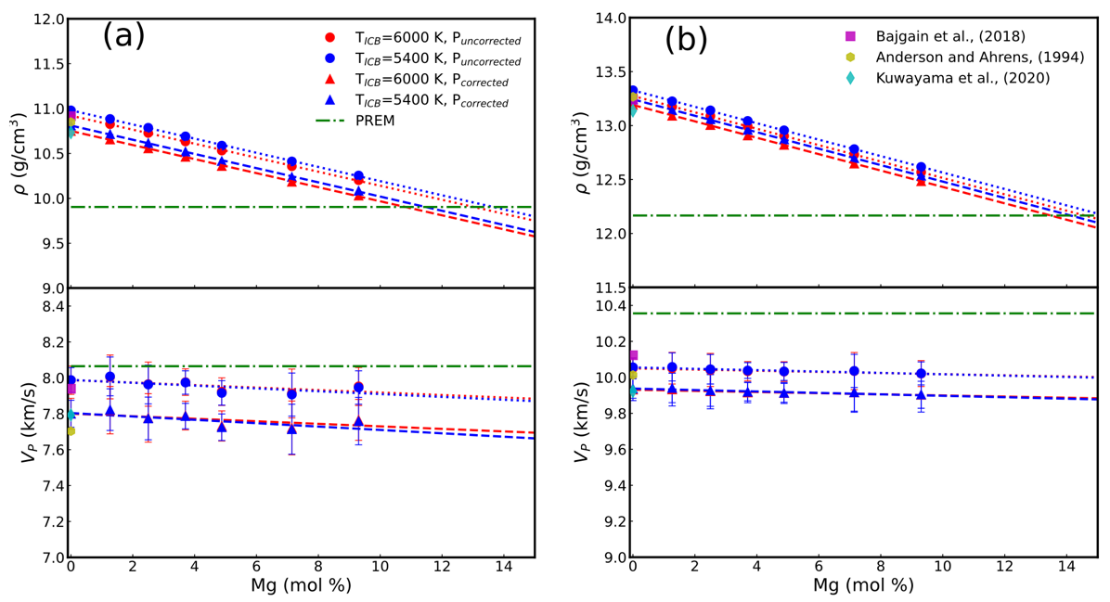
Figure 1. Effects of Mg on the density (ρ) and compressional wave velocity (VP) of liquid Fe-Mg alloys under core-mantle boundary (a) and inner-core boundary (b) conditions.
Combining the Fe-Mg simulation results with constraints from the latest seismic velocity models, the study finds that dissolving about 0.5–1.79 wt% Mg in the outermost part of Earth’s outer core (Fig. 2) can simultaneously explain the observed density and low-velocity characteristics of the E′ layer, thereby allowing for a stable chemical stratification. Meanwhile, previous research on early Earth’s core-mantle differentiation indicates that forming a liquid outer core with a Mg content exceeding 0.5 wt% requires extreme temperatures significantly higher than 3,500 K, which could only have been achieved during the Moon-forming giant impact. Hence, this study proposes that during the giant impact that formed the Moon, large amounts of Mg-rich material were injected into the top of the early outer core under extremely high temperatures. Over subsequent secular cooling of the core, this layer gradually evolved in composition, eventually forming the E′ layer detected today by seismic waves. At the same time, this process provides a new deep reservoir of Mg that may help explain the observed depletion of Mg/Al and Mg/Ca ratios in the bulk silicate Earth relative to CI chondrites, as revealed by geochemical observations.
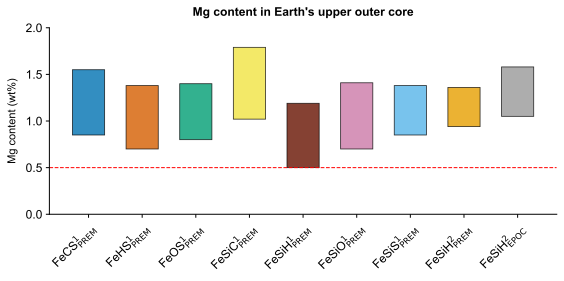
Figure 2. The calculated Mg content in Earth’s upper outer core (~600 km thick) from various core composition models and seismic constraints.
Dr. Tao LIU, a former Senior Research Fellow in the Department of Earth and Space Sciences at SUSTech, is the first author of this paper. Prof. Zhicheng JING is the corresponding author of the paper.
Paper Link: https://doi.org/10.1038/s41467-026-68572-4
Proofread ByNoah Crockett, Junxi KE
Photo ByYan QIU