The Institute of Robotics Research at the Southern University of Science and Technology (SUSTech) and Jining City, Shandong Province, signed and jointly established the “SUSTech Institute of Robotics Research – Jining Joint Laboratory.” The unveiling ceremony was held in the High-tech Zone of Jining. Attending the event were Jiandong PANG, Standing Committee Member of the Jining Municipal Committee and Minister of the Organization Department; Jiansheng DAI, Fellow of the Royal Academy of Engineering, Fellow of the European Academy of Sciences and Arts, and Director of the SUSTech Institute of Robotics Research; and Yadong WANG, Secretary of the Party Working Committee and Director of the Administrative Committee of the Jining High-tech Zone, among others.
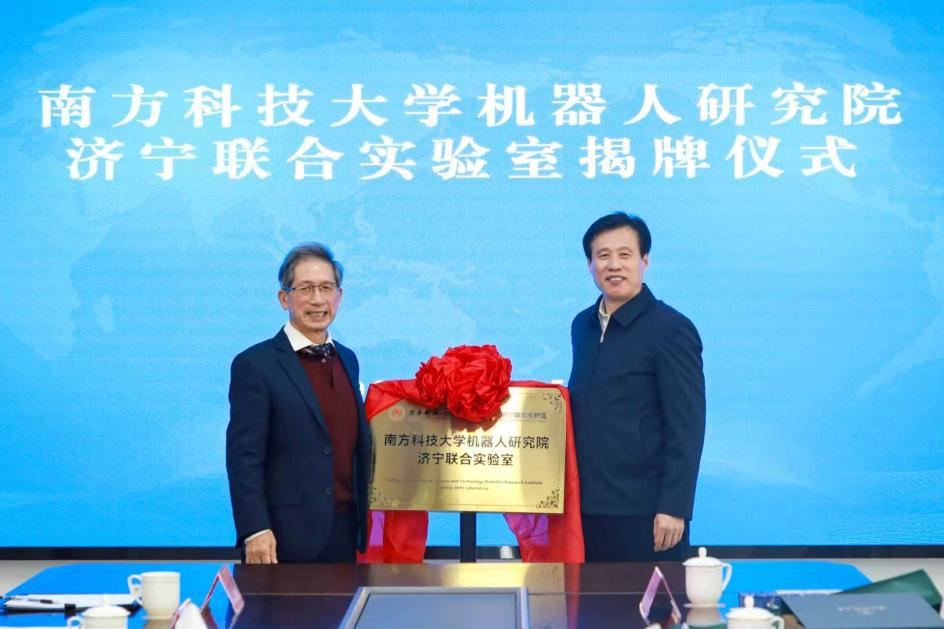
Jiansheng DAI and Jiandong PANG jointly unveiled the “SUSTech Institute of Robotics Research—Jining Joint Laboratory.”
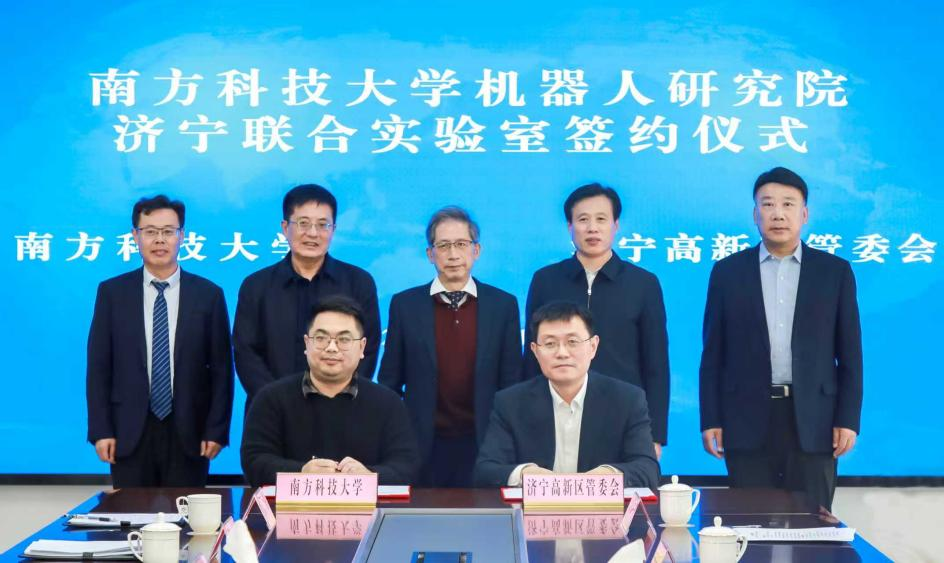
Xin MA, representing the SUSTech Institute of Robotics Research, signed a cooperation agreement with Lei ZHU, representing Jining City.
Xin MA, Executive Deputy Director of the University-Locality Cooperation Committee at SUSTech Institute of Robotics Research, signed a cooperation agreement with Lei ZHU, Deputy Secretary of the Party Working Committee of the Jining High-tech Zone.
Academician Jiansheng DAI stated that Jining City not only has a profound cultural heritage but also boasts a strong industrial foundation and outstanding technological and innovation advantages, creating a solid and broad basis for cooperation between the two sides. The establishment of the joint laboratory marks an important milestone for the SUSTech Institute of Robotics Research in its mission to serve regional economic development. In the future, the institute will fully leverage its disciplinary advantages in the field of robotics and deeply integrate with Jining City’s leading industrial resources.
In his speech, Jiandong PANG highly praised the cooperation. He said that this collaboration represents a “triple resonance” between a prestigious university and a famous city, strategy and demand, as well as cutting-edge technology and industrial pain points. He hopes that both parties will adhere to operational implementation, regular research, project-based advancement, building a new type of R&D system, and forming a virtuous cycle of “enterprises posing the problems, collaboration finding the answers,” creating a replicable and promotable example of successful industry-academia-research cooperation.
Proofread ByJunxi KE
Photo By