Associate Professor Lin ZENG from the Department of Mechanical and Energy Engineering at the Southern University of Science and Technology (SUSTech), in collaboration with its partners, has conducted in-depth research to enhance the comprehensive performance of aqueous zinc-ion batteries (AZIBs). The team proposed a suite of innovative strategies for AZIBs electrolyte engineering, hydrogel electrolytes, zinc anodes, and zinc-iodine batteries, securing a series of breakthroughs in key technical areas. Relevant research works have been published in top-tier materials and energy journals, including Angewandte Chemie International Edition, Advanced Materials, Advanced Energy Materials, Electrochemical Energy Reviews, Energy Storage Materials, Nano-Micro Letters, and Advanced Functional Materials.
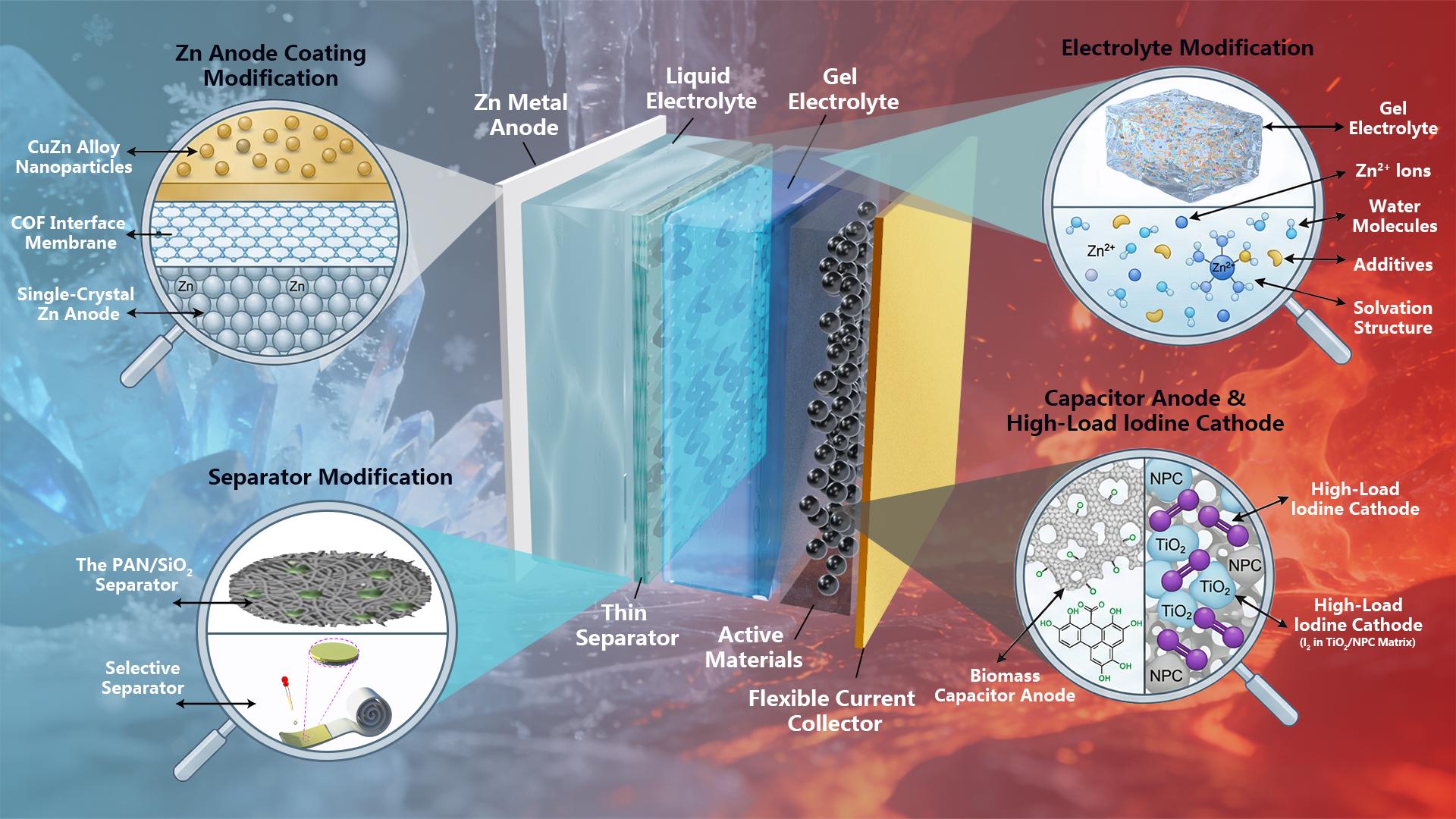
Figure 1. ZENG’s team’s research in the field of zinc-ion batteries
Key Achievement 1: CuZn Nanoalloy Particles and Graphene Coating Enable Long-Life Zinc Anodes
Targeting common failure mechanisms of zinc anodes in AZIBs, such as dendrite growth, side reactions, and hydrogen evolution, the team developed a set of strategies based on the concept of “interface regulation-deposition guidance-multifunctional protection.” They designed a graphene nanosheet-coated copper-zinc nanoparticle structure (CZPG), which leverages graphene’s high electrical conductivity and abundant nucleation sites, combined with the strong zinc affinity and hydrogen evolution inhibitive capabilities of CuZn nanoparticles, to form a bifunctional interface. The synergistic effect between the high dezincification potential of the CuZn alloy and the graphene conductive network effectively regulates the flux distribution and deposition kinetics of zinc ions (Zn2+), enabling zinc symmetric batteries to cycle stably for over 1,300 hours. This study, through interface engineering of the alloy-graphene hybrid coating, offers fresh insights for developing high-performance AZIBs and is expected to advance their application in grid-scale energy storage and other fields. Published in Small under the title “Synergistic Effects of CuZn Nanoparticles and Graphene for Advanced Zinc Anodes in Aqueous Zinc-Ion Batteries.” The paper lists SUSTech as the first affiliated institution. Xiuting WU, a research assistant in Lin ZENG’s team, is the first author with Lin ZENG serving as the corresponding author.

Figure 2. Schematic illustration of the flat zinc anode enabled by alloy & graphene coating
Key Achievement 2: High-Energy, High-Power Zinc-Ion Hybrid Capacitors with 150,000 Cycles
To address the insufficient energy and power density of zinc-ion hybrid capacitors (ZICs) and their unclear, complex energy storage mechanisms, the team proposed research strategies centered on “material design – simulation calculation – mechanism investigation.” Focused on synergistically improving energy density, power density, and ultra-long cycle life, they developed a hydrothermal coupling double-salt activation strategy to prepare oxygen-doped carbon electrodes with 1 nm pores. The resulting ZIC achieved an energy density of 135.5 Wh kg-1 and a power density of 24.00 kW kg-1, with no capacity fading after 150,000 cycles. This study not only deepens the fundamental understanding of charge storage mechanisms in ZIC carbon-based electrodes but also establishes a clear structure/performance relationship for porous carbon materials, laying a new foundation for the rational design of next-gen high-performance ZICs with high energy density, high power density, and ultra-long cycle life. Published in Advanced Energy Materials under the title “Spatial Confinement Effect and Defect-Dominated Redox Reactions Enhance Energy and Power in Zn-Ion Capacitors with 150,000 Cycles.” The paper is led by SUSTech. Hengyuan HU (Master’s student), Yongbiao MU (PhD student), and Zhiyu ZOU (Master’s student) from SUSTech, are co-first authors while Associate Professor Meisheng HAN, Professor Lin ZENG, and Professor Tianshou ZHAO are co-corresponding authors.

Figure 3. Schematic illustration of cathode optimization strategies for zinc-ion hybrid capacitors
Key Achievement 3: Wide-Temperature Gel Electrolyte for AZIBs (-60 °C to 60 °C)
In the field of gel electrolytes, the team tackled the stability challenge of AZIBs cycling over a wide temperature range by solving poor conductivity and contact issues of gel electrolytes through molecular regulation. They developed a multicomponent gel electrolyte that enables stable operation for over 1,500 hours at extreme temperatures ranging from -60 °C to 60 °C, while maintaining a high current density of 20 mA cm-2. This research provides a valuable reference for performance studies under extreme conditions. Published in ACS Nano under the title “Robust Piezoelectric-Derived Bilayer Solid Electrolyte Interphase for Zn Anodes Operating from −60 to 60 °C.” The paper designates SUSTech as the first affiliated institution. Yongbiao MU (PhD student) and Yuke ZHOU (Master’s student) from SUSTech are first authors, with Professor Guanjie HE (University College London), Professor Guangmin ZHOU (Tsinghua University Shenzhen International Graduate School), and Professor Lin ZENG as co-corresponding authors.

Figure 4. Engineering achievements of gel electrolytes. (a) Schematic of problems in traditional electrolytes. (b) Schematic of the mechanism of gel electrolyte strategy. (c) Schematic of wide-temperature gel preparation and polymer chain structure.
Key Achievement 4: Cosolvent-Additive Synergy Enables Low-Temperature Long-Life AZIBs
To solve the easy freezing problem of aqueous electrolytes, the team reconstructed the hydrogen bond network by introducing the synergistic effect of methanesulfonamide and glycerol, facilitating the formation of (100)-oriented zinc anodes and constructing zinc-zinc symmetric batteries. The battery exhibited exceptional cycling stability, lasting 4,000 hours at 1 mA cm-2, and even maintaining stable operation for over 5,400 hours at -20 °C. This design significantly expands the operating current and temperature range of AZIBs, enhancing their practicality and low-temperature adaptability, and offering an effective solution to the low-temperature freezing issue of aqueous electrolytes. Published in Nano-Micro Letters under the title “Decoding Hydrogen-Bond Network and Facet Engineering Synergy for Cryogenic Durable Aqueous Zinc-Ion Batteries.” The paper lists SUSTech as the first affiliated institution. Xiyan WEI (research assistant in Lin ZENG’s team) and Jinpeng GUAN (Master’s student at Guilin University of Technology) are first authors, with Dr. Yongbiao MU, Professor Lin ZENG, Professor Limin ZANG (Guilin University of Technology), and Professor Jingyu SUN (Soochow University) as co-corresponding authors.

Figure 5. Electrolyte engineering examples. (a) Natural polymer additive strategy. (b) Oriented Zn deposition-inducing additive strategy. (c) Okra polysaccharide additive for low-temperature AZIBs. (d) Low-temperature long-life Zn anode via hydrogen bond regulation.
This series of research has systematically overcome key bottlenecks of AZIBs in energy density, cycling stability, and applicability from multiple dimensions—including materials, interfaces, and system integration. It not only provides a solid theoretical basis and technical solutions for their engineering application but also contributes important scientific research support to accelerating the construction of a new power system dominated by renewable energy and advancing the national “dual carbon” strategic goals.
Proofread ByNoah Crockett, Junxi KE
Photo By