Prof. Aung Ko Ko KYAW and team from the Department of Electronic and Electrical Engineering at Southern University of Science and Technology (SUSTech) published a research article titled “Simultaneous Enhancement of Electron and Hole Mobility in para-Azaquinodimethane-Derived Polymer by Individually Applying Various Additives” in the internationally renowned journal Advanced Materials.

This work represents a breakthrough in charge transport modulation of ambipolar organic semiconductors. For the first time, the study demonstrates that electron and hole mobilities can be simultaneously enhanced within a single material system using only a single additive compatible with ionic, p-type, and n-type, providing a new strategy for the development of organic electronic devices.
Organic semiconductors are considered promising candidates for next-generation electronics due to their lightweight, low cost, printability, flexibility, and potential for wearable applications. However, their charge mobility and doping efficiency have long been limited, falling far behind silicon-based semiconductors. In ambipolar organic semiconductors, electron and hole transport are difficult to enhance simultaneously. Traditional doping mechanisms based on electron transfer heavily depend on energy level matching and typically require separate p-type and n-type dopants, which often interfere with each other and significantly limit device performance.
To address this critical bottleneck, the research team introduced para-azaquinodimethane (AQM) unit with a quinonoid structure and combined with the classical diketopyrrolopyrrole (DPP) backbone. By tuning the electron affinity of DPP flanking groups, three novel polymer materials were designed and synthesized, as shown in Figure 1: FuAQM, SeAQM, and PyAQM. FuAQM and SeAQM, incorporating furan and selenophene respectively, exhibit p-type dominant ambipolar behavior, while PyAQM with a pyridine unit shows n-type dominant characteristics, providing an ideal model system for systematic study of additive effects.

Figure 1: Molecular structures of polymer materials studied in this work.
The team further investigated three types of additives, ionic TBAI, n-type TeNF, and p-type Zn(C6F5)2 across the three polymers. Results showed that for p-type dominant FuAQM and SeAQM, additives weakened charge transport. In contrast, for n-type dominant PyAQM, electron and hole mobilities were both significantly enhanced regardless of the additive type, with electron mobility increasing by up to ~400% and hole mobility nearly 100%. This phenomenon surpasses the traditional understanding of electron-transfer doping and is reported for the first time in this field.
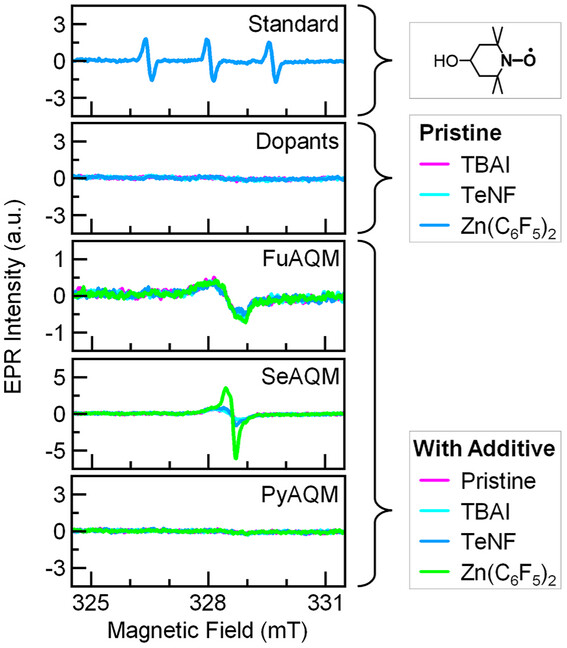
Figure 2: EPR spectra of reference radical compounds and polymers before and after additive treatment.
Mechanistic studies indicate that this synergistic enhancement is not due to electron-transfer doping. Electron paramagnetic resonance (EPR, Figure 2) tests showed clear signals for FuAQM and SeAQM, while no signal was detected for PyAQM, with or without additives, confirming the absence of electron transfer and consistent with the notion that traditional electron-transfer mechanisms cannot simultaneously enhance both electron and hole mobilities. Signals in FuAQM and SeAQM originated from radicals generated by quinonoid-aromatic resonance interconversion, which reduce backbone conjugation. In SeAQM, additives further intensified this side effect. In contrast, PyAQM’s n-type character stabilizes the quinonoid structure, maintaining a highly conjugated backbone.
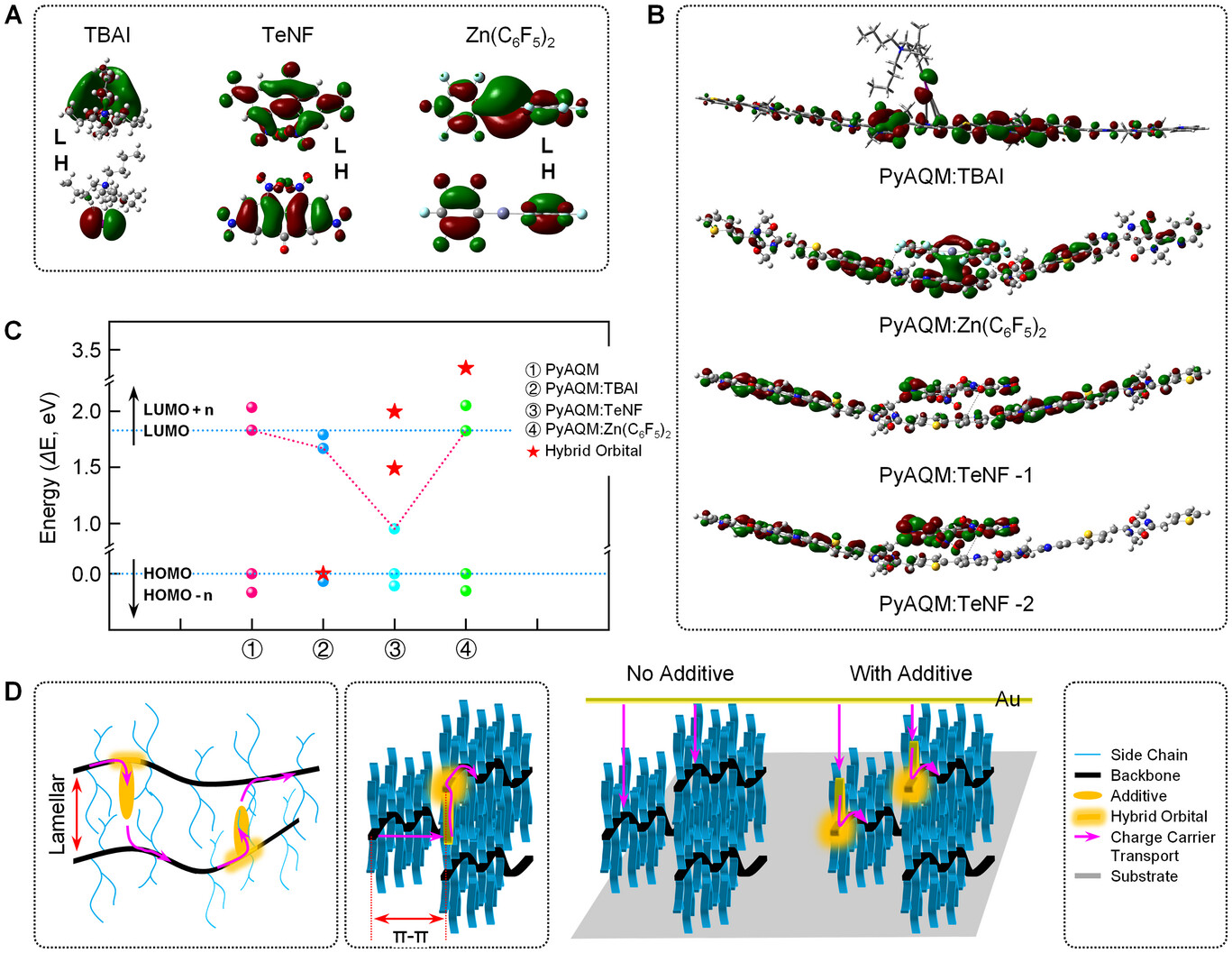
Figure 3: DFT calculations and mechanistic illustration.
Combining density functional theory (DFT) calculations and GIWAXS characterization, the researchers proposed a new mechanism: the AQM units promote effective orbital coupling between the polymer backbone and additives, creating new charge transport pathways and achieving simultaneous enhancement of electron and hole transport (Figure 3). Further computational analysis of the aromatic control systems reveals that the quinonoid structure plays a crucial role in facilitating strong orbital coupling.
This study demonstrates that enhancing orbital coupling between host polymers and guest additives via molecular design can circumvent the limitations of traditional doping mechanisms, enabling simultaneous improvement of p- and n-type mobilities in a single ambipolar organic semiconductor. This strategy shows excellent compatibility with ionic, p-type, and n-type additives and provides new design principles and evaluation criteria for high-performance ambipolar organic semiconductors and complementary logic circuits. The findings are expected to advance applications of organic electronics in flexible devices, wearable technologies, and novel integrated circuits.
The joint first authors of the paper are SUSTech Distinguished Postdoctoral Fellow Qian LIU, JSPS Researcher Waner HE from Institute of Science Tokyo, and PhD student Shuangzhe ZHANG from the Department of Materials Science and Engineering. SUSTech is listed as the first affiliation, with Professor Aung Ko Ko KYAW serving as the lead corresponding author. Dr. Qian LIU, Professor Tsuyoshi Michinobu from Institute of Science Tokyo, and Professor Prashant Sonar from Queensland University of Technology are co-corresponding authors. The work was also supported by Professor Xiaolong CHEN, Professor Lei LI, and other co-authors.
Paper link: https://doi.org/10.1002/adma.202513065
Proofread ByNoah Crockett, Junxi KE
Photo By