Recently, Professor Hong WANG’s team from the Department of Materials Science and Engineering at Southern University of Science and Technology (SUSTech) published their latest research in the journal Advanced Materials, titled “Scalable polymer composites enhanced by trace-amount polymer semiconductor for high-performance capacitive energy storage at 250 °C.”
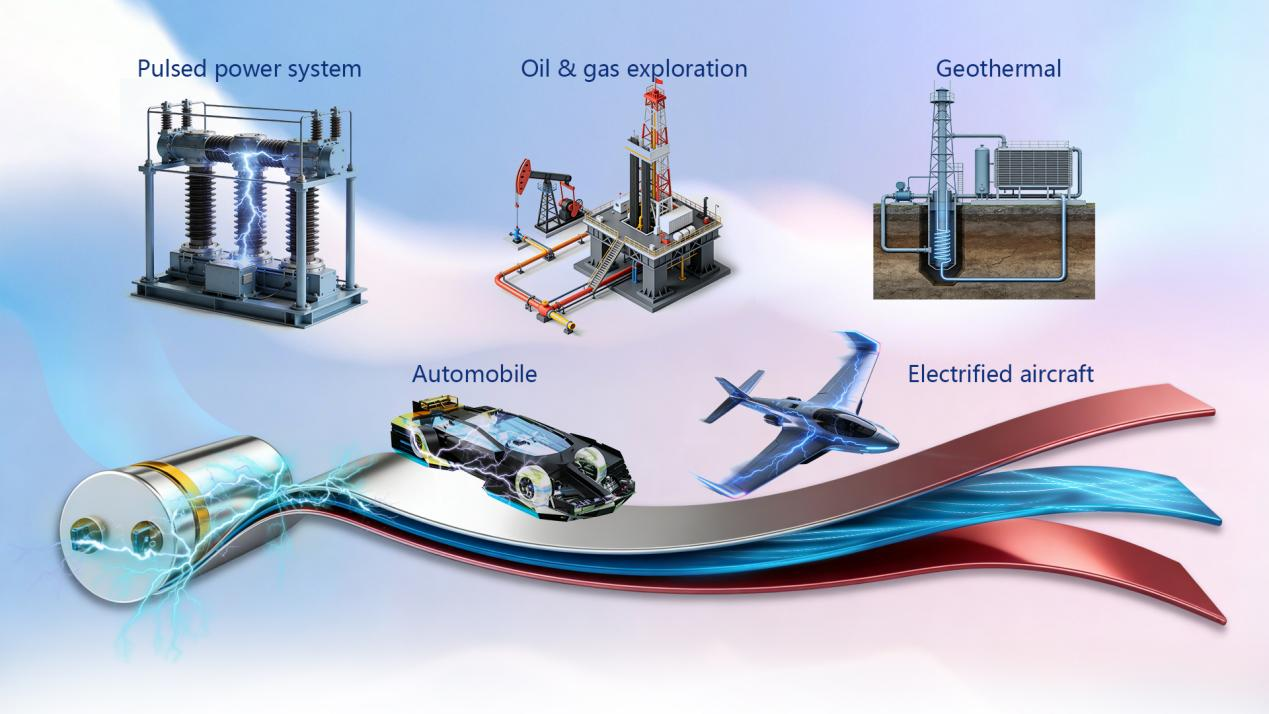
High-temperature polymer dielectric energy storage materials are crucial for advanced power electronic devices, but their practical application is severely limited by thermally activated charge transport, which leads to exponentially increasing conduction losses and premature breakdown. In emerging application areas such as electric vehicles, aerospace systems, and oil and gas exploration, there is an urgent need for high-performance energy storage materials that can operate stably in high-temperature environments, while traditional dielectric materials struggle to meet performance requirements under these extreme conditions.
The study found that introducing only a trace amount of polymer semiconductor can significantly regulate the band structure and charge transport properties of the composite material. This trace doping, through the interfacial interaction between the semiconductor and the polymer matrix, not only effectively suppresses charge mobility at high temperatures, reducing the bulk conductivity at 250°C by about three orders of magnitude, but also optimizes the breakdown field strength of the composite, overcoming the bottleneck of energy storage in conventional polymer materials at high temperatures. This strategy provides a new approach for developing dielectric energy storage materials that combine high energy density with excellent thermal stability and is expected to promote the miniaturization and efficiency improvement of high-temperature power electronic systems.
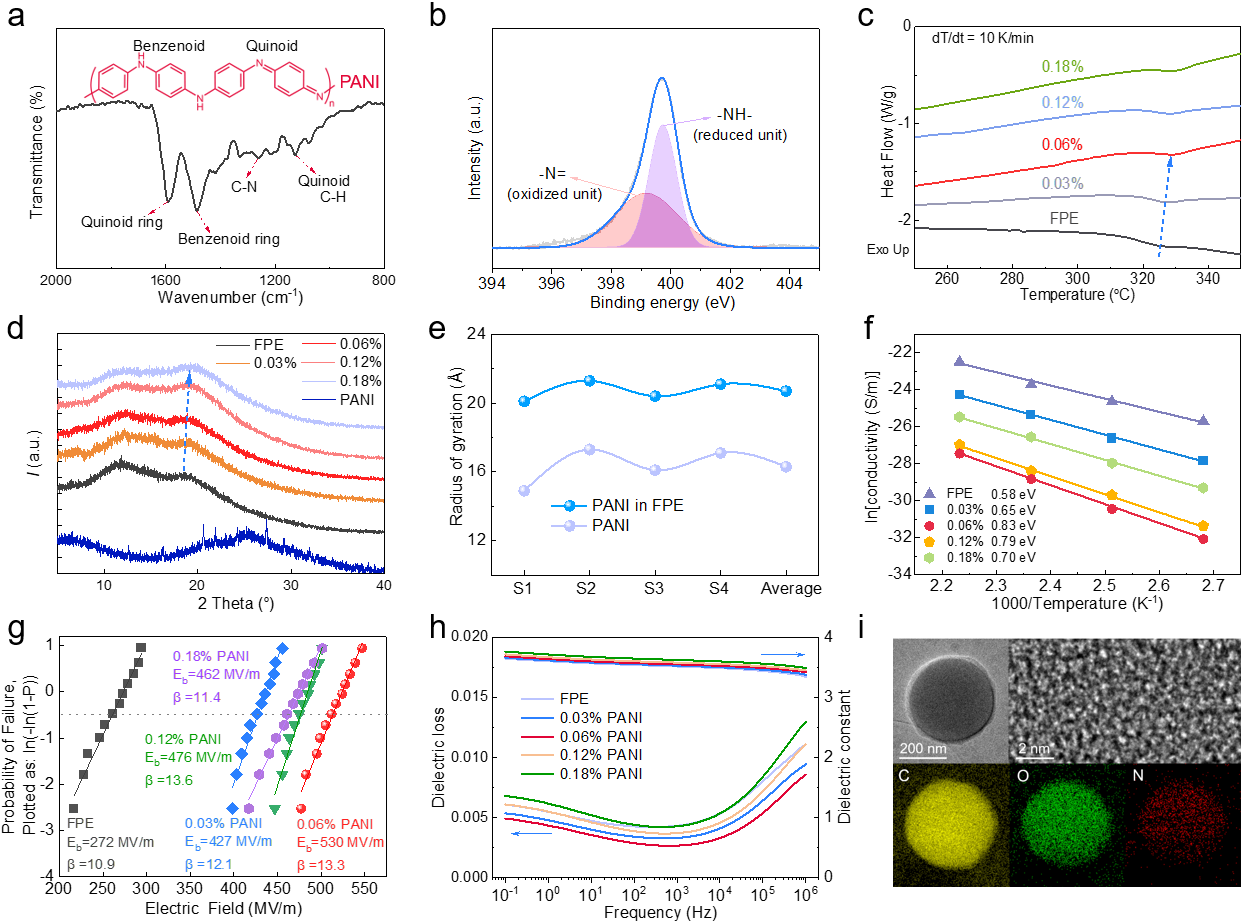
Figure 1. (a) Fourier transform infrared spectra of half-oxidized PANI. (b) N1s XPS spectra of half-oxidized PANI. These peaks correspond to secondary amine nitrogen (-NH) and imine nitrogen (-N=), respectively. (c) DSC curves of FPE and FPE-PANI composites with different PANI concentrations. (d) XRD curves of FPE and FPE-PANI composites with different PANI concentrations. (e) Radius of gyration of PANI molecular chains before and after optimization. (f) Arrhenius plots of conductivity for FPE and FPE-PANI composites under 200 MV m-1. (g) Weibull distribution plots of FPE and FPE-PANI with different PANI contents at 250°C. (h) Relationship between dielectric constant, dielectric loss, frequency for FPE, and FPE-PANI composites. (i) TEM results of FPE-PANI and elemental mapping images.
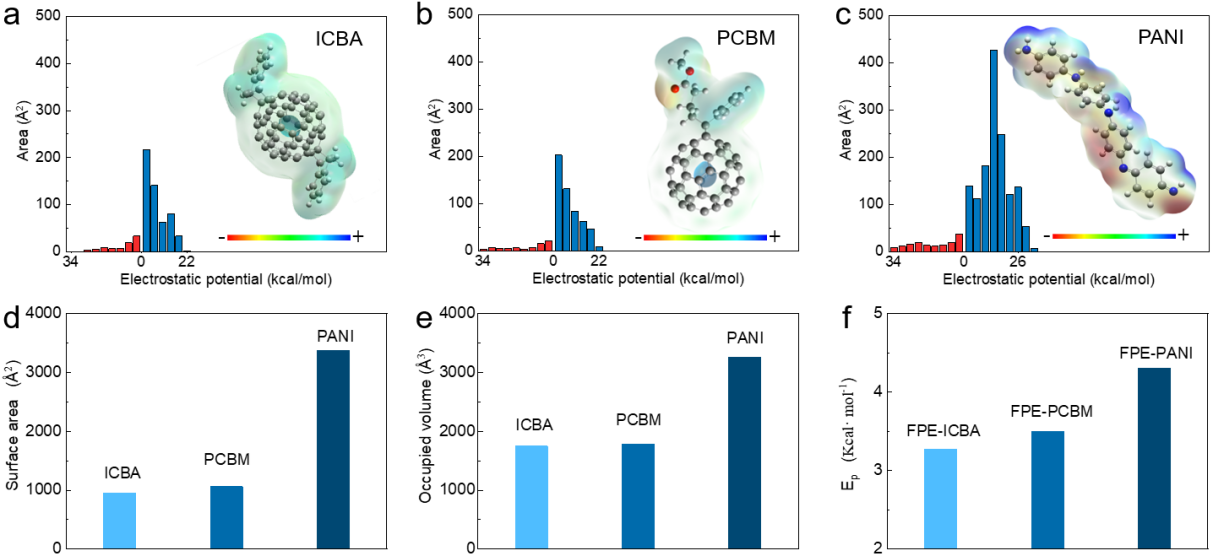
Figure 2. Positive Potential Optimization Strategy. (a-c) Molecular structures and electrostatic potential distributions of organic semiconductors (ICBA, PCBM, and PANI). (d,e) Specific surface area and volume of ICBA, PCBM, and PANI, and (f) interaction forces between the semiconductors and FPE.
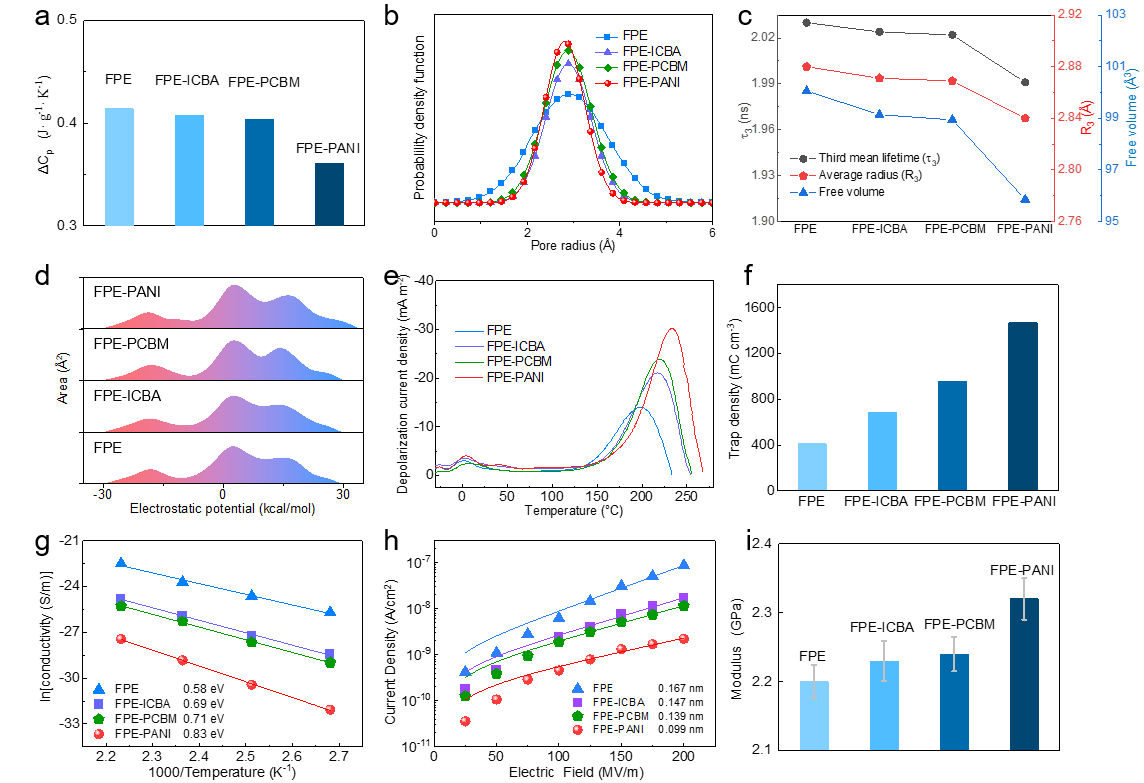
Figure 3. Mechanism and analysis of the optimization strategy for positive potential. (a) ΔCₚ of FPE and different semiconductor composite polymers during the glass transition process. (b) Pore size distribution of FPE and polymer composites obtained by PALS. (c) Third average lifetime, average radius, and free volume results of FPE and FPE composites. (d) Electrostatic potential distribution of FPE molecules influenced by organic semiconductors. (e) TSDC results of FPE and polymer composites. (f) Comparison of trap density of FPE and FPE composites measured by TSDC. (g) Arrhenius plots of conductivity of pristine FPE and polymer composites at 200 MV·m⁻¹. (h) Current density versus electric field curves of FPE and polymer composites at 150°C. (i) Young’s modulus of FPE and FPE composites.
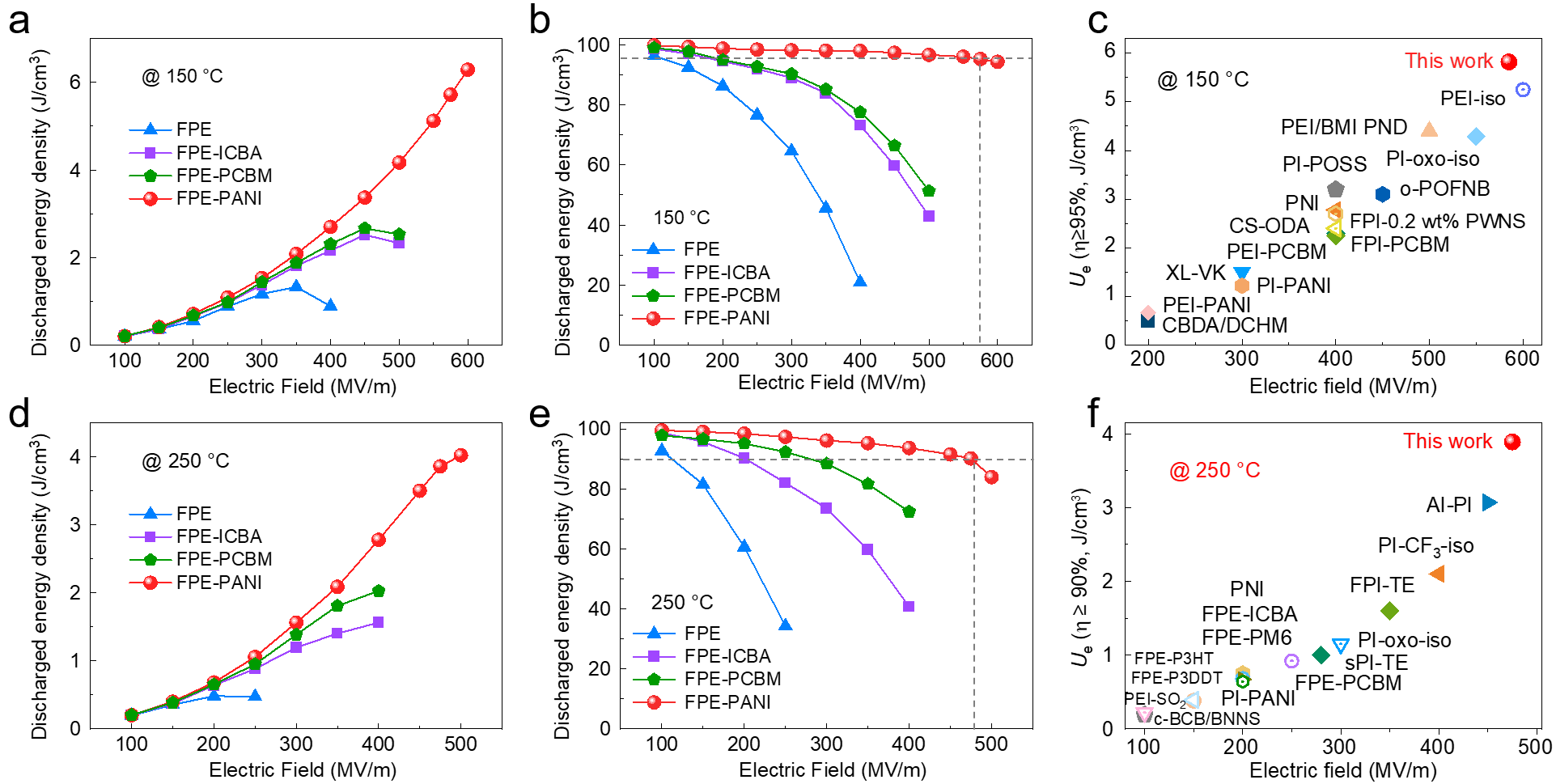
Figure 4. High-temperature energy storage performance of polymer composites. (a) Discharge energy density of FPE and polymer composites at 150°C calculated from P-E loops and (b) the variation of efficiency with electric field. (d) Discharge energy density and efficiency of FPE and polymer composites at 250°C. (c) Comparison of energy density of FPE-PANI with advanced dielectric polymers and polymer composites at 150°C and (f) 250°C.
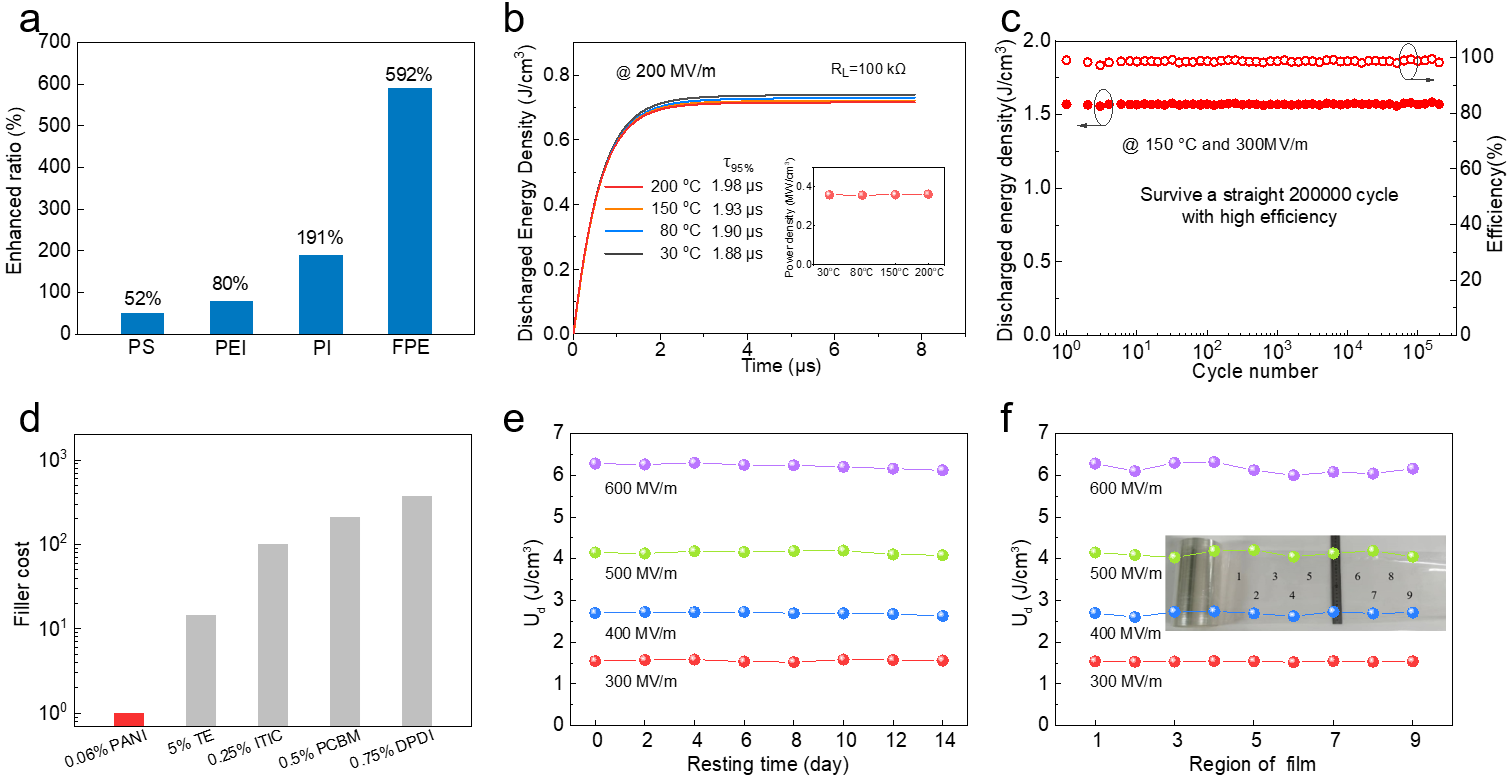
Figure 5. Stability and Scale-up Preparation. (a) Enhancement effect of introducing PANI with positive potential optimization strategy in different polymers. (b) Fast discharge curves and discharge power density of FPE-PANI at different temperatures. (c) Variation of discharge energy density and efficiency of FPE-PANI under a 300 MV m⁻¹ electric field with cycle number. (d) Cost comparison of PANI and advanced fillers used in polymer composites. (e) Change in discharge energy density of FPE-PANI films at 150°C with PANI solution standing time. (f) Discharge energy density of FPE-PANI films prepared by large-scale processing in different areas.
Zizhao PAN, Research Assistant Professor from the Department of Materials Science and Engineering at SUSTech, is the first author of the paper, and Hong WANG is the corresponding author. SUSTech is the primary affiliated institution of the paper.
Paper Link:https://doi.org/10.1002/adma.202521682
Proofread ByNoah Crockett, Junxi KE
Photo ByYan QIU