The Department of Earth and Space Sciences at Southern University of Science and Technology (SUSTech), in collaboration with the University of Hong Kong, Lancaster University, University College London, and other international partners, published a research paper titled “Dawn-dusk Asymmetrical Distribution of Saturn’s Cusp” in the international academic journal Nature Communications. This study utilized in-situ observation data from the Cassini spacecraft, combined with high-resolution magnetohydrodynamic (MHD) numerical simulations, to achieve a systematic statistical study of the global distribution of Saturn’s magnetospheric cusps. It revealed their significant dawn-dusk asymmetry: the peak occurrence of cusps appears in the afternoon sector (approximately 13-15 local time) and extends to the post-dusk region (around 20 local time), fundamentally different from the Earth’s cusps, which are symmetrically distributed around noon, and highly consistent with the latest findings of Jupiter’s dusk-side cusps.
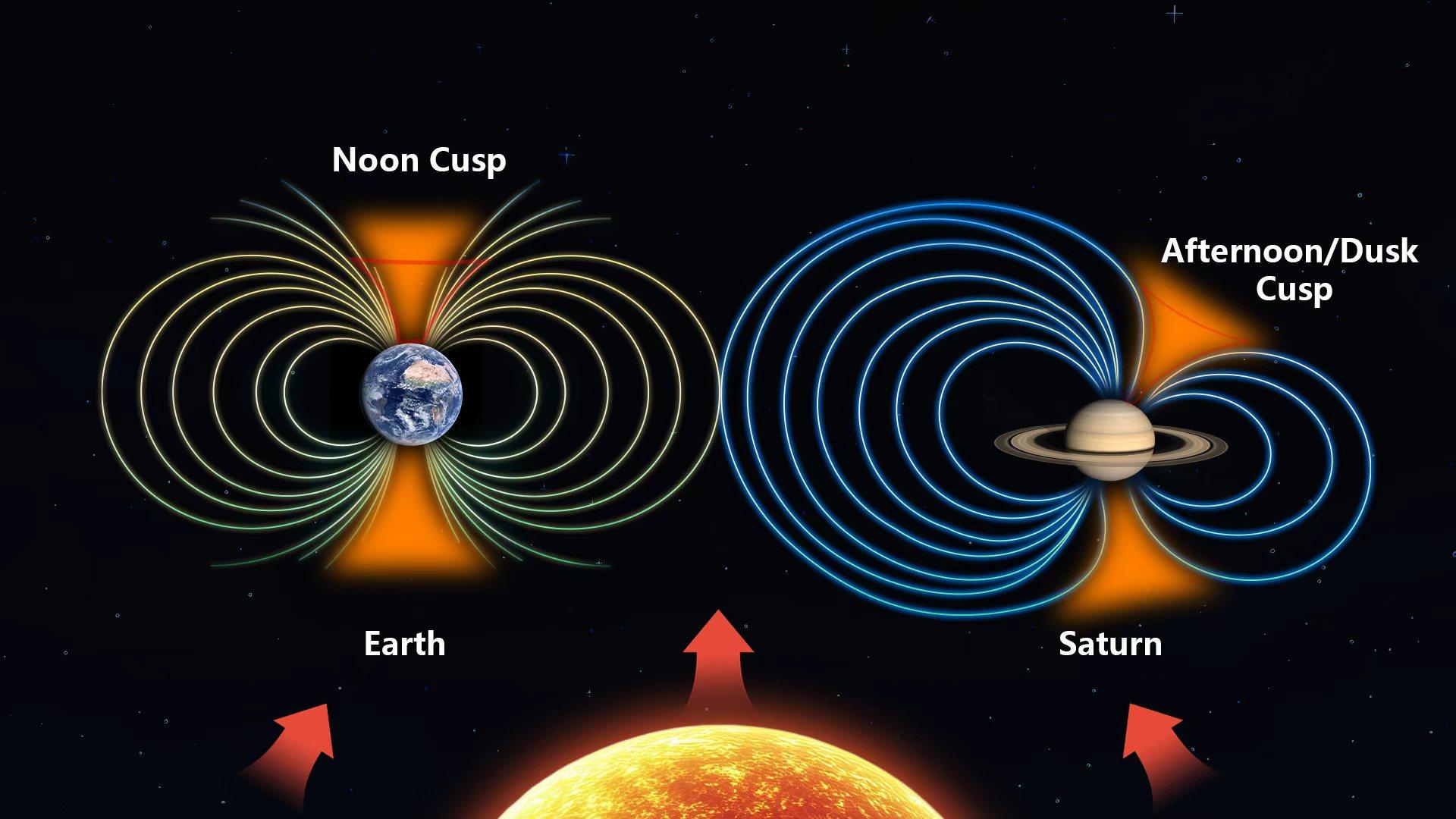
Planetary magnetospheres are formed by the continuous interaction between the solar wind and the planet’s internal magnetic field and display significant differences among the planets in the solar system. Unlike the Earth’s magnetosphere (which is primarily driven by solar wind), Saturn’s magnetosphere exhibits stronger internal driving characteristics; the planet’s approximately 10.6-hour rotation period and the continuous plasma injection from its moon Enceladus both dominate the overall dynamics of Saturn’s magnetosphere. The magnetospheric cusp is a critically important funnel-shaped region in the magnetosphere where solar wind particles can enter the planet’s upper atmosphere directly along this region after magnetic reconnection at the magnetopause, playing a key role in aurora formation, geomagnetic storms, and substorm processes in space weather. In the Earth’s magnetosphere, cusps are usually symmetrically distributed near local noon. However, how Saturn’s rapid rotation fundamentally alters the global distribution of its cusps lacked systematic statistical observational research and remains an important scientific question in the field of planetary magnetospheres.
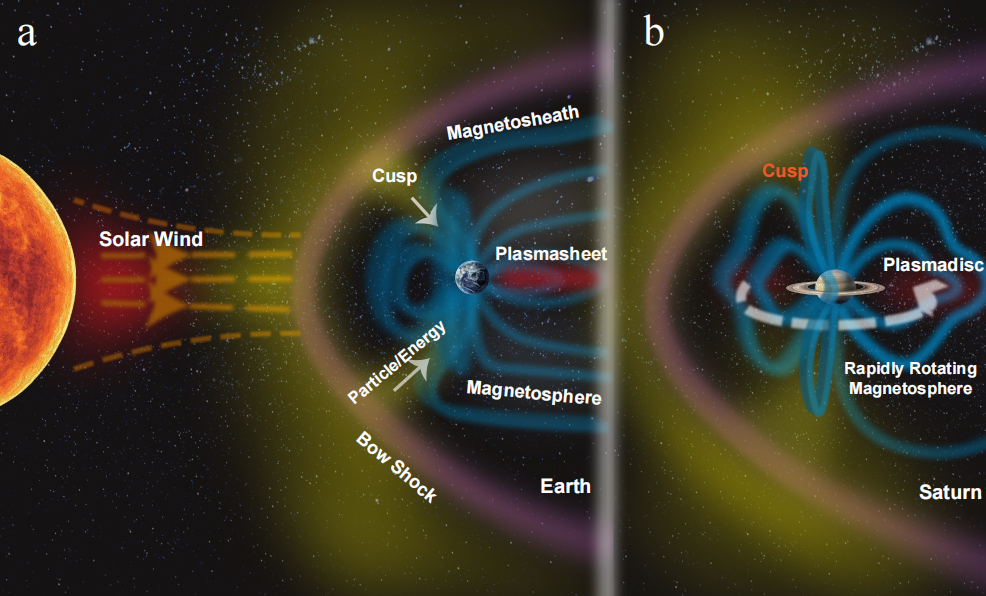
Figure 1. Schematic diagrams of the Earth’s magnetosphere driven by solar wind (a) and Saturn’s fast-rotating magnetosphere (b), where the global distribution image of Saturn’s polar cusp had not been fully clarified before this study.
Dr. Yan XU has been dedicated to observational and theoretical studies of planetary magnetospheric cusps and the solar wind-magnetosphere interactions. In previous work (XU et al., 2024, Nature Communications), the research team, based on in-situ observations from NASA’s Juno spacecraft, for the first time provided direct evidence of Jupiter’s magnetospheric polar cusps, finding that Jupiter’s cusp regions are not located in the traditionally understood dayside noon region but are significantly shifted toward the dusk and even the nightside, which is consistent with the unique three-dimensional magnetic topology revealed by global high-precision MHD simulations of Jupiter. This discovery broadens the traditional Earth-based analogy framework of planetary polar cusps and reveals the complex global magnetospheric configuration of rapidly rotating giant planets.
In this study, the research team systematically analyzed in-situ data from the Cassini spacecraft from 2004 to 2010, integrating multi-instrument measurements from the magnetometer (MAG), the electron spectrometer (CAPS-ELS), and the ion mass spectrometer (CAPS-IMS) to establish a two-tier cusp identification criterion combining core and auxiliary criteria: the core criterion is the magnetosheath-like electron spectrum characteristics in high-latitude regions (magnetic latitude >30°), supplemented by features such as ion dispersion, field-aligned electron distributions, and diamagnetic depression. Based on this, the research team ultimately identified 67 Saturnian cusp events, significantly expanding on the approximately 11 cases reported in previous studies, and the local time coverage extended from the previously studied roughly 9-15 hours to about 8-21 hours.
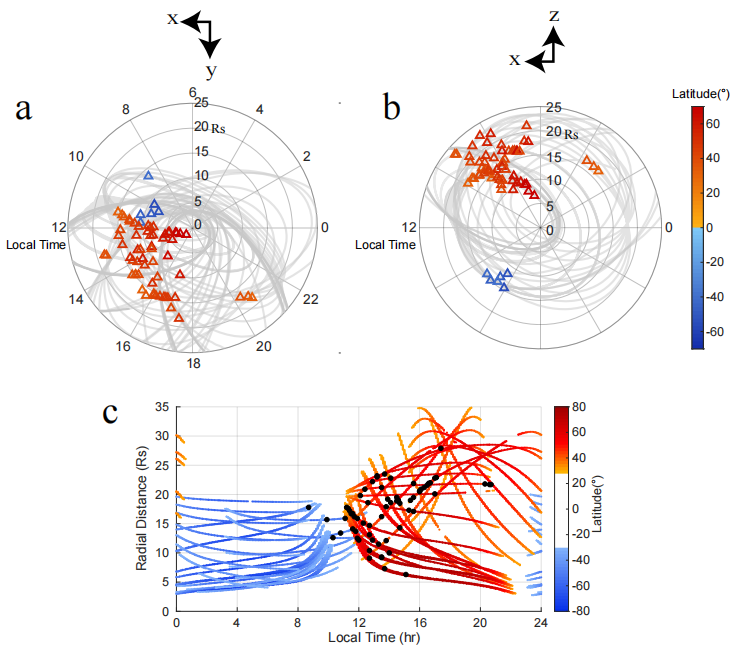
Figure 2. Global distribution statistics of all Saturn cusp events from 2004 to 2010.
After normalizing the high-latitude dwell time for each local time period, the global occurrence rate distribution of Saturn’s cusp shows a significant dawn-dusk asymmetry: the peak occurrence occurs at 13-15 LT (local time) in the afternoon, which is clearly shifted toward dusk compared to the peak position in Earth’s cusps (11-13 LT); notably, the study also identified multiple cusp events around 20 LT after dusk, consistent with the latest cusp locations observed at Jupiter. Plasma analysis of Saturn’s post-dusk cusp events indicates that their energy spectrum characteristics are highly similar to those of Jupiter’s dusk-side cusps, suggesting that the cusps of fast-rotating giant planets may share common microscopic physical mechanisms.
To reveal the physical origin of the above dawn-dusk asymmetry, the research team, in collaboration with Professor Binzheng ZHANG and Professor Zhonghua YAO’s teams at the University of Hong Kong, further numerically reproduced Saturn’s magnetic field topology using high-resolution global MHD simulations (based on the GAMERA code, with a resolution near the magnetopause of about 0.1-0.2 Saturn radii). The simulation results show that under the transport of magnetic flux driven by rapid rotation, closed magnetic flux significantly accumulates in the pre-noon sector, increasing local magnetic pressure, causing the dawn-side magnetopause to expand about 1-2 Saturn radii farther than the dusk side, forming an asymmetric magnetopause configuration; as cusps are structurally anchored to this magnetic topology, their global distribution is correspondingly biased toward dusk and can extend to post-dusk, in complete agreement with Cassini observations. Furthermore, the simulation reveals that influenced by the asymmetric magnetosphere configuration driven by rapid rotation, Saturn’s magnetopause reconnection is mainly driven by the east-west component of the interplanetary magnetic field (IMF By), rather than the north-south component (IMF Bz) that dominates Earth’s magnetopause reconnection, indicating fundamental differences in magnetopause coupling patterns between the two planets.
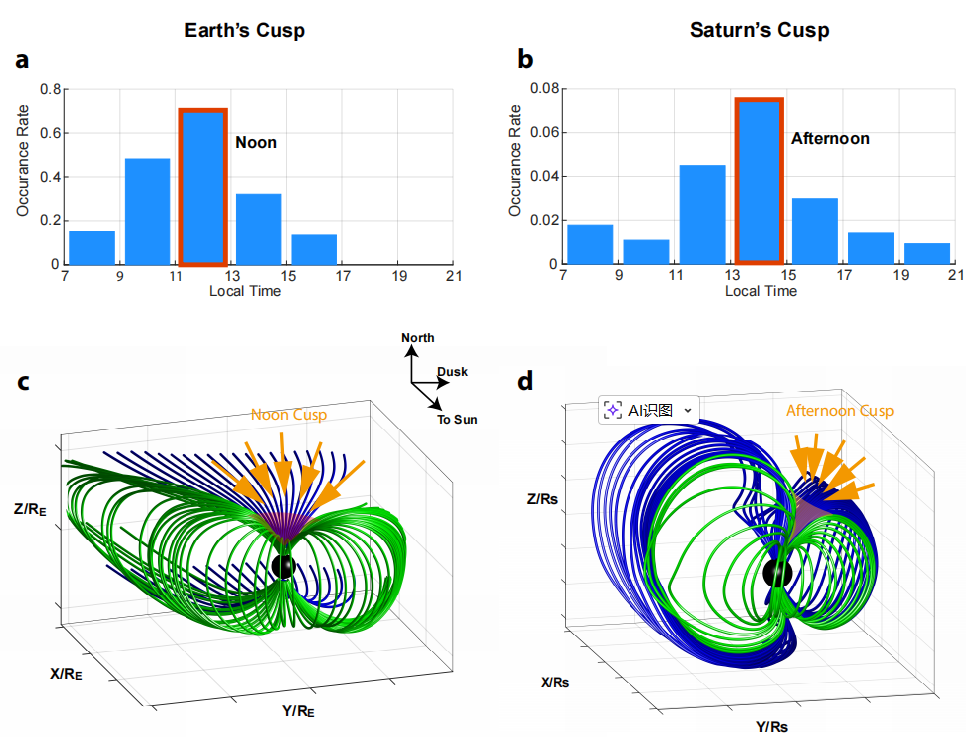
Figure 3. In-situ detection data revealing the occurrence distribution of the polar cusp regions of Earth (a) and Saturn (b), and the comparison of magnetic field configurations near the magnetopause of Earth (c) and Saturn (d), shown by MHD simulations.
This study, through the combination of systematic observations and high-resolution numerical simulations, for the first time provides a global statistical distribution map of Saturn’s magnetospheric polar cusp region, revealing the profound influence of rapid rotation and internal plasma sources on the global configuration of giant planet magnetospheres. The research findings corroborate the latest discoveries of Jupiter’s dusk-side polar cusp region, jointly constructing a comparative planetary science framework in which fast-rotating giant planets exhibit a common solar wind-magnetosphere interaction mechanism distinct from Earth. This provides important references and theoretical guidance for future in-depth exploration of Jupiter’s and Saturn’s polar cusps, as well as studies of magnetospheres of rotating planetary systems within and beyond the solar system.
The first author of this study is postdoctoral researcher Yan XU from Professor Shengyi YE’s group. The work was completed under the joint guidance of Professor Zhonghua YAO from the University of Hong Kong and Professor Shengyi YE from SUSTech, with SUSTech as the primary affiliation of the paper. The corresponding author is Professor Zhonghua YAO. Collaborators include Professor Binzheng ZHANG from the University of Hong Kong, Associate Professor Sarah Badman and Senior Lecturer Licia Ray from Lancaster University, UK, Professor Andrew Coates from University College London (UCL), and researchers from multiple other institutions.
Paper Link: https://www.nature.com/articles/s41467-026-69666-9
Proofread ByNoah Crockett, Junxi KE
Photo ByYan QIU