Professor Zongxiang XU from the Department of Chemistry at the College of Science, Southern University of Science and Technology (SUSTech), together with his collaborators, has made new advances in the development of self-assembled monolayer-based hole-selective contact materials for perovskite photovoltaics. Their work was published in the high-impact journal Nature Synthesis.
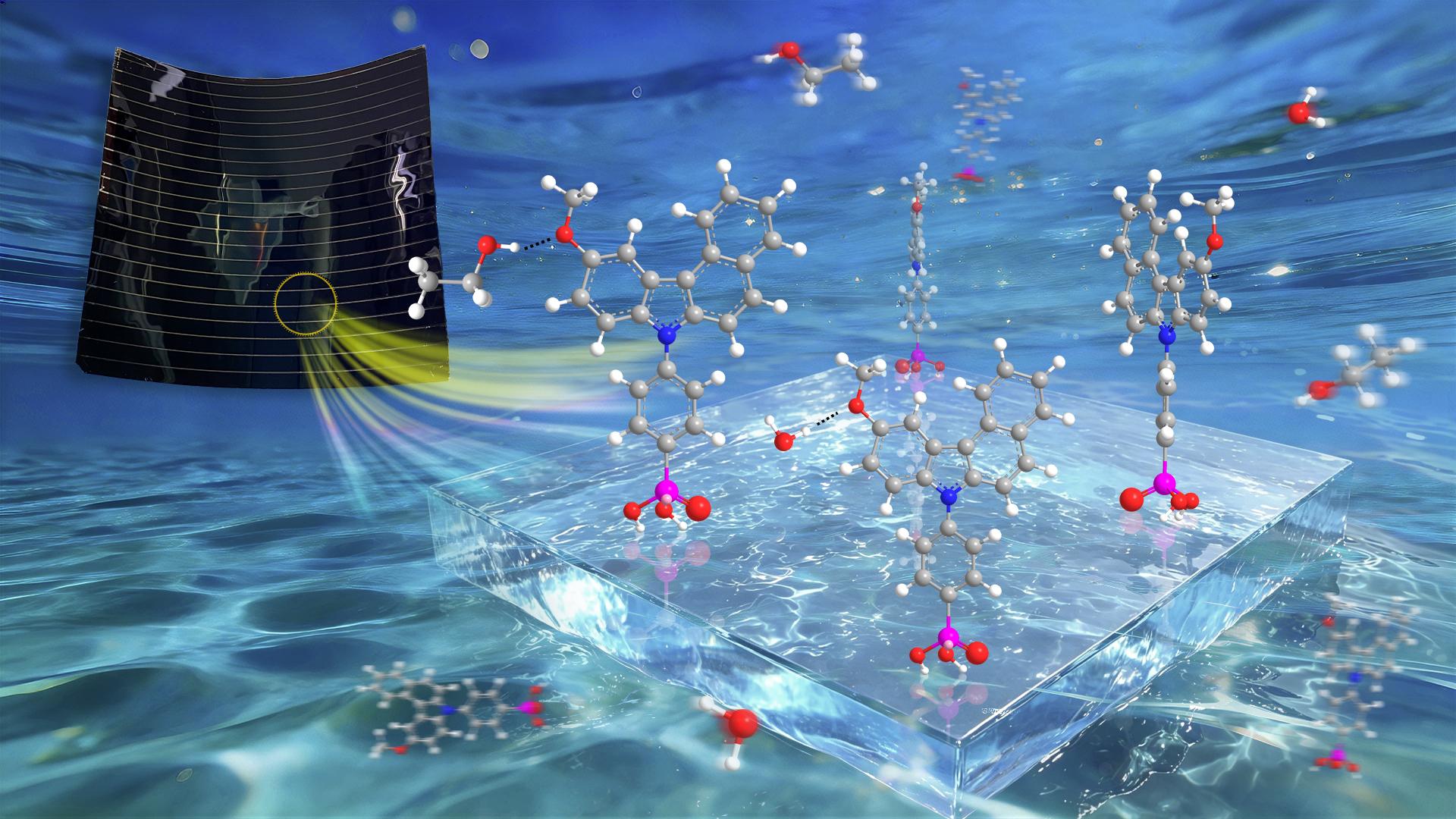
Over the past decade, perovskite solar cells (PSCs) have gradually emerged as one of the key focuses in next-generation photovoltaic research, thanks to their excellent optoelectronic properties, continuously rising power conversion efficiencies (PCEs), and favorable recyclability. They have become a cornerstone in this field. Among the various critical technologies driving the development of high-performance PSCs, the use of self-assembled monolayer (SAM) materials to construct hole-selective layers (HSLs) has stood out as a highly promising core strategy. Benefiting from their molecular-scale ultrathin architecture, SAM-based HSLs not only exhibit outstanding carrier selectivity but also significantly reduce the internal series resistance of the device, thereby effectively enhancing both the overall photoelectric conversion performance and operational stability.
Although spin-coating is widely adopted in laboratory settings and enables rapid fabrication of high-quality SAM functional layers, it still faces significant challenges when applied to large-scale industrial manufacturing and flexible device production. The main limitations of this technique include stringent requirements on substrate size and surface uniformity, as well as low solution utilization efficiency. These issues severely restrict its scalability and versatility across diverse device architectures. In contrast, soak-coating appears, in theory, to be better suited for large-scale industrial production and processing on flexible substrates. It offers several advantages, such as higher material utilization, good batch-to-batch reproducibility, and enhanced contact between anchoring groups and the surface of transparent conductive oxides (TCOs). However, two critical bottlenecks remain in practical applications; the relatively long soaking time required and the generally lower PCE of devices fabricated by this method compared to those made via spin-coating. Together, these shortcomings hinder the commercial scalability of soak-coating, leaving its technological development significantly behind that of spin-coating to date.
To address the aforementioned challenges, the research team built upon their previous work on carbazole (conjugated linker) phosphonic acid-based SAM materials (Joule, 2024, 8, 2123; Nature Communications, 2025, 16, 86; Joule, 2026, 10, 102227). Centered on a carbazole-conjugated linker–phosphonic acid molecular backbone, they rationally designed and precisely modified the terminal carbazole units, successfully synthesizing a series of novel SAM molecules. One representative example is (4-(10-methoxy-7H-benzo[c]carbazole-7-yl)phenyl)phosphonic acid (OB-PhpPACz). This molecule features a unique asymmetric structural design that integrates a methoxy substituent with a rigid benzo[c]carbazole framework. This synergistic combination significantly enhances the molecular dipole moment, improves molecular packing density, and boosts solubility in the green solvent ethanol. Further optimization of the solvent system revealed that adding 1.5 vol% water to ethanol can effectively strengthen the hydrogen-bonding network within the solvent. This not only improves the solubility of the SAM material but also markedly accelerates its self-assembly kinetics, thereby providing strong support for the controlled fabrication of high-quality SAM films.
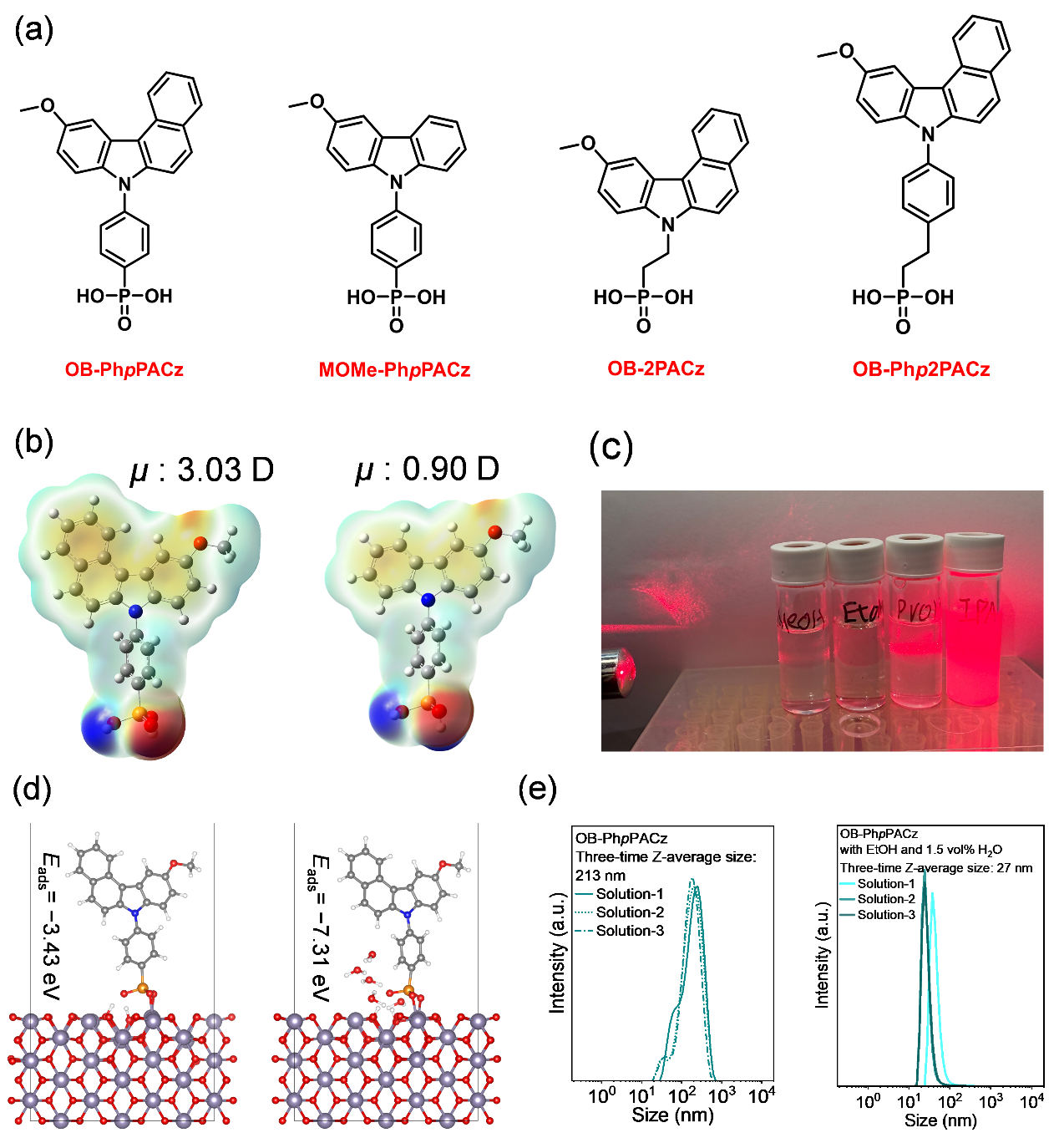
Figure 1. (a) Molecular structure of the SAM materials; (b) Molecular dipole moment of the SAM materials; (c) Tyndall effect of OB-PhpPACz in different alcohol solutions; (d) Adsorption models of OB-PhpPACz and OB-PhpPACz/H2O on FTO; (e) Dynamic light scattering measurements of OB-PhpPACz and OB-PhpPACz/H2O in ethanol solvent.
The SAM material OB-PhpPACz can rapidly form a high-quality SAM functional layer within just 5 minutes using a simple soak-coating process. Based on this, small-area PSCs with an active area of 0.071 cm2 achieved a certified PCE of 27.23%. Moreover, the devices exhibited excellent operational stability, with a certified steady-state efficiency of 26.69% measured under maximum power point tracking (MPPT) conditions. Notably, this soak-coating approach, combining high efficiency with a remarkably short processing time, can also be successfully extended to the fabrication of larger-area devices. A 1 cm2 device prepared via soak-coating attained a certified PCE of 25.75%, with a steady-state MPPT-certified efficiency of 24.85%. At the module level, mini-modules (aperture area: 12 cm2) fabricated using this method achieved a PCE of 23.25%, notably outperforming control modules fabricated via conventional spin-coating (21.98%). These results highlight the broad application prospects and substantial potential of both the OB-PhpPACz material and the associated soak-coating process for scalable module-level manufacturing.
For flexible substrates, which often feature pronounced surface irregularities and thus pose additional challenges for thin-film deposition, the soak-coating technique demonstrates even more prominent advantages due to its intrinsic tolerance to uneven surfaces. On flexible PEN/ITO substrates, the OB-PhpPACz SAM layer prepared via soak-coating significantly improved the PCE of small-area devices, increasing it from 23.93% (spin-coating baseline) to 24.98%. For 1 cm2 flexible devices, the PCE was substantially boosted from 21.59% to 23.98%. More impressively, even when scaling up the active area to 75 cm2, the process still delivered a PCE of 16.60%, far exceeding the 11.11% achieved by spin-coating. These findings strongly validate the scalability and versatility of the soak-coating method for large-area flexible photovoltaic manufacturing, laying a solid foundation for its future application in flexible optoelectronics.
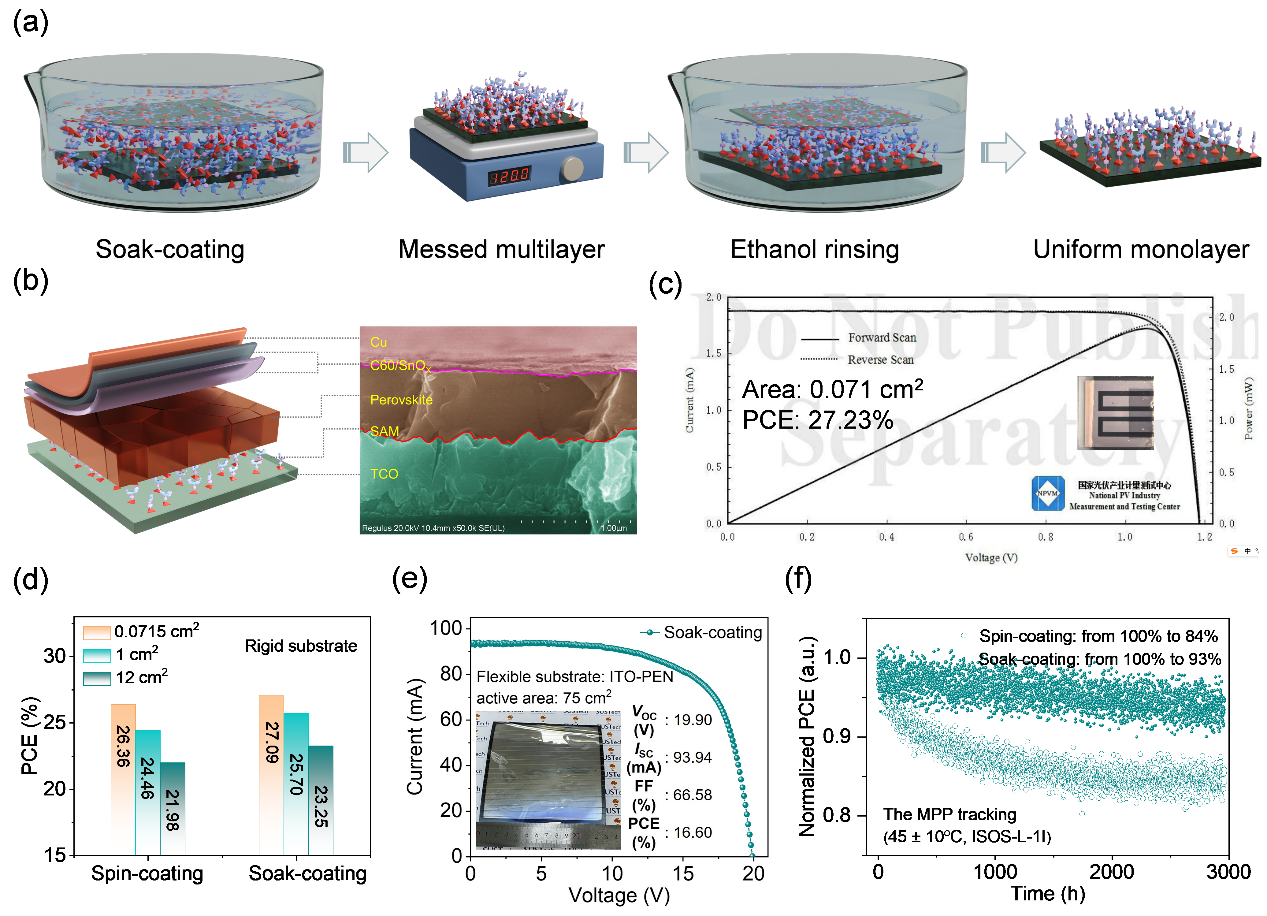
Figure 2. (a) Schematic diagram of the SAM soak-coating process; (b) Device structure of inverted PSCs; (c) Certified PCE of small-area PSC devices; (d) Comparison of device efficiencies across different areas fabricated by spin-coating and soak-coating processes; (e) Performance of large-area flexible PSC devices; (f) Stability comparison between devices fabricated by spin-coating and soak-coating processes.
It is particularly worth emphasizing that, based on the characteristics of the soak-coating process, the OB-PhpPACz solution can be reused up to 20 times while still enabling high-efficiency device performance. The research team also conducted an in-depth investigation into the recyclability of fully fabricated devices. By immersing the devices in water and applying ultrasonic treatment, efficient separation was successfully achieved among the perovskite light-absorbing layer, C60 electron transport layer, SnOX buffer layer, copper electrode, and the FTO substrate modified with OB-PhpPACz. Even after two rounds of recovery and reuse, the PSCs fabricated using the recycled OB-PhpPACz/FTO substrates still achieved a PCE exceeding 26%. This achievement not only highlights the sustainability of the soak-coating process and the overall recyclability potential of the device but also further confirms the excellent and robust molecular assembly properties of OB-PhpPACz, providing strong support for the development of sustainable and environmentally friendly next-generation photovoltaic technologies.
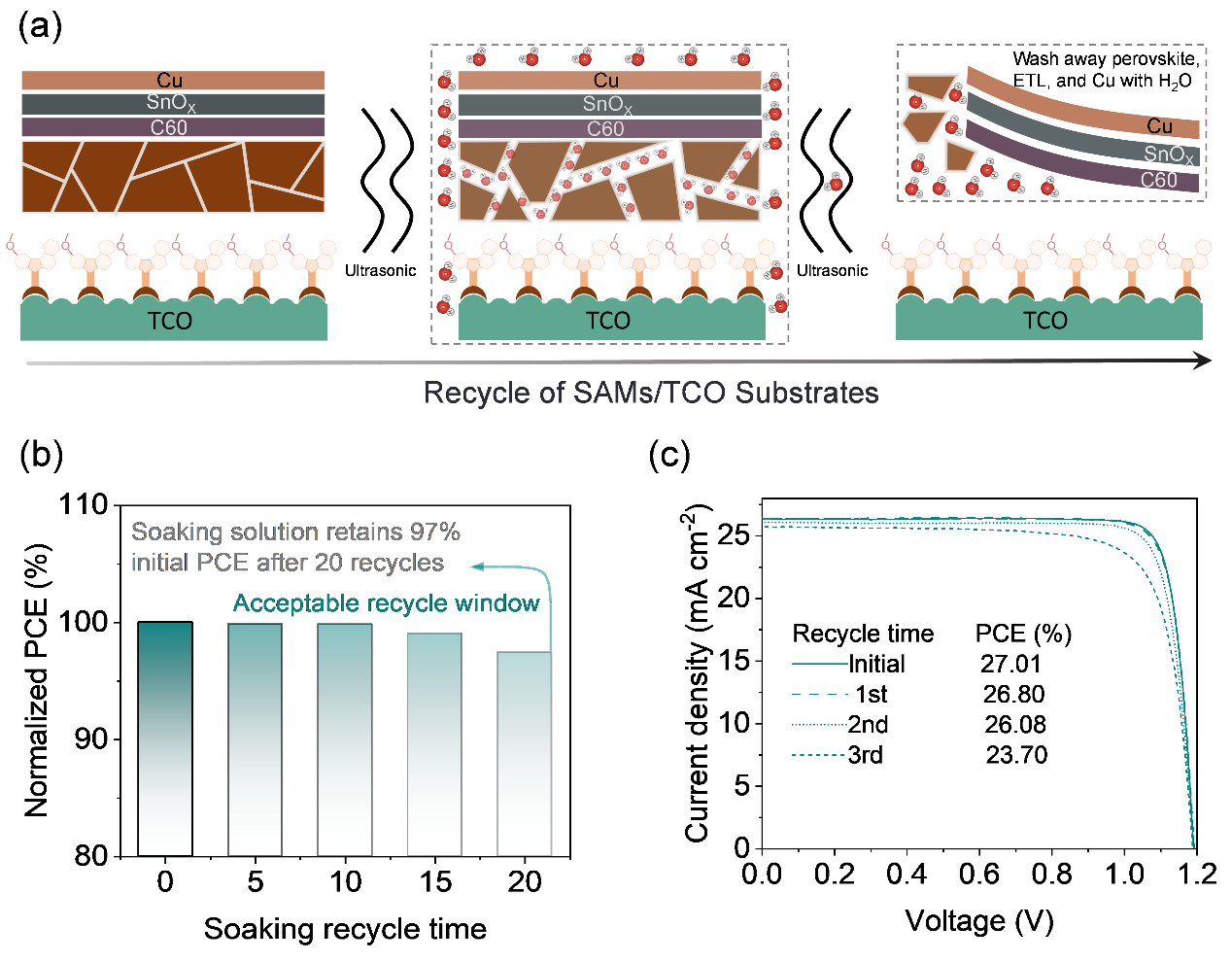
Figure 3. (a) Process flow for the recycling of PSC devices; (b) Relationship between the number of cycles for reusing SAM solution and the corresponding device PCE; (c) Relationship between the number of cycles for reusing TCO/SAM substrates and the corresponding device efficiency.
The related research results, entitled “A self-assembled monolayer via rapid and scalable soak-coating for perovskite solar cells,” have been published in Nature Synthesis.
The co-first authors of the paper are Dr. Geping QU, visiting scholar in Prof. Zongxiang XU’s group; Siyuan CAI, joint Ph.D. student between SUSTech and The University of Hong Kong; Letian ZHANG, M.S. student from SUSTech; and Dr. Yuli TAO from the University of Science and Technology of China. SUSTech is the first corresponding institution of the study. The co-corresponding authors include Dr. Ying QIAO, visiting scholar in Prof. Zongxiang XU’s group; Prof. Xu PAN from the Hefei Institutes of Physical Science, Chinese Academy of Sciences; Prof. Gao FENG from Linköping University, Sweden; Academician Alex Jen from City University of Hong Kong; and Prof. Zongxiang XU from SUSTech.
Paper link: https://www.nature.com/articles/s44160-026-01089-2
Proofread ByNoah Crockett, Junxi KE
Photo By