On March 27, 2026, Ke LIU, Dean of the School of Innovation and Entrepreneurship at Southern University of Science and Technology (SUSTech) and a foreign fellow of the Australian Academy of Technological Sciences &Engineering, hosted the SUSTech-TCL Innovation and Entrepreneurship Lectures, and gave a lecture titled “Energy Transition and Carbon Neutrality in the Age of Artificial Intelligence.” He systematically analyzed the current situation and China’s energy strategy choices, combining the global energy landscape, power demand in the AI era, and carbon neutrality pathways.
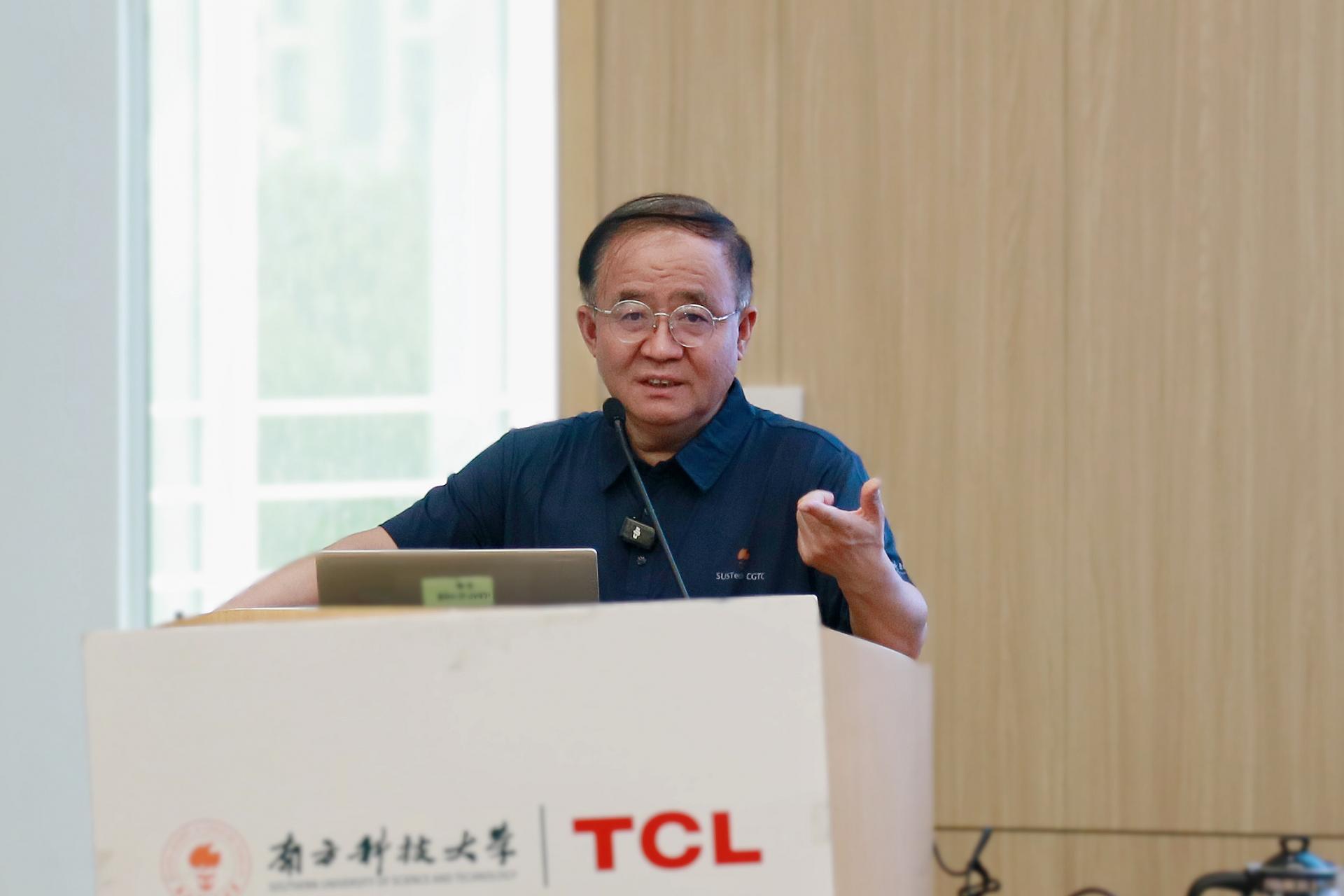
Dean of the School of Innovation and Entrepreneurship, Ke LIU
As a world-renowned energy expert, Ke LIU has held key positions in multinational companies such as ExxonMobil, UTC, and General Electric. After returning to China, he led a number of major scientific research projects at home and abroad, and made outstanding achievements in the fields of hydrogen energy, clean utilization of coal, and large-scale energy storage, and won many domestic and foreign science and technology awards and industry honors. In 2015, he was elected as a foreign fellow of the Australian Academy of Technological Sciences &Engineering, the only non-Australian scholar to be selected that year.
Ke LIU pointed out that the distribution and transportation channels of oil resources have a profound impact on global energy security. He stressed that as a populous country, China’s per capita share of oil resources is limited, and it is necessary to build a diversified, stable and sustainable energy system based on national conditions.
In the context of the rapid development of artificial intelligence, Ke LIU pointed out that the continuous improvement of computing power is inseparable from power support. The electricity consumption of data centers is growing rapidly, and electricity is becoming a key basic resource for AI development. In the process of achieving the carbon neutrality goal, the cost advantages of clean energy such as wind power and photovoltaic power are significant, but the instability of power generation is still the core factor restricting their large-scale application. Ke LIU said that energy storage technology has become a key link in the energy transition, in addition to battery energy storage, pumped hydro storage, hydrogen energy and liquid fuel energy storage and other technical routes have their own advantages, which need to be adapted to local conditions and coordinated development.
Talking about the development of China’s electric power, Ke LIU believes that China’s installed power capacity and power grid infrastructure have been continuously improved, providing a stable guarantee for the development of manufacturing and the application of artificial intelligence. With the continuous growth of electricity demand, issues such as grid expansion, grid connection efficiency, and clean energy consumption are still important research topics. There are huge development opportunities in the future field of power grid infrastructure construction and energy equipment.
Ke LIU further elaborated on the strategic significance of liquid energy, pointing out that liquid fuel has irreplaceable advantages in the field of transportation due to its high energy density and easy transportation and storage. He expounded the first principle of liquid fuel as an energy carrier in the history of the development of the automobile industry, analyzed the application scenarios and development boundaries of electric vehicles, and emphasized that various technical routes need to complement each other.
Combined with long-term research and industrial practice, Ke LIU pointed out that hydrogen as an energy carrier has challenges in terms of volumetric energy density, storage and transportation safety, and is difficult to become a popular energy carrier. In contrast, methanol, as a low-carbon liquid fuel, has the advantages of cleanliness, efficiency, and convenient storage and transportation, and is an important link between renewable energy conversion and storage. By converting wind energy and solar energy into methanol, it can not only achieve effective storage of green electricity, but also provide low-carbon fuel support for transportation, shipping, and low-altitude economy. He also introduced the application progress and industrialization achievements of the team in methanol hybrid, distributed energy supply and other technologies.
Based on the resource endowment of western China, Ke LIU proposed a technical route for preparing low-carbon methanol with “green electricity + inferior coal” and transporting it across regions through pipelines. The route can efficiently utilize the abundant wind, solar and coal resources in the western region to achieve long-distance and low-cost energy transmission. It will not only help alleviate the energy pressure in the east, but also achieve significant carbon emission reduction throughout the life cycle. He also shared the idea of high-value utilization and ecological improvement of coal through coal separation technology.
Finally, Ke LIU said in his summary that energy transition and carbon neutrality are long-term system projects that need to be based on national conditions and respect scientific laws. He hopes that young students and entrepreneurs can seize the opportunity of AI and energy integration, deepen technological innovation, help national energy security and green development with pragmatic solutions, and contribute wisdom and strength to the realization of sustainable development.
Proofread ByJunxi KE
Photo ByWenju LIU