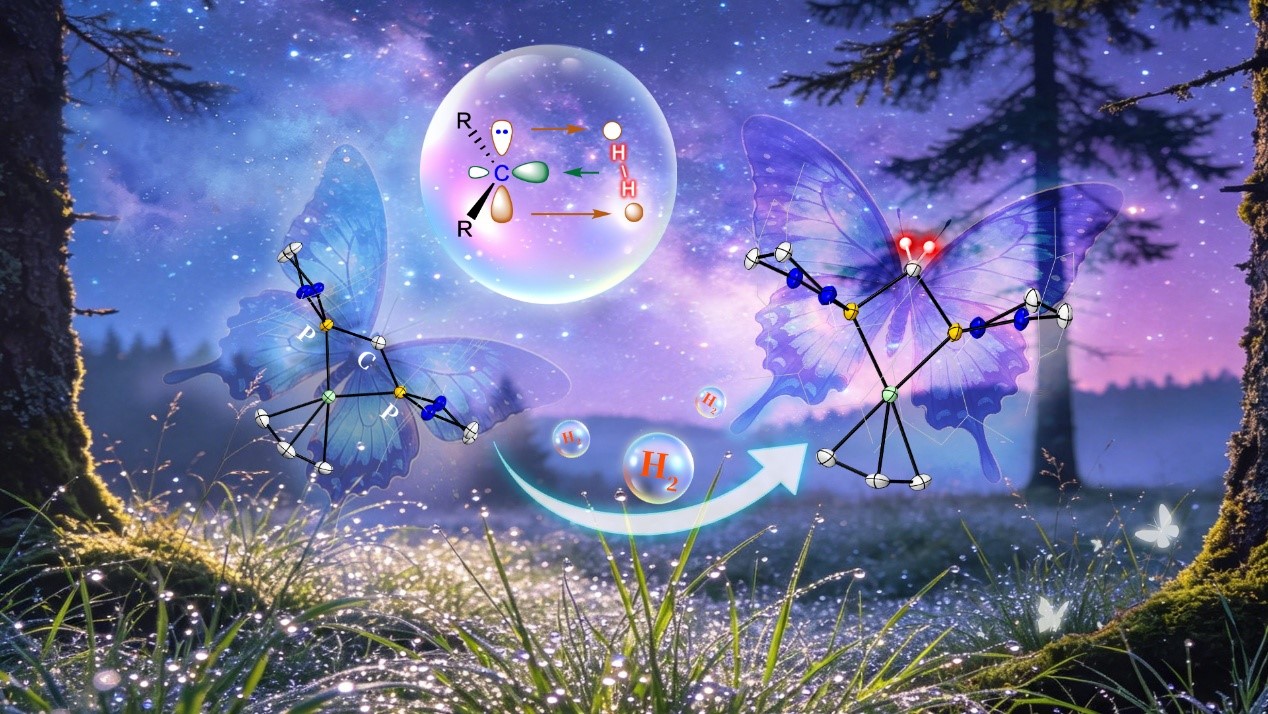
Liu Leo LIU’s team at Southern University of Science and Technology (SUSTech) has made a breakthrough in carbene chemistry, uncovering an unprecedented mechanism for carbene-mediated hydrogen activation. Their finding, titled “A Neutral σ0π2 Carbene Enabling Hydrogen Activation via a σ-Face Pathway,” was published in Nature Chemistry. By regulating the electronic structure of carbenes, the team achieved the stable synthesis of a neutral σ0π2 carbene and applied it to hydrogen activation, revealing a novel reaction path distinct from conventional paradigms. This research not only deepens our understanding of the electronic structure and reactivity of carbenes but also provides new insights for future developments in related fields.
Hydrogen activation is a key elementary reaction in synthetic chemistry and energy conversion, which has long relied primarily on transition metal systems (Fig. 1a). In contrast, research progress on hydrogen activation by singlet carbenes has remained extremely limited. Singlet carbenes typically exhibit a σ2π0 electronic structure, and due to orbital symmetry constraints, hydrogen activation can only proceed along a non-least-motion path, resulting in substantial structural/electronic reorganization and therefore a high activation barrier. To date, only one singlet carbene is capable of activating dihydrogen, and only at slightly elevated temperatures (Fig. 1b).
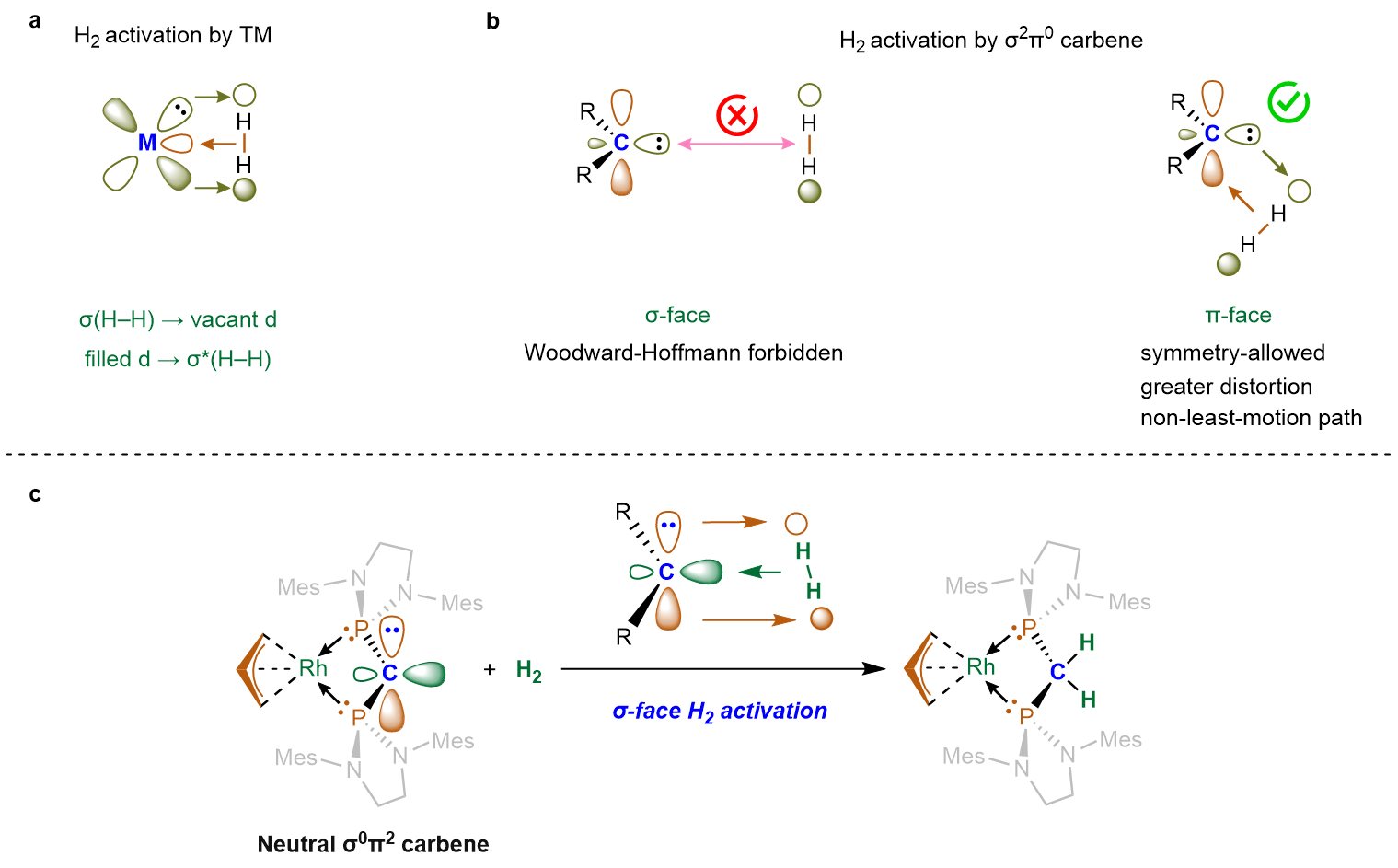
Figure 1. Conceptual overview, notable examples, and present work. a. TM-mediated H2 activation. b. Hydrogen activation at a σ2π0 carbene. c. Overview of this work.
In 2024, Liu Leo LIU’s group isolated a cationic σ0π2 metallodiphosphinocarbene, overcoming the electronic limitations of traditional carbene systems (Science 2024, 383, 81). Building on this, the team further extended σ0π2 carbene to neutral systems. Through precise control of the ligand environment, they realized the one-step synthesis of a neutral σ0π2 carbene (Fig. 1c). X-ray crystallography, two-dimensional deformation electron density mapping, and NMR spectroscopy consistently established its distinctive σ0π2 electronic configuration, with an empty in-plane σ orbital and a filled out-of-plane π orbital (Figs. 2a, 2c, and 2d).
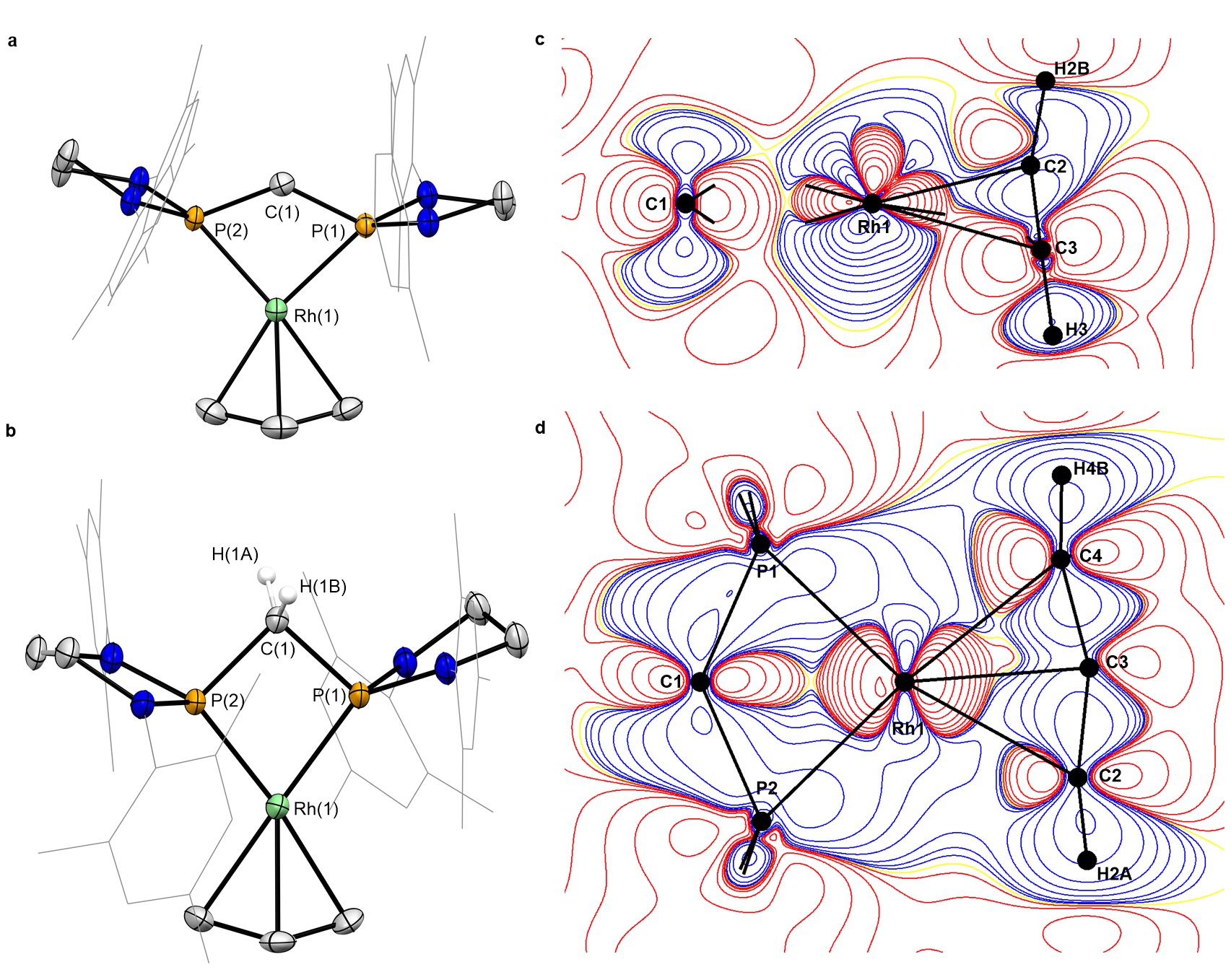
Figure 2. Single-crystal X-ray diffraction and experimental two-dimensional deformation density map. a. Solid-state structure of 2. b. Solid-state structure of 3a. c. Deformation density cross-section taken in a plane perpendicular to the CP2Rh plane. d. Deformation density map within the CP2Rh plane.
Treatment of a benzene solution of 2 with 1 atmosphere of H₂ at room temperature afforded compound 3a. NMR, HRMS, and X-ray diffraction analyses collectively confirmed that hydrogenation converts the carbene carbon center into a saturated carbon atom (Fig. 2b). Further isotopic labeling and kinetic studies were found to be in good agreement with the concerted but asynchronous σ-face activation pathway revealed by theoretical calculations.
To elucidate the intrinsic nature of this reaction, the team performed theoretical calculations to uncover the mechanism of hydrogen activation by this carbene. The results show that the reaction follows a σ-face activation pathway: hydrogen molecules approach laterally along the σ-face of the carbene, cleaving the H–H bond via a concerted but asynchronous process (Fig. 3a). Compared to the traditional π-plane path, this path has a lower activation barrier and smaller skeletal deformation, exhibiting an earlier transition state characteristic, and approximating a least-motion path. The root of this transformation lies in the unique Lewis ambiphilic property of the neutral σ0π2 carbene: on the one hand, the in-plane empty σ orbitals can accept electrons from the H–H bond; on the other hand, the out-of-plane π lone pair can donate electrons to the H–H σ* orbital, and the two work together to promote the activation of hydrogen (Fig. 3b).
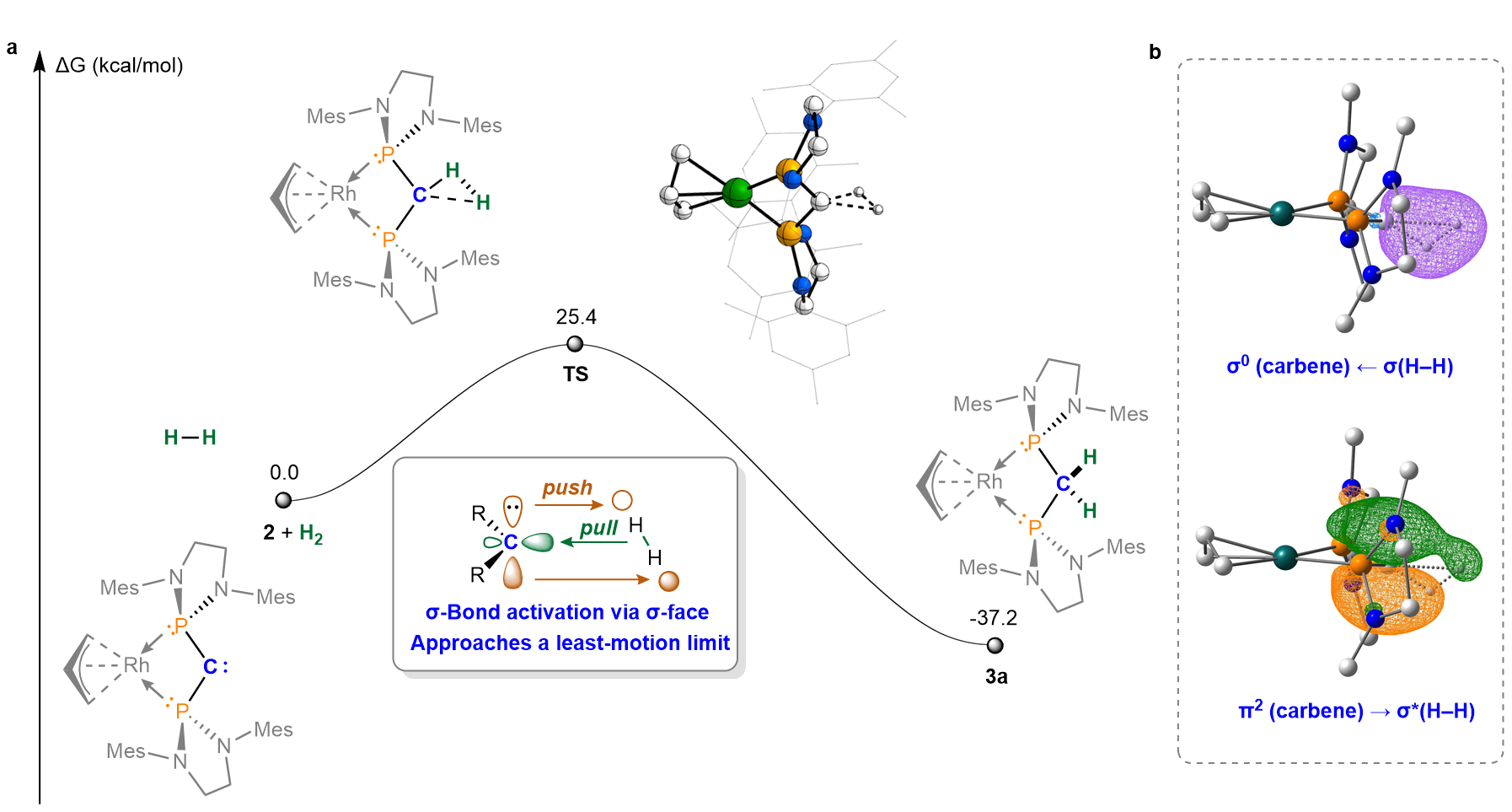
Figure 3. Theoretical analysis. a. Gibbs free energy profiles for H2 activation by 2. b. Natural localized molecular orbital (NLMO) analysis of TS.
This achievement breaks away from the classical reactivity paradigm of traditional singlet carbenes, demonstrating for the first time that a stable carbene can achieve small molecule activation via the σ-face pathway. It thus expands the boundaries of carbene chemistry and provides new insights into the development of ambiphilic main-group-element chemistry.
The co-first authors are postdoctoral researcher Fei FAN and Master’s student Haoxiang NONG. Liu Leo LIU is the corresponding author. Postdoctoral researcher Miaomiao ZHOU from the team also contributed to the research. SUSTech is the first affiliation of the paper. Research Assistant Professor Xiaoyong CHANG from the Department of Chemistry, and Assistant Professor Qiuming LIANG from the Great Bay University assisted in crystal analysis.
Article Link: https://www.nature.com/articles/s41557-026-02147-0
Proofread ByNoah Crockett, Junxi KE
Photo ByYan QIU