The research group led by Associate Professor Bing YANG from the Department of Physics at Southern University of Science and Technology (SUSTech), the State Key Laboratory of Quantum Functional Materials, and the Quantum Science Center of Guangdong-Hong Kong-Macao Greater Bay Area has made progress in experimental research on quantum tunneling and quantum entanglement of macroscopic matter. The related results were published under the title “Scalable generation of massive Schrödinger cat states via quantum tunneling” in the internationally recognized academic journal, Nature Physics.
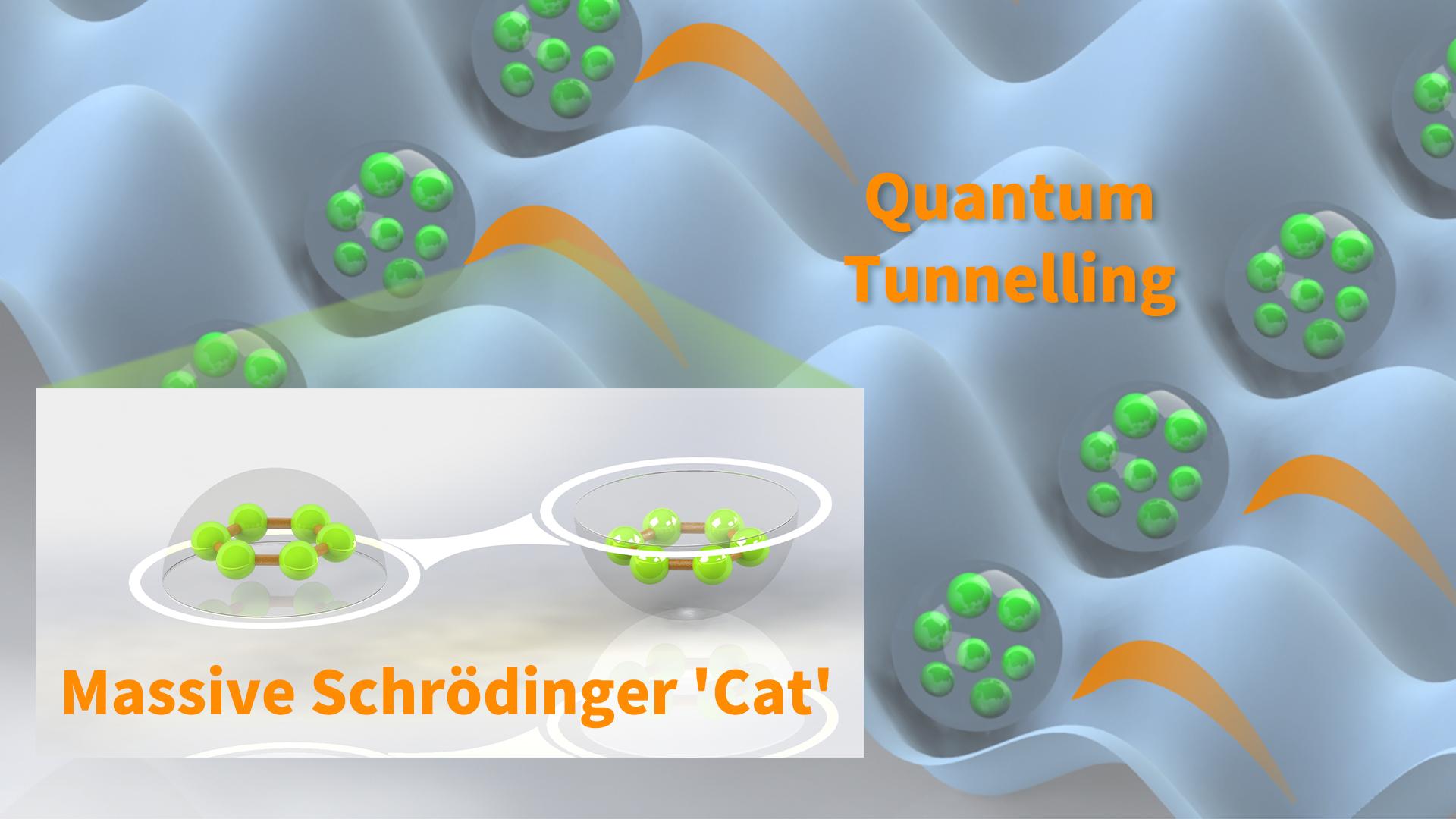
Quantum tunneling refers to the quantum phenomenon in which particles can pass through a potential barrier even when their kinetic energy is lower than the height of the barrier. Since Friedrich Hund proposed this concept based on the Schrödinger equation in 1927, quantum tunneling has been widely applied in fields such as solid-state physics and scanning tunneling microscopy, and related research has repeatedly received the Nobel Prize in Physics (such as in 1973, 1986, 2025, etc.). However, the quantum tunneling effect decays exponentially with the mass of the particle, making its realization in large-mass objects a long-standing challenge.
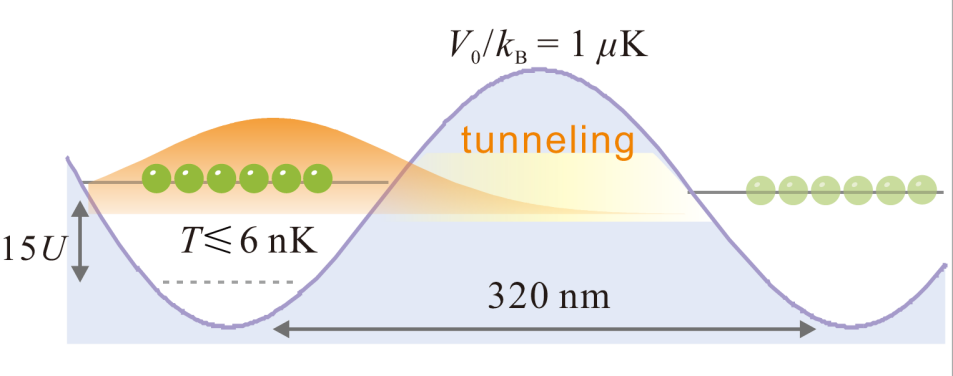
Figure 1: Schematic diagram of quantum tunneling of ultracold atomic clusters.
For an electron with a kinetic energy of 1 eV, the probability of tunneling through a barrier with a height of 2 eV and a width of 0.1 nm is about 0.36; whereas for a proton with a mass approximately 1836 times that of an electron, the tunneling probability under the same conditions is only about 10⁻¹9, showing a significant mass suppression effect. This exponential decay rule makes quantum tunneling of macroscopic mass objects almost unobservable.
In this study, the team precisely controlled the interactions between ultracold atoms to construct a bound atomic cluster system, overcoming the traditional exponential suppression mechanism and achieving approximate mass independence of tunneling strength. In the experiment, atomic clusters with a mass of 608 atomic mass units (approximately equivalent to a million electron masses) were observed to undergo quantum tunneling, providing a new path for exploring quantum effects at larger mass scales.
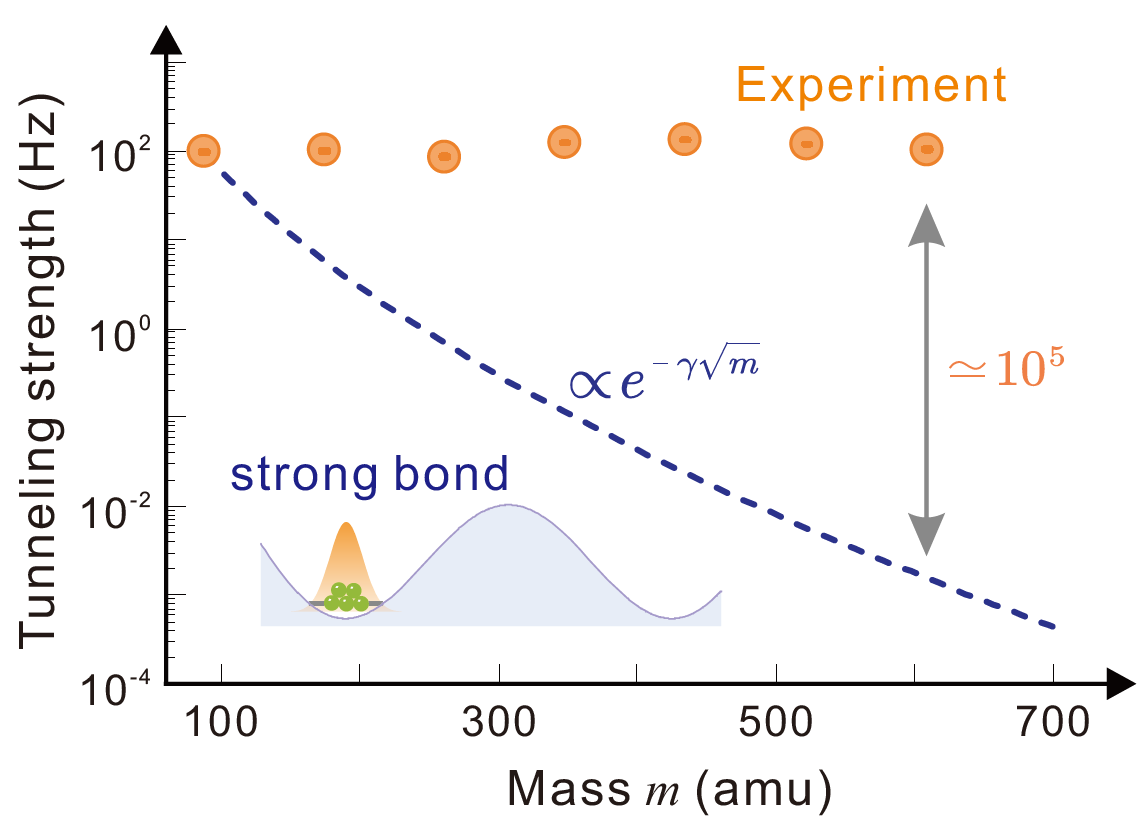
Figure 2: The variation of quantum tunneling intensity with mass. At 608 AMU, the observed value is five orders of magnitude higher than the intensity predicted by exponential decay.
Furthermore, the team used the quantum tunneling process to construct spatially entangled states (Schrödinger cat states), achieving quantum superposition of spatial distributions. Such entangled states are highly sensitive to spatially correlated physical quantities and can be used for quantum-enhanced precision measurements. The NOON states (|N,0⟩ |0,N⟩) constructed in the experiment exhibit phase sensitivity that increases with the number of particles N. Based on Fisher information analysis, a single cluster achieved a maximum quantum enhancement of 3.4(2) dB. By measuring approximately 250 clusters in parallel, high-precision detection of energy differences on the submicron scale of about 1.4(1) Hz was achieved.
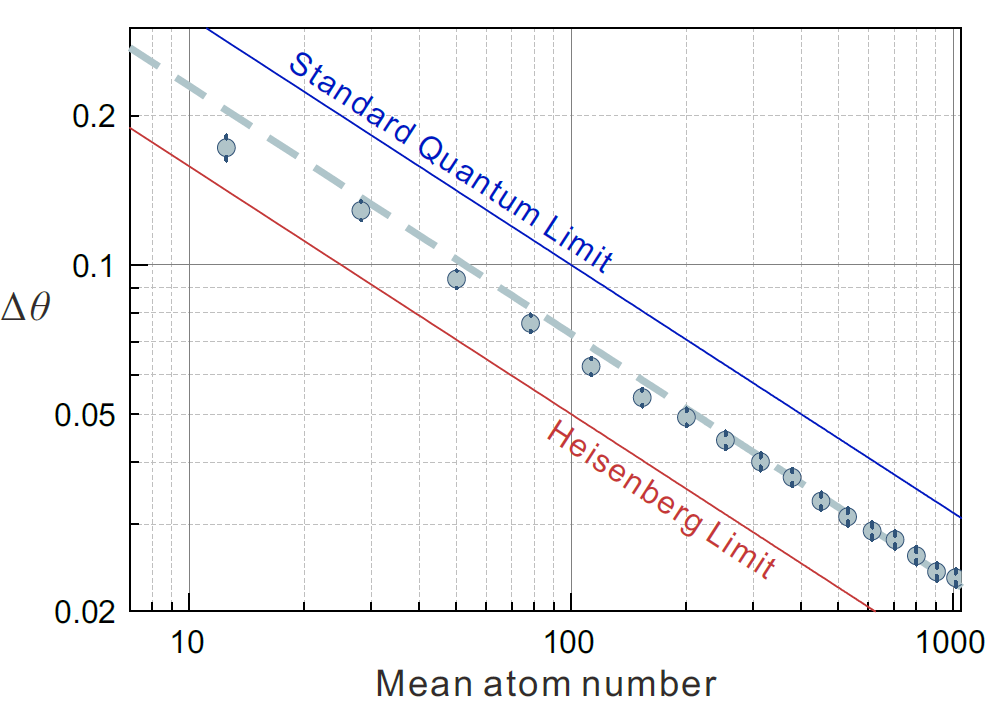
Figure 3: Precision measurement beyond the standard quantum limit using quantum entangled states.
Compared with traditional single-atom interferometry schemes, the spatial entanglement of large-mass clusters provides a new experimental platform for probing mass-sensitive and spatially correlated physical effects (such as gravitational fields), and also offers an important means for studying the intersection of quantum mechanics and gravity.
Postdoctoral researcher Han ZHANG, PhD students Yongkui WANG and Yi ZHENG are co-first authors of the paper. Bing YANG is the sole corresponding author. SUSTech is the first affiliated institution.
Article link: https://www.nature.com/articles/s41567-026-03281-9
Proofread ByNoah Crockett, Junxi KE
Photo By