Associate Professor Zhen GAO’s team from the Department of Electronic and Electrical Engineering at Southern University of Science and Technology (SUSTech) experimentally realized the three-dimensional photonic quantum Hall effect of Fermi arcs for the first time in a three-dimensional inhomogeneous magnetic Weyl photonic crystal with broken time-reversal symmetry, and directly observed its typical feature, one-sided chiral hinge states. The related results were published in National Science Review under the title “Three-dimensional photonic quantum Hall effect of Fermi arcs.”
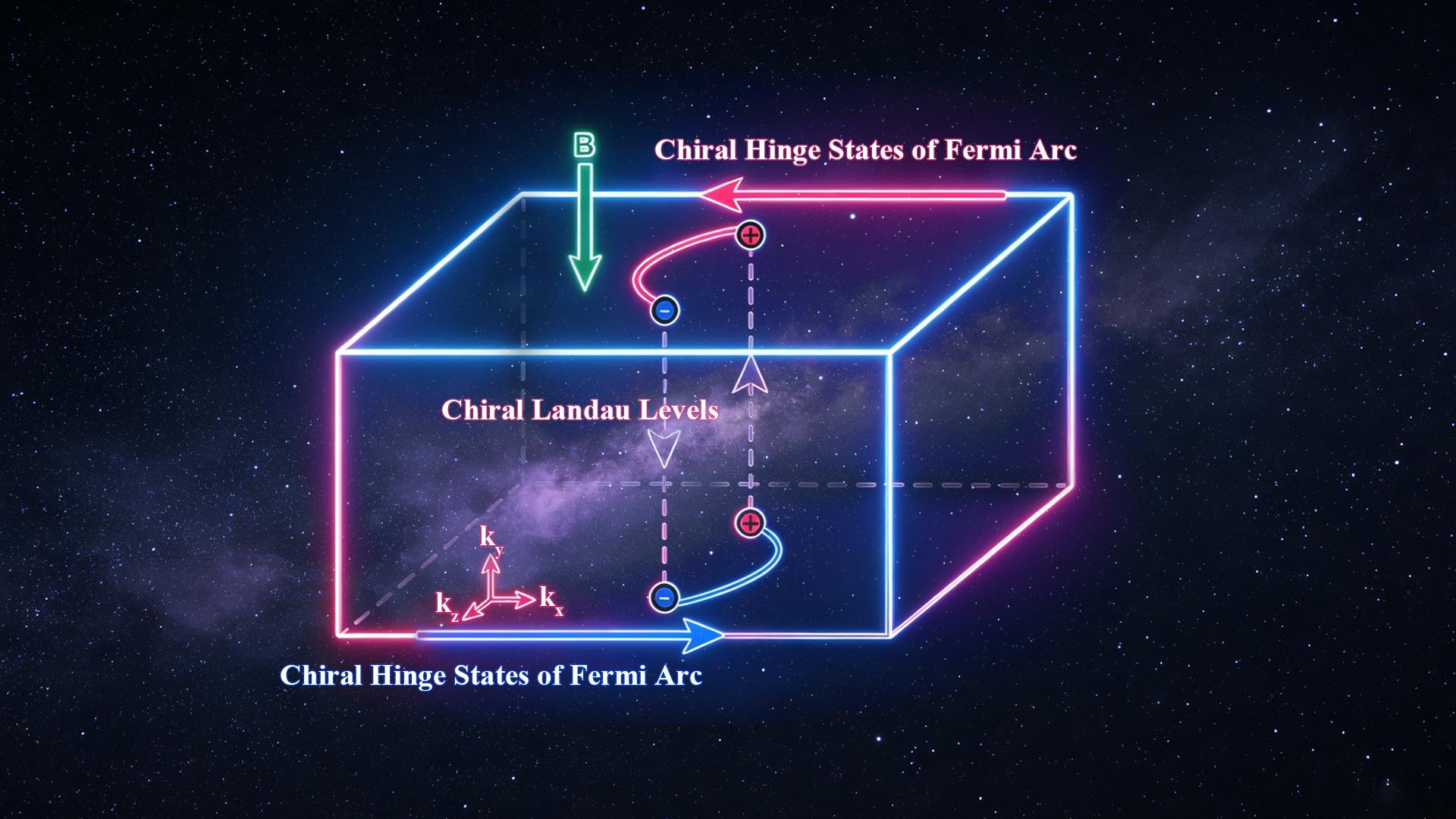
Since the discovery of the two-dimensional quantum Hall effect in 1980, exploring its extension to higher dimensions has been a frontier topic in condensed matter physics. In recent years, scientists have predicted that in topological semimetals, a closed loop formed by a pair of Fermi arcs on opposite surfaces can, under a magnetic field, give rise to a unique three-dimensional quantum Hall effect of Fermi arc. The most striking feature of this effect is the one-sided chiral hinge states that propagate unidirectionally and robustly along the diagonal hinges. However, this novel higher-order topological state has never been directly observed in any physical system.
To address this challenge, the research team led by Associate Professor Zhen GAO at SUSTech employed a time-reversal-symmetry-broken inhomogeneous three-dimensional magnetic Weyl photonic crystal. By introducing an effective pseudo‑magnetic field through structural gradient engineering to create chiral Landau levels, they experimentally observed for the first time the three-dimensional photonic quantum Hall effect of Fermi arcs and their associated one-sided chiral hinge states. Their results show that these robust chiral hinge states exhibit unidirectional transmission and backscattering immunity, and can be switched between two pairs of hinges by tuning the pseudo‑magnetic field or the operating frequency. This work not only provides new experimental evidence for the three-dimensional quantum Hall effect of Fermi arcs but also offers a novel physical mechanism for robust optical information transport in three-dimensional space. It holds potential applications in robust three-dimensional topological photonic devices such as isolators and unidirectional waveguides.
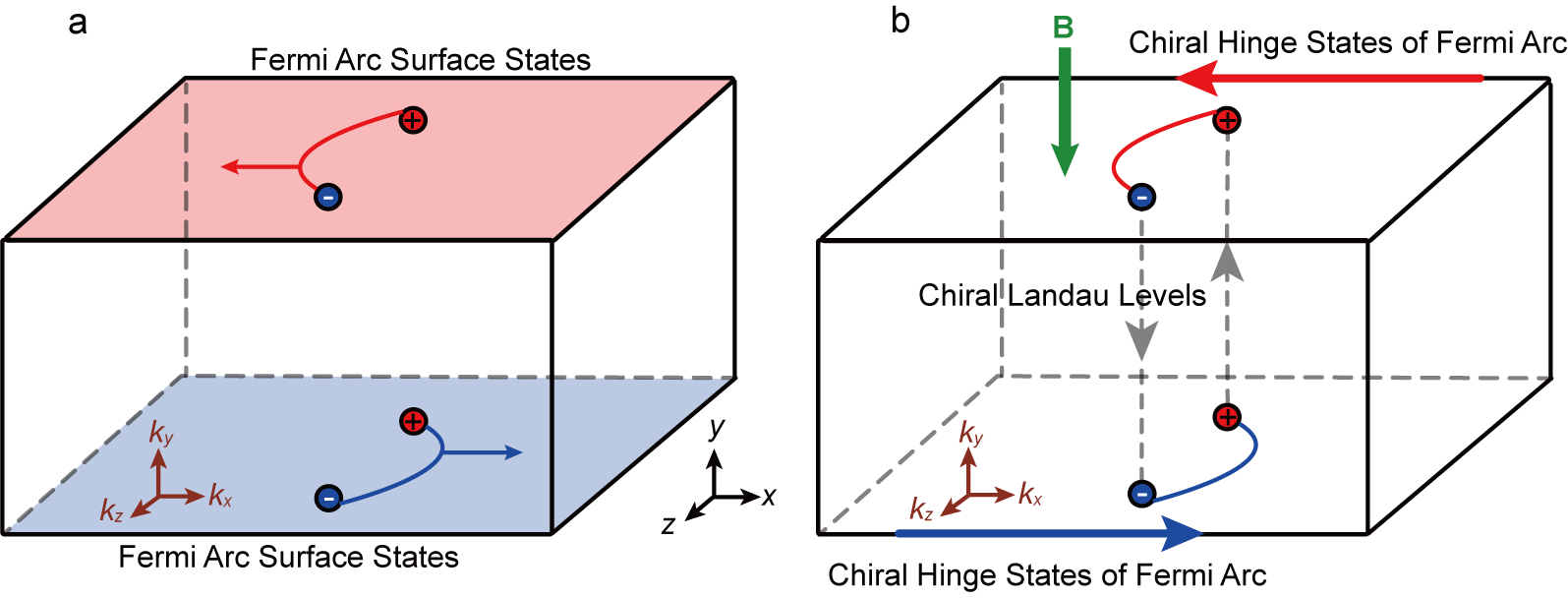
Figure 1. 3D QHE of Fermi arcs in Weyl semimetals. (a) Fermi-arc surface states of a Weyl semimetal. Weyl points of opposite charge (red and blue dots) are connected by surface Fermi arcs (red and blue arcs) on opposite surfaces. Arrows indicate the propagation direction of chiral Fermi-arc surface states. (b) Under a magnetic field (or pseudo‑magnetic field) B (green arrow), both the bulk states and the closed Fermi loop formed by two surface Fermi arcs give rise to chiral Landau levels (gray dashed lines with arrows) and one-sided chiral hinge states at the two diagonal hinges (red and blue arrows), which are the hallmarks of the three-dimensional quantum Hall effect of Fermi arcs.
The research team started from a three-dimensional Haldane model. By spatially and non-uniformly tuning the intralayer coupling strength ratio (Figure 2), the Weyl points were uniformly shifted along a specific direction in momentum space (kx), effectively generating an in-plane pseudo‑magnetic field. This pseudo‑magnetic field quantizes both bulk states and surface Fermi arcs into Landau levels, and in a finite‑size sample, gives rise to one-sided chiral hinge states localized on the front surface and the diagonally opposite hinge on the back surface.
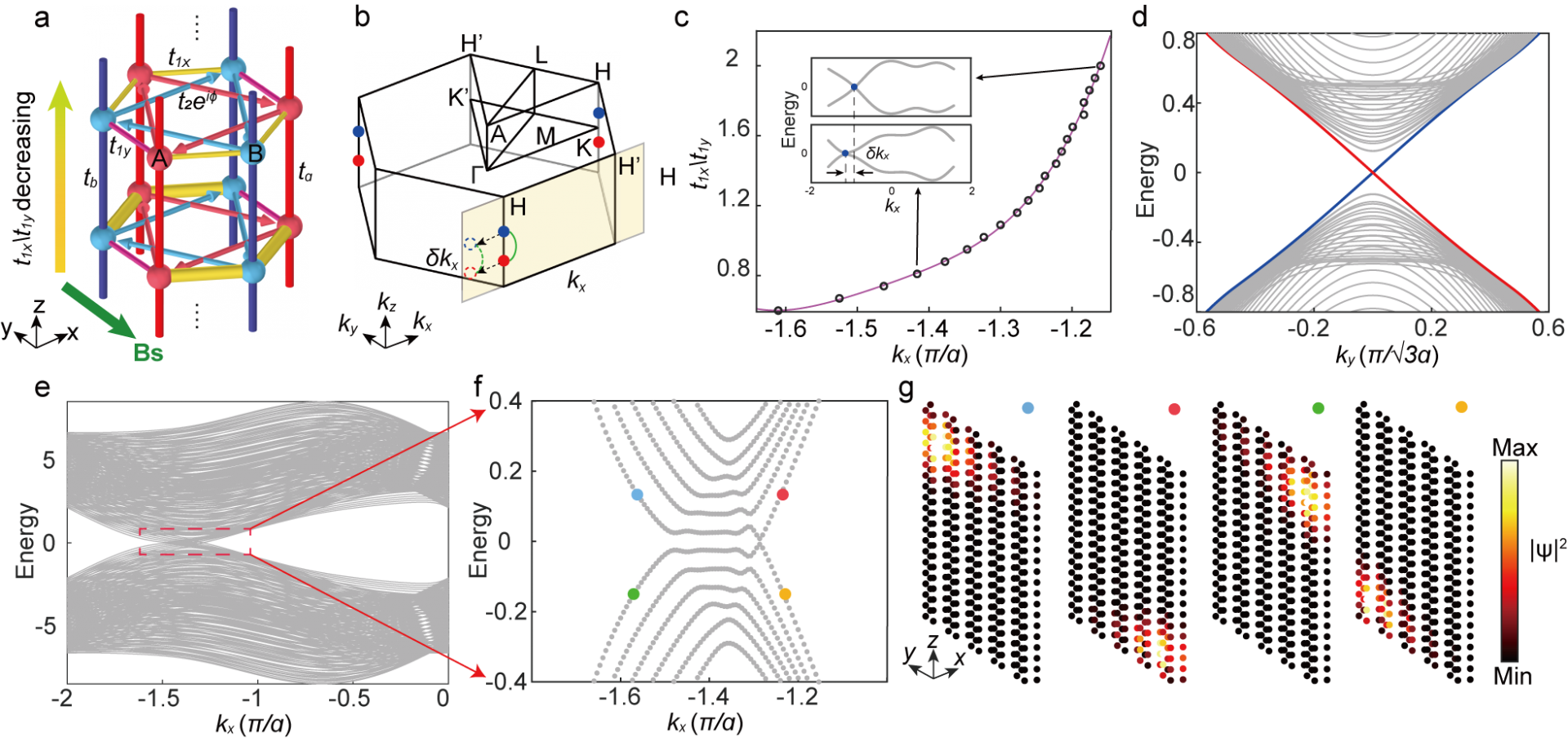
Figure 2. Inhomogeneous 3D Haldane model with PMF. (a) Schematic of the inhomogeneous 3D Haldane model. (b) Schematic of the 3D bulk Brillouin zone and the (010) surface Brillouin zone. Red and blue dots indicate Weyl points with opposite topological charges. Black dashed arrows indicate the shift of Weyl points along the –kx direction to generate the pseudo‑magnetic field. (c) Simulated (black circles) and fitted (purple line) curves showing the relationship between the nearest‑neighbor coupling ratio (t1x/t1y) and the shift of the Weyl point along –kx. (d) Chiral zeroth Landau levels corresponding to two Weyl points of opposite topological charge. (e) Projected band structure along kx for a finite inhomogeneous 3D Haldane model with open boundary conditions in both y and z directions. (f) Enlarged projected band structure of the Landau levels (gray dashed lines). (g) Calculated eigenenergy distribution of the Fermi‑arc one‑sided chiral hinge states at two different energies corresponding to the two colored points in panel (f).
For experimental implementation, the team constructed an inhomogeneous magnetic Weyl photonic crystal (Figure 3). The crystal consists of a square lattice of yttrium‑iron‑garnet (YIG) rods sandwiched between permanent magnets that provide a constant magnetic field, breaking time‑reversal symmetry. By varying the aspect ratio of the cross‑section of the YIG rods layer by layer, the intralayer coupling in each layer was precisely controlled, yielding the designed pseudo‑magnetic field. Bulk dispersion measurements in the microwave regime clearly revealed chiral Landau levels with opposite group velocities (Figure 3h).
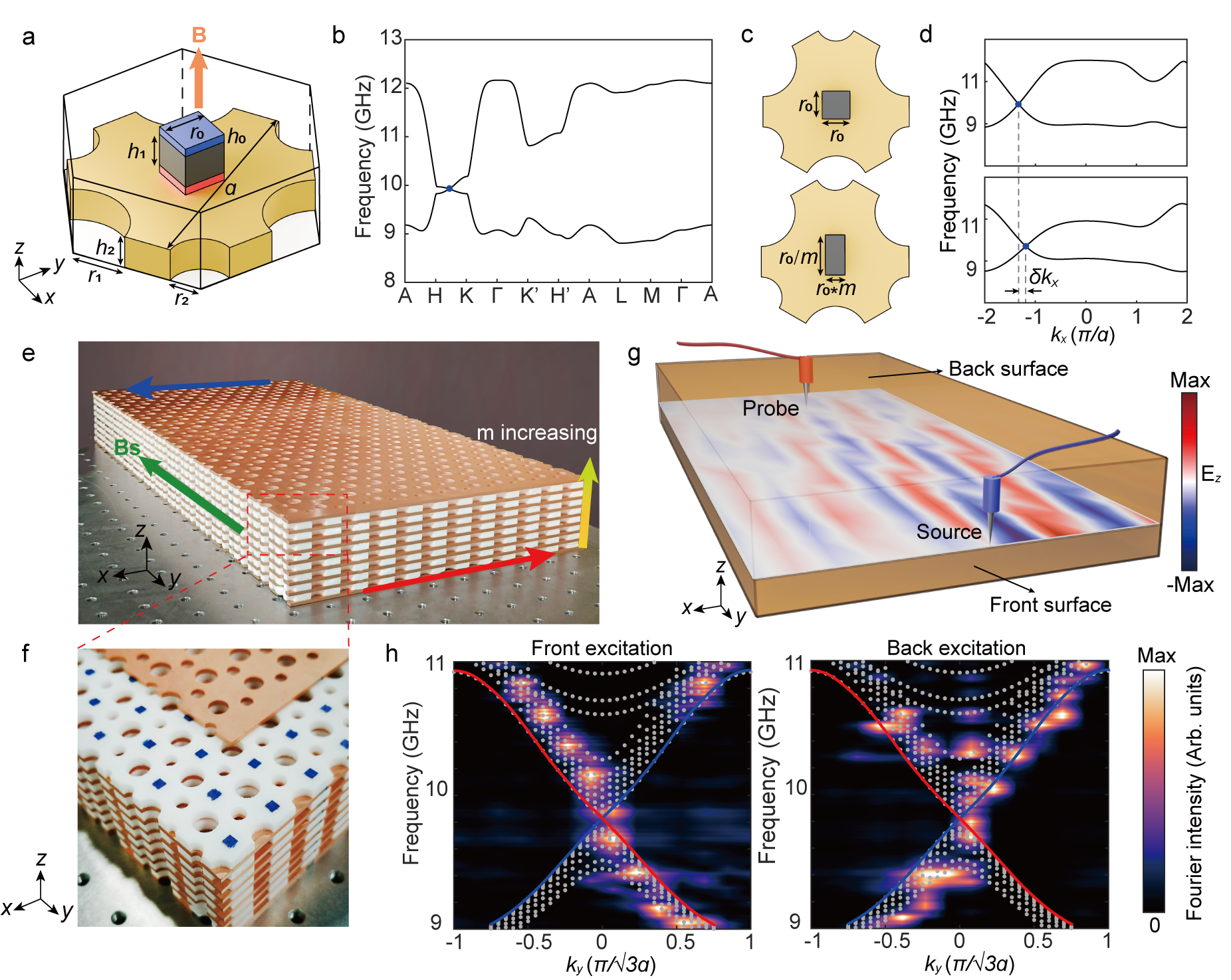
Figure 3. Photonic realization of 3D QHE of Fermi arcs in an inhomogeneous magnetic Weyl photonic crystal. (a) Unit cell of the 3D gyromagnetic photonic crystal, consisting of a square YIG rod (dark gray) sandwiched between two permanent magnets (blue and red, providing a magnetic field B = 110 mT)placed on metal plates (yellow). (b) Simulated bulk band structure of the 3D gyromagnetic photonic crystal showing a pair of Weyl points (blue dots at 9.9 GHz). (c),(d) Layer‑dependent unit cell (length = r0/m, width = r0 × m, m < 1) and the corresponding bulk band dispersions along kx. (e) Photograph of the fabricated experimental sample. (f) Close‑up view of the sample. The first copper plate has been removed to reveal the internal structure. (g) Schematic of the experimental setup. A pair of source and probe antennas (red and blue) inserted into the sample are used to measure the electric field distribution of bulk states. (h) Measured (color map) and simulated (blue and red lines) chiral zeroth Landau levels along ky for front‑surface excitation (left panel) and back‑surface excitation (right panel).
More importantly, the team directly observed the one‑sided chiral hinge states for the first time (Figure 4). Measured field distributions show that at a frequency of about 9.88 GHz, the hinge state is strictly confined to one hinge and propagates unidirectionally, and the hinge states on the front and back surfaces are located on diagonally opposite hinges (Figures 4b, e). By reversing the direction of the pseudo‑magnetic field, the hinge states can be switched to the other diagonal pair of hinges. Even when a metallic obstacle is inserted into the propagation path, the hinge state smoothly bypasses it without backscattering. The high contrast between left‑going and right‑going transmission signals (Figure 4i) fully verifies the topological protection and strong robustness of the unidirectional states.
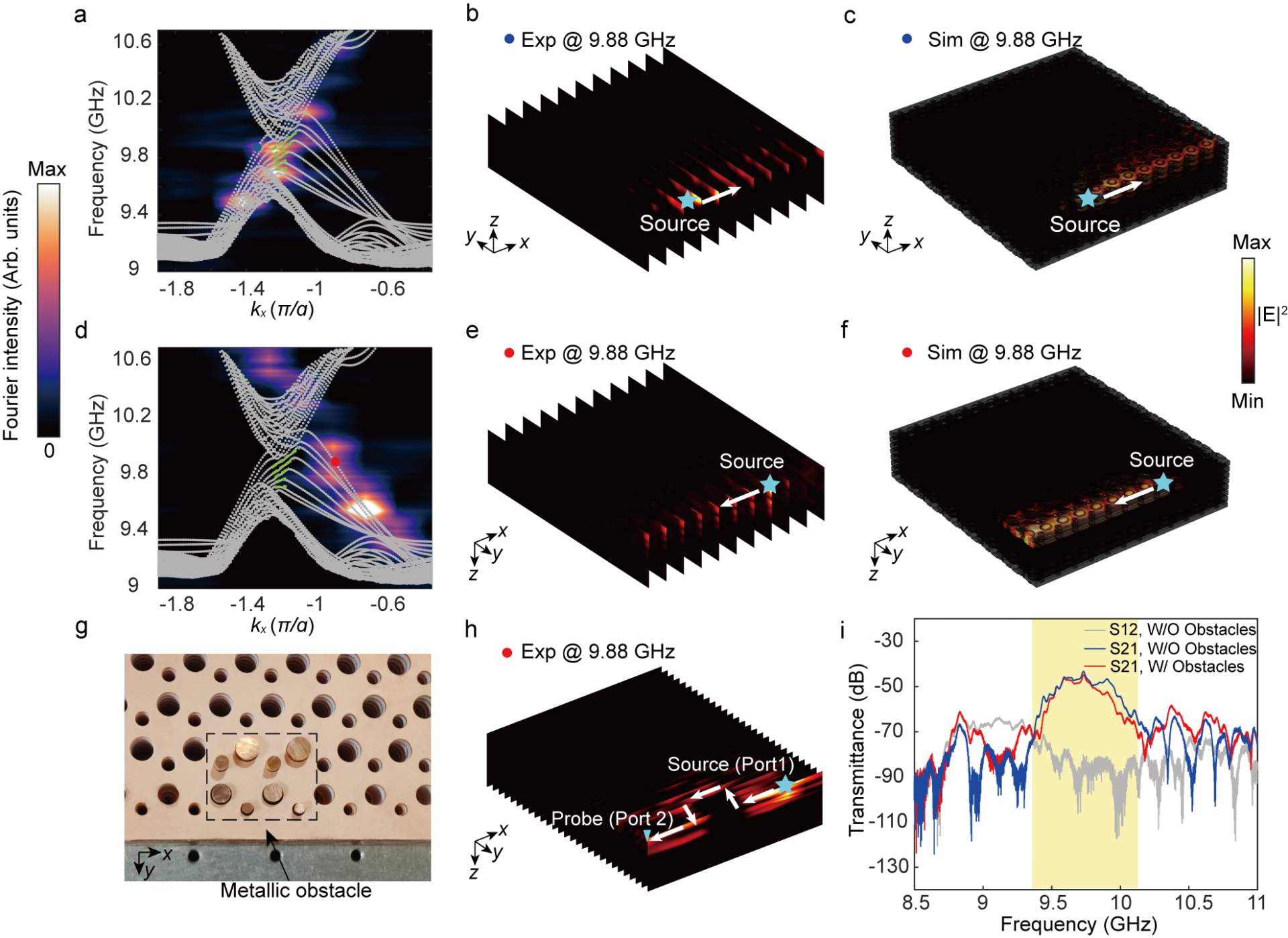
Figure 4. Observation of one-sided chiral hinge states of Fermi arcs. (a) Measured (color map) and simulated (gray dashed lines) band dispersion of the one‑sided chiral hinge states of Fermi arcs in the 3D inhomogeneous magnetic Weyl photonic crystal along kx. (b),(c) Measured (b) and simulated (c) electric field distributions at 9.88 GHz for the Fermi‑arc chiral hinge state corresponding to kx = -1.32π/a (blue point in (a)). The cyan star indicates the point source. (d‑f) Same as (a‑c) but for the chiral hinge state at the diagonal hinge at kx = -0.93π/a 9.88 GHz, kx = -0.93π/a (red point in (d)) at 9.88 GHz. (g) Photograph of a copper rod inserted into the sample as a metallic obstacle (black dashed square). (h) Measured electric field distribution of the Fermi‑arc chiral hinge state bypassing the metallic obstacle. (i) Measured transmission spectra for right‑going (gray line, S12) and left‑going (blue line, S21) without obstacle, and for left‑going (red line, S21) with the metallic obstacle
The research team has experimentally realized for the first time the three‑dimensional photonic quantum Hall effect of Fermi arcs in an inhomogeneous magnetic Weyl photonic crystal, and directly observed the chiral Landau levels and one‑sided chiral hinge states of Fermi arcs. This work not only establishes an ideal platform for exploring three‑dimensional quantum Hall physics but also opens new avenues for designing robust photonic devices. Looking ahead, other quantum Hall analogs (such as the three‑dimensional quantum anomalous Hall effect in Weyl semimetals and the four‑dimensional quantum Hall effect) could also be realized in three‑dimensional gyromagnetic photonic crystals.
SUSTech is the first affiliation of this paper. Zhen GAO is the only corresponding author. Zhengting WU and Minqi CHENG, master’s students at SUSTech, are the co-first authors. In addition, Ziyao WANG and Jingming CHEN (Ph.D. students at SUSTech), Siqi XU (undergraduate student at SUSTech, now a Ph.D. student at MIT), Yan MENG (visiting scholar), Dr. Xiang XI from Dongguan University of Technology, Xiankai SUN (professor at The Chinese University of Hong Kong), and Perry Ping SHUM and Haizhou LU (Chair Professors at SUSTech) made significant contributions to this work.
Article Link: https://academic.oup.com/nsr/advance-article/doi/10.1093/nsr/nwag251/8665134
Proofread ByNoah Crockett, Junxi KE
Photo ByYan QIU