The team led by Assistant Professor Jin-Long WANG from the Department of Materials Science and Engineering at the Southern University of Science and Technology (SUSTech), together with collaborators, has made a series of research advances in the field of multi-band spectrally tunable electrochromic smart windows. The related findings have been published in the international journals Watt and Nano Research.
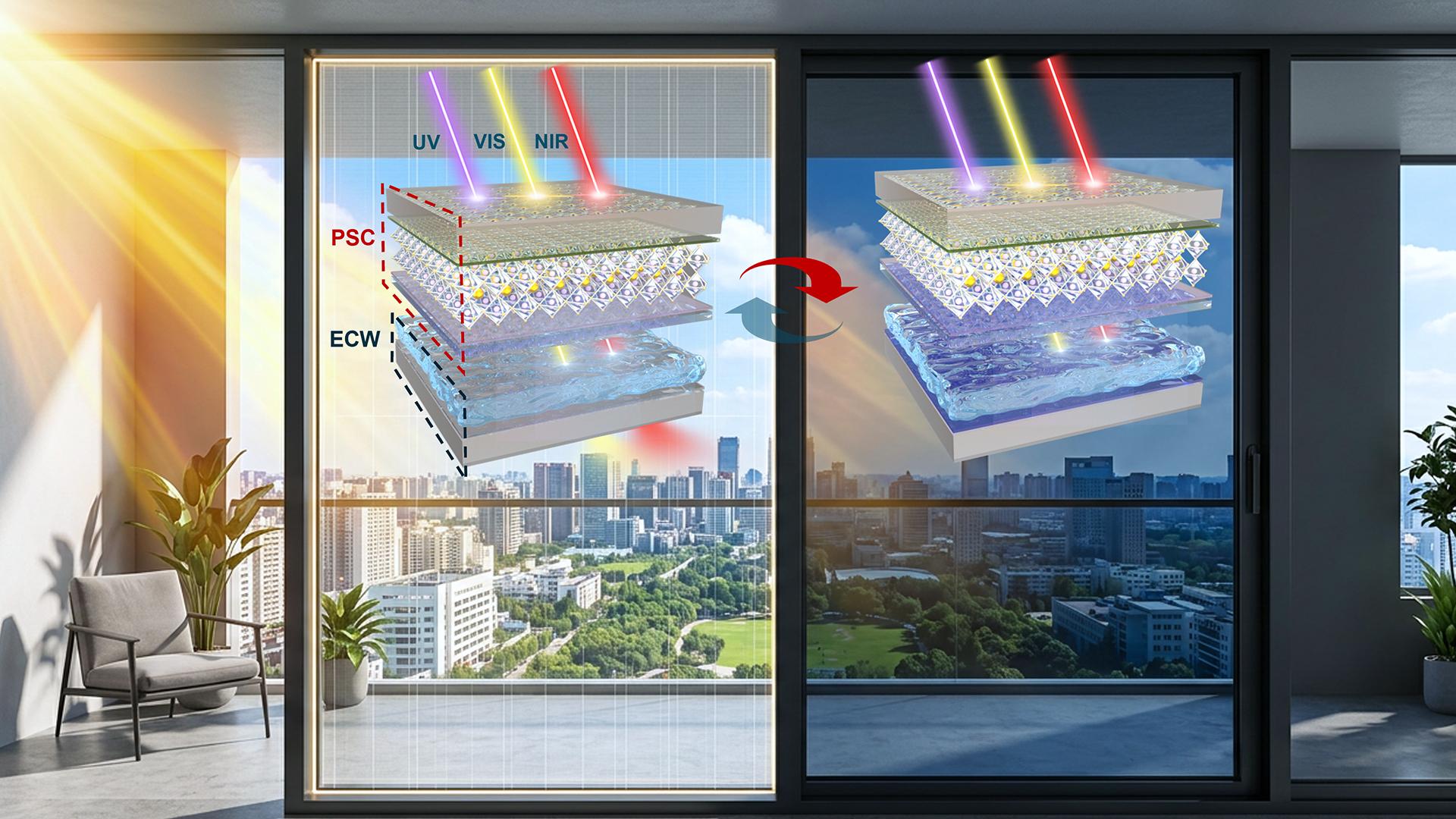
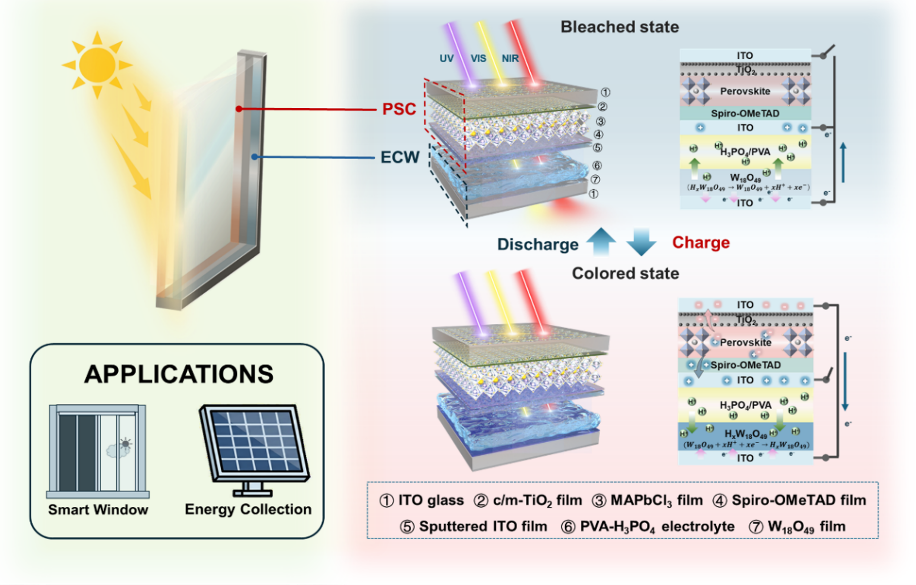
Figure 1. Schematic diagram of the structure and modulation mechanism of PSC-ECW.
Since the operation of traditional electrochromic smart windows still relies on an external power supply, the additional power consumption generated by this energy-for-energy mode seriously affects their actual net energy-saving benefits. The research team adopted a “shared transparent ITO electrode” strategy, seamlessly coupling a transparent wide-bandgap perovskite (MAPbCl3) solar cell with an electrochromic (W18O49) device to successfully construct a self-powered electrochromic smart window that combines high initial transmittance with accurate tri-band solar spectrum modulation capabilities. In the device, the wide-bandgap perovskite solar cell is responsible for absorbing ultraviolet light and generating photovoltage and photocurrent to drive the W18O49 electrochromic layer, achieving a reversible transition between transparent and colored states.
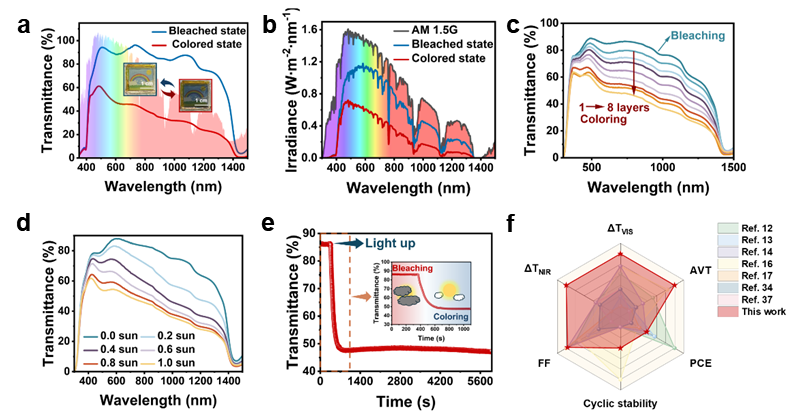
Figure 2. Optical performance and adaptive regulation capability of the PSC-ECW.
As shown in Figure 2, the prepared device features a highly transparent appearance, self-powered modulation, and environment-adaptive photothermal management capabilities. Under low irradiation or in cold environments, the device maintains a high transmittance of 86.8%, ensuring natural indoor daylighting; under strong solar irradiation, it effectively reduces solar radiation transmittance by absorbing ultraviolet light to generate electricity and self-drive electrochromism. As external irradiation intensity and climate conditions change, the smart window can autonomously match and switch to the appropriate optical state, achieving on-demand dynamic photothermal management. The device exhibits excellent multi-band spectral modulation capabilities, with a visible light modulation amplitude of 43% at 640 nm and a near-infrared modulation amplitude of 57% at 1100 nm, balancing daylighting control and thermal insulation needs.
The system features adaptive characteristics, with its output voltage dynamically adjusting according to the incident light intensity (0.2 to 1 sun), driving the optical modulation rate to achieve a step-wise increase from 3.8% to 34.9%, thus realizing automatic optical management under different lighting conditions. Although the response time (coloration 68 s, bleaching 36 s) is slightly slower than that of independent devices due to internal impedance limitations, it remains within the acceptable range for practical applications and does not affect its functional realization. Its performance under actual meteorological conditions is highly practical. It maintains a high transmittance of 86% on cloudy days, while on sunny days, it spontaneously switches to a 47% shielding state, and the voltage remains above the working threshold during long-term operation, fully proving its reliability as an all-weather smart window.
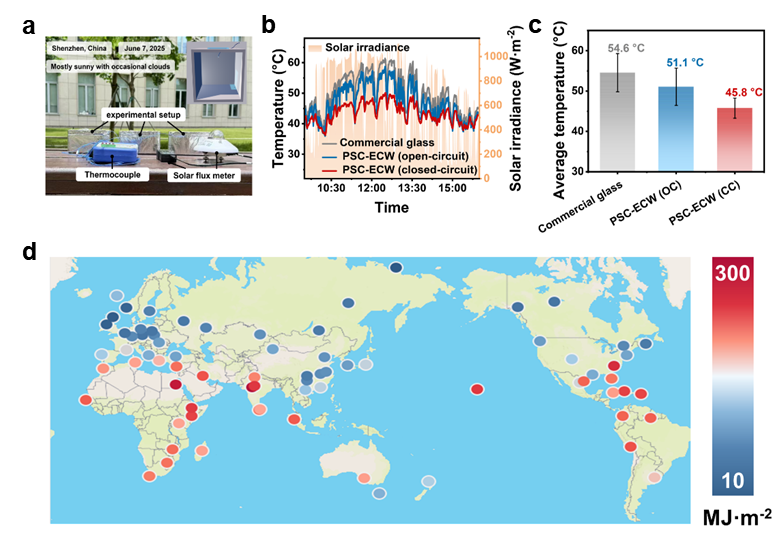
Figure 3. Outdoor testing and energy-saving simulation of the PSC-ECW.
Outdoor practical tests further verified that when the sunlight is weak in the morning, the device maintains the bleached state. At noon, as the irradiation strengthens, it automatically switches to the colored state to block visible and near-infrared light, achieving a maximum temperature drop of 11.9 °C, and then returns to transparency as the light intensity weakens. Statistical analysis shows that during the main working hours, the average indoor temperature is reduced by 3.5 °C (open circuit) and 8.8 °C (closed circuit), respectively, compared with commercial glass. Simulation results of a full-scale building model show that in a typical high-energy-consumption city like Shenzhen, this smart window can achieve an energy-saving effect of 145.9 MJ m-2 per year compared with commercial glass (equivalent to an annual reduction of 40.4 kg of CO2 emissions per square meter). Thanks to its excellent light transmittance, the minimal increase in heating demand in winter has a negligible impact on overall energy consumption. Based on evaluations of six representative cities globally, the annual energy-saving rate of PSC-ECW exceeds 30% in tropical regions and is also above 10% in temperate regions. Therefore, this smart window can effectively reduce indoor thermal loads and possesses excellent cooling performance, significant net energy-saving value, and broad climate applicability, providing a reliable technological solution for green building energy conservation and carbon reduction.
This research achievement has been published online in the international journal Watt under the title “A perovskite solar cell-powered smart window with high initial transparency for tri-band solar spectrum management.” Xue-Feng HUANG, a Class of 2023 Master’s student, and Meng-Han ZHU, a Class of 2022 PhD student from the Department of Materials Science and Engineering at SUSTech, are the co-first authors of the paper. Chair Professor Shu-Hong YU and Assistant Professor Jin-Long WANG are the co-corresponding authors of the paper, with SUSTech serving as the first and corresponding institution.
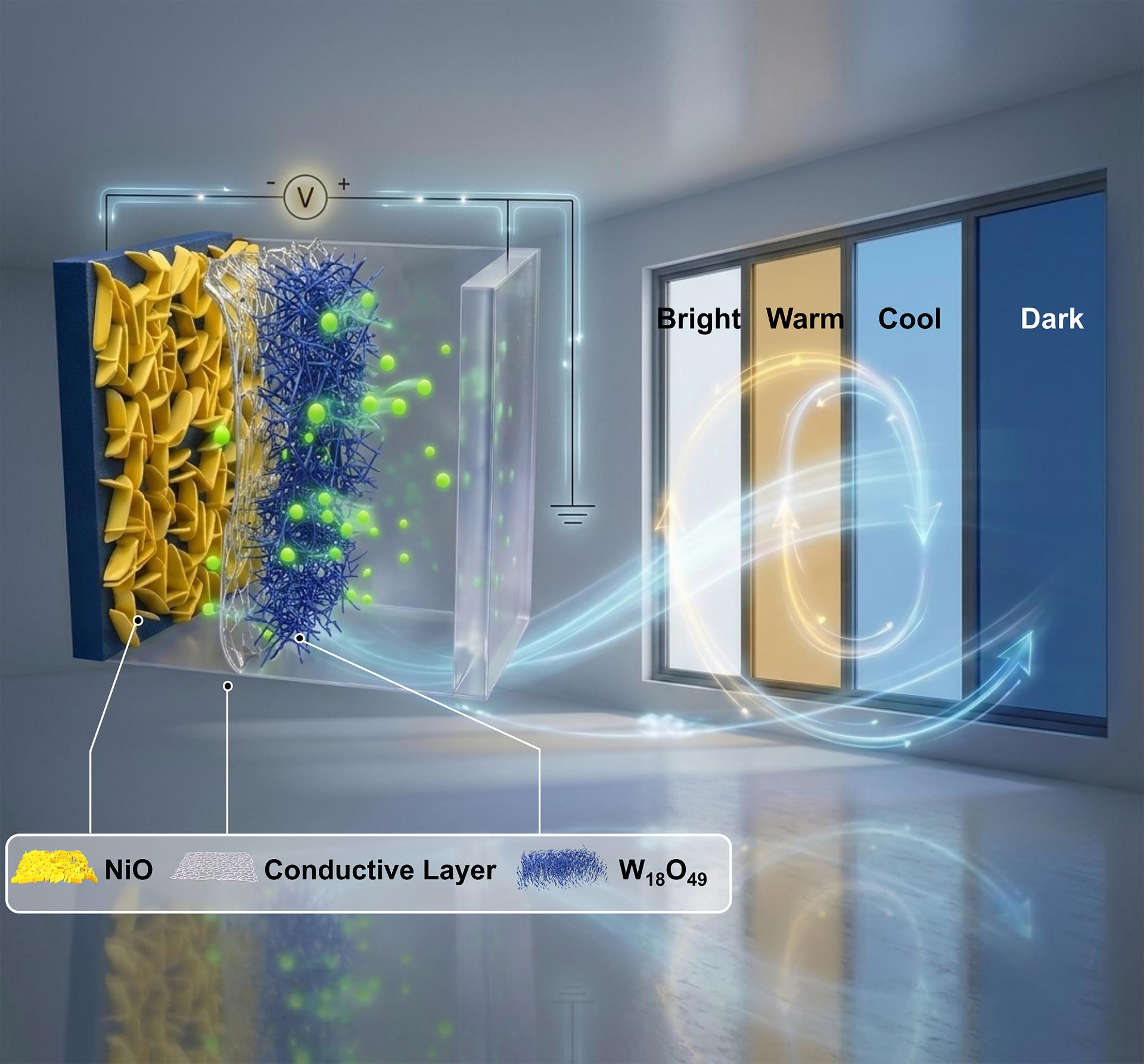
Figure 4. Schematic diagram of the tandem composite electrochromic smart window.
Based on the above findings, the research team proposed a tandem composite electrochromic electrode design, constructing a NiO/ITO/W18O49 (NIW) sandwich structure, which enables the independent yet synergistic operation of the anodic NiO and cathodic W18O49 on the same electrode (Figure 4). In this structure, the bottom layer consists of porous NiO nanosheets, a highly conductive ITO transition layer is introduced in the middle, and the top is covered with a W18O49 nanowire network. The open hierarchical pore structure ensures sufficient electrolyte penetration, reducing ion diffusion resistance; meanwhile, the ITO intermediate layer significantly improves electron transport and lowers the effective work function, thereby accelerating the electrochromic response. The device can achieve multiple optical states, such as transparent, brown, and blue, under different bias voltages, and synergistically modulate the visible and near-infrared bands. When further assembled into a multi-mode smart window device, it exhibits excellent solar light modulation, thermal management, and anti-counterfeiting display capabilities, proving the application potential of this tandem structure in high-performance multi-color smart windows.
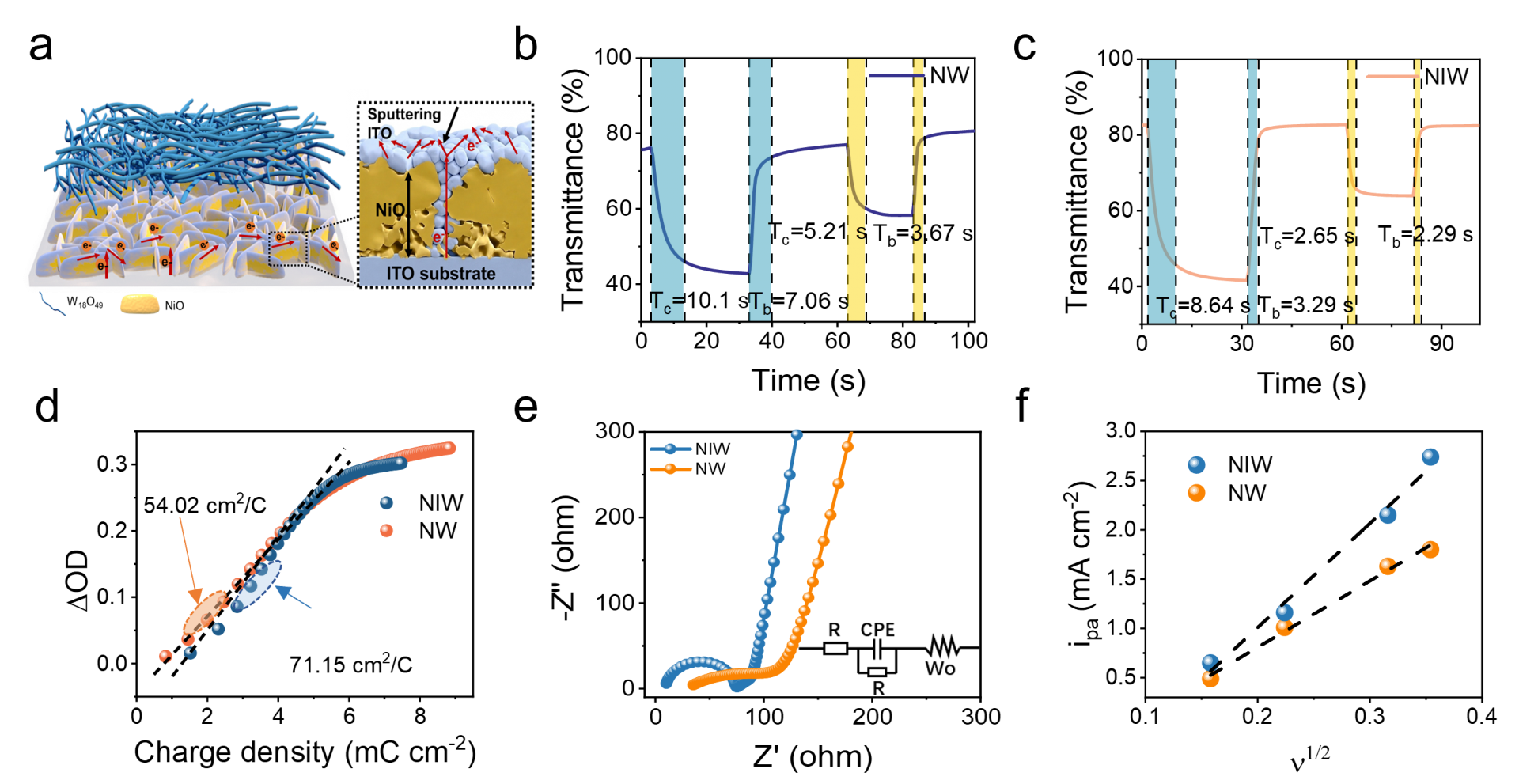
Figure 5. (a) Schematic of the NIW electrode tandem structure and conductive paths. (b-c) Real-time transmittance changes of NW and NIW electrodes at 630 nm. (d) Optical density (630 nm) and charge density curves for NW and NIW electrodes. (e) Nyquist plots of NW and NIW electrodes. (f) Relationship between cathodic peak current density and the square root of the scan rate for NW and NIW electrodes.
As shown in Figure 5, this study systematically investigated the optical and electrochemical behaviors of the NIW electrode. Compared with the control sample NW without the introduction of ITO, both the response speed and coloration efficiency of NIW were significantly improved, indicating that the intermediate conductive layer plays a key role in promoting electron transport. Electrochemical impedance spectroscopy further demonstrated that NIW possesses lower charge transfer resistance and faster Li+ diffusion, verifying its superior kinetic performance.
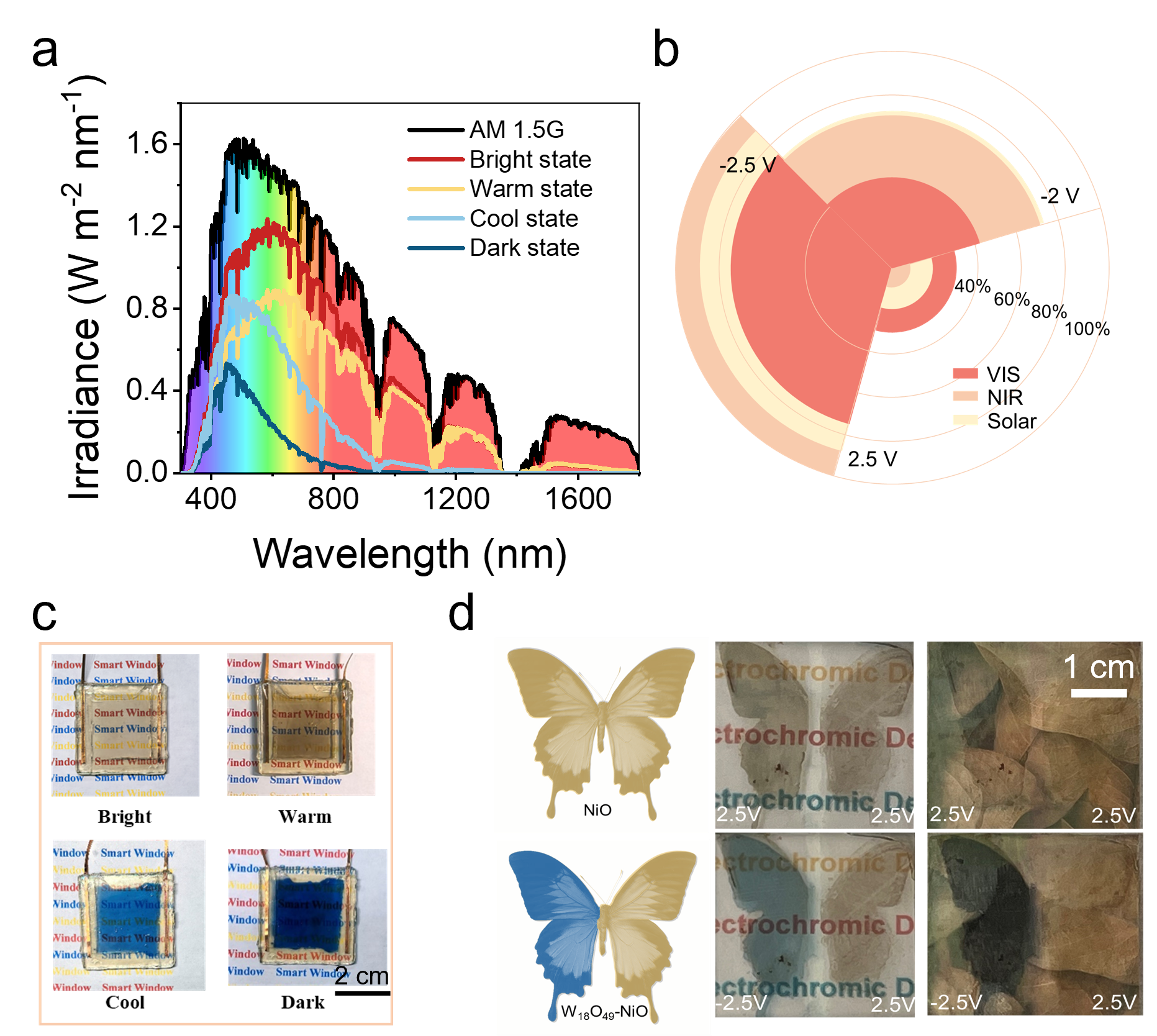
Figure 6. (a) Solar irradiation spectra of the tandem composite electrochromic device under different states. (b) ΔT of the device in the visible light, near-infrared light, and the entire solar spectrum regions under different bias voltages. (c) Corresponding optical photos. (d) Optical photos of the tandem-structured electrochromic device at different potentials for anti-counterfeiting and privacy protection functions.
When assembled into a multi-mode electrochromic device, it demonstrated remarkable solar radiation modulation capabilities under various bias voltages. At 2.5 V, the anodic NiO participated in the modulation, presenting a brown color suitable for a mild shading mode. At -2 V and -2.5 V, the cathodic W18O49 strongly absorbed visible and near-infrared light, presenting a blue color ideal for cool and deep shading modes. Thermal management tests demonstrated that this smart window could significantly reduce the absorber’s temperature in a model room, reflecting excellent potential for building energy savings. The team fabricated a butterfly-patterned device to showcase local independent addressing and multi-area color coding capabilities, highlighting its application value in anti-counterfeiting and privacy protection.
This research provides new material design concepts for constructing high-performance multi-color smart windows, showing tremendous application potential in building energy conservation and optical anti-counterfeiting.
This research achievement has been published online in the international journal Nano Research under the title “Tandem design of conductivity-enhanced electrochromic electrode for multi-spectra modulation smart window.” Meng-Han ZHU, a Class of 2022 PhD student from the Department of Materials Science and Engineering at SUSTech, and Si-Zhe SHENG, a Research Assistant Professor at the Institute of Major Scientific Facilities for New Materials, are the co-first authors of the paper. Chair Professor Shu-Hong YU and Assistant Professor Jin-Long WANG are the co-corresponding authors of the paper, with SUSTech serving as the first and corresponding institution.
Paper Link 1: https://doi.org/10.26599/NR.2026.94908696
Paper Link 2: https://doi.org/10.1007/s44503-026-00008-y
Proofread ByNoah Crockett, Junxi KE
Photo ByYan QIU