On July 30, François Forget, a member of the French Academy of Sciences, research director at the French National Centre for Scientific Research (CNRS), and deputy director of the Laboratoire de Météorologie Dynamique (LMD), visited Southern University of Science and Technology (SUSTech) for the SUSTech Lecture Series. He gave a lecture titled “Mars: Latest Discoveries, New Mysteries, and Future Explorations,” sharing insights from his research into the Martian atmosphere, climate evolution, and space exploration with students and faculty.
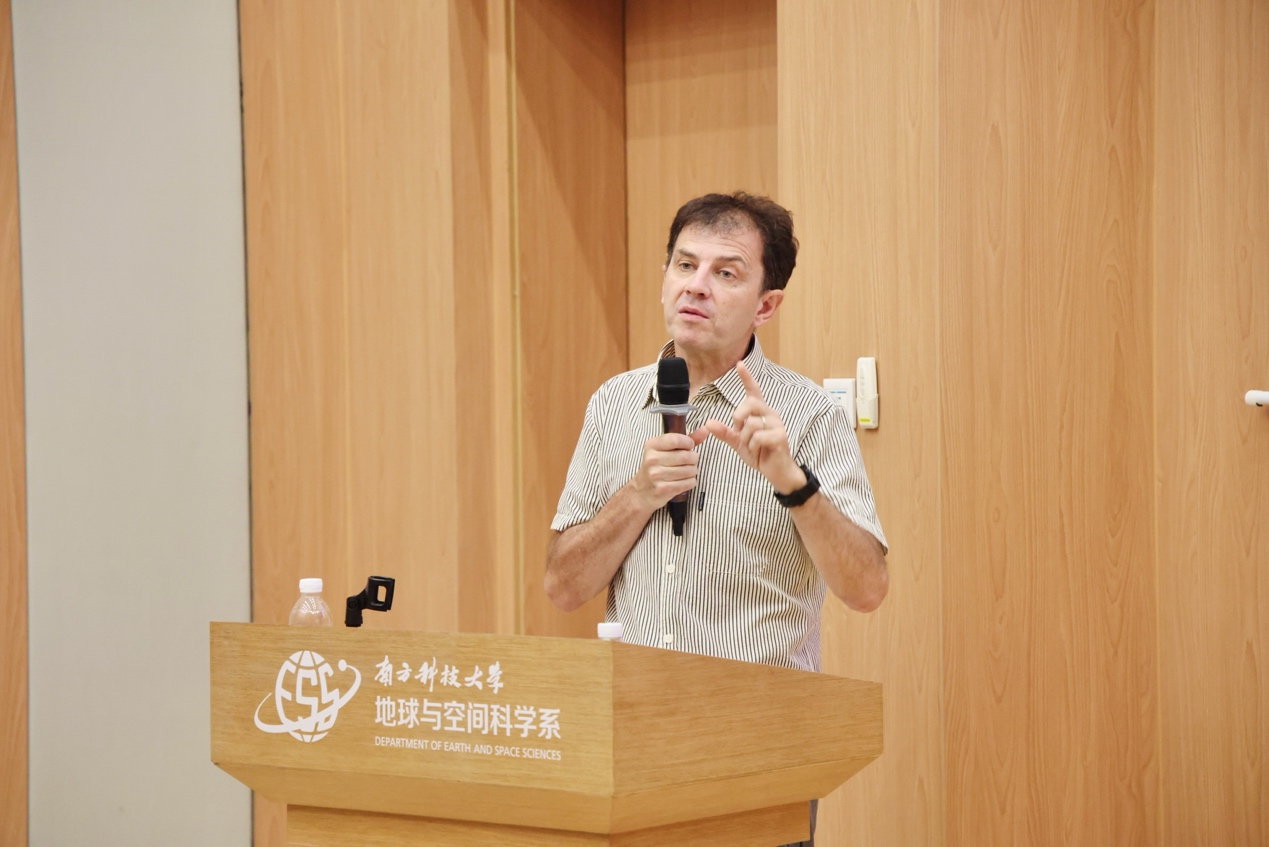
Dr. Forget began by reviewing the challenging history of robotic Mars explorations. He cited several well-known mission failures. Mars Observer lost contact in 1993, three days before the planned orbital-insertion burn. Mars Climate Orbiter was lost in 1999 after a mismatch between English and metric units in navigation calculations, which placed it onto a trajectory that was too close to Mars. ESA’s Schiaparelli lander crashed in 2016 due to unexpectedly high rotation rates which saturated its inertial measurement unit, leading to erroneous attitude and altitude estimates and a premature termination of the descent sequence. He pointed out that progress in space exploration depends not only on conceiving new missions but also on learning from failures and improving upon them.
François then reviewed recent findings from orbiters, landers, and rovers, covering Martian dust, water-ice clouds, subsurface ice layers, and evidence of ancient rivers and lakes. Although the Martian surface looks barren, dust, water vapor, seasonal CO2 ice caps, and atmospheric circulation continue to interact, forming a complex and active climate system. He further presented how to develop planetary climate models to produce observed phenomena and to advance our understanding.
He highlighted several factors that can generate the surface wind stress needed to lift dust, including frontal systems, topography-driven circulations, and strong winds associated with thermal contrasts near the edges of the seasonal CO2 caps. These processes can contribute to regional and global dust storms. By refining the treatment of water-ice cloud formation in the model, the research team reproduced key features of the Arsia Mons Elongated Cloud (AMEC), including its exceptionally elongated shape. He also explored how variations in Mars’s obliquity redistribute water among the atmosphere, surface ice deposits, and subsurface ice reservoirs.
Turning to unresolved questions such as the origin of atmospheric methane, the possible presence of subsurface liquid water, and the nature of the early Mars climate, Dr. Forget outlined priorities for future explorations. These included subsurface drilling, the NASA-ESA Mars Sample Return campaign, China’s Tianwen-3 mission, and global measurements of Martian winds. He said his team would continue integrating observations, numerical simulations, and data from future missions to advance our understanding of Martian climate evolution and the planet’s potential habitability.
During the Q&A session, François Forget engaged in in-depth discussions with faculty members and students on topics including the migration of Martian water ice, ice accumulation during high-obliquity periods, and hydrogen escape from the upper atmosphere.
Proofread ByLulu LI, Siteng FAN, Junxi KE
Photo ByDepartment of Earth and Space Sciences