Associate Professor Jinlong ZHU’s research group from the Department of Physics at the Southern University of Science and Technology (SUSTech) and the State Key Laboratory of Quantum Functional Materials, along with collaborators, made progress in the field of high-pressure physics of topological insulators. The team successfully induced superconductivity in the topological insulator Bi2Se3 for the first time without destroying its topologically non-trivial crystal structure (R-3m phase), revealing that pressure uniformity is a key factor in the coexistence of superconductivity and topology. The related findings were published in Physical Review Letters under the title “Hydrostatic Pressure-Induced Superconductivity in the Topological Phase of Bi2Se3.”
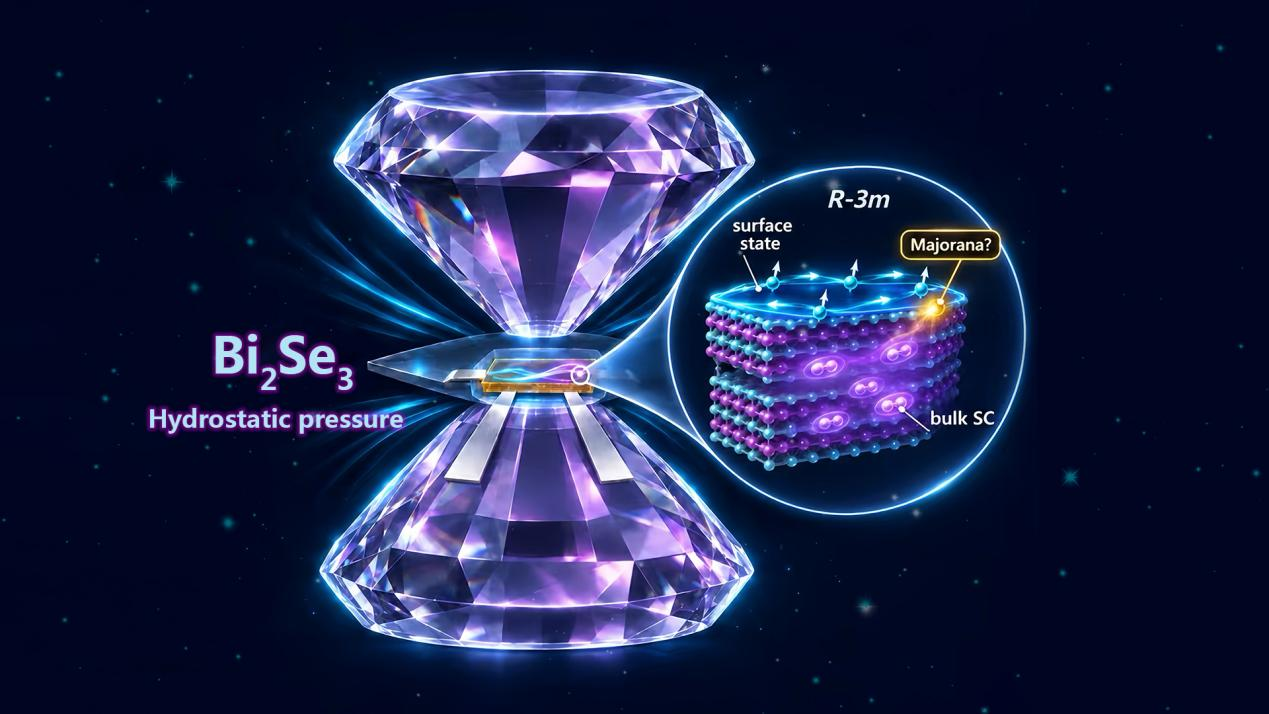
Introducing superconductivity into a topological insulator while preserving its nontrivial band topology provides a promising and widely explored route for realizing topological superconductivity and Majorana zero modes. Bi2Se3 is a typical three-dimensional topological insulator, with a relatively large bulk band gap and a single Dirac cone surface state. Existing studies show that while Cu-intercalated Bi2Se3 (CuxBi2Se3) can exhibit superconductivity, it only occurs within a very narrow copper concentration range, and chemical intercalation inevitably introduces disorder and compositional inhomogeneity. Previous high-pressure studies under non-hydrostatic conditions reported superconductivity in undoped Bi2Se3 only after the ambient-pressure R-3m phase transformed into a high-pressure monoclinic (C2/m) phase. Whether superconductivity can emerge while maintaining the topological R-3m phase has been an unresolved question in this field.
The team prepared Bi2Se3 nanoflakes and bulk crystals, created quasi-hydrostatic conditions in a diamond anvil cell using Daphne 7373 and argon as pressure-transmitting media, and carried out a systematic study combining electrical transport, Hall measurements, synchrotron X-ray diffraction, Raman spectroscopy, and first-principles calculations.
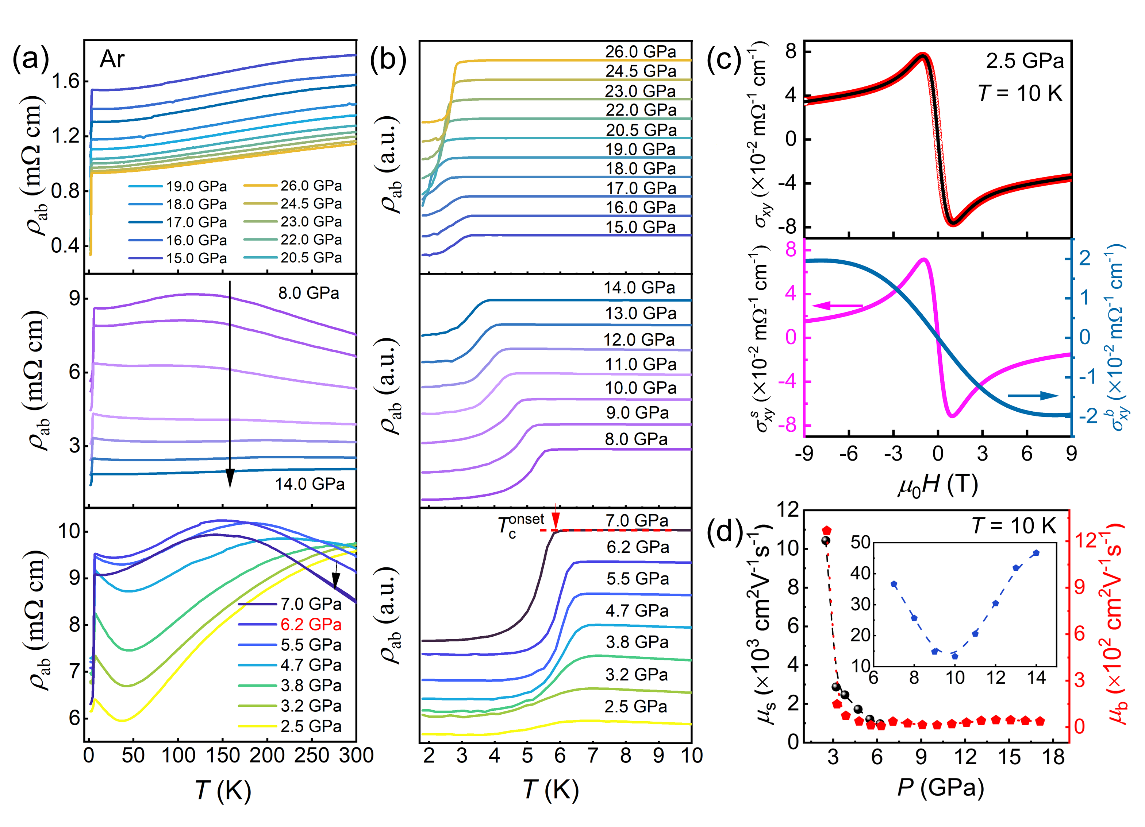
Figure 1. Pressure-Induced Superconductivity and Hall Effect in Argon Gas Pressure Transmission
Electrical transport measurements show that under quasi-hydrostatic pressure conditions, Bi2Se3 nanoflakes about 56 nm thick exhibit a superconducting transition at 2.4 GPa (with an onset transition temperature of about 8.1 K). Bulk crystals show a higher pressure threshold, with the superconducting transition occurring at 4.1 GPa (onset temperature around 5.8 K). Additionally, using argon gas as a pressure-transmitting medium, which has better hydrostatic performance, the superconducting transition was independently reproduced at 2.5 GPa. Hall measurements observed a significant low-field nonlinear Hall response in the low-pressure region of the R-3m phase. Two-component transport analysis separated out a high-mobility surface conduction channel with mobility an order of magnitude higher than the bulk channel, consistent with a picture of topological surface states participating in transport. In situ X-ray diffraction confirmed that the R-3m phase is stable up to about 12 GPa, while low-temperature Raman spectroscopy detected subtle anomalies in lattice dynamics around 3 GPa, revealing an electronic structure transition within the R-3m phase.
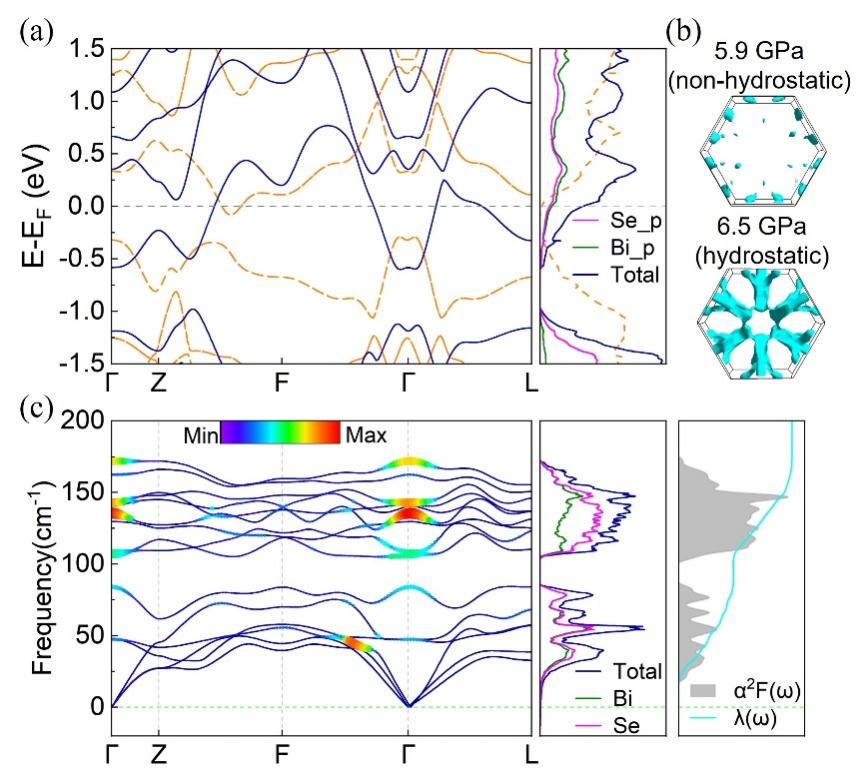
Figure 2. Calculations of Electronic Structure and Phonon Spectrum
First-principles calculations further reveal that under hydrostatic pressure, the conduction band shifts downward, the carrier concentration significantly increases, the density of states at the Fermi level rises, and a general softening of high-frequency phonons enhances electron-phonon coupling, whereas anisotropic stress under non-hydrostatic conditions suppresses the growth of carrier concentration and weakens electron-phonon coupling. Among the three different pressure media (argon, Daphne 7373, and NaCl), superconductivity emerges when the bulk carrier concentration approaches 1020 cm-3, consistent with the critical density reported in previous high-pressure C2/m phases and copper-intercalated systems, pointing to a common concentration threshold.
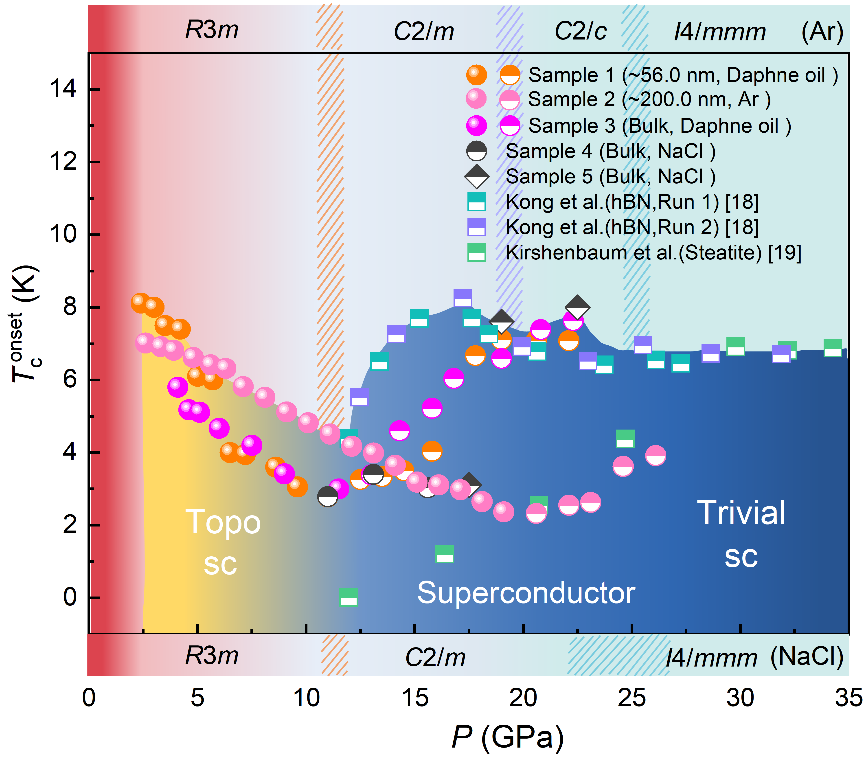
Figure 3. Temperature-pressure phase diagram of Bi₂Se₃
This study demonstrates that superconductivity can emerge in Bi2Se3 with the topologically nontrivial R-3m phase under quasi-hydrostatic pressure. The uniformity of pressure determines the conditions for superconductivity by modulating the evolution of carrier concentration, electronic structure, and lattice dynamics. This result provides new experimental evidence for investigating the interplay between superconductivity and nontrivial topology, as well as for controlling similar states through pressure or strain engineering.
PhD students Qunfei ZHENG from the Department of Physics at SUSTech, Jiayang LI from the High Magnetic Field Laboratory, Hefei Institutes of Physical Science, and Lingxiao ZHAO, an Associate Researcher at the Quantum Science Center of Guangdong-Hong Kong-Macao Greater Bay Area, are co-first authors. Researchers Ning HAO from the High Magnetic Field Laboratory, Chinese Academy of Sciences, Pei WANG, an Associate Researcher at the Institute of Solid State Physics, and Jinlong ZHU are co-corresponding authors. SUSTech is the first affiliated institution.
Paper Link: https://journals.aps.org/prl/accepted/10.1103/nbwq-sx6g
Proofread ByNoah Crockett, Junxi KE
Photo ByYan QIU