A research team led by Professor Zhenzhong ZENG from the School of Environmental Science and Engineering and the State Key Laboratory of Soil Pollution Control and Safety at the Southern University of Science and Technology (SUSTech) published a research paper in Nature Geoscience titled “Regional land carbon shifts strengthen atmospheric carbon dioxide–land carbon flux coupling.” Combining global atmospheric carbon dioxide (CO2) observations with land carbon flux estimates from atmospheric inversions and dynamic global vegetation models, the study finds that the atmospheric CO2 growth rate has become increasingly tightly coupled to fluctuations in the land carbon sink over the past six decades. The researchers further explain this strengthening through changes in regional land carbon contributions.
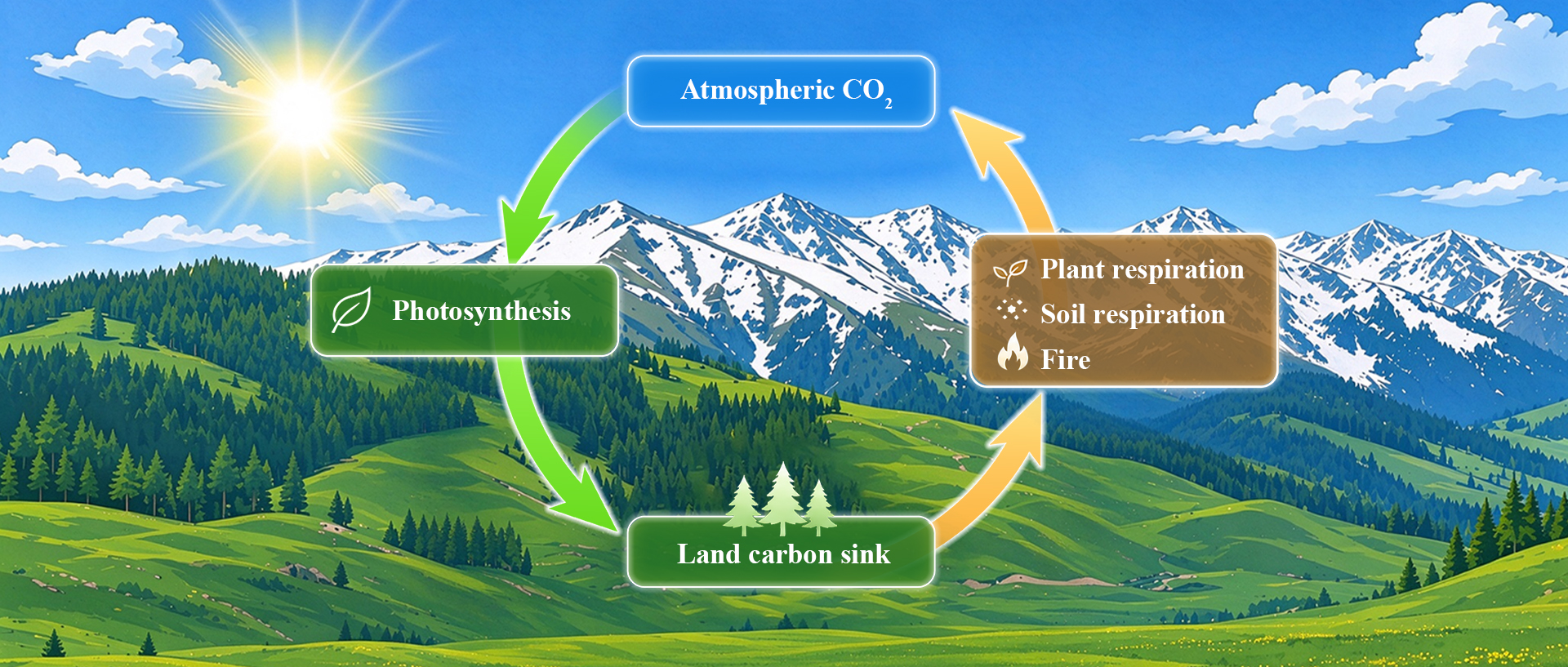
Terrestrial ecosystems absorb about 30% of anthropogenic carbon dioxide emissions annually and are important natural carbon sinks for mitigating climate change. Carbon in terrestrial ecosystems is mainly stored in vegetation and soil, with soil serving as the largest organic carbon pool. Key processes, including photosynthesis, plant respiration, and soil respiration, are sensitive to temperature and water availability, contributing to substantial year-to-year variability in the land carbon sink. Interannual fluctuations in land carbon sinks are the primary driver of interannual variability in atmospheric CO2 growth rates, with a close negative correlation between the two. For this reason, long-term observational records of atmospheric carbon dioxide are often used to constrain land sink variability and its climate sensitivity. However, whether this relationship has remained stable over time, and how different regions contribute to it, remains unclear.
The research team analyzed the long-term changes in the relationship by integrating global atmospheric carbon dioxide growth rate observations from 1959 to 2022 with multiple land carbon sink datasets. The results show that the negative correlation between the detrended atmospheric carbon dioxide growth rate and the detrended land carbon sink anomalies has strengthened over the past six decades, according to both atmospheric inversions and process-based model results (Fig. 1).
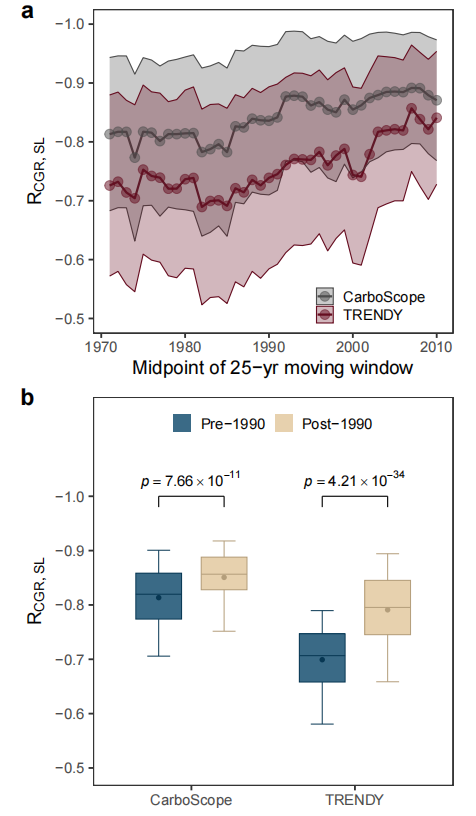
Figure 1. Temporal evolution of the global detrended atmospheric carbon dioxide-land carbon flux relationship
To understand the regional basis of this strengthening, the research team quantified changes in regional contributions to the global atmospheric carbon dioxide-land carbon flux correlation. They found a pronounced spatial reorganization of these contributions. In the CarboScope inversion, the fraction of land area reinforcing the global negative correlation increased from 78.1% to 82.7%, whereas the TRENDY model ensemble showed a slight contraction in area but a stronger contribution from the regions that remained. Both datasets identified concentrated reinforcing contributions in the tropics and frequent sign reversals at higher latitudes (Figure 2). These changes were associated with shifts in regional land carbon sink variability and its sensitivity to temperature and water availability.
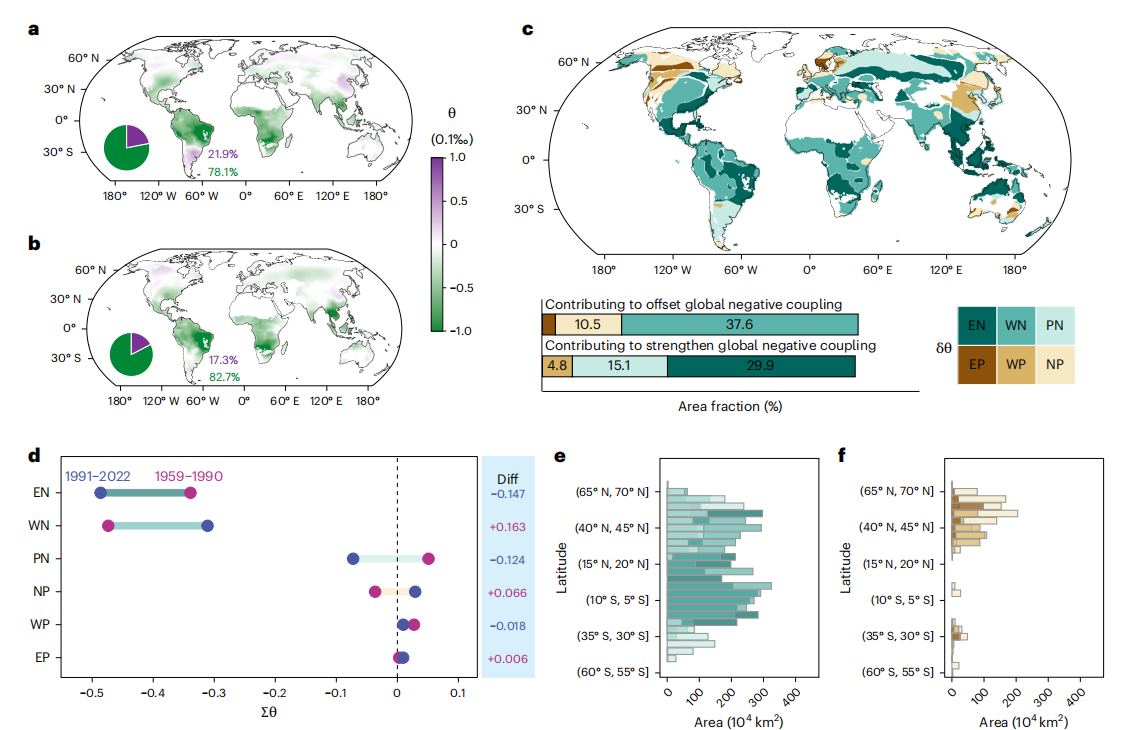
Figure 2. Spatial reorganization of regional contributions to the global atmospheric carbon dioxide-land carbon flux relationship
This study reveals how the spatial reorganization of regional land carbon contributions has strengthened the global coupling between atmospheric CO2 growth rate and the land carbon sink over the past six decades. Because this coupling changes over time, observational constraints derived from recent decades may not transfer directly to earlier periods or remain valid under future climate conditions. This temporal dependence needs to be considered when using historical observations to constrain future land carbon responses to climate change. The findings can also inform assessments of how Earth system models represent regional land carbon sink variability and its climate sensitivity.
Dr. Shuxin LUO, a visiting scholar at SUSTech, is the first author of the paper. Zhenzhong ZENG from SUSTech, Academician Dongxiao ZHANG, and Associate Professor Yuntian CHEN from the Eastern Institute of Technology, Ningbo, are corresponding authors. SUSTech is the first listed affiliation of this paper. Other collaborators include Professor Philippe Ciais from the Laboratoire des Sciences du Climat et de l’Environnement (LSCE), Professor Peter B. Reich from the University of Michigan, Professor Alan D. Ziegler from Kasetsart University, Professor Qing HU, Dr. Yingzuo QIN, Xiaoye LIU, Xinyu ZOU, Qiaomei FENG, Jingyang GAO from SUSTech, and Dr. Yakun ZHU from the Eastern Institute of Technology, Ningbo.
Paper Link: https://doi.org/10.1038/s41561-026-02136-5
Proofread ByNoah Crockett, Junxi KE
Photo By