Associate Professor Zhongrui WANG’s research group at the School of Microelectronics of the Southern University of Science and Technology (SUSTech), along with collaborators, proposed an efficient neural-field reconstruction system using resistive-memory-based compute-in-memory (CIM). This system targets the sparse signal reconstruction needs in applications like medical imaging, AR/VR, and embodied intelligence. By combining neural-field algorithms with resistive-memory-based CIM hardware and optimizing both software and hardware together, it improves computational efficiency while maintaining reconstruction quality. The related work, titled “Efficient and accurate neural-field reconstruction using resistive memory,” was published in the top-tier journal Nature.

In real-world applications, intelligent systems often lack access to complete, dense observation data. For example, medical CT imaging has to control the scan dose and acquisition time, AR/VR systems need to quickly generate 3D scenes based on limited viewpoints, and robots and embodied AI systems have to understand the surrounding environment from limited sensory information. Figuring out how to recover high-quality signals from sparse or incomplete inputs is a priority for AI systems in real-world scenarios.
Neural fields provide an effective way to represent these kinds of problems. Unlike directly storing pixels, voxels, or point clouds, neural fields use neural networks to learn a continuous function that maps spatial or spatiotemporal coordinates to image intensity, color, density, and other information. Allowing the representation of images and 3D scenes more compactly. But neural field models usually need a lot of forward passes and matrix operations, and on traditional digital computing platforms, issues like data movement, energy consumption, and latency can become a bottleneck.
The research team built a neural field reconstruction system based on resistive-memory-based CIM. Resistive memory units can store neural network weights through their conductance states and perform parallel matrix operations across the array, cutting down on the data movement overhead caused by the separation of memory and computation in von Neumann architectures. Taking advantage of the resistive memory hardware, the team also did co-design across algorithms, devices, circuits, and systems to make neural field models work better on real hardware.
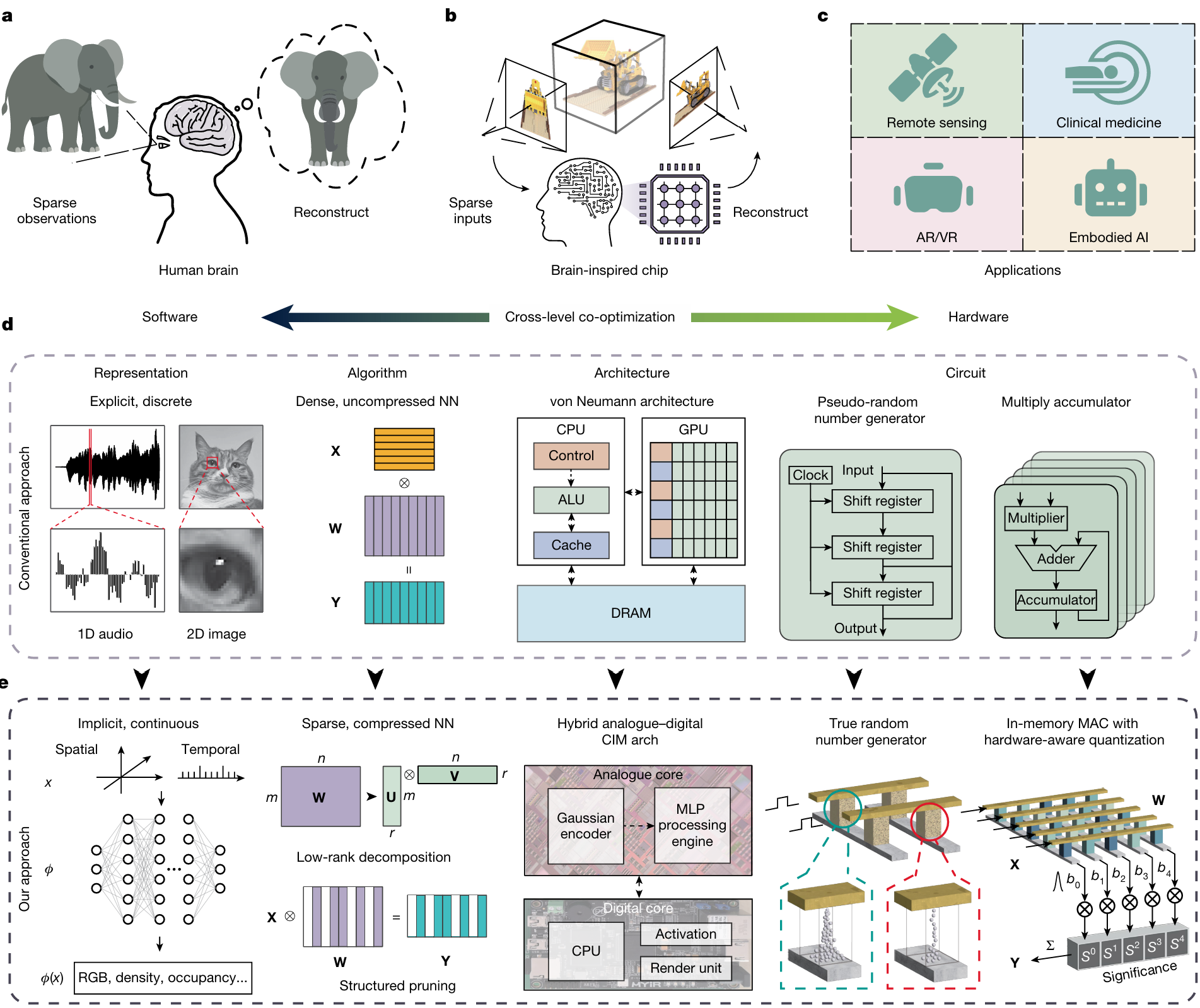
Figure 1. Resistive-Memory-based CIM Neural Field System for Sparse Signal Reconstruction
Figure 1 shows the overall idea of this work. At the algorithm level, the system uses neural fields as a continuous signal representation and combines methods like low-rank decomposition and structured pruning to reduce model complexity and hardware deployment costs. At the encoding level, the research team leverages the intrinsic randomness of resistive memory to achieve Gaussian encoding, turning the random conductance distribution of devices into useful physical random resources, thereby enhancing the model’s ability to express spatial details. At the weight-mapping level, the team proposes a hardware-aware quantization method and combines it with corresponding analog circuit designs to reduce the impact of resistive memory write errors on computational accuracy, thus improving the reconstruction quality of neural fields on hardware.
The research team built a hardware platform based on 40 nm 256 Kb resistive-memory-based CIM macro units and validated the system performance on multiple representative tasks. In the 3D CT sparse reconstruction task, the system can recover fairly complete three-dimensional medical images from a limited number of CT slices, providing a potential solution for low-dose and fast medical imaging. In the novel view synthesis task, the system can generate 3D scene images from different viewing angles based on existing images, which can be applied in AR/VR, 3D content creation, and robotic vision. The team also further evaluated the system’s potential in dynamic scene novel view synthesis tasks, showing its ability to handle complex spatiotemporal signals. Experimental results demonstrate that, based on the 40 nm 256 Kb resistive-memory-based CIM macro unit, this architecture achieves roughly 23.5-fold, 21.0-fold, and 32.3-fold energy efficiency improvements compared with GPUs across three types of tasks while maintaining good reconstruction quality.
This research presents a hardware-software co-design approach for efficient neural field reconstruction. Neural fields provide compact, continuous signal representation, resistive-memory-based CIM hardware offers highly parallel and low-power computation, and hardware-aware algorithms and circuit designs improve the system’s tolerance to real device imperfections. This work offers a new hardware implementation reference for efficient sparse signal reconstruction in fields such as medical imaging, AR/VR, 3D vision, and embodied intelligence.
The first author of the paper is Yifei YU (a PhD student at the University of Hong Kong) from Zhongrui WANG’s research group and a visiting student at SUSTech, with corresponding authors including Associate Professor Zhongrui WANG from SUSTech, Professor Xiaojuan QI from the University of Hong Kong, Researcher Dashan SHANG from the Institute of Microelectronics of the Chinese Academy of Sciences, and Professor Qi LIU from Fudan University. Academician Ming LIU from Fudan University and Professor Kwang-Ting CHENG from the Hong Kong University of Science and Technology also participated in the research.
Paper Link: https://www.nature.com/articles/s41586-026-10646-w
Proofread ByNoah Crockett, Junxi KE
Photo BySchool of Microelectronics