A research team led by Chair Professor Hui LI from the Department of Materials Science and Engineering at the Southern University of Science and Technology (SUSTech), together with Research Associate Professor Jiantao FAN from the SUSTech Academy for Advanced Interdisciplinary Studies, has made progress in the study of ionomer stability in pure-water Anion Exchange Membrane Water Electrolysis (AEMWE). The related work, titled “Oxidative stability as a guiding principle for durable ionomer cations in pure-water electrolysis,” was published in Nature Communications.
Pure-water AEMWE is an important technological route for green hydrogen production due to its simplified system design, low corrosiveness, and potential cost advantages. Anion exchange ionomers are key materials in these devices. They conduct OH⁻ within the catalyst layer and help maintain the morphological stability of the reaction interface.
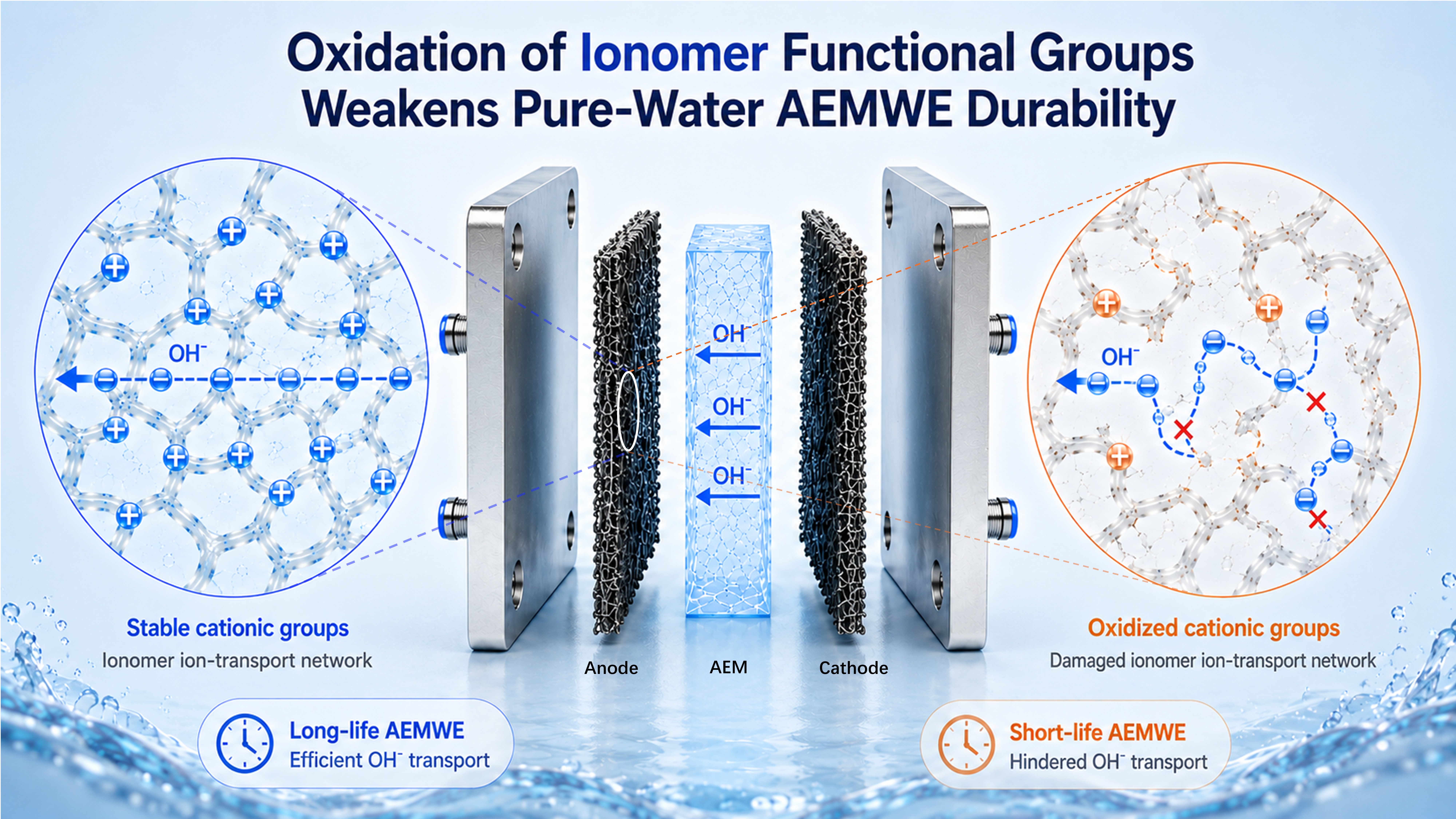
Figure 1. Schematic illustration of the performance degradation mechanism in pure-water AEMWE induced by oxidation of ionomer cationic functional groups.
The design of such ionomers has focused mainly on the alkaline stability of their cationic functional groups. Several mature commercial structures have been developed on this basis and have been widely used in alkaline fuel cells and alkaline-fed water electrolysis systems. However, the anodic environment in pure-water AEMWE differs from that in strongly alkaline systems. The local pH is closer to neutral, while a higher anodic potential is required to drive the reaction. These conditions challenge the applicability of conventional alkali-stable cation structures in pure-water electrolysis.
The research team constructed a series of anion exchange ionomers with different cationic functional groups and systematically compared their alkaline stability, oxidative stability, and device durability in pure-water AEMWE. The study found that cationic structures with good alkaline stability do not necessarily perform well in pure-water electrolysis environments. By contrast, cationic functional groups with higher oxidative stability are better able to preserve ionomer structural integrity and ion-conducting capability, thereby improving device operational stability.
Based on an ionomer design with enhanced oxidative stability, the team achieved stable electrolyzer operation for more than 360 hours at 80 °C and 1 A cm⁻². This lifetime was twice that of devices based on alkali-stable cation structures.
To further clarify the oxidative degradation mechanism of cationic functional groups, the team conducted electrochemical oxidation tests using representative quaternary ammonium model compounds. The results showed that under the high-potential oxidative environment close to that of the pure-water AEMWE anode, quaternary ammonium cations can undergo degradation reactions such as demethylation. Some cyclic quaternary ammonium structures with superior alkaline stability were found to exhibit reduced stability under oxidative conditions.
By combining distribution of relaxation times analysis of impedance spectra, electrode morphology analysis, and ionomer structural characterization, the researchers proposed a degradation pathway of “cationic functional group oxidation, to ionomer structural degradation, to catalyst-layer interfacial failure, to device performance decay.” The study identifies electrochemical oxidative stability as a long-overlooked but critical evaluation metric for the design of anode ionomers in pure-water AEMWE.
This work provides molecular-level mechanistic insights into the durability bottleneck of pure-water electrolysis devices. It also offers design guidance for the development of highly stable anion exchange ionomers and high-performance pure-water hydrogen production systems.
Yiqi JIN, a doctoral student studying at SUSTech and Harbin Institute of Technology, is the first author of the paper. Hui LI and Jiantao FAN are the corresponding authors. SUSTech is the primary corresponding institution.
Paper Link: https://www.nature.com/articles/s41467-026-73209-7
Proofread ByNoah Crockett, Junxi KE
Photo By