On June 15, 2026, Jin-Quan YU, Member of the American Academy of Arts and Sciences, the U.S. National Academy of Sciences, and Fellow of the Royal Society, as well as Professor of chemistry at Scripps Research, visited the Southern University of Science and Technology (SUSTech) for the 439th SUSTech Lecture Series and delivered a lecture titled “Synthetic C–H Activation with Bifunctional Ligands: From Curiosity to Industrialization.”
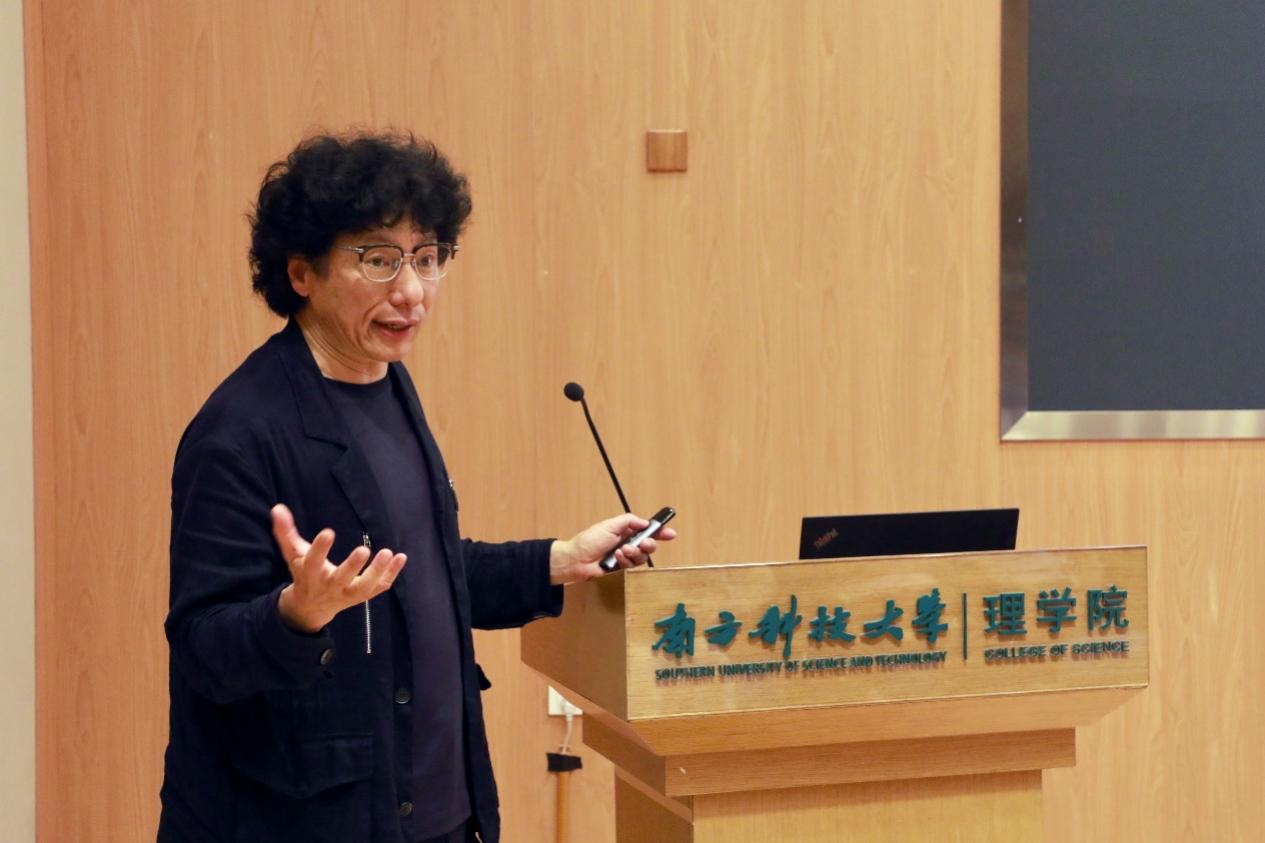
Professor Jin-Quan YU deeply analyzed the key challenges in the field of C–H activation in his report. He believes that the slow progress in this field over the past few decades is fundamentally due to most researchers confusing two essentially different directions. The first is low-cost, large-scale industrial catalysis aimed at bulk chemicals (like methane conversion), and the second is highly selective synthesis of complex drug molecules with precise control over chirality. Professor YU clearly focuses his research on the latter, how to precisely edit complex molecules containing multiple similar C–H bonds under mild conditions. He outlined four major challenges in this area: improving reactivity, controlling stereoselectivity, regulating site selectivity, and demonstrating scalability and sustainability.
Professor YU detailed his team’s breakthrough progress in designing bifunctional ligands. He shared the development of ligand design and showcased a series of bifunctional ligands applicable to a wide range of readily available substrates, successfully achieving C–H activation reactions with both enantio- and site-selectivity, thereby constructing point-, axial-, and planar-chiral compounds. He presented exciting application results for industrial transformation. His team successfully developed a mild process that requires no silver additives or special solvents and can be scaled up to kilogram levels. They also applied their developed C–H activation reactions in drug synthesis, including the first non-addictive painkiller based on C–H activation technology and several anticancer drug candidates.
During the Q&A portion, faculty and students actively asked questions about ligand design principles, AI applications in catalysis, and industrial upscaling bottlenecks, and Professor YU offered advice based on his own experience. He encouraged young scholars to be “honest,” not to blindly follow trends, but to critically assess the scientific problems they want to solve.
Proofread ByJunxi KE
Photo ByDepartment of Chemistry