The research team led by Associate Professor Xihan CHEN from the Department of Mechanical and Energy Engineering at the Southern University of Science and Technology (SUSTech) reported a significant advance in hot-carrier dynamics. Their work, entitled “Enhancing Hot-Carrier Lifetime through Spin Splitting and Strain Interaction in Chiral Perovskite Materials,” has been published in Physical Review Letters.
Hot carriers are nonequilibrium charge carriers with energies substantially higher than the band edges of semiconductors. Their relaxation dynamics determine how rapidly electronic energy is dissipated into the crystal lattice, playing a critical role in the performance of optoelectronic and energy-conversion devices. Using a chiral two-dimensional perovskite (S-3AMPPbI4) as a model system, the researchers combined ultrafast spectroscopy with first-principles calculations to investigate how photoinduced lattice dynamics influence electronic structure and energy relaxation processes.
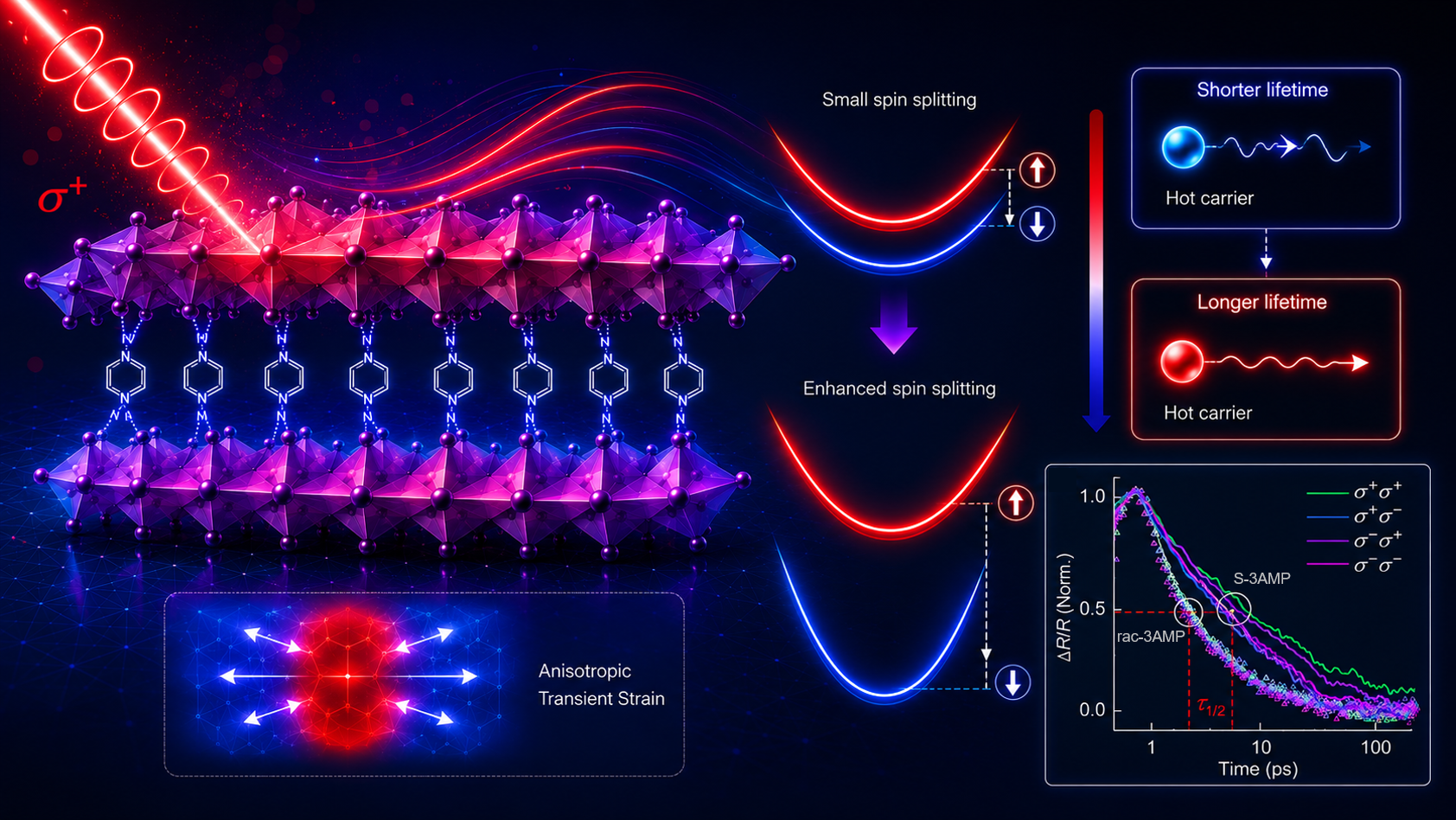
Ultrafast transient spectroscopy was employed to probe the evolution of the electronic structure following photoexcitation. A pronounced enhancement of spin splitting was observed in the chiral perovskite (S-3AMP), with the splitting energy increasing continuously as the photoexcited carrier density increased. In contrast, the racemic counterpart (rac-3AMP) exhibited only conventional band-edge bleaching features without any evidence of spin-split states. Detailed analysis revealed that the spin splitting could be enhanced from approximately 20 meV in the ground state to nearly 100 meV under photoexcitation. These results demonstrate that optical excitation can dynamically modify the spin-split electronic structure of the material.
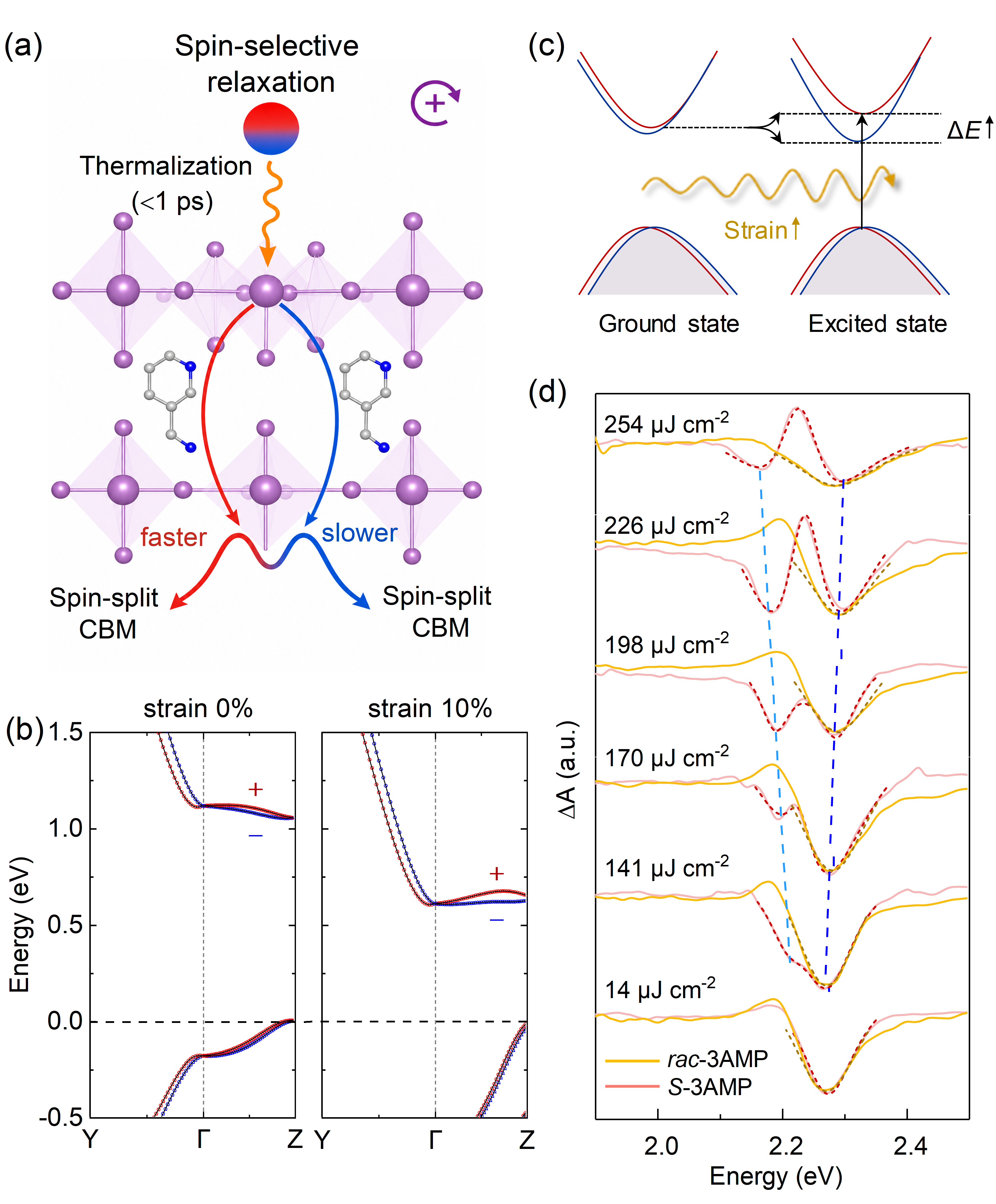
Fig. 1. Photoinduced enhancement of spin splitting with increasing carrier density.
To uncover the origin of the enhanced spin splitting, coherent acoustic phonon spectroscopy was employed to investigate the lattice response following photoexcitation. A strong correlation was identified between photoinduced transient strain and the magnitude of spin splitting. First-principles calculations revealed that confined photoexcited excitons generate anisotropic lattice distortions characterized by in-plane expansion and out-of-plane compression. Because the electronic structure is particularly sensitive to out-of-plane strain, these anisotropic lattice responses substantially enhance the conduction-band spin splitting. The excellent agreement between theory and experiment establishes transient strain as the key driving force behind the giant enhancement of spin splitting.
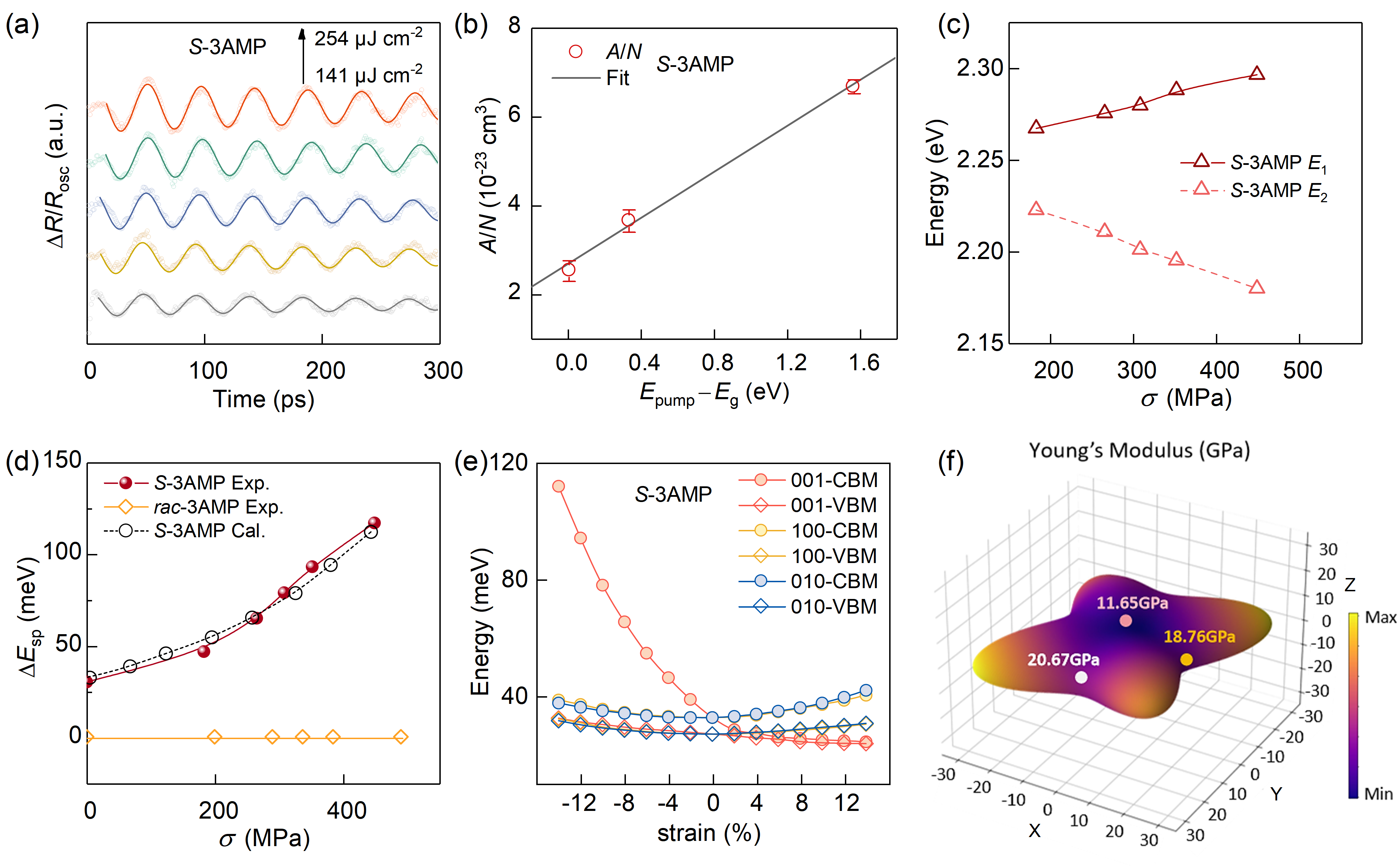
Fig. 2. Experimental and theoretical verification of transient-strain-enhanced spin splitting.
The influence of enhanced spin splitting on hot-carrier relaxation was subsequently examined using circularly polarized ultrafast spectroscopy. By selectively probing different spin channels, the researchers directly tracked the relaxation dynamics of spin-polarized hot carriers. The results revealed the emergence of spin-dependent hot-carrier relaxation pathways, with different spin states exhibiting distinct cooling rates. As the enlarged spin splitting imposes additional spin-selection constraints on carrier scattering, energy dissipation is partially suppressed, enabling hot carriers to remain in high-energy states for significantly longer times. Consequently, the hot-carrier lifetime was extended by up to a factor of three. These findings demonstrate that spin degrees of freedom can directly participate in nonequilibrium energy dissipation processes and provide a new perspective on hot-carrier dynamics in materials with strong spin-orbit coupling.
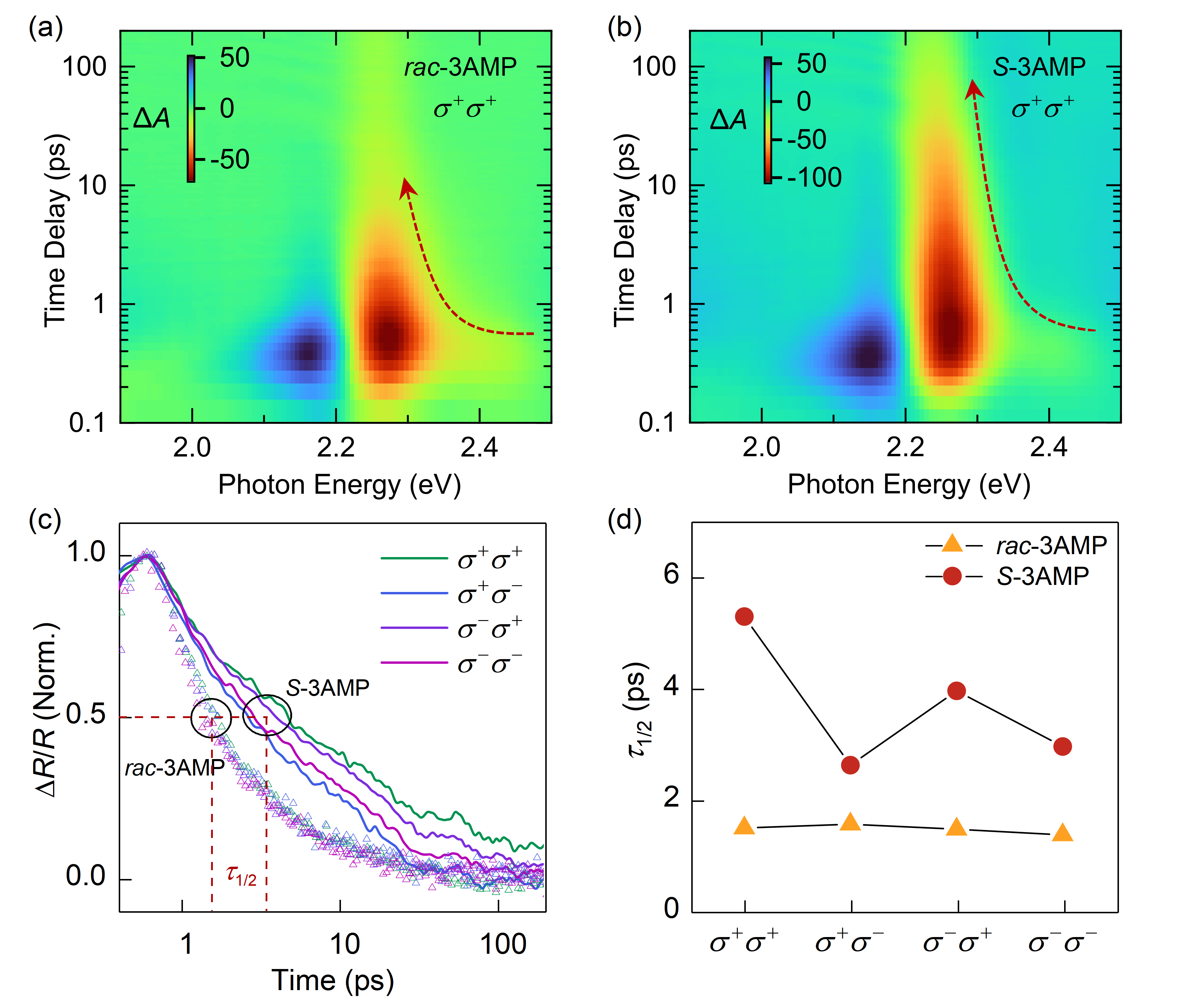
Fig. 3. Spin-dependent hot-carrier relaxation dynamics.
This work establishes a direct connection between photoinduced transient strain, enhanced spin splitting, and hot-carrier relaxation. It reveals how lattice and spin degrees of freedom can cooperatively regulate nonequilibrium carrier dynamics and provides new opportunities for developing spin-optoelectronic devices, hot-carrier technologies, and spin-related energy-conversion systems.
Dr. Yuling HUANG, a postdoctoral researcher at the Institute for Carbon Neutrality, SUSTech, and Xiaofeng LUO, a Ph.D. student from the School of Physics at South China Normal University, are the co-first authors of the paper. Associate Professor Xihan CHEN of SUSTech and Associate Researcher Jinzhu ZHAO of South China Normal University are the corresponding authors. SUSTech is the first affiliated institution of the work.
Paper Link: https://journals.aps.org/prl/abstract/10.1103/9tfy-gp2t
Proofread ByNoah Crockett, Junxi KE
Photo By