The team led by Associate Professor Hongqiang WANG from the Department of Mechanical and Energy Engineering at the Southern University of Science and Technology (SUSTech) published a research article titled “A thin robot made of flexible electronics for in-situ machining and inspection of large structures” in Nature Communications. The team developed a novel “two-degree-of-freedom” electrostatic film actuator fabricated using flexible-circuit techniques, featuring high repeatability, speed, and output force. By further integrating electrostatic adhesion, the team built an ultrathin flexible robot with a thickness of only 970 μm and a mass of approximately 19.7 g, targeting in-situ machining and inspection in narrow internal spaces and on complex surfaces of large structures where conventional robots are difficult to deploy.
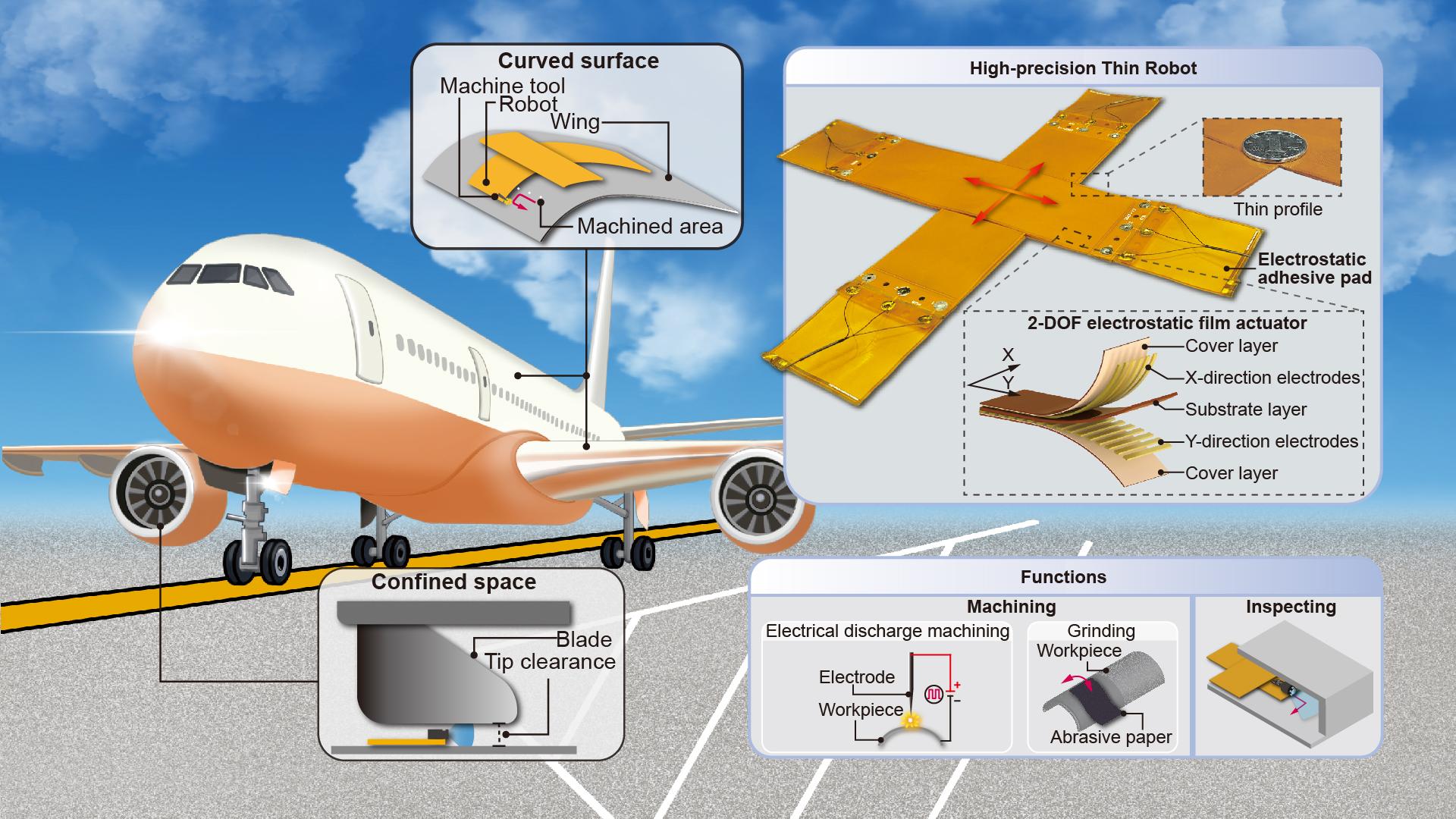
Large and complex structures such as aircraft and ships require frequent inspection, cleaning, and maintenance during service, yet conventional machine tools are difficult to apply to workpieces of such large dimensions. Various mobile robots for in-situ operation, including wheeled and legged platforms, have been developed. Existing platforms are often heavy (>7 kg) and bulky (minimum dimension >0.35 m), which may deform or damage thin-shell structures and delicate surfaces, increasing the risk of fracture and corrosion. Their large form factors also limit access to confined spaces. Therefore, new actuation technologies are urgently needed to build flexible robots that can enter narrow spaces and adapt to complex surfaces, providing a new technical route for in-situ machining and inspection.
Electrostatic film actuators generate electrostatic driving forces via micrometer-scale electrode arrays embedded in flexible films, offering a thin, flexible form factor, low power consumption, and high open-loop control accuracy. However, conventional actuators typically move along only one direction, limiting their use in complex operations. To address this challenge, the team proposed a two-degree-of-freedom actuator based on an orthogonal two-layer electrode architecture. As shown in Fig. 1(a), the actuator can generate two mutually orthogonal driving forces in the plane, thereby driving the slider to move in arbitrary planar directions. Fig. 1(b) and Fig. 1(c) show the electrode details and the assembly scheme, respectively, highlighting advantages such as ease of fabrication and assembly and potential scalability. In Fig. 1(d), the actuator follows the “SUSTech” lettering trajectory using only open-loop control, demonstrating its positioning capability.
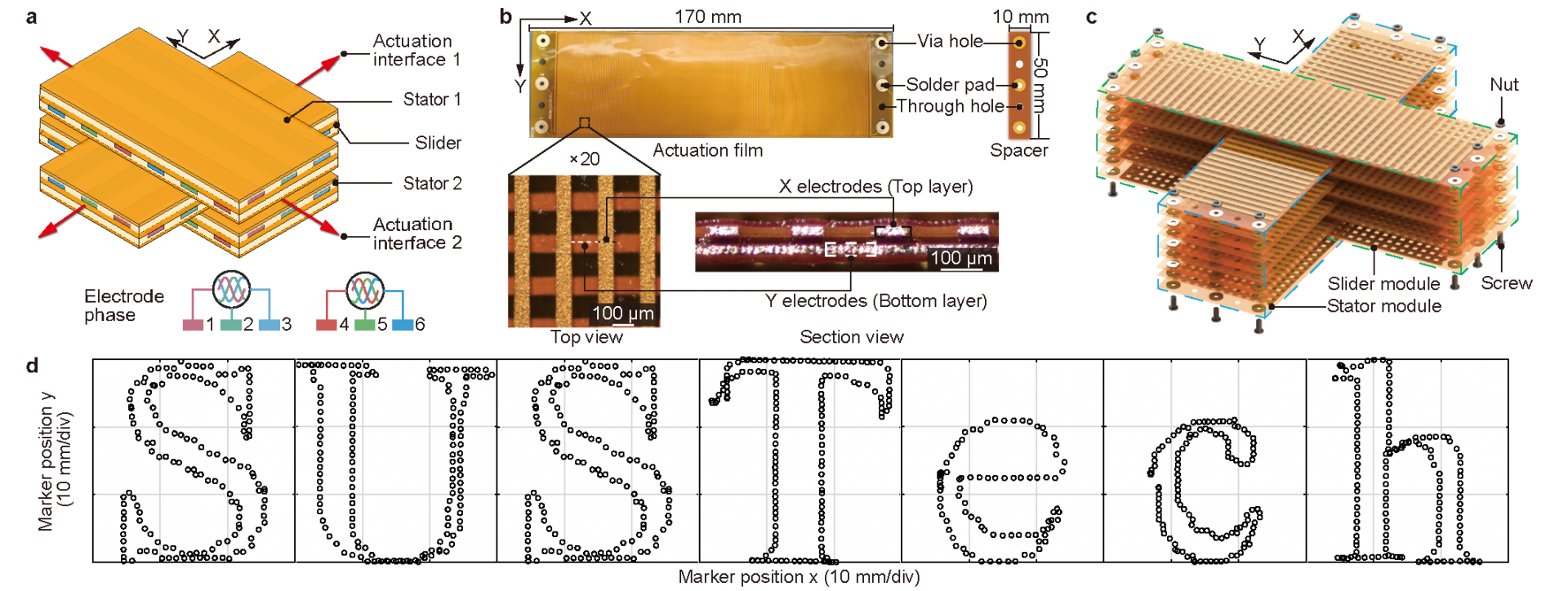
Fig. 1. Mechanism, structure, and performance of the two-degree-of-freedom electrostatic film actuator. (a) Design and operating principle of the actuator. (b) Images of the actuation film and its electrodes. (c) Schematic of the actuator assembly. (d) The actuator follows the “SUSTech” trajectory.
At the robot level, the team connected electrostatic adhesive pads to the ends of the actuator through flexible joints, enabling independent control of the adhered and released states between the slider/stator and the substrate. This design converts the actuator’s local motion into large-range locomotion of the entire robot. As shown in Fig. 2(a), the robot can perform both straight and diagonal movements, reaching a maximum speed of approximately 39.0 mm/s, which provides a locomotion basis for in-situ operation.
The robot also shows adaptability on different surfaces. As shown in Fig. 2(b), it can locomote on various insulating substrates, including acrylic, paper, rubber, and wood, demonstrating the compatibility of the electrostatic adhesive feet with different material surfaces. Fig. 2(c) and Fig. 2(e) show locomotion on curved and vertical surfaces, respectively, indicating that the robot can adapt to complex geometries, such as curved and vertical surfaces, commonly found in large structures, including aircraft and ships.
Benefiting from its lightweight structure, the robot can perform low-damage operations on fragile or sensitive surfaces. Fig. 2(d) shows that it can move on a 10 μm-thick aluminum foil surface without causing damage, demonstrating its compatibility with thin-shell structures and delicate surfaces. Owing to its flexible design, the robot can also conform to more complex geometries under external constraints, as shown in Fig. 2(f), it moves along the outer surface of a small-radius cylindrical tube, demonstrating its adaptability to complex structures. Fig. 2(g) shows that it can carry a payload of approximately four times its own weight, indicating that the platform can carry functional modules such as sensors and machining tools. Fig. 2(h) shows that the robot can maintain locomotion after deformation caused by external impact, supporting stable operation in complex environments.
Fig. 2. Locomotion performance of the robot. (a) Two-dimensional locomotion. (b) Locomotion on insulating substrates. (c) Locomotion on a curved surface. (d) Traversal on 10 μm-thick aluminum foil. (e) Locomotion on a vertical surface. (f) Locomotion on the outer surface of a small-radius cylindrical tube. (g) Payload test. (h) Robustness test.
The team further demonstrated the robot’s potential for in-situ inspection. By mounting a micro camera on the robot’s foot, as shown in Fig. 3(a), the robot can enter a narrow gap only 7 mm high to capture images, and can inspect and reconstruct the internal structure through scanning. This demonstration verifies the feasibility of using the robot for internal inspection of confined spaces in large structures.
In the in-situ machining demonstration, the robot carried a micro tungsten discharge needle to the target region and performed electrical discharge machining on a 3 × 3 array within a 9 mm × 9 mm area, as shown in Fig. 3(b). This result indicates the platform’s potential to bring microscale machining capability into spaces that are difficult for conventional equipment to reach.
The team also demonstrated the robot’s use in in-situ grinding. Fig. 3(c) shows the process and result of the robot carrying abrasive paper to grind a curved surface, while Fig. 3(d) further shows controlled-area grinding. These demonstrations verify the platform’s feasibility for maintenance and localized treatment of complex surfaces on large structures.
Fig. 3. Demonstrations of in-situ operation by the robot. (a) Narrow-gap inspection and three-dimensional reconstruction of internal structures. (b) Array electrical discharge machining. (c) Curved-surface grinding. (d) Controlled-area grinding.
Overall, this study combines flexible-electronics manufacturing, electrostatic actuation, and robotic system design to establish an ultrathin, flexible robotic platform that offers a thin, lightweight form factor, surface adaptability, and tool-carrying capability. The demonstrations verify its feasibility in in-situ operation scenarios such as locomotion on complex surfaces, narrow-gap inspection, curved-surface grinding, and microscale electrical discharge machining, providing a new technical approach for in-situ inspection and machining in geometrically constrained and sensitive environments where conventional rigid robots are difficult to deploy or operate safely.
Huacen WANG, a doctoral student in the Department of Mechanical and Energy Engineering at SUSTech, is the first author of the paper. Yujin DAI, a master’s student; Ting WANG, a visiting scholar; Wuheng WANG, Liwei SHI, and Jiarui ZOU, undergraduate students; and Zeju ZHENG, a visiting student, all from the Department of Mechanical and Energy Engineering at SUSTech, are co-authors. Hongqiang WANG is the sole corresponding author. SUSTech is the first affiliation.
Proofread ByNoah Crockett, Junxi KE
Photo By