Professor Jing XU’s team at the Southern University of Science and Technology (SUSTech) made a significant breakthrough in the asymmetric total synthesis of the cryptic diterpenoid natural product Venezuelaene A. Their research, titled “Asymmetric Total Synthesis of Venezuelaene A via TEMPO⁺BF₄⁻-Mediated Oxidative Nazarov Cyclization and Cascade Metathesis,” was published in the Journal of the American Chemical Society (JACS).
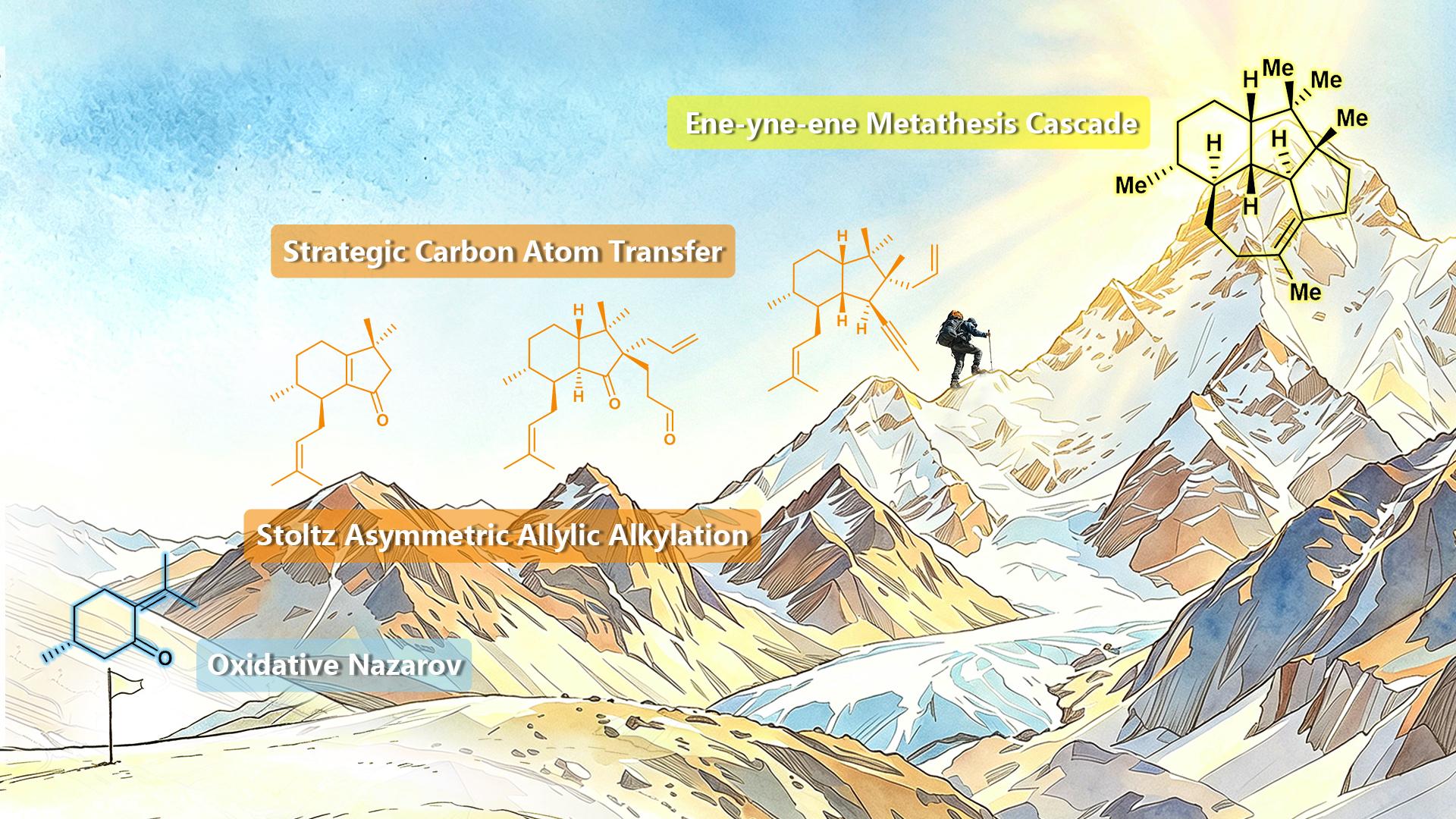
This molecule features a rare [5-5-6-7] tetracyclic framework, including a highly strained trans-fused [5-5] ring, two adjacent quaternary carbons, and six consecutive stereocenters, making its synthesis extremely challenging. The team completed the first asymmetric total synthesis of this molecule in 22 steps using TEMPO⁺BF₄⁻-mediated oxidative Nazarov cyclization, Stoltz decarboxylative asymmetric allylation, an intramolecular carbon atom transfer strategy, and alkene-alkyne-alkene cascade metathesis, providing a new approach for the efficient construction of complex polycyclic terpenes.
Terpenes, as the most structurally diverse family of natural products, exhibit wide and significant biological activity, and members with highly strained fused ring systems are particularly challenging to synthesize. In 2020, Professor Shengying LI’s team at Shandong University discovered Venezuelaene A/B from Venezuelan streptomycetes through genome mining. Their skeleton contains a highly strained trans-fused [5-5] ring, two adjacent quaternary carbons, and six consecutive stereocenters, making synthesis extremely difficult. Starting from inexpensive chiral starting material (-)-isopulegone, Professor XU’s group designed the retrosynthetic analysis (Figure 1). The [5-7] bicyclic unit of the target molecule would be constructed via alkene-alkyne-alkene cascade metathesis; the alkyne and the C20 angular methyl would be transformed through an intramolecular carbon atom transfer strategy (Pinacol coupling, ring opening, decarbonylation, Colvin rearrangement); the C3 quaternary carbon center would be installed via Stoltz decarboxylative allylation, and the remaining [6-5] bicyclic unit’s cyclopentenone moiety comes from the team’s TEMPO⁺BF₄⁻-mediated oxidative Nazarov cyclization.
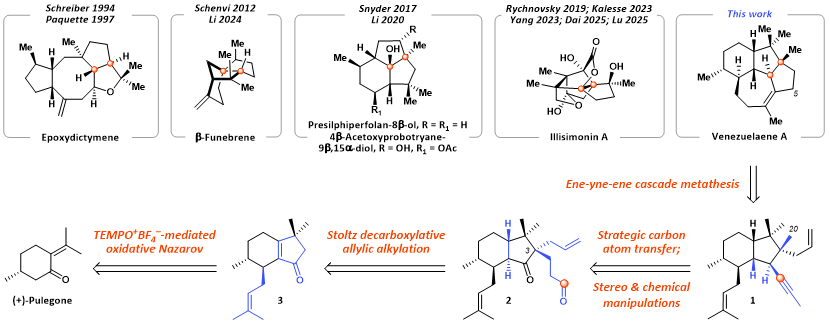
Figure 1. Representative natural products containing the high-strain trans [5-5] ring system and the retrosynthetic analysis of venezuelaene A.
In the synthesis, the research team first introduced a bulky isoprenyl group into (+)- menthone, and through a 1,2-addition obtained the dienyl tertiary alcohol 5. Then, using TEMPO⁺BF₄⁻ in DME at room temperature, they achieved an oxidative Nazarov cyclization, constructing the [6-5] bicyclic α,β-unsaturated ketone 3 with a C15 tertiary carbon in 61% yield. Afterwards, the Stoltz asymmetric decarboxylative allylation successfully installed the C3 tertiary carbon. However, early attempts to homologate the intermediate and control the C1/C2 stereochemistry ran into serious obstacles. The conjugated reduction product was difficult to isomerize into the cis-fused compound, and the C2 ketone carbonyl was too hindered to allow effective functionalization. Various derivatization strategies all failed (Figure 2).

Figure 2. Challenges of homologation and stereochemical control encountered in early studies.
The research team turned to an intramolecular carbon transfer strategy (Figure 3), constructing a new five-membered ring through SmI₂-mediated pinacol coupling, then highly stereoselectively reducing it under lithium/ammonia conditions to get cis-cis-fused [6-5-5] tricyclic compound 24. After ring opening to get compound 27, they successfully overcame both steric and stereochemical challenges. This strategy may seem roundabout, but it could be the only viable pathway in the context of this synthesis. After building the C20 angular methyl via Tsuji-Wilkinson decarbonylation, constructing the terminal alkyne via Colvin rearrangement and methylation. To get the enyne-ene precursor 1, they smoothly constructed the [5-7] bicyclic system under tandem metathesis conditions, obtaining the [5-5-6-7] tetracyclic framework without detecting the [6-5-6-6] byproduct, marking the first time such a metathesis reaction was used to construct complex systems containing a trans-fused [5-5] high-strain motif. Finally, selective hydrogenation of the diene completed the total synthesis of Venezuelaene A in 58% yield.
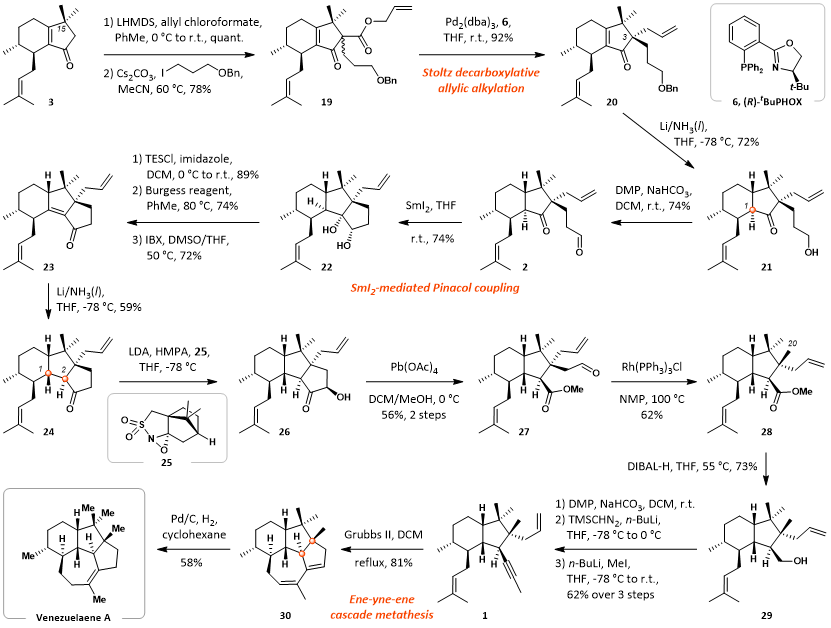
Figure 3. Total Synthesis of Venezuelaene A
This is a breakthrough in the total synthesis of highly strained polycyclic terpenes and is the first to achieve the asymmetric synthesis of Venezuelaene A. The core strategies include TEMPO⁺BF₄⁻-mediated oxidative Nazarov cyclization, Stoltz decarboxylative asymmetric allylation, intramolecular carbon atom transfer strategy, and enyne-ene tandem cross-metathesis reactions. This study not only provides new ideas for the synthesis of complex natural products with severe steric hindrance and high strain but also demonstrates the synthetic utility and strategic value of TEMPO⁺BF₄⁻-mediated Nazarov reactions in building complex polycyclic frameworks with highly substituted five-membered carbon rings.
The first author is PhD student Sujun XIE from the Department of Chemistry at SUSTech. Professor Jing XU and Associate Professor Chengqing NING are the co-corresponding authors. SUSTech is the first affiliation of the paper. PhD student Axiao TAO, Master’s student Qian WANG, and visiting student Jiadong YU also made significant contributions. Research Assistant Professor Xiaoyong CHANG and Assistant Researcher Yang YU at the Department of Chemistry provided important support for crystal structure analysis and mass spectrometry.
Paper Link: https://doi.org/10.1021/jacs.6c09948
Proofread ByNoah Crockett, Junxi KE
Photo ByDepartment of Chemistry