Professor Zhen GAO’s team at the Southern University of Science and Technology (SUSTech) achieved the first experimental observation of antichiral hinge states in a 3D gyromagnetic photonic crystal, extending the antichiral topological states from first-order to higher-order topological phases. The research team realized the antichiral transport of higher-order hinge states in 3D gyromagnetic photonic crystals through a two-dimensional modified Haldane model with dimerized interlayer stacking. This system simultaneously exhibits a unique topological semimetal phase, an unconventional band configuration of nodal surfaces wrapping nodal lines, and supports tilted, four-fold, degenerate hinge state dispersions. This achievement opens a new path for the multi-channel integration of 3D nonreciprocal topological photonic devices and is expected to promote the development of robust electromagnetic transport and high-density waveguide interconnects. The related results were published in Nature Communications under the title “Observation of Antichiral Hinge States in a Three-dimensional Gyromagnetic Photonic Crystal.”
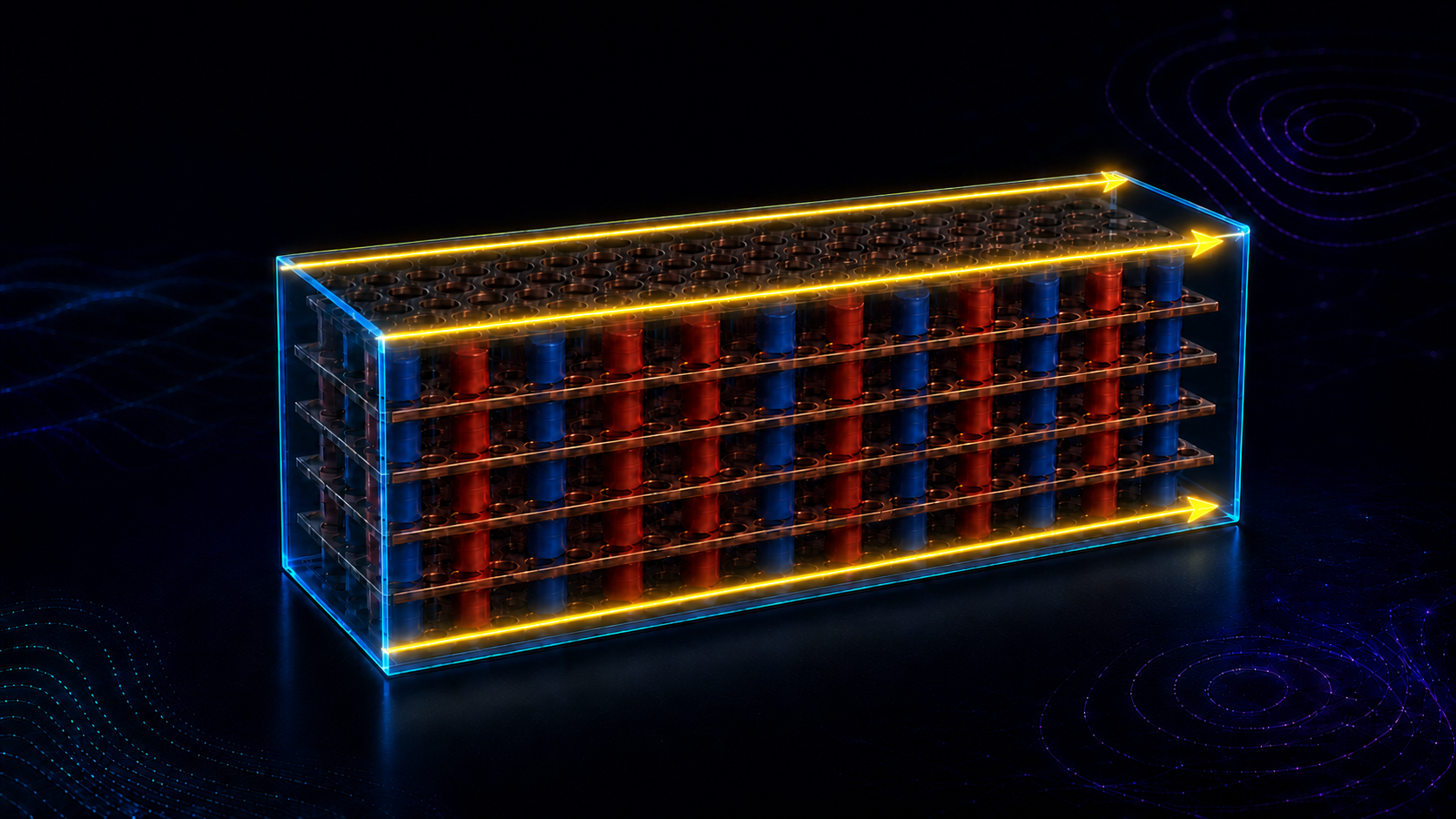
Antichiral edge states and surface states can propagate in the same direction along spatially separated parallel boundaries. To date, the experimental realization of antichiral states has been limited to first-order topological phases, and their higher-order counterparts, antichiral hinge states, have remained elusive in experiments. The research team experimentally observed antichiral hinge states for the first time in a gyromagnetic photonic crystal, which implements a 3D modified Haldane model with dimerized interlayer coupling. Through microwave near-field scanning, the team directly resolved its hallmark features, nonreciprocal, co-propagating transport along four parallel hinges, as well as the characteristic tilted hinge state dispersion. These results extend antichiral topology to higher-order systems and establish a universal platform for 3D nonreciprocal topological photonic devices.
To clearly illustrate the core innovation of this work, Figure 1 compares the propagation behaviors of chiral and antichiral topological states in 2D and 3D systems: 2D chiral edge states propagate in opposite directions along two parallel boundaries (Figure 1a), whereas antichiral edge states propagate in the same direction along two parallel boundaries (Figure 1b). Generalizing this concept to 3D higher-order topological systems, chiral hinge states propagate in opposite directions along two pairs of parallel hinges (Figure 1c), while the antichiral hinge states realized for the first time in this study propagate in the same direction along two pairs of parallel hinges (Figure 1d). This comparison intuitively demonstrates that antichiral hinge states extend the “co-propagating” characteristic from first-order boundary states to higher-order hinge states, providing a completely new approach for 3D nonreciprocal multi-channel transport.
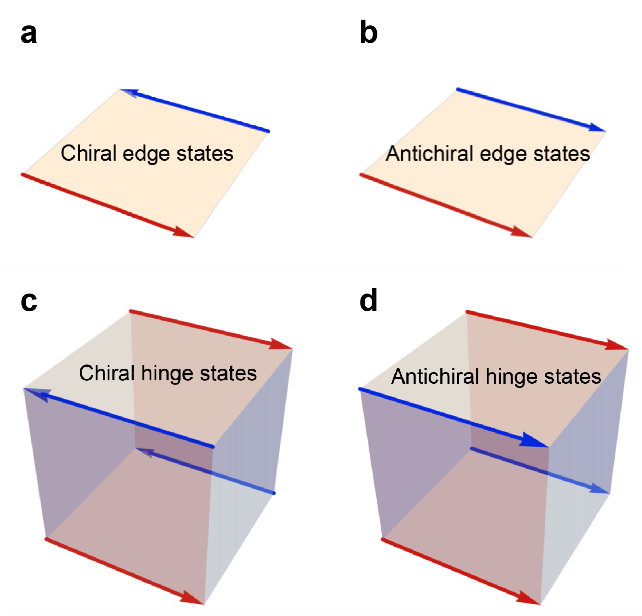
Figure 1. Schematic of chiral and antichiral topological states in 2D and 3D systems. a, Chiral edge states, propagating in opposite directions along two parallel boundaries. b, Antichiral edge states, propagating in the same direction along two parallel boundaries. c, Chiral hinge states, propagating in opposite directions along two pairs of parallel hinges. d, Antichiral hinge states, propagating in the same direction along two pairs of parallel hinges.
The study first constructed a 3D tight-binding model consisting of stacked 2D modified Haldane layers, introducing dimerized interlayer coupling (Figure 2a). The in-plane Hamiltonian describes the modified Haldane model, while the out-of-plane Hamiltonian introduces a Su-Schrieffer-Heeger (SSH) type dimerization for the interlayer coupling, thereby generating higher-order band topology. Because these two act on independent degrees of freedom, this factorization provides an intuitive mechanism for the formation of antichiral hinge states. They originate from the direct product of the in-plane antichiral edge states and the out-of-plane SSH-type topological boundary states. The 3D Brillouin zone (BZ) is shown in Figure 2b. The calculated bulk band structure in Figure 2c reveals a unique topological semimetal phase characterized by the coexistence of frequency-shifted nodal lines (NLs) and nodal surfaces (NSs). The in-plane C3 symmetry protects the nodal lines located at the K and K’ points, making them extend continuously along the k2 direction. Notably, these nodal lines do not exist in isolation but are wrapped by nodal surfaces that form a closed manifold in the 3D momentum space. This unique “nodal surfaces wrapping nodal lines” configuration stems from the interplay between the in-plane Dirac dispersion and the dimerized interlayer coupling. In the projected band dispersion of a finite structure (Figure 2e), the tilted four-fold degenerate hinge state dispersion connects the projections of the frequency-shifted nodal surfaces, while the tilted surface state dispersion emanates from the frequency-shifted nodal lines; their co-propagation along parallel boundaries confirms their antichiral nature. By calculating the nested polarization pyvz in the 3D momentum space (Figure 2f), which is quantized to 1/2 within the momentum interval bounded by the projected boundaries inside the nodal surfaces, the higher-order topological properties of the system are verified.
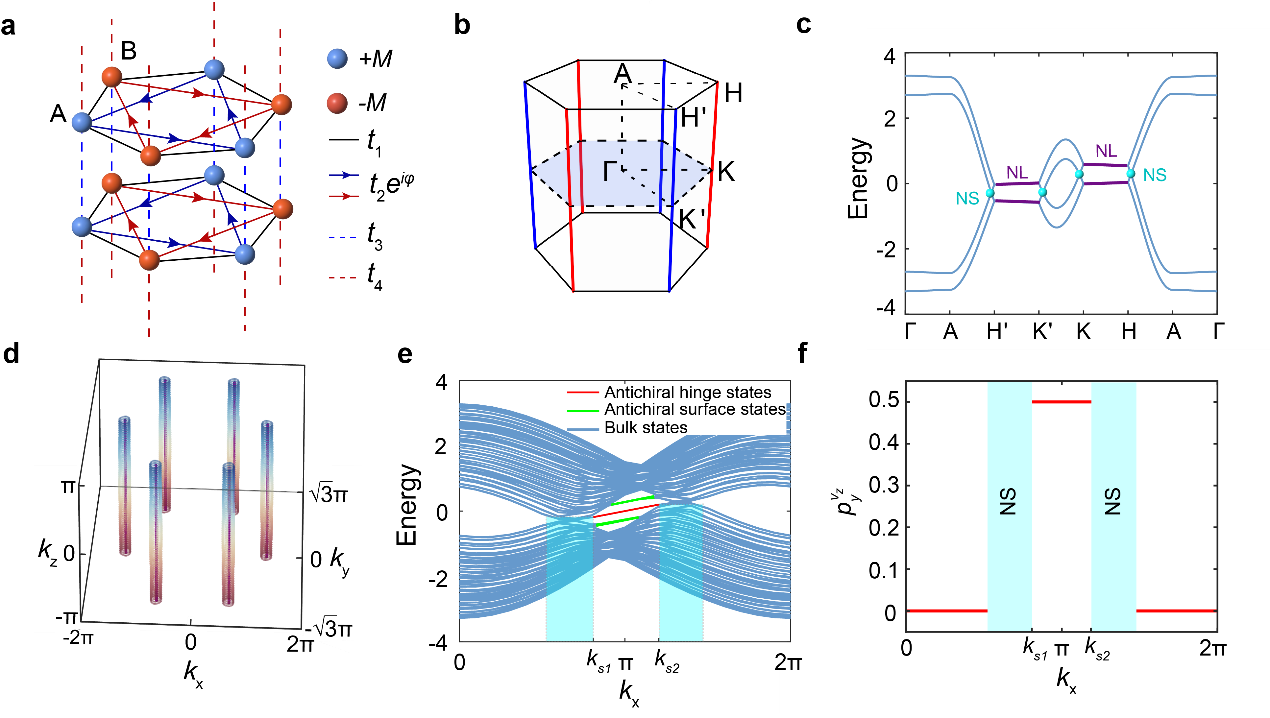
Figure 2. Theoretical model. a, Schematic of the 3D modified Haldane model with dimerized interlayer coupling; sublattices A and B are represented by blue and red spheres, respectively. b, 3D Brillouin zone. c, Calculated bulk band structure of the 3D tight-binding model with parameters M = 0, t1 = 1, t2 = 1/18, Ѱ = π/2, t3 = 0.2, t4 = 5t2. Cyan spheres represent nodal surfaces (NSs), and purple lines represent nodal lines (NLs). d, Visualization of nodal surfaces (colored curved surfaces) and nodal lines (purple lines) in the 3D momentum space. e, Projected band dispersion of the 3D modified Haldane model (finite in the y and z directions, periodic in the x direction) with dimerized interlayer coupling. The red and green lines represent antichiral hinge states and surface states, respectively, and the cyan shaded areas represent the nodal surfaces. f, Variation of the nested polarization pyvz, calculated via the nested Wilson loop for the occupied bands, along kx.
The team implemented this theoretical model in a 3D gyromagnetic photonic crystal. As shown in Figure 3a, the unit cell consists of two types of gyromagnetic cylinders sandwiched between two pairs of permanent magnets, in addition to two perforated metal plates. The permanent magnets generate staggered magnetic fields, causing the gyromagnetic cylinders in sublattices A and B to be magnetized along the +z and -z directions, respectively, to break time-reversal symmetry while preserving the required sublattice symmetry. Higher-order topology is achieved by tuning the geometry of the two perforated metal plates to dimerize the interlayer coupling. The simulated bulk band structure of the 3D gyromagnetic photonic crystal (Figure 3b) is highly consistent with the theoretical results. The projected dispersion along the kx direction (Figure 3c) reveals four degenerate antichiral hinge states located within the bandgap of the antichiral surface states. Both exhibit a characteristic tilted dispersion with a positive group velocity, which is a hallmark of antichiral propagation. The simulation results in Figure 3d and 3e indicate that the electromagnetic waves are tightly localized on the four parallel hinges and nonreciprocally propagate in the same direction along all four parallel hinges, directly proving the realization of antichiral hinge states.
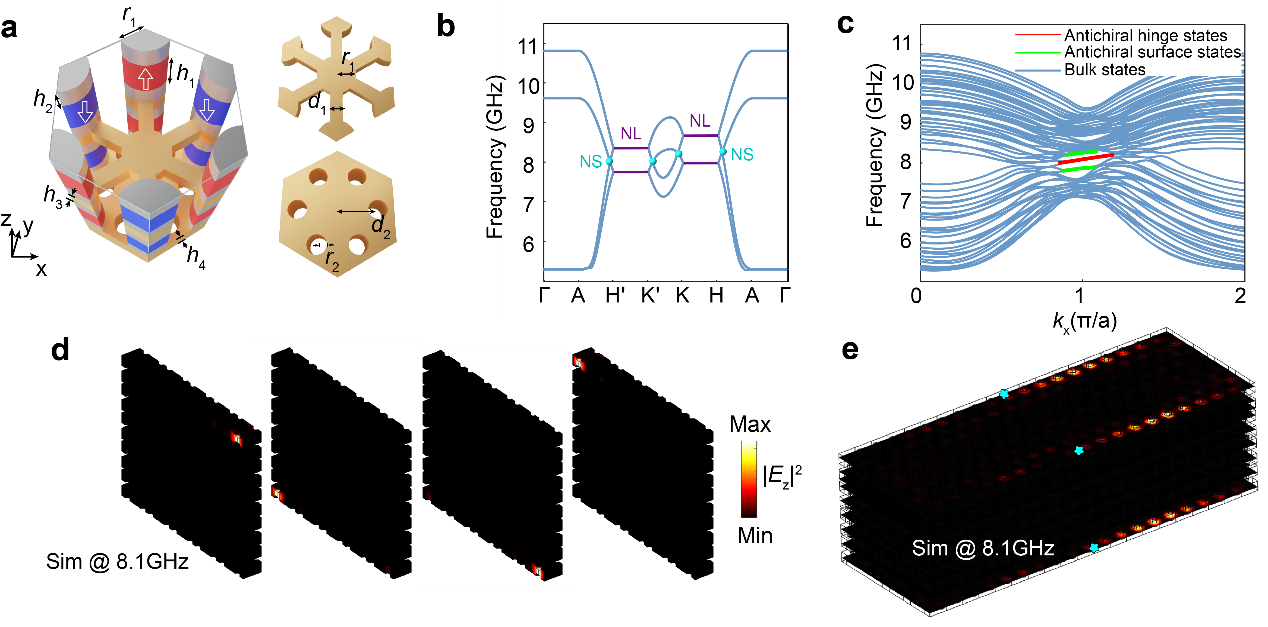
Figure 3. Design of the 3D gyromagnetic photonic crystal. a, Left panel: the unit cell of the 3D gyromagnetic photonic crystal, with an in-plane lattice constant a = 7.5 mm and a lattice constant along the z-direction az = 11 mm. Other geometric parameters are: r1 = 1.3 mm, h1 = 2 mm, h2 = 1 mm, h3 = 1 mm, h4 = 2 mm. Right panel: top views of two different perforated metal plates, with geometric parameters d1 = 0.8 mm, d2 = a/2.8, and r2 = r1/2. White arrows indicate the magnetization directions. b, Simulated bulk band structure of the 3D gyromagnetic photonic crystal along high-symmetry lines. Cyan spheres represent nodal surfaces (NSs), and purple lines represent nodal lines (NLs). c, Simulated projected dispersions of antichiral surface states (green lines) and hinge states (red lines) along the kx direction. d, Simulated electric field distributions of the eigenmodes of the four-fold degenerate antichiral hinge states at kx = π/a. e, Simulated electric field distributions of the antichiral hinge states at a frequency of 8.1 GHz, with a point source (cyan star) placed at the center of the four parallel hinges.
The team experimentally verified the antichiral hinge states in the fabricated 3D gyromagnetic photonic crystal. The sample consists of 20 × 4 × 5 unit cells (Figure 4a). By measuring the transmission spectra at the top two hinges using a pair of source and probe antennas, clear nonreciprocal transmission was observed within the frequency range of the antichiral hinge states (Figure 4b, c), where the forward transmission (S21) significantly exceeds the backward transmission (S12), directly revealing its co-propagating feature along parallel hinges. Using a microwave probe antenna mounted on a robotic arm for near-field scanning, the measured electric field distributions (Figure 4d, e) further demonstrate that the antichiral hinge states propagate unidirectionally along the +x direction on the two parallel hinges. By performing a Fourier transform on the measured complex electric field distributions, the reconstructed dispersion relations of the hinge states (Figure 4f, g) agree well with the simulation results, exhibiting the typical tilted dispersion and positive group velocity characteristics of antichiral propagation.
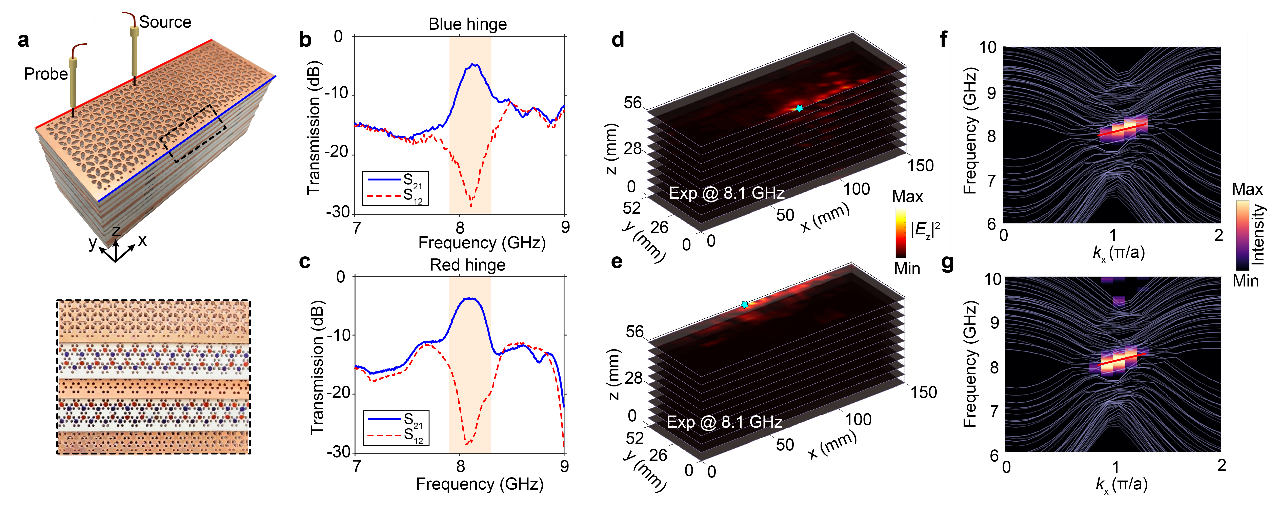
Figure 4. Experimental observation of antichiral hinge states. a, Upper panel: photograph of the fabricated 3D gyromagnetic photonic crystal sample, containing 20 × 4 × 5 unit cells in the x, y, and z directions, respectively. Lower panel: enlarged photograph of the perforated copper plates and foam boards (white). Red and blue disks indicate the magnetization directions of the gyromagnetic cylinders at different sublattice sites, respectively. b, c, Forward (S21, blue line) and backward (S12, red line) transmission spectra measured at the top two hinges. The orange shaded area indicates the frequency range of the antichiral hinge states. d, e, Measured electric field distributions of the antichiral hinge states at 8.1 GHz when the source antenna (cyan star) is placed at the center of the hinges. f, g, Comparison of the measured dispersions (color maps) and simulated dispersions (red lines) of the antichiral hinge states at the top two hinges along the kx direction.
The team investigated the topological robustness of the hinge states. Microwave near-field measurements were performed in a 3D gyromagnetic photonic crystal containing a sharp corner (Figure 5a-c), and the results indicate that the antichiral hinge states can smoothly bypass the sharp corner without significant backscattering. The team removed one gyromagnetic cylinder and its corresponding permanent magnet along its propagation path to introduce a lattice defect (Figure 5d-f). The measured electric field distribution proves that the hinge states can circumvent the defect and continue transmitting, verifying the strong robustness of the antichiral hinge states protected by topology.
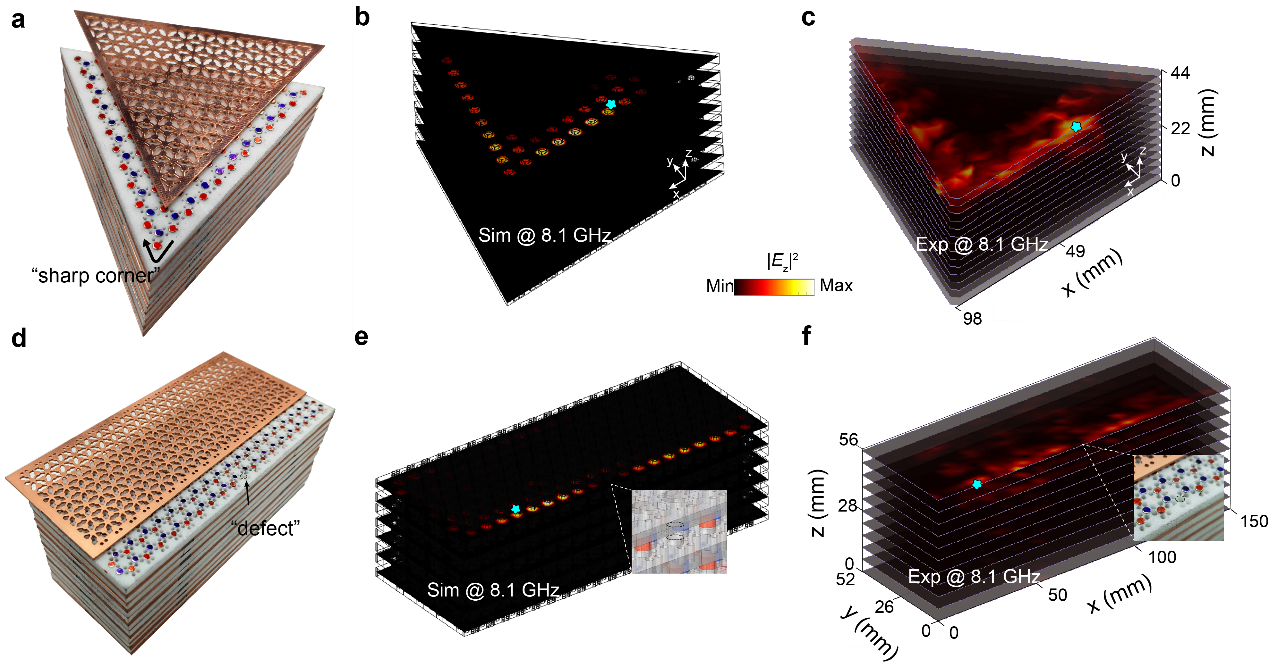
Figure 5. Experimental verification of the robustness of antichiral hinge states against sharp corners and structural defects. a, Photograph of the fabricated 3D gyromagnetic photonic crystal sample containing a sharp corner. b, c, Simulated (b) and measured (c) electric field distributions showing the antichiral hinge states smoothly bypassing the sharp corner without backscattering. d, Photograph of the fabricated 3D gyromagnetic photonic crystal sample containing a lattice defect at the top hinge. e, f, Simulated (e) and measured (f) electric field distributions showing the antichiral hinge states passing through the lattice defect without backscattering.
Ziyao WANG, a Doctoral student at SUSTech, and Tianzhi XIA, a lecturer at Qujing Normal University, are the co-first authors. Lecturer Tianzhi XIA, Postdoctoral Fellow Hanrong XIA, and Professor Zhen GAO are the co-corresponding authors of the paper. SUSTech is the primary affiliated institution of the paper.
Paper Link: https://www.nature.com/articles/s41467-026-77286-6
Proofread ByNoah Crockett, Junxi KE
Photo By