Professor Hai-Zhou LU’s research group from the Department of Physics at the Southern University of Science and Technology (SUSTech), the State Key Laboratory of Quantum Functional Materials, Guangdong Provincial Key Laboratory of Topological Matter, and the Quantum Science Center of Guangdong-Hong Kong-Macao Greater Bay Area made significant progress in the theoretical study of third-order nonlinear transport in quantum materials. The research team put quantum geometric effects and disorder scattering mechanisms into a unified framework, systematically revealing 20 possible mechanisms for third-order nonlinear transport, and proposed a data analysis method that combines magnetic point group symmetry diagnostics with scaling law fitting. This provides an operational “mechanism fingerprint” to quantitatively distinguish the contributions from quantum geometry and disorder scattering in experiments. The related results were published in the international physics journal Physical Review X under the title “Identifying Geometric Third-Order Nonlinear Transport in Disordered Materials.”
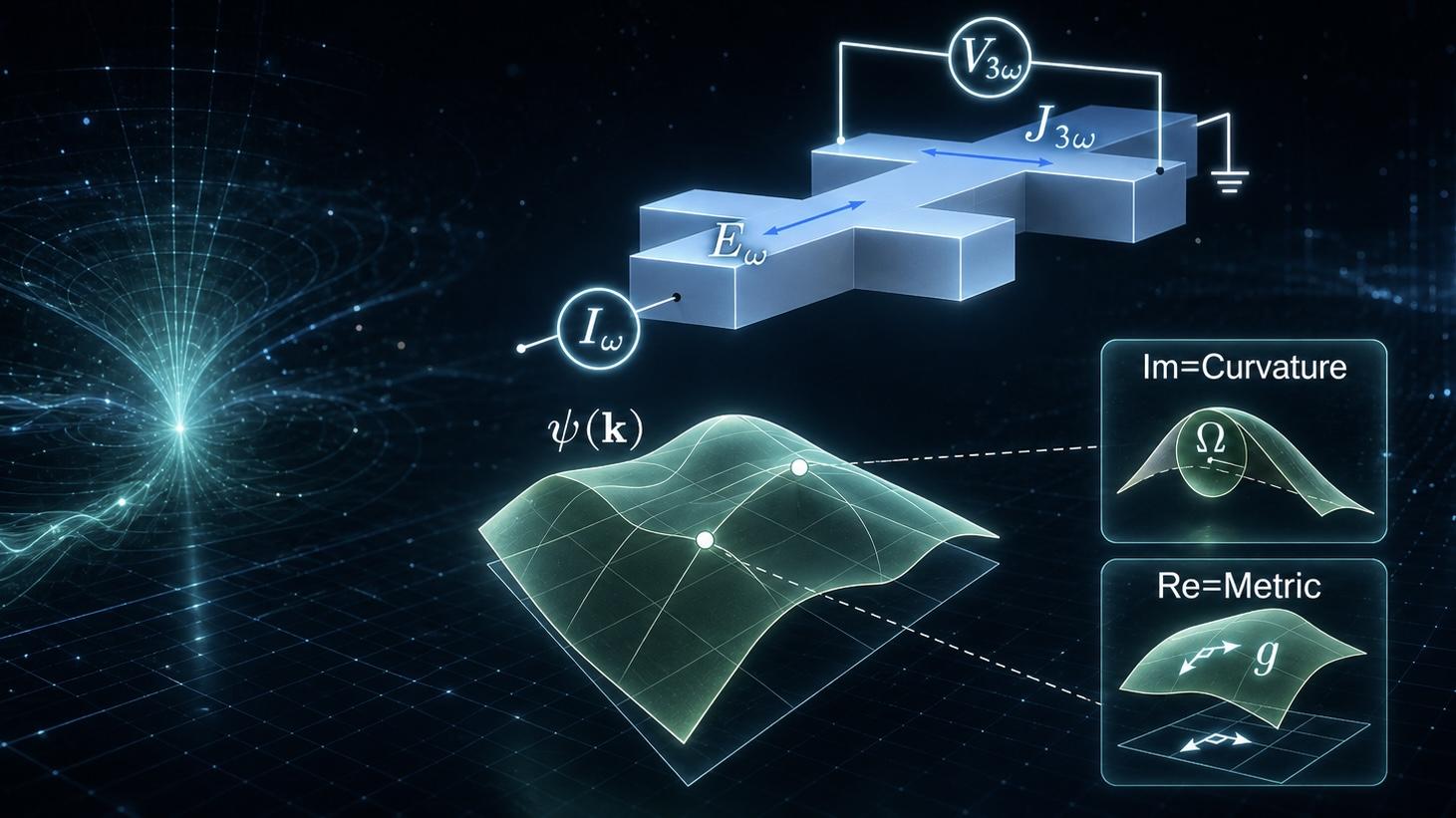
In conventional low-frequency AC transport measurements, experiments typically read the voltage signal at the same frequency as the driving current. If higher harmonic voltages such as the second and third harmonics are measured, a new window opens for observing the geometric properties of quantum materials. In recent years, the second-order nonlinear Hall effect has been widely used to detect Berry curvature dipoles and quantum metric dipoles; the third-order nonlinear Hall effect is thought to reveal Berry curvature quadrupoles, quantum metric quadrupoles, and intrinsic third-order mechanisms that mix Berry curvature and quantum metrics.
In real materials, impurities and defects are inevitable. Processes like side jumps and skew scattering of electrons in disordered potentials can also generate nonlinear responses. Observing a third-harmonic transverse voltage in experiments does not automatically mean it comes from quantum geometry. How to compare intrinsic quantum geometric contributions with extrinsic disorder scattering contributions within the same theoretical framework, and reliably identify the dominant mechanism from experimental data, is a key challenge in this rapidly developing field.
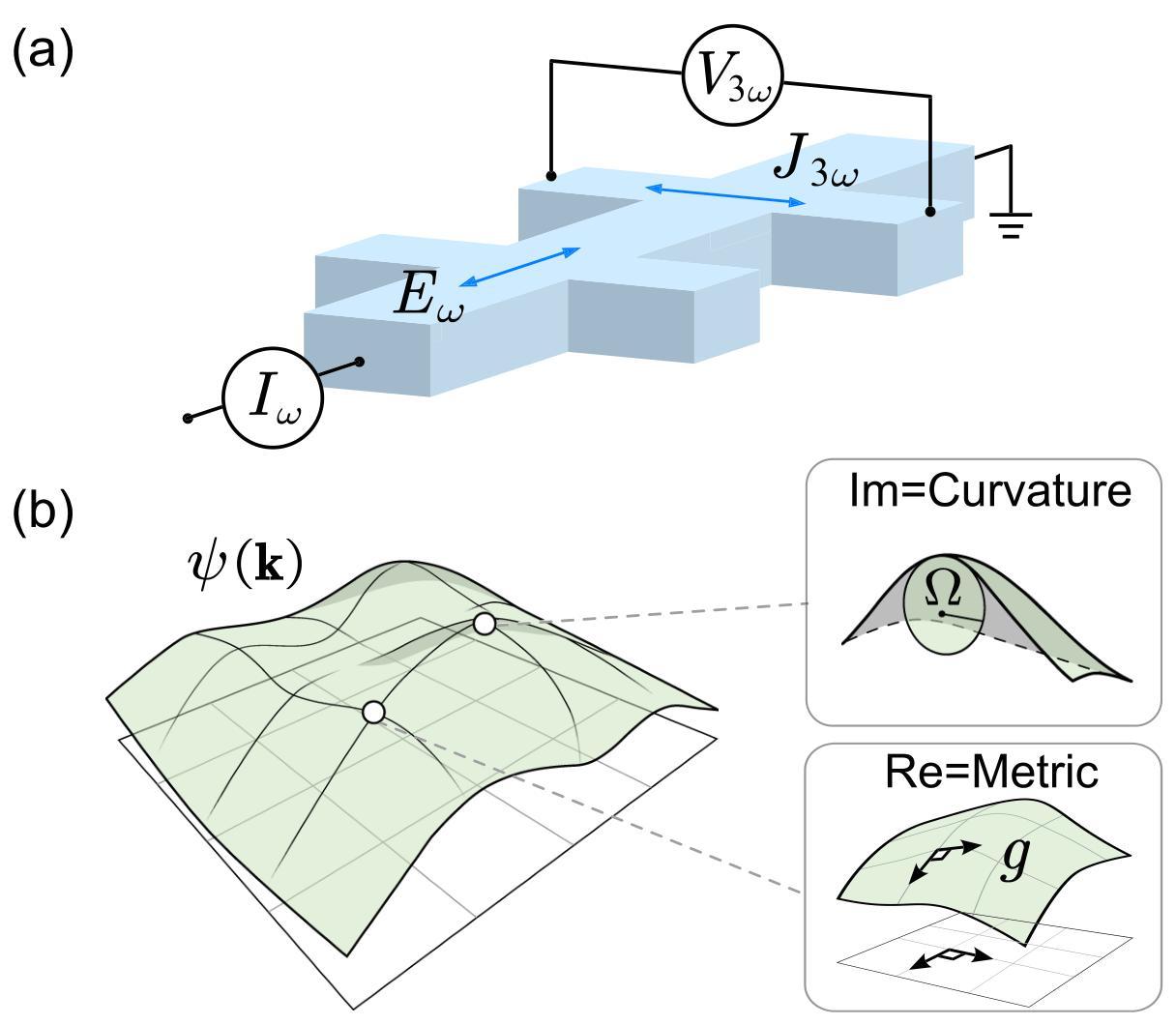
Figure 1. Schematic diagram of the measurement of the third-order nonlinear Hall effect and the Berry curvature and quantum metric in the quantum state manifold.
To address this issue, the research team started from the Boltzmann equation, simultaneously expanding the electron velocity and nonequilibrium distribution function under the action of an electric field. Quantum geometry, side jump, and skew scattering can each enter different orders of velocity or the distribution function; when all contributions line up at the third order of the electric field, the team obtained a complete map of the third-order nonlinear transport mechanisms. In addition to the previously studied Berry curvature quadrupole, quantum metric quadrupole, and third-order intrinsic mechanisms, the framework also includes third-order skew-scattering, third-order side-jump, and various mechanisms mixing quantum geometry with disorder scattering, totaling 20 different mechanisms.
The significance of this “mechanism panorama” is that it no longer assumes in advance that higher-order nonlinear signals come from some idealized mechanism, but instead allows all possible contributions to be tested at the same theoretical level. The study also categorizes the relevant mechanisms into time-reversal even and time-reversal odd based on time-reversal symmetry, providing an initial filter for subsequent experimental diagnostics.
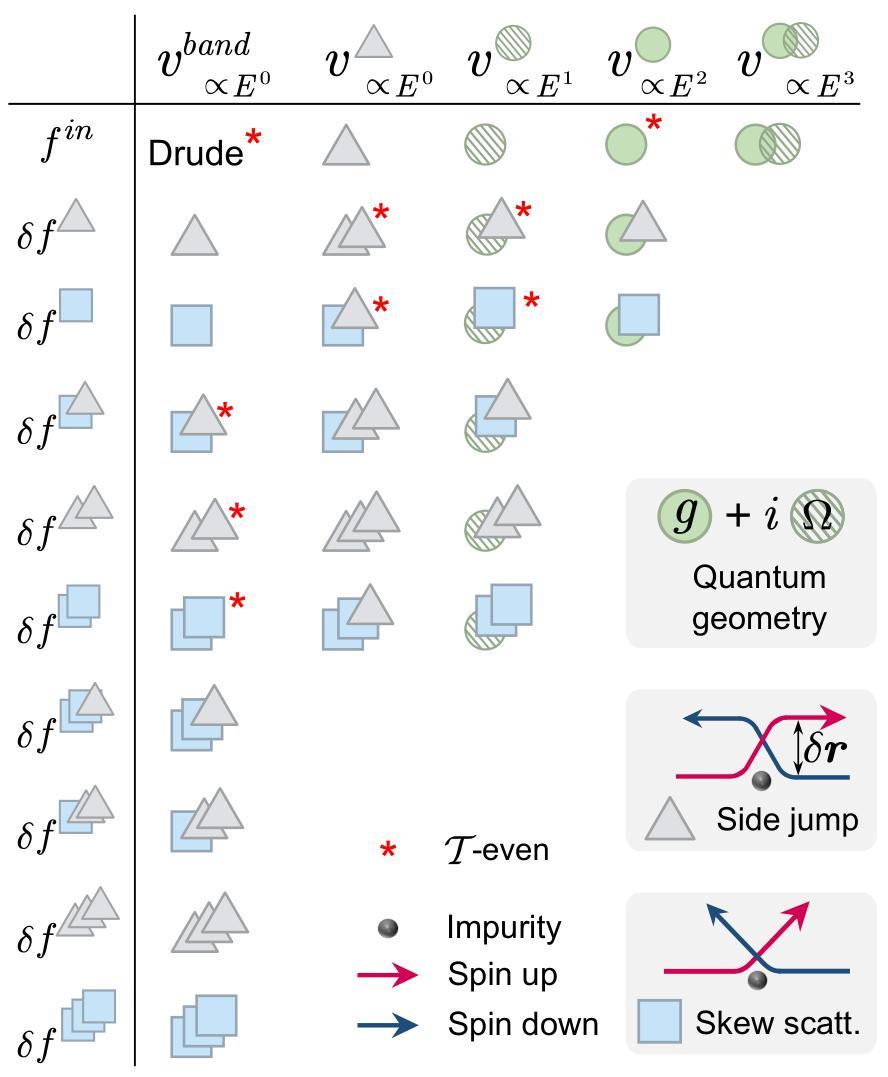
Figure 2. Schematic map of third-order nonlinear transport mechanisms. Quantum geometry, side-jump, and skew scattering combine in different orders of velocity and nonequilibrium distribution functions, forming 20 mechanisms.
After fully listing all the mechanisms, the research team further addressed the problem of “how to identify them from data.” The core principle is to establish a scaling law relationship between third-order nonlinear conductivity and linear longitudinal conductivity. Since linear and nonlinear conductivities depend differently on scattering time, different physical mechanisms leave distinct weight distributions on the powers of the scaling polynomial, like a set of “mechanism fingerprints” that can be read and fitted from experiments.
The study found that among the 20 mechanisms, 12 have distinguishable weight features when dominant. For example, the third-order intrinsic mechanism, the quantum metric quadrupole mechanism, and the Berry curvature quadrupole mechanism correspond to different dominant terms in the scaling law; if disorder scattering is involved, characteristic combinations can appear among multiple polynomial terms. This means experimentalists don’t have to rely solely on signal magnitude or trends in a single temperature range to identify mechanisms—they can quantitatively fit multiple sets of data and perform confidence checks by continuously adjusting temperature, disorder level, or longitudinal conductivity.
To test the applicability of the scheme, the team applied the scaling law to analyze various reported experimental data, including 2D materials, topological materials, ferromagnets, and antiferromagnets. Analysis of systems like MoTe₂, WTe₂, FeSn, and Fe₅GeTe₂ shows that quantum metric quadrupoles, Drude-type contributions, mixtures of quantum geometry with side-jump or skew scattering, and third-order intrinsic mechanisms each exhibit their own dominant features in different materials and temperature ranges. The analysis of Fe₅GeTe₂ further shows that above 100 K, the signal is mainly contributed by the second-order side-jump mechanism and a mixture of Berry curvature and skew scattering; when the temperature drops below 100 K, the nonlinear Hall conductivity flattens and becomes almost independent of longitudinal conductivity. Based on this, it’s inferred that in the 40-100 K range, the response is mainly dominated by the third-order intrinsic mechanism. This mechanism arises from the geometric coupling of Berry curvature and quantum metric, is scattering-independent, and aligns with the experimental observation of ferromagnetic order in Fe₅GeTe₂ around 100 K. The researchers also applied this scaling law to analyze data for materials such as FeTe, Cd₃As₂, TaIrTe₄, MnBi₂Te₄, VSe₂, and RuO₂.
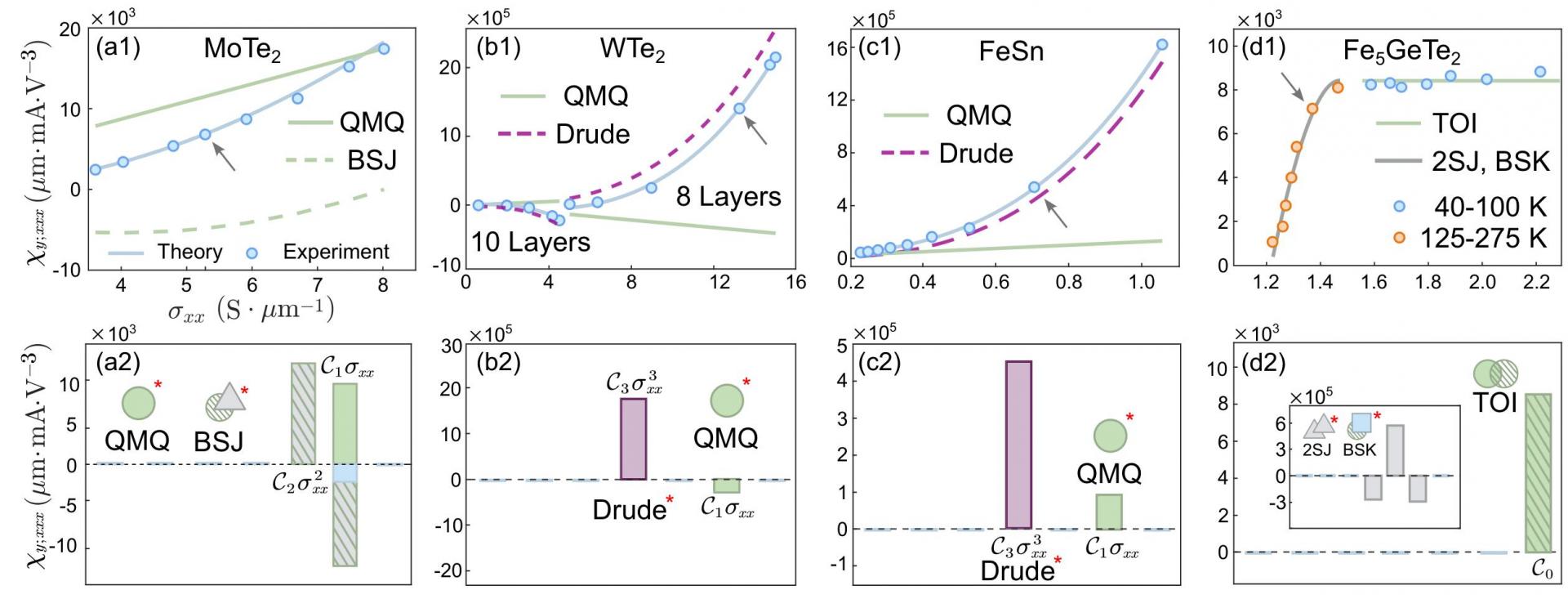
Figure 3. Example of applying scaling laws to multi-class experimental data: Different mechanisms show distinct weight fingerprints in the relationship between third-order nonlinear Hall conductivity and linear longitudinal conductivity.
In the practical analysis process, the research team proposed a two-step approach. First, based on the magnetic point group of the sample or device, determine whether time-reversal and rotational, mirror, or other symmetry operations exist, thereby ruling out nonlinear conductivity components and physical mechanisms forbidden by symmetry. Second, depending on whether the system preserves time-reversal symmetry, select the appropriate scaling law, fit the experimental data with polynomials, and use confidence intervals to identify which scaling parameters are statistically significant.
This study established a “mechanism-complete, symmetry-constrained, experimentally-fittable” framework for analyzing third-order nonlinear transport, taking higher-harmonic transport from merely qualitative signal observations to quantitative identification of microscopic mechanisms. Since the basic idea is not limited to third-order responses, related methods could be extended to nonlinear transport of any order, potentially making nonlinear transport a universal tool for probing geometric effects, symmetry breaking, and phase transitions in quantum materials.
PhD student Zhen-Hao GONG from the Department of Physics at SUSTech is the first author of the paper. Professor Hai-Zhou LU is the corresponding author, with collaborators including Academician X. C. XIE from Peking University, Fudan University and Hefei National Laboratory, as well as Master’s student Zhi-Hao WEI from the Department of Physics at SUSTech. SUSTech is the primary institution of the paper.
Paper link: https://doi.org/10.1103/515g-qjq8
Proofread ByNoah Crockett, Junxi KE
Photo By