Assistant Professor Yang LEI’s team from the School of Environmental Science and Engineering at the Southern University of Science and Technology (SUSTech) published a research paper in Nature Communications titled “Mineral‑integrated electrochemical system enabling membrane‑free pH swing and active chlorine species generation for urine valorization.” The study developed a mineral-electrochemical coupled system for simultaneous alkalization and oxidation (EAO). By introducing wollastonite at the anode, this system can efficiently recover phosphorus from urine and stabilize urea without using a membrane, providing a green and cost-effective solution for urine recycling.
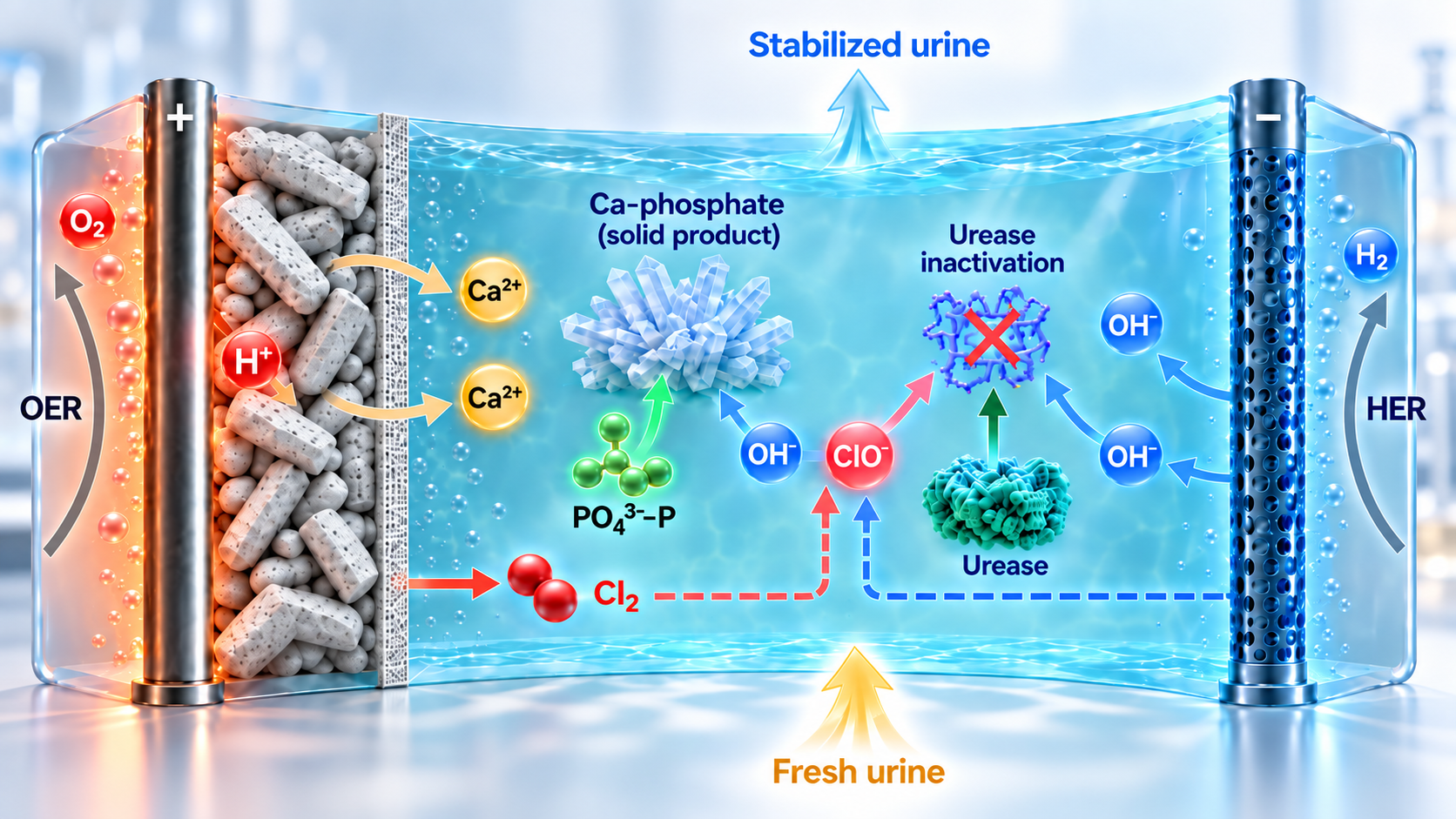
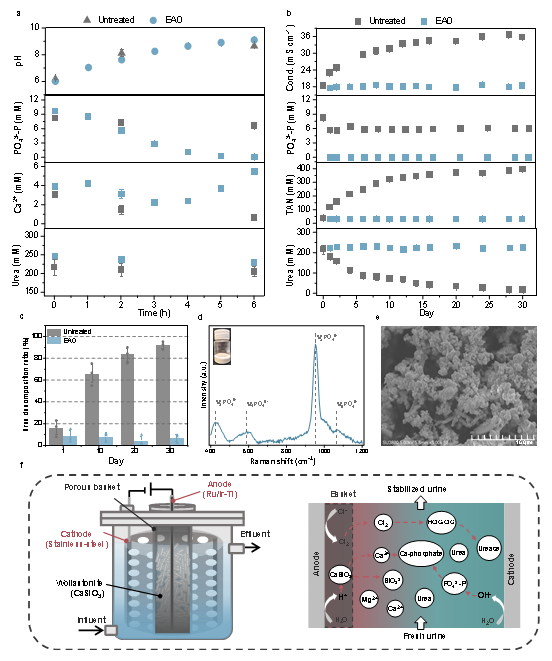
Figure 1. Electrochemical alkalization and oxidation system simultaneously achieves phosphorus recovery and urea stabilization. (a) Changes in pH, phosphorus, calcium, and urea concentrations in the EAO system and untreated control; (b) changes in conductivity, phosphorus, total ammonia nitrogen, and urea concentration over a 30-day storage period; (c) comparison of urea decomposition rates; (d) Raman spectra of the recovered products (white precipitate is calcium phosphate); (e) SEM images of the recovered products; (f) EAO reactor configuration and working principle.
Although urine accounts for less than 1% of domestic wastewater by volume, it is enriched with large amounts of nutrients like nitrogen and phosphorus, making it highly valuable for resource recovery. However, once excreted, urease rapidly catalyzes urea hydrolysis, leading to nitrogen loss, pipe scaling, and odors. Traditional stabilization methods using acidification or alkali addition come with chemical usage and safety risks, while conventional membrane electrochemical systems are often limited by membrane fouling and high costs. To address these issues, the research team designed the EAO system, coupling an inert anode with silicate minerals using a porous net. When powered, oxygen evolution at the anode helps dissolve silicate, releasing Ca²⁺; hydrogen evolution at the cathode continuously generates OH⁻, quickly raising the solution’s pH. Meanwhile, active chlorine species produced by anodic chlorine evolution effectively suppress urease activity. With the combined effect of high alkalinity and active chlorine species, the system can simultaneously promote calcium phosphate precipitation and stabilize urea (Figure 1).
Experimental results showed that after 6 hours of treatment, phosphate concentration in synthetic urine dropped from 9.7 to 0.1 mM, achieving a 99.1% removal rate. Over a 30-day storage period, urea hydrolysis in EAO-treated urine was only 6.6%, compared to 92.0% in untreated urine, fully demonstrating the system’s synergistic effectiveness in phosphorus recovery and urea stabilization.
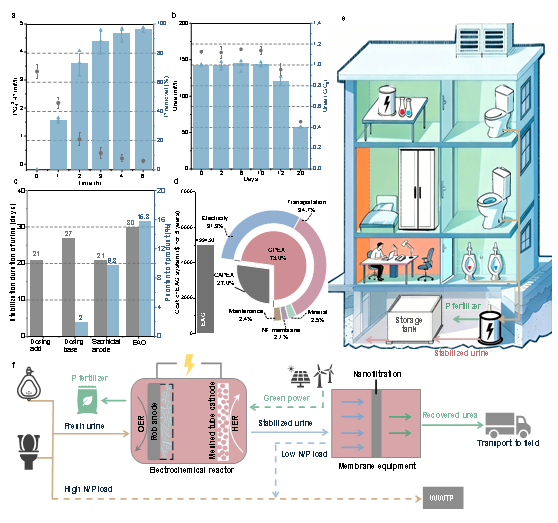
Figure 2. Performance and economic assessment of the EAO system treating real urine. (a) Phosphorus recovery performance for real urine; (b) Urea stabilization during storage; (c) Comparison with reported urine resource recovery technologies in terms of stabilization duration and phosphorus content in the product; (d) Techno-economic analysis based on current reactor operating conditions; (e-f) Schematic of urine electrochemical stabilization and resource recovery for practical applications.
The team further examined the EAO system’s ability to handle real source-separated urine and its economic advantages. Results show that at a current density of 12 A m⁻² and urine diluted 2 times, the system achieves the best energy efficiency. For undiluted urine (no-water/water-saving toilet scenario) and urine diluted 5 times (public toilet scenario), high phosphorus removal and long-term urea stabilization can still be achieved by adjusting the electrolysis time. In experiments with real urine, the phosphorus recovery rate reached up to 96.0%, and the urea stabilization period could be maintained for over 10 days (Figure 2).
Techno-economic analysis indicates that the total cost of the EAO system is around $4,995, with transportation and electricity as the main cost components. Calculated per phosphorus recovery amount, the cost per kg of phosphorus is about $2.51, comparable to low-energy microbial electrochemical technologies. The system does not require membranes or sacrificial anodes, significantly reducing maintenance frequency and operational risks. The recovered calcium phosphate product contains 15.8% phosphorus, and its bioavailability is better than commercial hydroxyapatite, showing potential as fertilizer or a high-value raw material. Additionally, the system offers a new technical route for the subsequent high-value use of urea in urine. Efficient co-recovery of phosphorus and urea greatly enhances the overall application prospects of this technology.
Ju LUO, a Master’s graduate from the School of Environmental Science and Engineering, is the first author, and Assistant Professor Yang LEI is the sole corresponding author. SUSTech is the sole affiliation for this study. Team members Zhengshuo ZHAN, Weiquan LI, and Lingyu HE made important contributions to the research.
Proofread ByNoah Crockett, Junxi KE
Photo By