On September 19, 2026, Kechang XIE, former Vice President of the Chinese Academy of Engineering, Academician of the Chinese Academy of Engineering, and a foreign member of the US National Academy of Engineering, visited the School of Innovation and Entrepreneurship at the Southern University of Science and Technology (SUSTech) and delivered his SUSTech-TCL Innovation and Entrepreneurship Lecture, titled “From Fuel to Feedstock — Reflections on Modern Coal Chemical Industry Development.” He discussed topics such as coal value transformation, low-carbon coal chemical pathways, artificial intelligence empowerment, and talent cultivation.
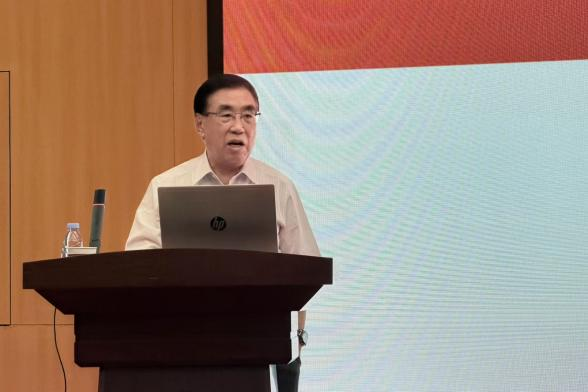
Kechang XIE Gives Keynote Speech
At the start of his lecture, Academician XIE pointed out that China has abundant coal reserves, but lacks sufficient oil and natural gas. Against the background of low-carbon energy structures and the development of artificial intelligence, he emphasized the need to rethink coal’s value positioning, promote low-carbon utilization of high-carbon energy, shift the value focus from fuel to feedstock, and carry out targeted design and system evaluation in the conversion process. Focusing on the shift from calorific value to carbon value, he stressed that using coal as feedstock does not mean it is low-carbon, and carbon reduction effectiveness cannot be judged solely by the type of feedstock. He proposed advancing full-chain decarbonization through five approaches: upstream carbon reduction, process carbon reduction, coupled decarbonization, recycling carbon reduction, and end-of-pipe carbon fixation.
XIE stated that a product’s low-carbon performance depends on life cycle assessment; single-point or in-plant carbon accounting can easily hide the true transfer of emissions. He introduced the GIS-LCA technology, which incorporates geographic spatial information into life cycle assessment. This technology allows carbon footprint accounting to move from “total calculation” to “identifying locations, tracing sources, and recognizing hotspots,” providing a basis for process improvement, supply chain optimization, and industrial spatial layout.
Talking about AI empowering low-carbon coal conversion, XIE said that China’s modern coal chemical industry has reached a considerable scale, with several technologies at the international advanced level. Continuous breakthroughs in key technologies and the ongoing accumulation of multi-source, cross-scale data will lay a foundation for intelligent modeling. His team developed a regional, spatiotemporal, and intelligent energy-carbon planning platform that integrates planning layout, simulation prediction, evaluation, and optimization, which can support the design of low-carbon transition paths.
XIE encouraged the students, in an era of energy transformation and rapid technology development, to actively learn new tools while maintaining independent thinking and a critical spirit. They should be good at raising valuable questions, focus on real scientific problems, and conduct research oriented to the country’s major needs, courageously exploring the path of low-carbon utilization of high-carbon energy, and not fearing setbacks.
Proofread ByRong XIA, Junxi KE
Photo BySchool of Innovation and Entrepreneurship