Associate Professors Kejie CHEN, Haoran MENG, and Zhenguo ZHANG from the Department of Earth and Space Sciences at the Southern University of Science and Technology (SUSTech), together with collaborators, have reported new findings on the rupture process of the 2025 M7.7 Mandalay earthquake in Myanmar. The study combines high-rate GNSS displacement records, satellite remote sensing, seismic-array data, strong-motion and teleseismic records, and near-fault CCTV footage. Together, these datasets link rupture propagation over hundreds of kilometers to ground motion unfolding within seconds at a single site, providing new constraints on how rupture behavior varies with depth along the same fault. The findings were published in Science Advances under the title “On-fault and remote observations of exceptionally long, supershear rupture in the 2025 M7.7 Mandalay earthquake.”
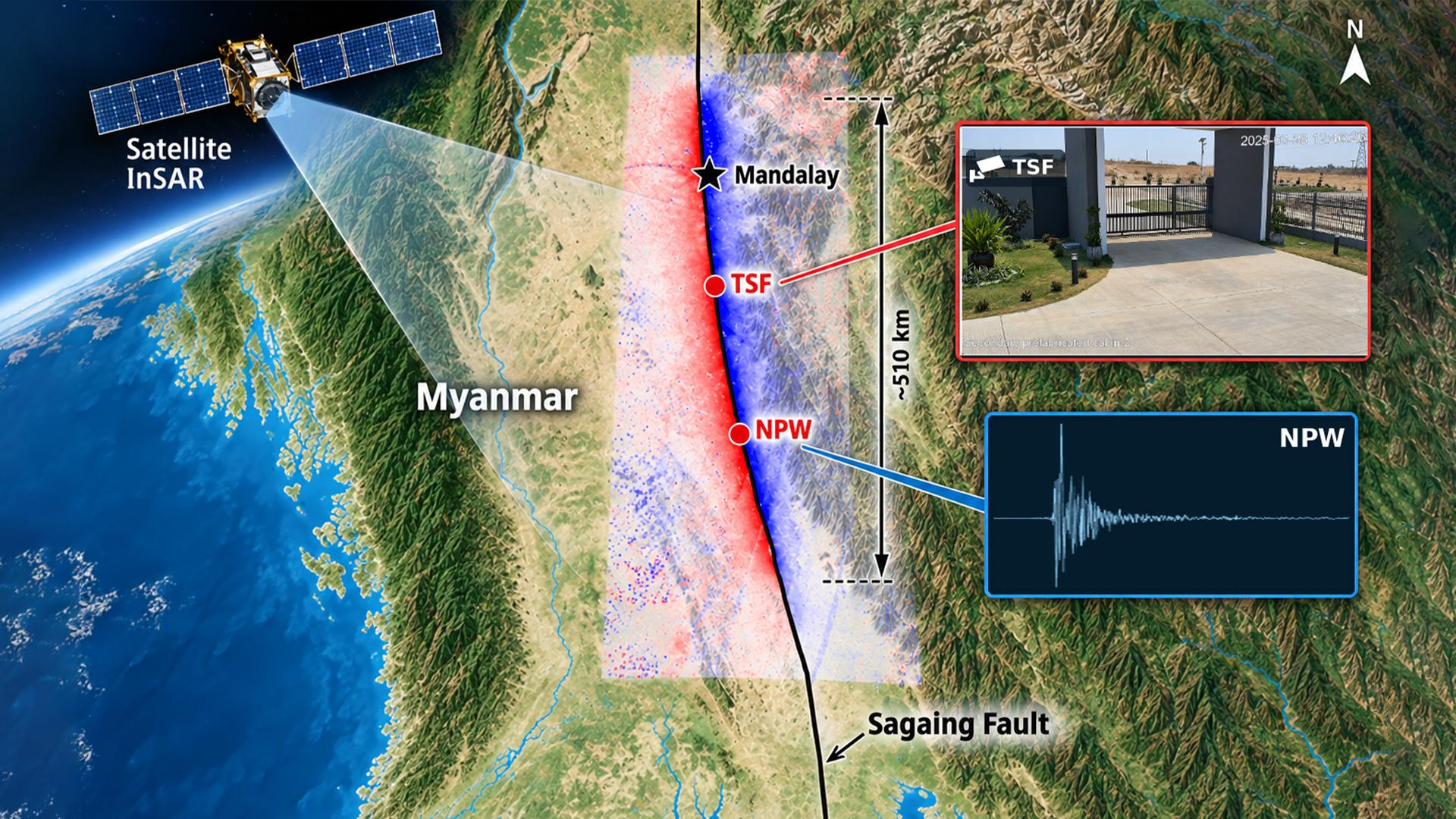
On March 28, 2025, a magnitude 7.7 earthquake struck near Mandalay, Myanmar, rupturing approximately 510 km of the Sagaing Fault (Figure 1). The rupture extended well beyond a previously identified seismic gap of approximately 260 km. Multiple studies have shown that parts of the rupture propagated at supershear speeds, meaning that the rupture front traveled faster than the local shear-wave velocity.
During a major earthquake, different parts of a fault do not begin and end slipping simultaneously. Instead, the rupture front advances along the fault, activating different sections in sequence. Understanding such an exceptionally long rupture requires more than measuring the final fault offset: researchers also need to know when rupture reached different locations, how long local slip lasted, and whether rupture behaved differently at depth and near the surface. In this earthquake, instrumental monitoring networks captured the overall rupture propagation, while a CCTV camera close to the fault recorded local ground motion, allowing these two scales to be compared.
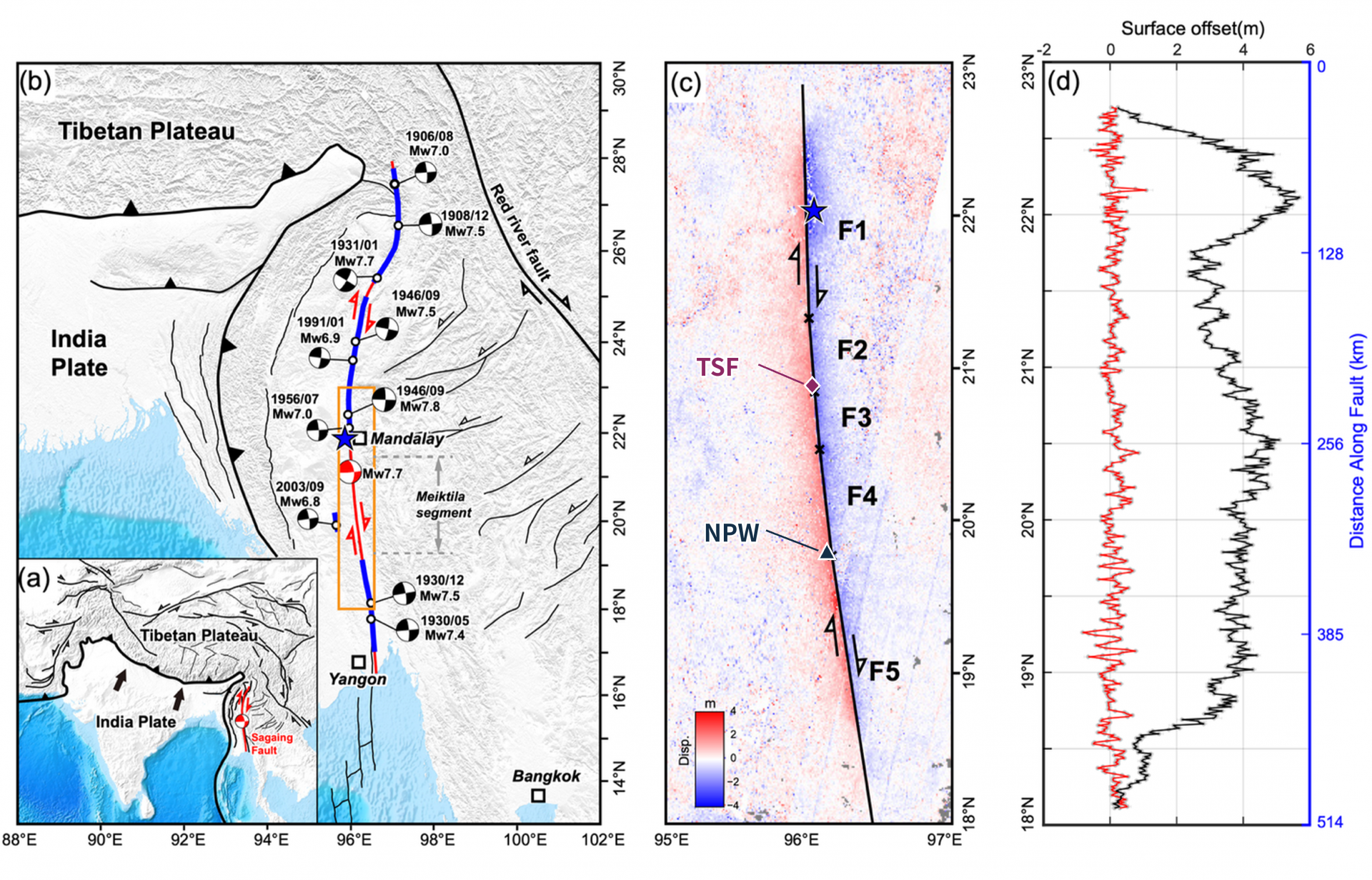
Figure 1. Tectonic setting and coseismic surface deformation of the 2025 Mandalay earthquake. (a, b) The Sagaing Fault and historical earthquakes; (c) north–south coseismic displacement derived from optical image correlation, with a diamond marking the TSF camera and a triangle marking the NPW strong-motion station; (d) surface fault offsets along the rupture.
The team used high-frequency seismic waves recorded by seismic arrays in Guangdong, China, and Australia to track the migration of seismic radiation along the fault, together with Rayleigh-wave coherence analysis to constrain rupture speed. The results show that the rupture propagated both northward and southward from the hypocenter. The southward rupture accelerated from subshear to sustained supershear speeds, reaching approximately 4.8–5.3 km/s over a long distance (Figure 2).
Meanwhile, high-rate GNSS recorded the evolution of surface displacement, strong-motion and teleseismic waveforms constrained the timing of fault slip, and optical and radar remote sensing provided information on fault geometry and surface deformation. By combining these datasets in a joint finite-fault inversion, the researchers reconstructed the rupture history and found that most slip was concentrated at depths shallower than 15 km.
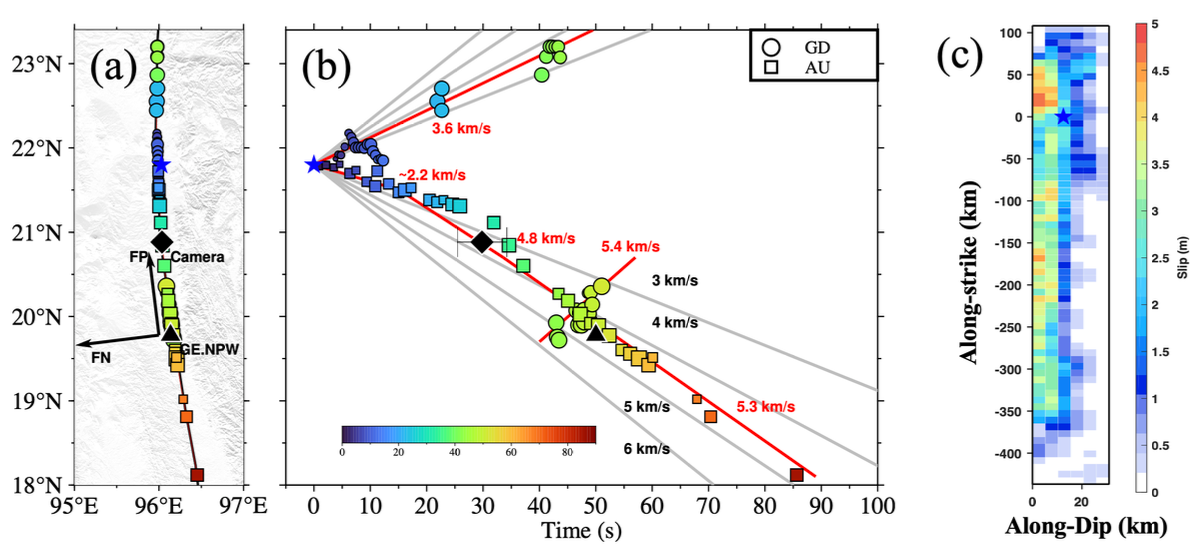
Figure 2. Overall rupture constrained by regional seismic arrays and joint finite-fault inversion. (a, b) Locations and timing of high-frequency seismic radiation, with circles and squares representing results from the Guangdong and Australian arrays, respectively; (c) slip distribution obtained from the joint inversion.
At the Thazi solar farm, a CCTV camera located approximately 15 m from the surface fault trace recorded ground motion as the rupture passed. The researchers stabilized the footage, corrected lens distortion, calibrated image scale using field measurements, and corrected the camera clock using timestamps from photographs taken at the site. This allowed the video-derived ground motion to be compared with rupture timing inferred from instrumental observations.
Analysis of the footage (Figure 3) shows that the two sides of the fault moved approximately 2.8 m relative to each other in about 2 s. By tracking the motion of a sliding gate, the researchers also estimated ground displacement perpendicular to the fault. Notable fault-normal motion began before the main fault-parallel slip, consistent with the expected signature of a local subshear slip pulse.
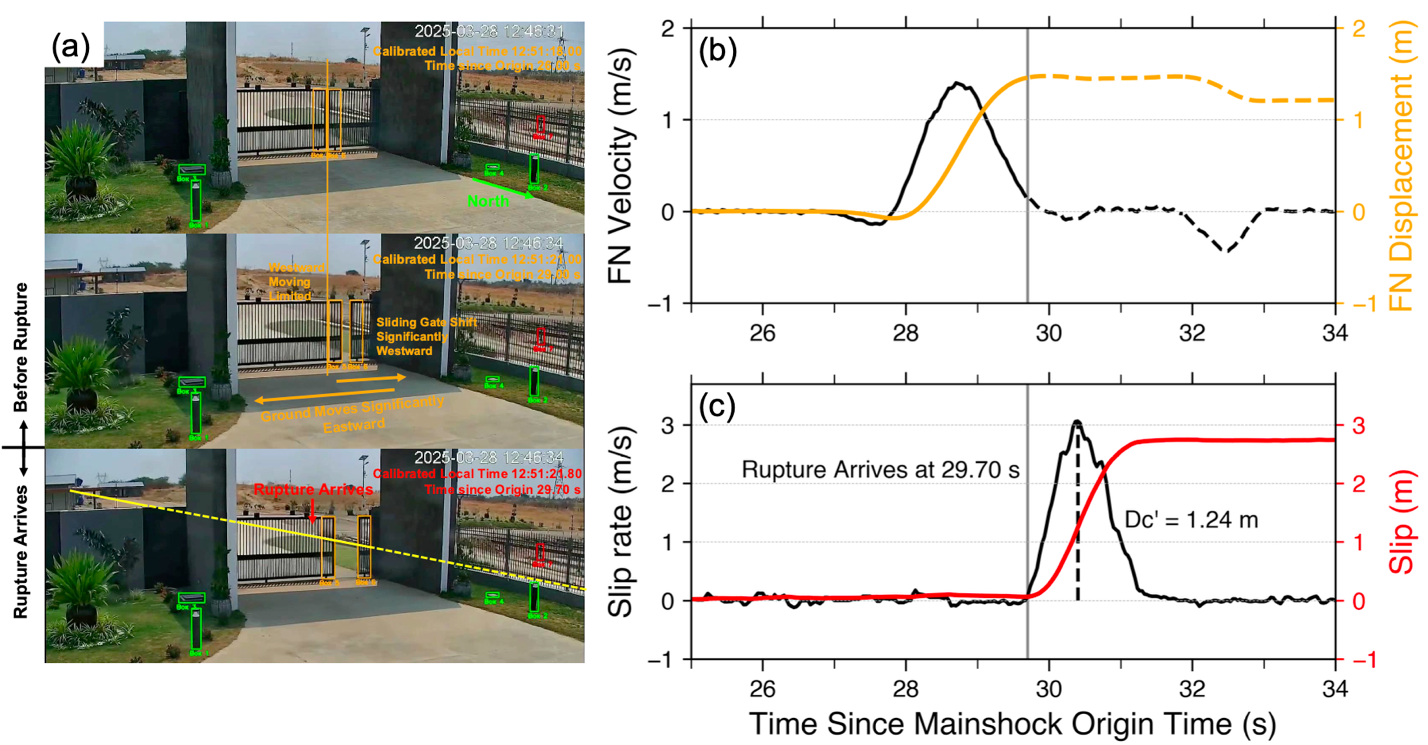
Figure 3. Near-fault CCTV footage and local ground motion at the Thazi solar farm. (a) Video frames before and during rupture arrival; (b) fault-normal ground motion inferred from the sliding gate, with dashed sections indicating less reliable measurements; (c) fault slip and slip rate, showing approximately 2.8 m of slip within about 2 s.
Supplementary Movie S1. Stabilized near-fault CCTV footage with lens distortion corrected.
Regional seismic-array analysis suggests that the rupture front near Thazi propagated at supershear speed, whereas the near-surface motion recorded by the camera exhibited characteristics of subshear rupture.
The team combined video-derived fault slip and ground motion with rupture timing and slip distribution inferred from geophysical observations, then used three-dimensional dynamic rupture simulations to explore the effects of depth-dependent frictional weakening. Under the slip-weakening friction law used in the simulations, fault strength decreases progressively as slip accumulates. At depth, the model uses a relatively short slip-weakening distance of 0.18–0.40 m, allowing most of the strength reduction to occur over relatively little slip and favoring sustained supershear propagation. At shallow depths, the model adopts a larger slip-weakening distance of approximately 1.24 m, estimated from the video, so more slip is required for the fault to weaken.
The model also assigns higher cohesion near the camera site to approximate energy dissipation associated with off-fault damage and deformation. Together, the greater shallow slip-weakening distance and higher local strength limit rupture acceleration near the surface, allowing deep supershear rupture and shallow subshear rupture to coexist in the simulation. This offers one plausible, though non-unique, explanation for the differences between the seismic-array and video observations.
The video also provides a local check on the resolution of the finite-fault source model. The approximately 2-s slip duration recorded at the camera site is considerably shorter than the 10–20-s duration inferred by the kinematic finite-fault inversion. Because the inversion uses band-limited data and finite-sized subfaults, its slip-time functions average motion over space and time, smoothing short local slip pulses into longer-duration signals. The near-fault footage makes it possible to examine this limitation using an actual earthquake.
Dynamic rupture simulations further suggest that high initial stress, efficient dynamic weakening, and the relatively straight geometry of the Sagaing Fault favored the exceptionally long, approximately 510-km rupture. Considering the NPW near-fault strong-motion records together with the seismic-array results, the team also explored the possibility of a secondary back-propagating rupture triggered by P-wave-induced stress perturbations. Dynamic triggering remains a plausible, but non-unique, interpretation.
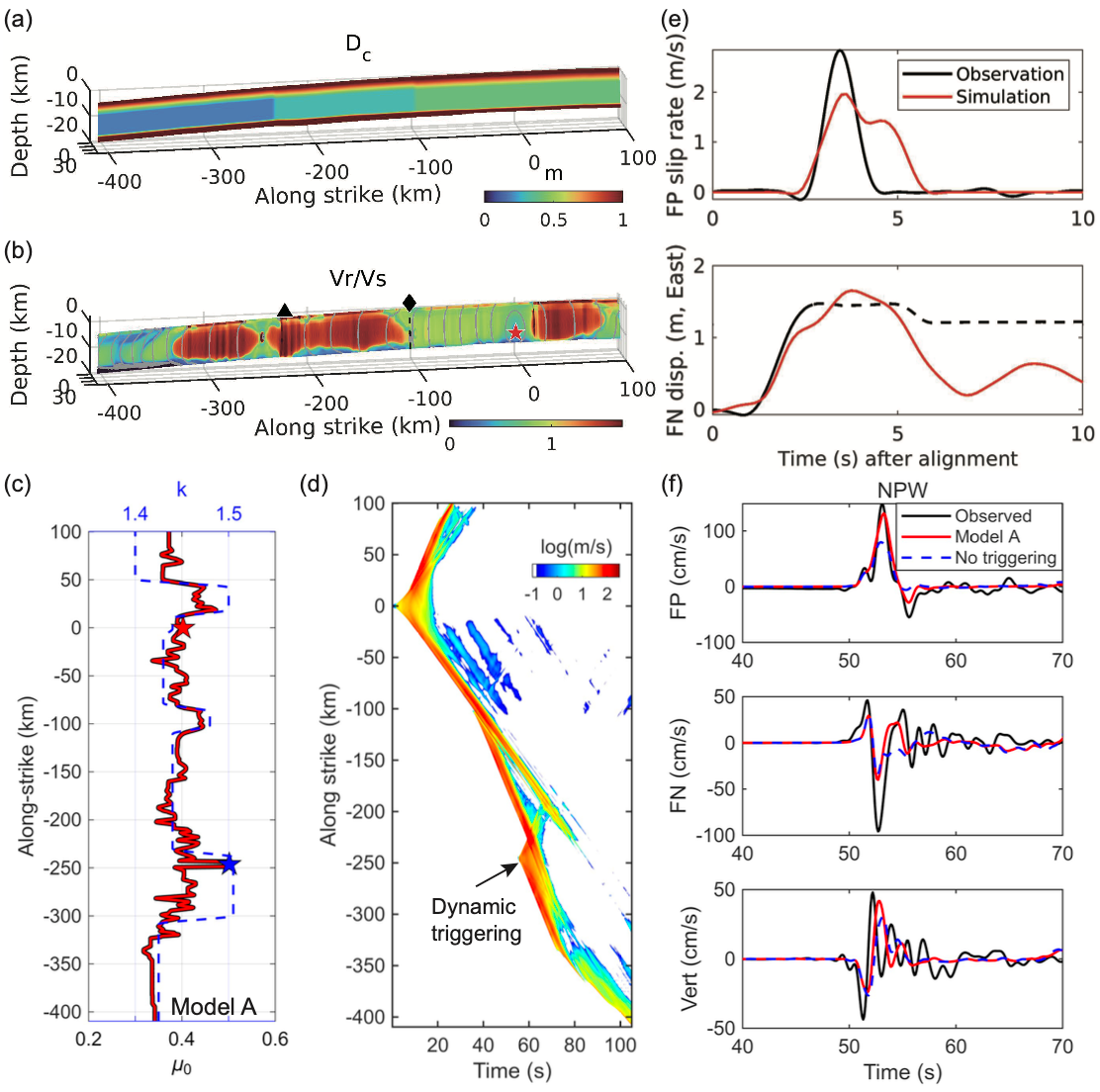
Figure 4. Dynamic rupture simulations and comparisons with observations. (a) Slip-weakening distance; (b) rupture-speed distribution, showing subshear rupture near the surface and supershear rupture at greater depths close to the video site; (c, d) model stress parameters and rupture evolution; (e) comparison of video-derived observations and simulation results; (f) NPW waveform comparisons for scenarios with and without dynamic triggering. The synthetic waveforms were shifted by 8 s for comparison. Dynamic triggering is not uniquely established by these observations.
Seismic stations, GNSS, and satellite remote sensing form the basis of conventional instrumental monitoring for large earthquakes. At the same time, security cameras, smartphones, dashcams, and drones increasingly capture natural hazards as they unfold. These widely deployed devices may record local ground motion at sites without nearby scientific instruments. By connecting rupture propagation over hundreds of kilometers with a few seconds of ground motion close to the fault, this study highlights the potential of combining geophysical observations with video recorded by everyday devices.
Coauthor Xiaofei CHEN, a member of the Chinese Academy of Sciences, noted that integrating instrumental observations with ubiquitous sensing can broaden the observational basis for understanding earthquake physics. Calibrated videos, analyzed alongside seismic, GNSS, and satellite data, can connect large-scale rupture propagation with local fault motion and support deeper investigation of processes such as frictional weakening and energy dissipation.
Coauthor Qiang MA, deputy director of the Institute of Engineering Mechanics, China Earthquake Administration, and chief engineer of the National Earthquake Intensity Rapid Reporting and Early Warning Project, emphasized the potential of existing, widely distributed devices to expand observational coverage at relatively low additional deployment cost. Once calibrated and validated, video footage can provide useful on-site evidence for post-earthquake ground-motion analysis and damage assessment. Records from more well-documented earthquakes may also help evaluate ground-motion estimates used in earthquake early-warning systems. Improved data access, sharing, and rapid processing will be important for using such records in emergency response.
By integrating conventional monitoring networks with widely available sensing devices, everyday video recordings could play a greater role in improving our understanding of earthquake rupture physics and supporting disaster risk reduction.
Kejie CHEN is the first author of the paper, and Haoran MENG and Zhenguo ZHANG are the corresponding authors. SUSTech is the lead institution. Other coauthors include Xiaofei CHEN, a member of the Chinese Academy of Sciences; Zaiwang LIU and Min ZHOU, doctoral students at SUSTech; Zijia WANG and Zhongqiu HE, postdoctoral researchers at SUSTech; Kai HUANG, a research assistant professor at SUSTech; Haipeng LUO, an associate professor at SUSTech; Fuhua ZHENG, a doctoral student at McGill University; Guoguang WEI, an assistant professor at Southwest Jiaotong University; Jindong SONG and Qiang MA of the Institute of Engineering Mechanics, China Earthquake Administration; Chris Milliner, a research scientist at Caltech, and Solene L. Antoine, a postdoctoral researcher at Caltech; Jean-Philippe Avouac, a member of the U.S. National Academy of Sciences, a professor at Caltech, and director of the Institut de Physique du Globe de Paris; and Chaofeng WANG, an assistant professor, and Jianhao GAO, a doctoral student, at the University of Florida.
Paper Link: https://www.science.org/doi/full/10.1126/sciadv.aee5191
Proofread ByNoah Crockett, Junxi KE
Photo By