Research teams led by Associate Professor Junxue LI and Assistant Professor Shuo-Ying YANG in the Department of Physics and the State Key Laboratory of Quantum Functional Materials at the Southern University of Science and Technology (SUSTech) have recently made progress in superconducting spintronics. The study was published in Science Advances under the title “Vortex-mediated spin current injection into two-dimensional superconductor NbSe₂.”
In heterostructures comprising the two-dimensional superconductor niobium diselenide (NbSe₂) and the ferrimagnetic insulator LiAl₂Fe₃O₈ (LAFO), the researchers observed a thermoelectric signal with the opposite sign to the conventional vortex Nernst effect in a standalone NbSe₂ layer. Temperature- and magnetic-field-dependent measurements linked this response to spin current injection in the vortex liquid state. These observations are consistent with earlier theoretical predictions of spin-vorticity transmutation and the inverse vortex spin Hall effect. The study provides experimental evidence for using superconducting vortices to transfer spin angular momentum and opens a new route for exploring spin transport in superconductors.
Superconducting spintronics seeks to combine the properties of superconductors with those of electron spins to establish new physical foundations for low-power information devices. Injecting spin angular momentum into superconductors and transporting it efficiently is one of the central challenges in this field. Previous studies have focused mainly on spin-polarized quasiparticles and spin-triplet Cooper pairs. Magnetic flux vortices, which are ubiquitous in type-II superconductors, offer another possibility.
A magnetic flux vortex consists of a core surrounded by circulating superconducting electron pairs. Because vortex motion produces electrical resistance, conventional superconducting applications generally aim to pin vortices in place. Theories suggest that vortices may also couple to spin degrees of freedom through the orbital angular momentum of the circulating superfluid or the spin polarization of the vortex core. In the vortex liquid state, where pinning is weakened and vortices are mobile, this coupling may allow vortices to contribute to the transfer of spin angular momentum. Whether externally injected spins can drive superconducting vortices, however, requires experimental verification.
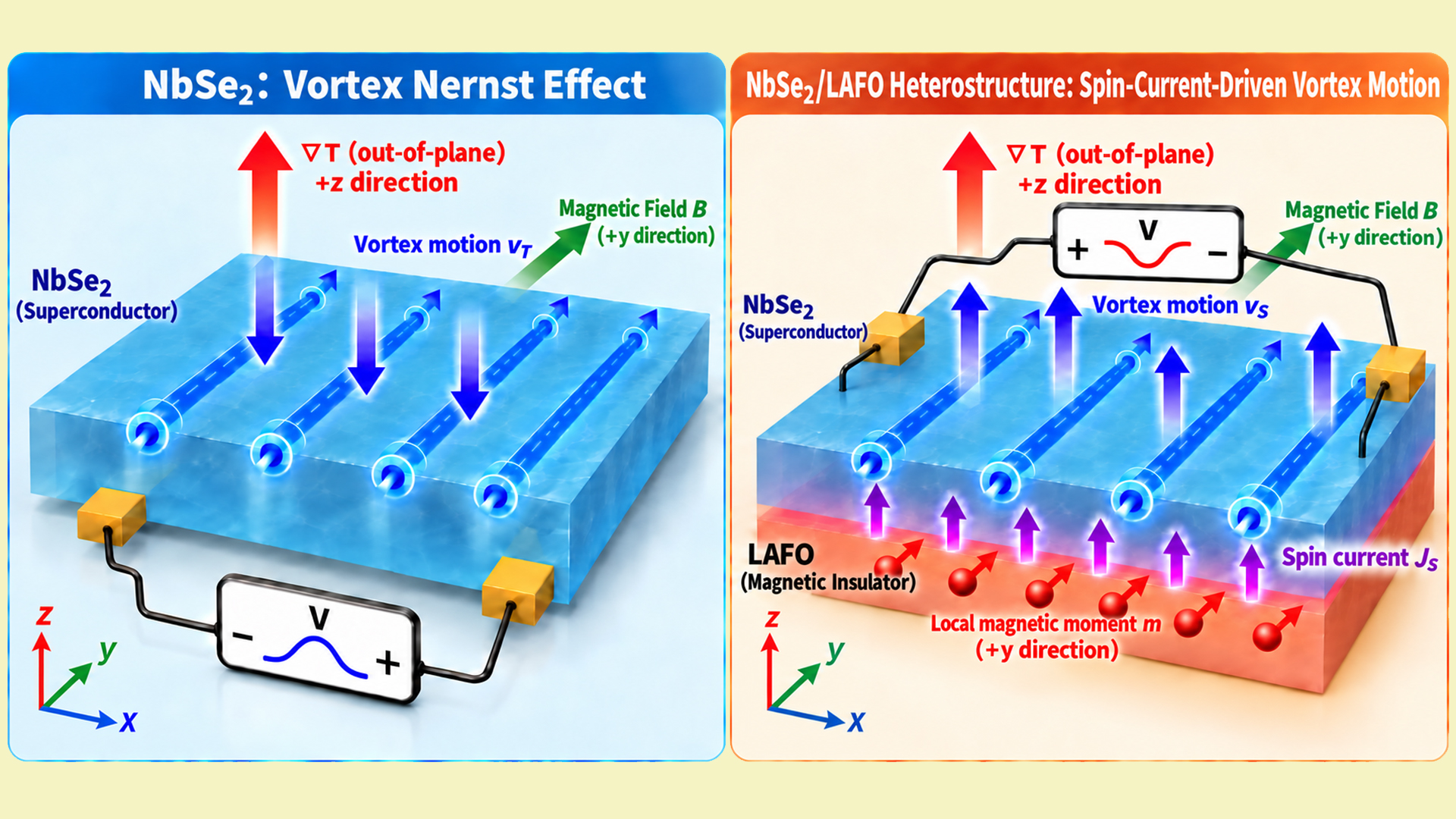
Figure 1. Physical pictures of the conventional vortex Nernst effect and vortex-mediated spin current injection. The two driving mechanisms can produce vortex motion in opposite directions, leading to transverse voltages of opposite polarity.
The team constructed heterostructures using the layered superconductor NbSe₂, which has strong spin–orbit coupling, and the ferrimagnetic insulator LAFO, which has low magnetic damping. For comparison, they also fabricated standalone NbSe₂ devices on nonmagnetic SiO₂/Si substrates to measure the conventional vortex Nernst effect. A microheater on top of each device generated a temperature gradient perpendicular to the film, while a magnetic field was applied in the film plane and the transverse second-harmonic voltage in NbSe₂ was measured. As illustrated in Figure 1, in the conventional vortex Nernst effect, the temperature gradient drives vortices from the hot side to the cold side, producing a transverse electric field. If spin current injected from the magnetic layer into the superconductor drives vortices in the opposite direction, the resulting voltage will reverse sign. The difference in voltage polarity between the heterostructure and the control device therefore provides an important clue for identifying this process.
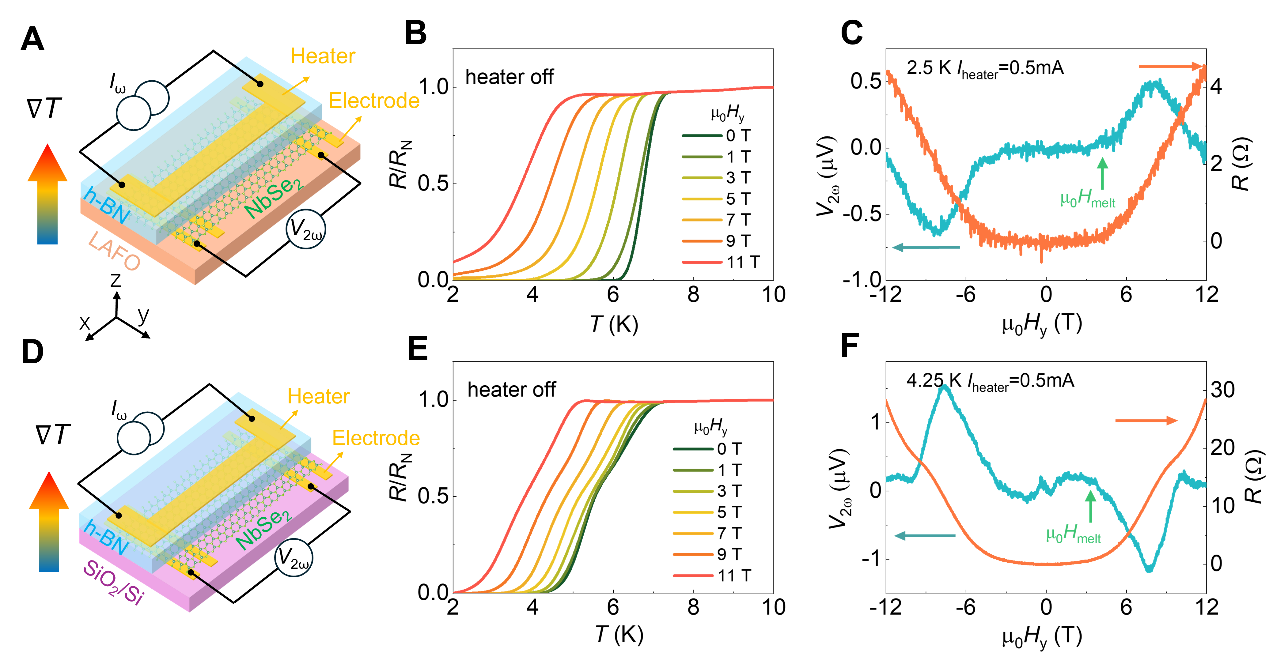
Figure 2. Device structures and thermoelectric transport measurements. The NbSe₂/LAFO heterostructure and the NbSe₂ control device on a nonmagnetic substrate exhibit thermoelectric responses of opposite polarity in the superconducting transition region.
Both types of devices exhibited pronounced thermoelectric peaks near the upper critical magnetic field (Figure 2), but the signal in the NbSe₂/LAFO heterostructure had the opposite sign to that in the control device. This sign reversal was reproduced across multiple devices, consistent with the expected vortex motion driven by spin current injection. The magnetic fields at which the signal appeared were far above the magnetization saturation field of LAFO, indicating that the response cannot be explained simply by magnetization reversal or domain-wall motion in the magnetic layer.
To establish the relationship between the reversed signal and superconducting vortices, the team systematically measured the thermoelectric voltage as a function of temperature and magnetic field, while simultaneously monitoring the resistance under the same heating conditions. The results showed that the pronounced thermoelectric response occurred mainly between the vortex-lattice-melting field and the upper critical magnetic field, corresponding to the vortex liquid regime (Figure 3). At lower magnetic fields, pinning restricted vortex motion and the thermoelectric response was weak. Upon entering the vortex liquid state, vortices became more mobile, and the thermoelectric signal increased.
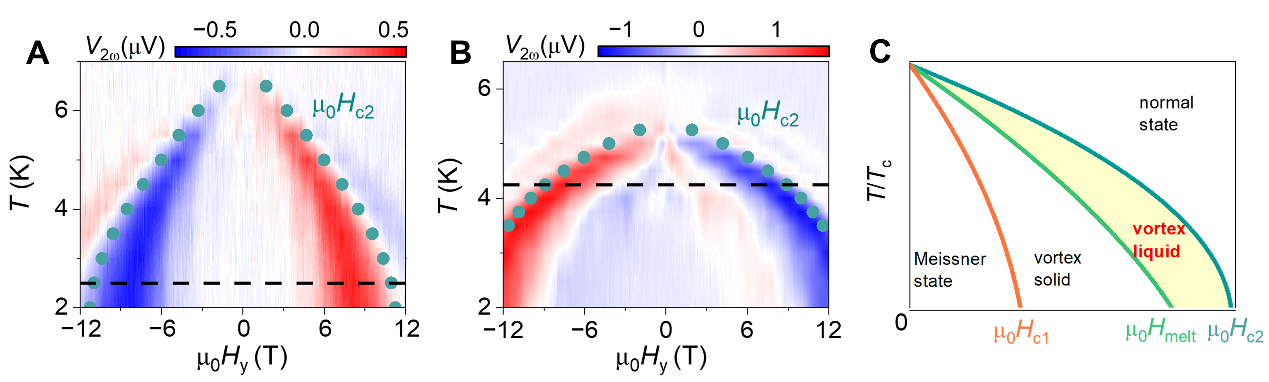
Figure 3. Temperature-magnetic field maps of the thermoelectric response and the superconducting phase diagram. The main thermoelectric signals in both the heterostructure and the control device lie within the vortex liquid regime and retain opposite polarities.
Further temperature-dependent measurements showed that the thermoelectric signals in both types of devices reached large amplitudes in the superconducting transition region and fell below the measurement resolution above the superconducting transition temperature. This behavior differs from that of a normal-state quasiparticle Nernst signal and does not support attributing the observed sign reversal to a normal-state quasiparticle contribution. Together with the phase region in which the signals appeared, these results support a dominant role for vortex motion in the thermoelectric response of the heterostructure.
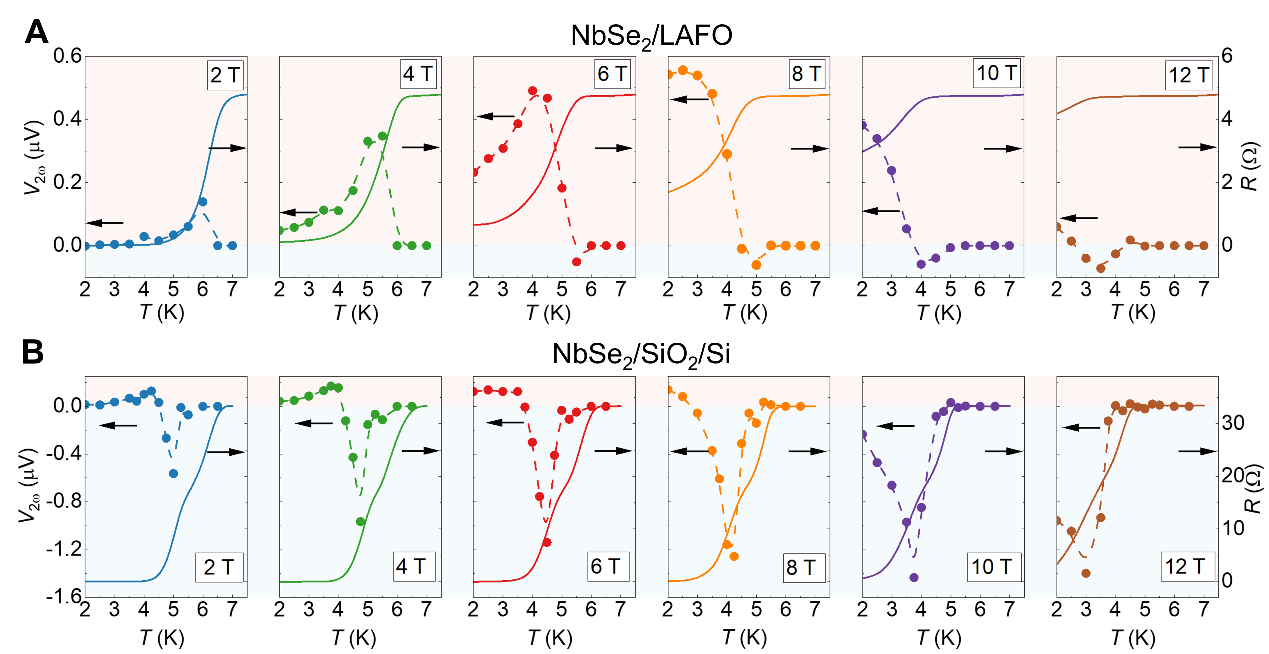
Figure 4. Temperature dependence of the thermoelectric voltage at different magnetic fields. The thermoelectric signals evolve through the superconducting transition and disappear in the normal state, further supporting their connection to superconducting vortex dynamics.
At the microscopic level, the experimental results are consistent with the theoretical pictures of spin–vorticity transmutation and the inverse vortex spin Hall effect. In the former, interfacial spin–orbit interactions can generate a charge current, which then drives vortices through the Lorentz force. In the latter, a spin-accumulation gradient directly drives vortex motion. Both mechanisms link injected spin angular momentum to vortex motion, although their respective contributions remain to be distinguished. Control measurements showing that reversing the temperature gradient also reverses the thermoelectric signal provide additional support for this physical picture.
This study extends the role of superconducting vortices beyond a source of dissipation to be suppressed, establishing them as physical objects for investigating spin injection and angular momentum transfer. It also establishes an experimental method for identifying vortex-mediated spin injection through thermoelectric signal polarity and temperature-magnetic field phase diagrams. Because magnetic flux vortices are widespread in type-II superconductors, this approach could be extended to other superconducting materials, including high-temperature superconductors with particularly rich vortex physics.
Future studies combining spin pumping, nonlocal transport, and vortex dynamics measurements could further test the spin transport distances and conversion efficiencies enabled by vortices, and explore reciprocal vortex-induced spin-torque effects. These efforts would provide a foundation for developing superconducting spintronic devices based on vortices.
SUSTech is the first-listed affiliation. Ph.D. students Meng YANG and Xiaolong YIN are co-first authors, and Associate Professor Junxue LI and Assistant Professor Shuo-Ying YANG are co-corresponding authors.
Article Link: https://www.science.org/doi/10.1126/sciadv.aeh1582
Proofread ByNoah Crockett, Junxi KE
Photo By