The 10th International Conference on Surface Engineering (ICSE 2026) was held in Yangzhou. During the event, the results for the “2026 China’s Top 10 Advances in Surface Science and Technology” were announced, and the research achievement from Professor Fuzeng REN’s team at the Department of Materials Science and Engineering at the Southern University of Science and Technology (SUSTech), titled “Construction of Ultra-Fatigue-Resistant Multi-Level Heterostructured NiTi Shape Memory Alloys via Pre-Strained Warm Surface Treatment,” was selected.
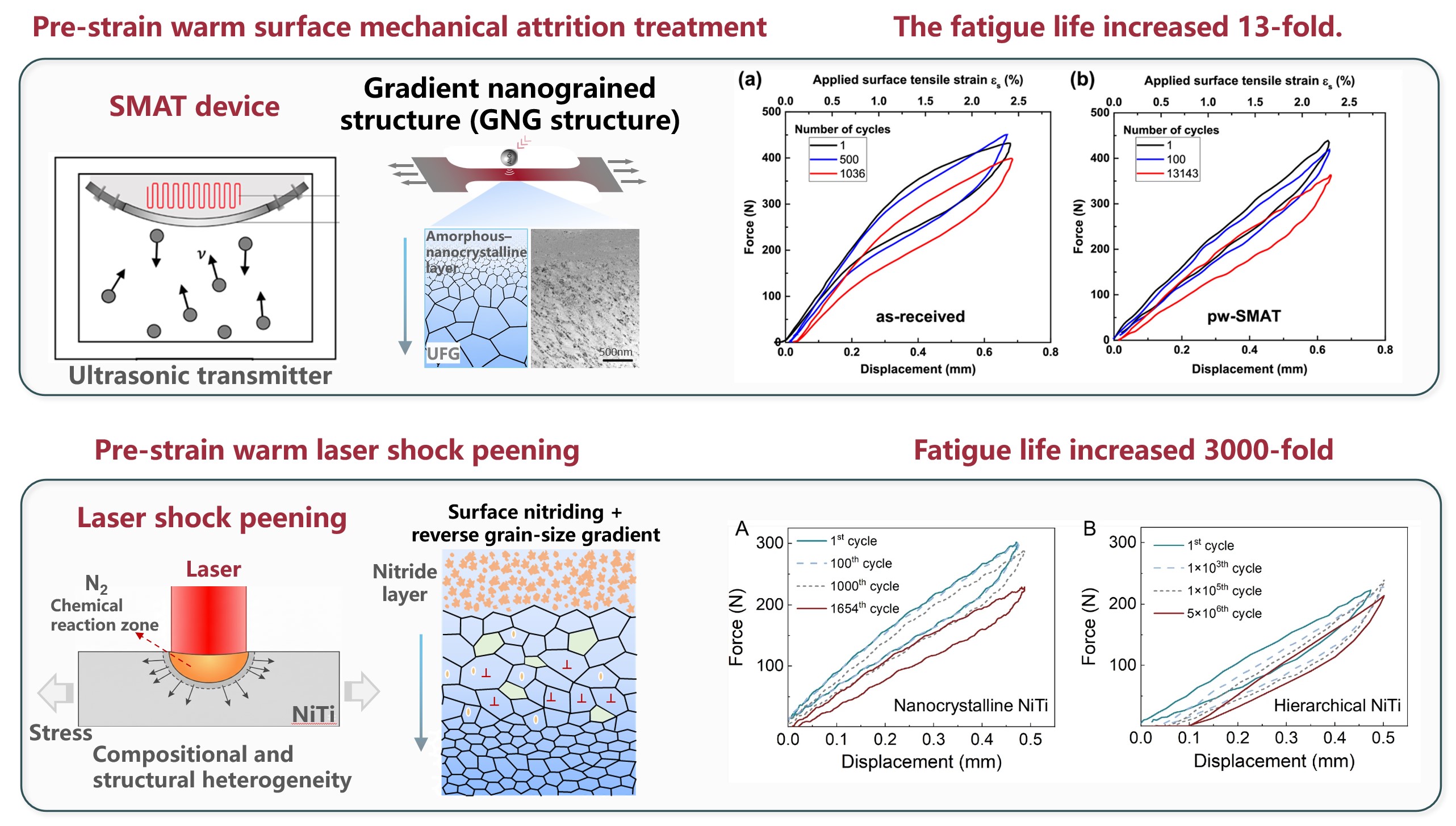
Professor Fuzeng REN’s team proposed a synergistic design strategy for gradient heterogeneous structures and subsequently developed two technologies: pre-strained warm surface mechanical attrition treatment and pre-strained warm laser shock peening. By controlling surface composition, grain-size gradients, phase structure, and residual stress, the team achieved a synergistic improvement in the superelasticity and fatigue resistance of NiTi alloys. In their research on pre-strain warm surface mechanical attrition treatment, the team combined heating with pre-strain to improve the utilization of impact energy to induce surface plastic deformation, developed gradient nanostructures, and generated GPa-level residual compressive stresses. In bending fatigue tests, the treated material’s fatigue life increased from around 1,000 cycles to about 13,000 cycles (13 times that of untreated samples) while maintaining superelasticity.
The team further invented the pre-strain warm laser shock peening, creating a nitride-enriched surface layer, an inverted grain-size gradient, and a phase gradient on the surface of nanocrystalline NiTi alloys, and introduced residual compressive stress exceeding 1 GPa. In four-point bending tests with a maximum surface tensile strain of 1.94%, the treated samples still did not fracture after 5 million cycles, increasing fatigue life by more than 3,000 times. These findings demonstrate that a hardened surface layer and residual compressive stresses can suppress localized plastic deformation and crack initiation, while gradient structures and multiphase interfaces can induce crack deflection, branching, and blunting, hindering crack propagation. These synergistic effects provide a structural design basis for enhancing the high-cycle bending fatigue life of superelastic alloys.
The team’s research findings have been published in leading journals, including Nature Communications, Acta Materialia, and Advanced Functional Materials. The team has filed four invention patent applications related to these technologies, one of which has been granted. In terms of translating these achievements, the team is working with Peking University Shenzhen Hospital to develop high-performance medical metal implants and is exploring applications of fatigue-resistant superelastic NiTi alloys in solid-state refrigeration prototypes, promoting the transition of research results to device applications.
The theme of the 10th International Conference on Surface Engineering (ICSE 2026) was “Surface Reconstruction: Functional Surface Design for Future Manufacturing” and is organized by the Chinese Mechanical Engineering Society (CMES). Founded in 1936, CMES is one of the oldest and largest engineering societies in China.
Proofread ByJunxi KE
Photo ByDepartment of Materials Science and Engineering