The research team, led by Yifei Zhu, in the Department of Mathematics at the Southern University of Science and Technology (SUSTech), has applied Topological Data Analysis to the study of speech time series. The team proposes and systematically validates a topology-enhanced machine-learning framework, TopCap, together with topology-enhanced neural networks, TopNN. The open-access version of record for their work, titled “Topology-enhanced machine learning for speech signal processing,” was published online in Nature Communications.
The methodology of Topological Data Analysis is concerned with relationships that survive continuous deformation: connections, loops, cavities, and separations. It has been used in brain-activity monitoring, protein-structure analysis, materials characterization, financial time series, and image recognition, turning stable structures hidden in high-dimensional noise into computable and comparable topological invariants. In recent years, it has been integrated with deep learning at multiple levels, reducing training costs while improving the interpretability and robustness of artificial intelligence.
Conventional speech recognition relies heavily on spectral engineering techniques, such as short-time Fourier transforms and Mel-frequency cepstral coefficients. Here, ZHU’s research team embeds phonetic time series into a high-dimensional Euclidean space and uses persistent homology to capture loops, holes, and connected structures in the resulting point cloud. The most prominent topological descriptors are then fed into accessible machine-learning models, yielding a transparent and computationally efficient pipeline, TopCap. The team further concatenates these descriptors with hidden states from GRUs and related neural networks, producing TopNN and giving black-box deep learning models a structural prior grounded in topology. Across multiple benchmark corpora of human speech data, including ALLSSTAR, LJSpeech, TIMIT, and LibriSpeech, the topology-enhanced models demonstrate competitive accuracy and improved robustness and stability under noise conditions.
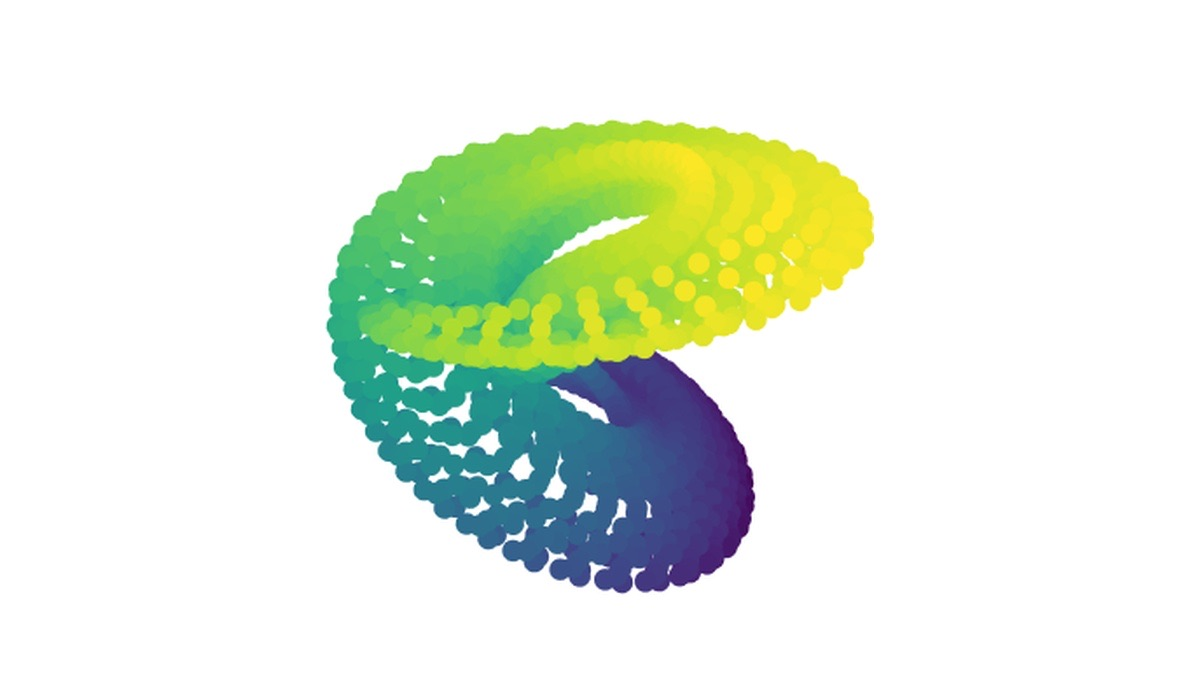
Figure 1. Point-cloud structure formed by a phoneme segment after time-delay embedding; colors indicate the position of the data points in a three-dimensional projection of the high-dimensional embedding space.
Reviewers, in the peer review published alongside the paper, pointed out that the main contribution of this work isn’t just classification accuracy, but conceptually goes beyond conventional spectral analysis: topological methods can capture the intrinsic complex structure of speech signals and can even feed back into neural networks. The study further establishes that maximal persistence grows approximately as the square root of the embedding dimension, while remaining extremely sensitive to the delay parameter. These findings challenge existing heuristic parameter-selection strategies and show that, for real-world speech signals, higher-dimensional embedding can amplify rather than obscure salient topological features.

Figure 2. Topological profiles for point-cloud embeddings of different phonemes, together with recurrent gating connections and information propagation in deep learning networks for speech signals.
Looking ahead, the team proposes a “topological trinity for speech intelligence,” linking phonetic statistics in data science, neural networks trained on speech in artificial intelligence, and auditory cortical population activity in neuroscience through shared manifold geometry and topology, by applying methods from computational topology. Through interdisciplinary research communication and collaboration, this program aims to model distribution spaces of speech data, graph structures among phonemes, and mechanisms of human auditory perception, with potential implications for language-dependent phonetic systems and more interpretable, robust, brain-inspired speech intelligence.
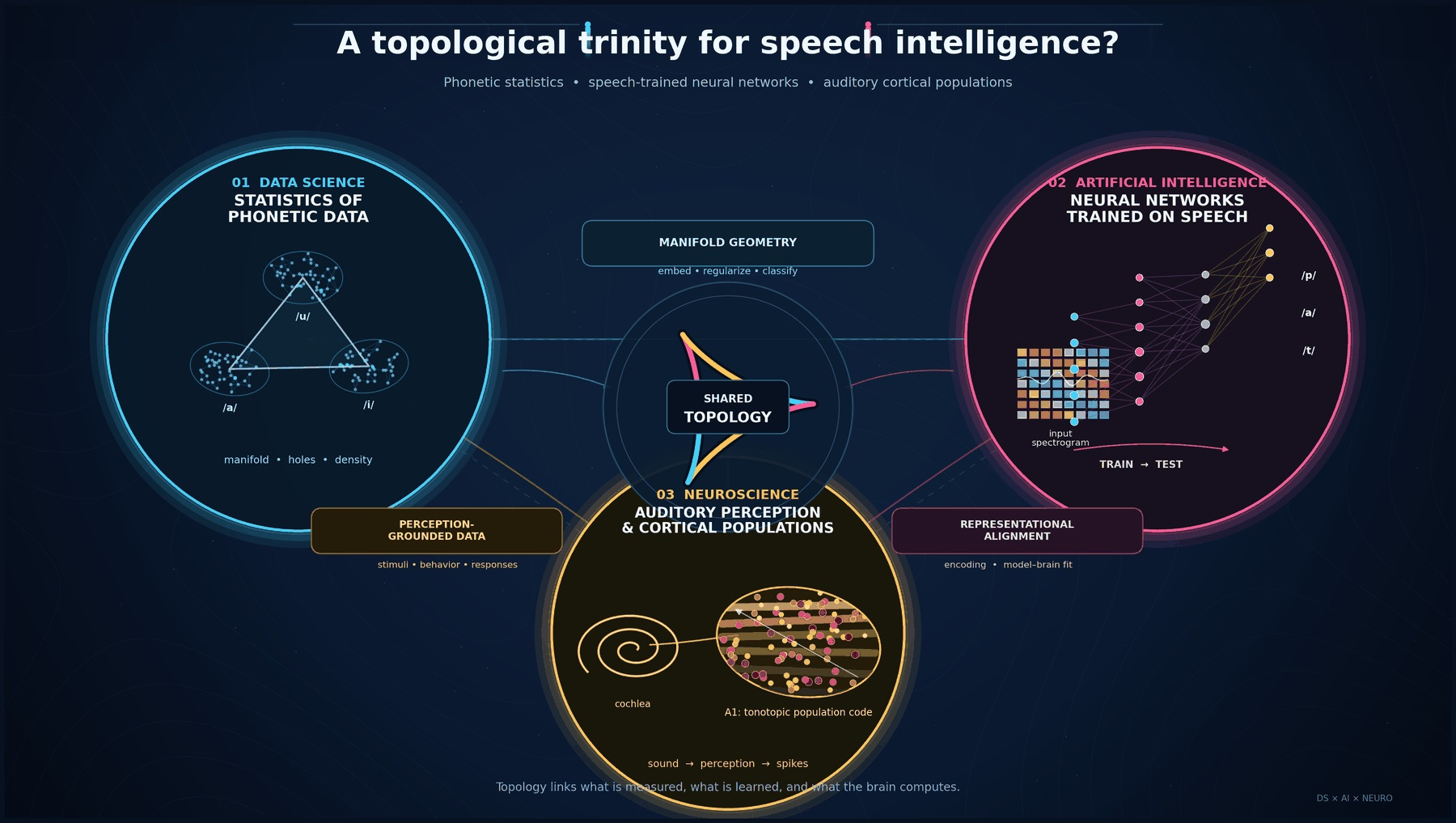
Figure 3. A proposed “topological trinity for speech intelligence,” phonetic statistics, neural networks trained on speech, and population responses of neurons in the auditory cortex share manifold geometry and topological structures.
The conceptualization, algorithms, and experiments of this research were independently carried out by Assistant Professor Yifei Zhu’s group, and SUSTech’s Department of Mathematics was the single institutional affiliation of this article. SUSTech undergraduate student Pingyao FENG and Ph.D. student Qingrui QU contributed equally as co-first authors, with Yifei Zhu being the corresponding author. The publication of this research represents another recent advance by the Department of Mathematics in applying mathematical theory to artificial intelligence, following Kailiang WU’s team’s work on the alternating neural integrators. The team particularly thanks the Shenzhen Center for Applied Mathematics, as well as related SUSTech research groups from the Department of Statistics and Data Science, the Department of Biomedical Engineering, and the School of Design, for their valuable interdisciplinary exchanges.
Article Link: https://www.nature.com/articles/s41467-026-77649-z
Proofread ByNoah Crockett, Junxi KE
Photo By