Professor Xuejun SONG’s team from the Department of Medical Neuroscience at the School of Medicine at the Southern University of Science and Technology (SUSTech) published a research paper in Nature Communications titled “Microglia-dependent PDGFB regulation of neuronal KCND2 in the hypothalamic paraventricular nucleus determines propofol anesthesia induction.” The study reveals that microglia-dependent PDGFB is a key molecule controlling the loss of consciousness induced by anesthetics in the induction of anesthesia with propofol. The most widely used, safest, and most effective general anesthetic, PDGFB plays an even more important role than the star target molecule, the GABAA receptor.
How does consciousness disappear? Why can general anesthetics make the brain “shut down”? Since general anesthesia was introduced into clinical practice, understanding how anesthetics induce a reversible loss of consciousness has been a core question in anesthesiology, as well as one of the central issues in neuroscience research. For more than a century, studies on anesthesia mechanisms have formed three theoretical hypotheses: the nonspecific lipid theory, the specific protein target theory, and the neural circuit theory. GABAA receptors and NMDA receptors are considered the most important molecular targets for anesthesia induction. Most anesthetics work by activating GABAA receptors, which suppress neuronal excitability and neural circuits, thereby disrupting the integrity and function of neural circuits responsible for neural signaling and the perception/subjective experience of consciousness, ultimately producing anesthesia. However, some drug agents that can activate GABAA receptors do not produce anesthetic effects.
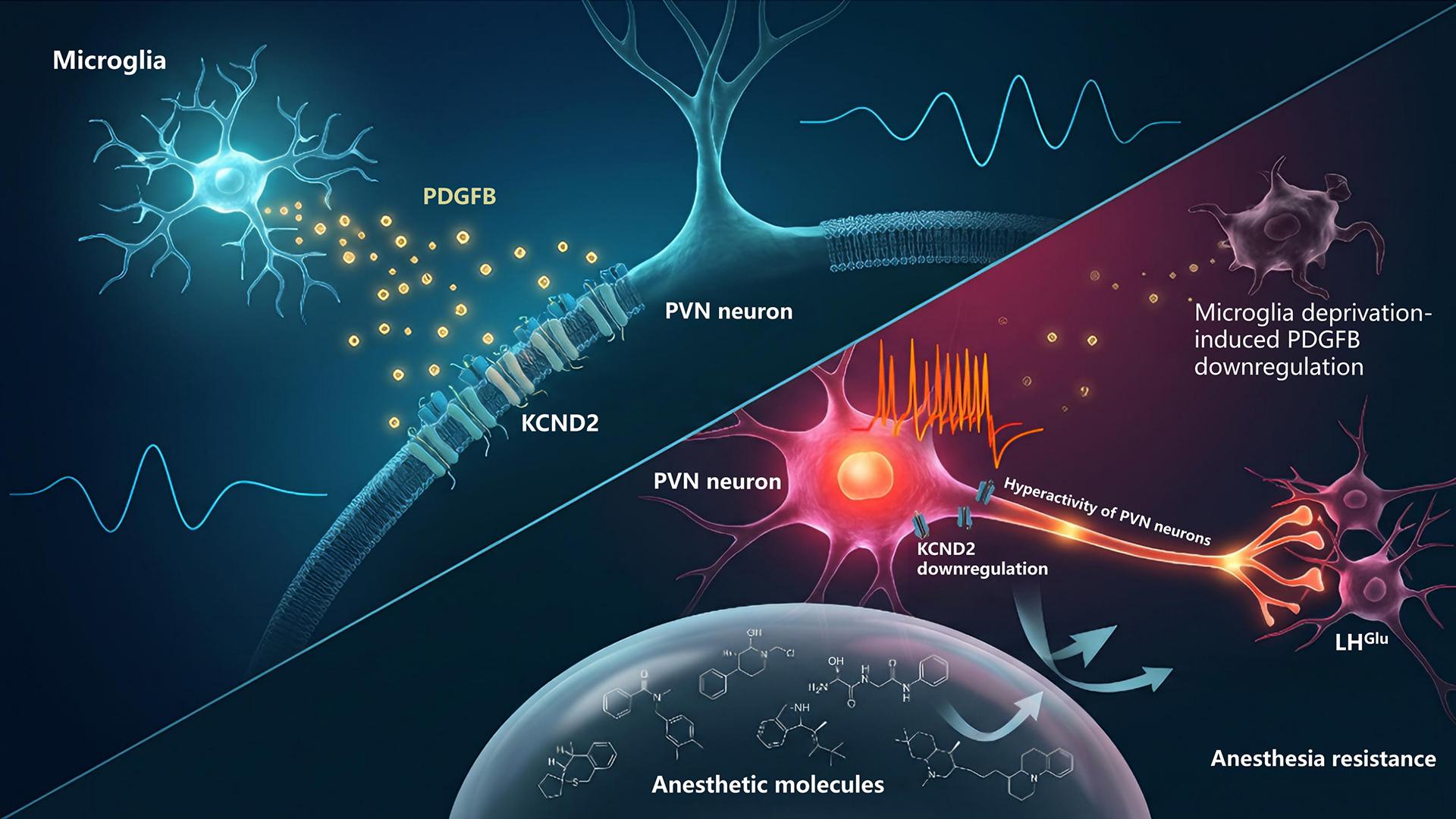
The team led by Xuejun SONG discovered that PDGFB protein molecules derived from and dependent on microglia are key molecules controlling the loss of consciousness and are important conditions for the successful induction of anesthesia by propofol. Knocking out PDGFB or microglia produces a significant resistance to anesthesia induction, an effect even more pronounced than inhibiting GABAA receptors. This research reveals a non-neuronal molecular mechanism regulating anesthesia sensitivity, supplementing the classic neuron-centered GABAA receptor theory of anesthesia and expanding the understanding of the molecular neural mechanisms underlying anesthesia induction. Microglia-dependent PDGFB modifies neuronal excitability by regulating the potassium channel Kcnd2 in PVN neurons, controlling the anesthesia induction process of propofol and making anesthetic doses of propofol unable to produce anesthesia or loss of consciousness. At the neural circuit level, the study identified the glutamatergic neurons in the PVN as opposing propofol anesthesia. The research demonstrates a regulatory system for anesthetic-induced loss of consciousness involving the microglia, PDGFB, KCND2, PVN, glutamatergic neuron, and LH glutamatergic circuit; providing a foothold for understanding anesthetic-induced loss of consciousness.
In exploring the principles of general anesthesia, Xuejun SONG’s team, building on the neuron-centric theory of anesthesia, proposed and demonstrated a microglia-dependent molecular neural mechanism for anesthetic-induced loss of brain consciousness. At the same time, they discovered the molecular neural mechanism behind the active recovery of consciousness from anesthesia and proposed the “active consciousness awakening theory.” These studies reveal that the disappearance and recovery of brain consciousness are dynamic and active processes of neural activity driven by specific molecules and neural circuits. The activity of the microglia-PDGFB-KCND2 signaling pathway sets the baseline for anesthetic-induced loss of consciousness, while the activity of the VPM-KCC2 ubiquitin degradation and EphB1-NR2B signaling axes determines how the brain “wakes up on its own” after consciousness is lost. This series of studies by Xuejun SONG’s team is piecing together a complete molecular neural mechanism map for the “switching off and on” of consciousness, providing new theoretical hypotheses for deeply understanding the mechanisms of general anesthesia and transitions in conscious states, as well as offering directions and targets for understanding and preventing postoperative consciousness and cognitive disorders.
Drs. Boxu CAO, Hongyu YAO, Jiangjian HU, and Yuexin LIU from the Department of Medical Neuroscience in the School of Medicine at SUSTech, are co-first authors of the paper, and Professor Xuejun SONG is the corresponding author. SUSTech is the first institution for the paper.
Paper Link: https://www.nature.com/articles/s41467-026-78798-x
Proofread ByNoah Crockett, Junxi KE
Photo ByYan QIU