Associate Professor Jinhui ZHONG’s team from the Department of Materials Science and Engineering at the Southern University of Science and Technology (SUSTech) made research progress in the study of charge separation mechanisms in polar semiconductors and the metal nanoparticle-assisted generation of triplet states. The results were published in the academic journals Advanced Materials and Advanced Functional Materials.
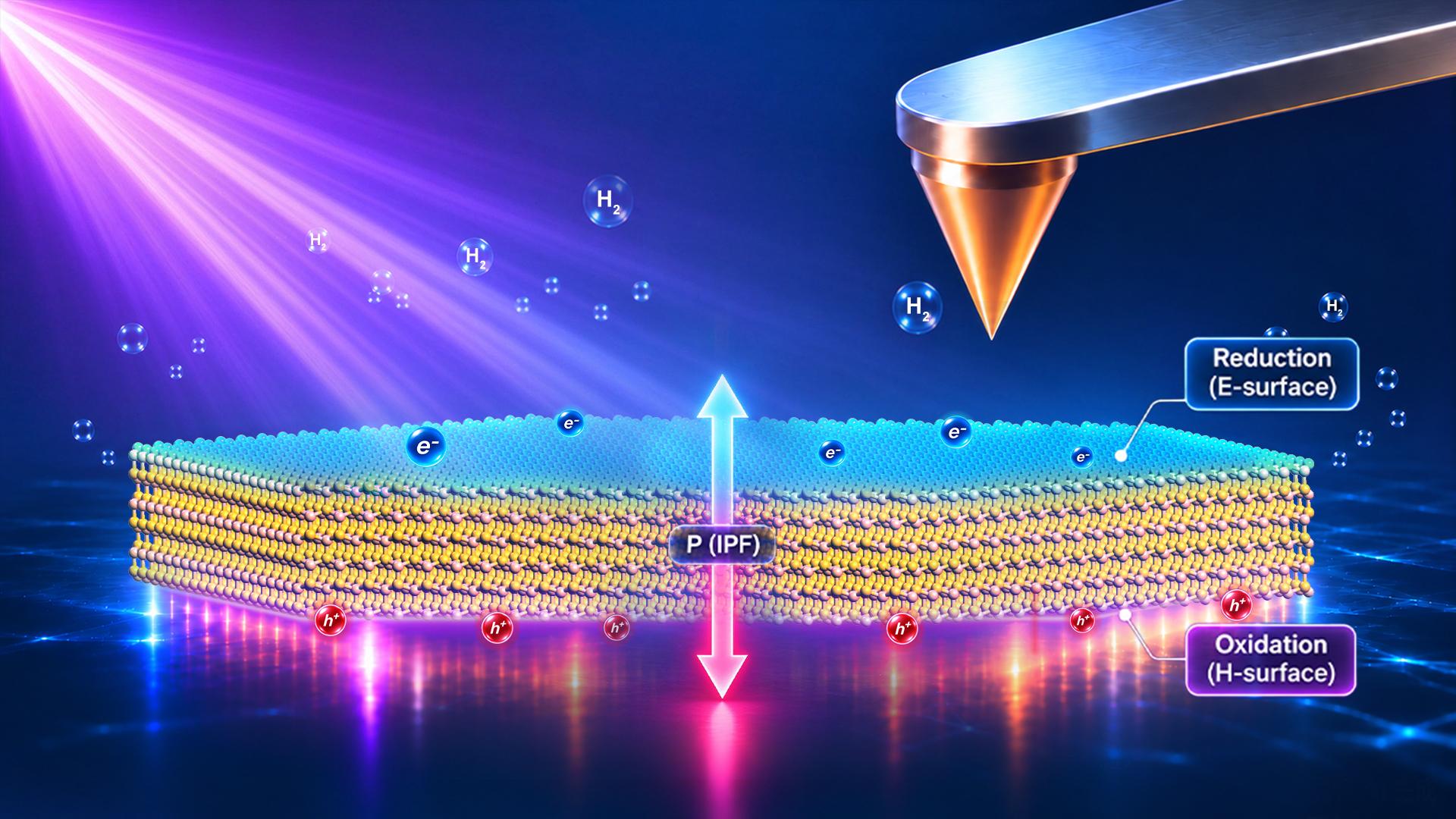
First Direct Visualization of Electron/Hole Spatial Separation Driven by Polarization Fields in a Single Polar Semiconductor Material
The efficiency of separating photogenerated electrons and holes directly determines how effectively solar energy can be converted into chemical energy. Traditional heterojunction interfaces can separate charges, but they often come with lattice mismatches and defects, which act as “traps” for charge recombination. Polar semiconductors (like wurtzite-structured CdS) naturally have non-centrosymmetric lattices, which theoretically create a built-in polarization field along the [001] direction. This field could drive electrons and holes to move in opposite directions within a single material. Direct experimental evidence has long been lacking. In 1D CdS nanorods, the polarization field is easily masked by local fields arising from structural non-uniformities, twin defects, or uneven surface ligand distribution, leading to conflicting conclusions in different studies about where electrons and holes actually gather. Figuring out how to remove these interferences and directly observe polarization field-driven charge separation is a key unresolved scientific question in this field.
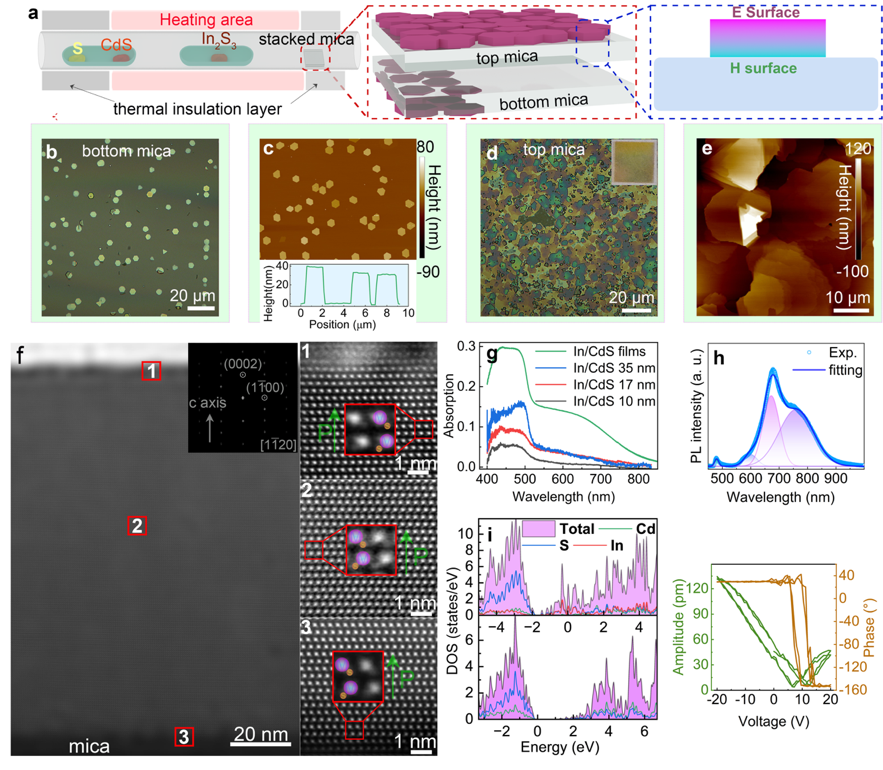
Figure 1. Preparation, Morphology, and Crystal Structure Characterization of 2D In/CdS Micron Sheets
The research team suggested that if CdS is made into two-dimensional micron-sized sheets, with both the top and bottom surfaces being large-area polar planes and the side area being very small, it could minimize side interference and let the built-in polarization field along the thickness direction dominate carrier redistribution. However, under certain conditions, CdS tends to form one-dimensional nanorods. The team managed to control its growth behavior by introducing indium (In) and successfully prepared two-dimensional In/CdS single-crystal sheets with highly consistent crystal orientation and large exposed polar crystal planes. They confirmed that these sheets retained the wurtzite structure, intrinsic CdS light absorption, and polarization field along the [001] direction, providing an ideal platform for directly observing spatial separation of electrons and holes.
The research team used Kelvin Probe Force Microscopy (KPFM) to image the surface potential of individual microflakes. In the dark, the surface of the microflakes showed a uniform negative potential; under 450 nm light, the top surface potential became more negative, indicating that photo-generated electrons were gathering on the top surface. After flipping the microflakes using a PMMA-assisted transfer technique, they found that the bottom surface potential became significantly positive under illumination, showing that holes were accumulating there. Through photo-deposition experiments with gold (photoreduction) and MnOx (photo-oxidation), they confirmed that gold nanoparticles selectively deposited on the top surface, while MnOx deposited on the flipped bottom surface, directly verifying the polarity-dependent charge separation of “electron-rich top, hole-rich bottom.” Single-molecule fluorescence imaging further showed that the top surface could selectively drive reduction reactions, while oxidation reactions were significantly suppressed.
Based on the above charge distribution images, the team selectively deposited Au and Ni nanoparticles as co-catalysts on the electron-rich surface. Under visible light (λ≥420nm), the photocatalytic hydrogen production rate of NiAu-In/CdS reached about 226 μL·h⁻¹·cm⁻², which is roughly 18 times that of bare In/CdS, with an apparent quantum yield of 4.76% at 420 nm.
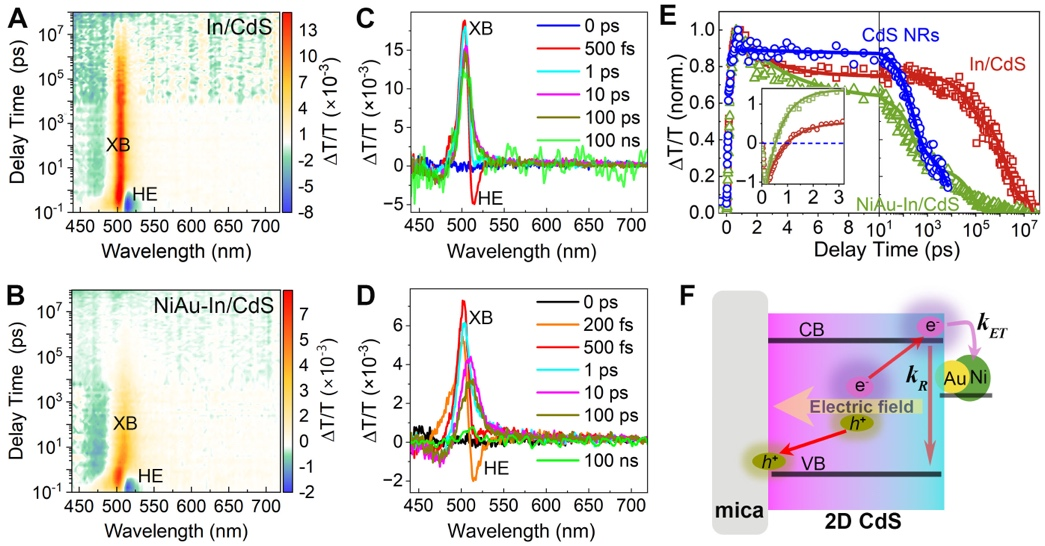
Figure 2. Ultrafast transient transmission spectra of 2D In/CdS and NiAu-In/CdS
The research team used femtosecond and nanosecond transient absorption spectroscopy to systematically track carrier dynamics in In/CdS and NiAu-In/CdS after loading with a co-catalyst. The results showed that the 2D In/CdS without a co-catalyst displayed a long-lived exciton bleach signal, with a lifetime of up to 2.02 microseconds, indicating that the polarization field can significantly suppress electron-hole recombination. After loading Ni/Au co-catalysts on the electron-rich surface, the average lifetime of the exciton bleach signal shortened from 2.02 microseconds to 76 nanoseconds, reflecting an electron transfer efficiency of about 96% from CdS to the co-catalyst in the NiAu-In/CdS heterostructure. Single-particle transient absorption spectra further confirmed, from a kinetics perspective, the “accessibility” advantage of 2D geometry in polarization field-driven charge separation; while polarization fields exist in 1D structures too, they can only be fully “utilized” for long-lived charge-separated states in 2D configurations with large exposed polar facets.
This work for the first time directly visualized the polarization field-driven electron/hole spatial separation in a single polar semiconductor material, providing direct experimental evidence for the long-debated “polar semiconductor charge separation” issue. At the same time, the study shows that “2D geometry selective cocatalyst loading” is an effective strategy to turn the intrinsic polarization field into photocatalytic performance, offering a new idea for designing efficient solar energy conversion materials.
The research findings were published in Advanced Materials under the title “Direct visualization of polarity-driven carrier redistribution in two-dimensional In/CdS.” The first author of the paper is Ming ZHOU, a senior research scholar from the Department of Materials Science and Engineering at SUSTech. Panwang ZHOU from the Dalian Institute of Chemical Physics, Chinese Academy of Sciences, and Jinhui ZHONG are the co-corresponding authors. SUSTech is listed as the first affiliation. The research received assistance from the Department of Materials Science and Engineering, the Department of Mechanical and Energy Engineering, the Shenzhen-Hong Kong Institute of Microelectronics, and related teams from Xiamen University.
Metal Nanoparticles Sensitize Molecular Triplets to Achieve Efficient Photon Upconversion
In the second study, the research team built a metal-molecule hybrid system using gold (Au) and platinum (Pt) nanoparticles with Rhodamine B (RhB). They revealed the mechanism of molecular triplet state formation mediated by interfacial hole transfer and charge recombination, and suggested that electron states below the metal’s Fermi level participate in hole transfer, providing favorable thermodynamic and kinetic conditions for efficient triplet generation. This study achieved singlet oxygen production, photodynamic antibacterial effects, and triplet-triplet annihilation photon upconversion, showing the potential of metal nanoparticles as a platform for triplet sensitization.
Using femtosecond and nanosecond transient absorption spectroscopy, the team tracked the “hole transfer–charge recombination–triplet formation” process in RhB after light excitation. Fast spin flipping in the metals helps form long-lived RhB triplets after charge recombination, with the average triplet lifetimes of Au-RhB and Pt-RhB being 81.7 μs and 78.8 μs, respectively.
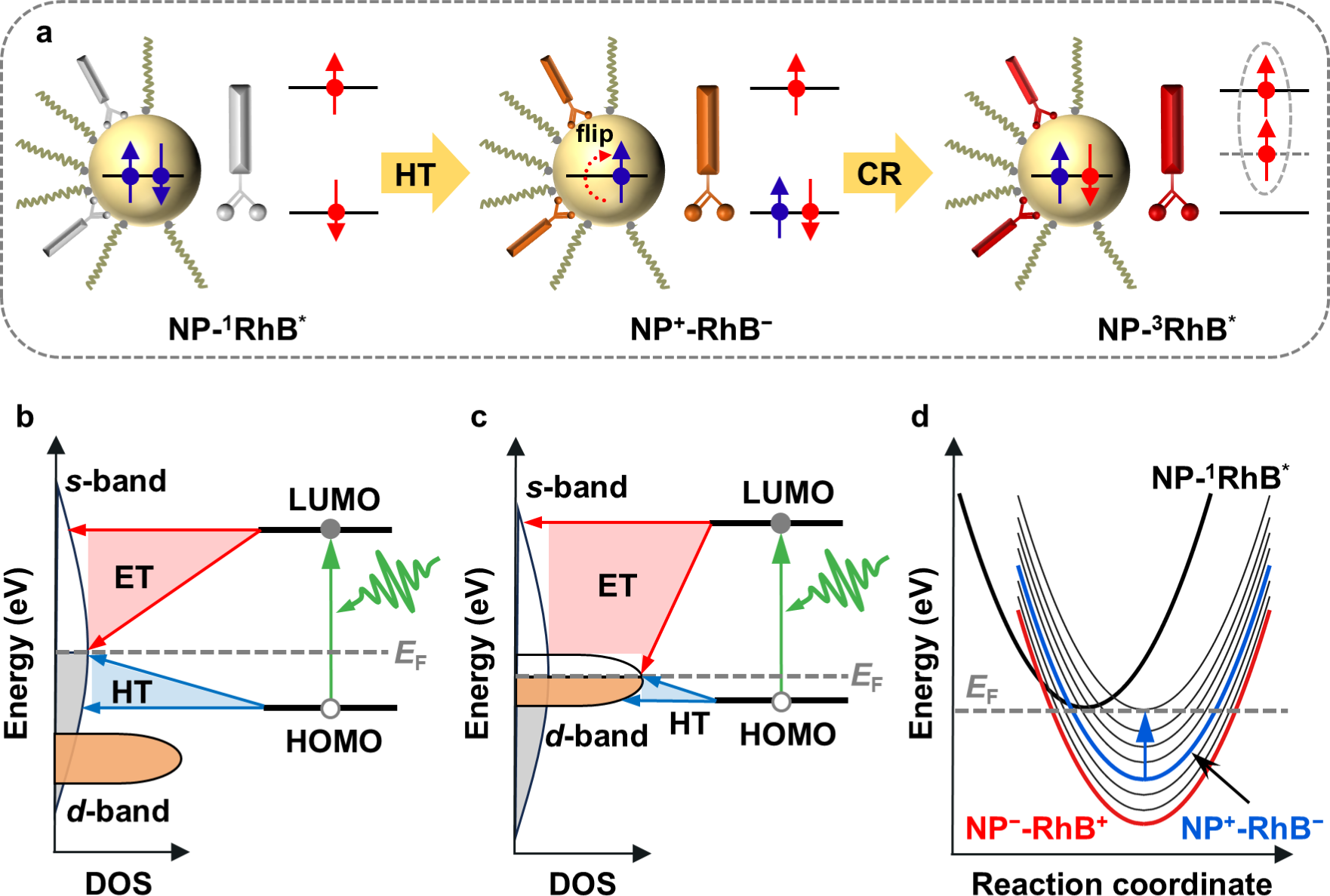
Figure 3. Mechanism of hole transfer, charge recombination, and RhB triplet state formation mediated by metal nanoparticles
By combining ultraviolet photoelectron spectroscopy, electrochemical measurements, and energy level analysis, the research team further proposed that the transfer of holes to electron states below the metal Fermi level is thermodynamically and kinetically favorable for subsequent triplet formation, providing new insights into the involvement of metal gapless electronic structures in molecular photosensitization. The research team also transferred the triplet energy of RhB to 9,10-diphenylanthracene (DPA), achieving triplet-triplet annihilation upconversion (TTA-UC) that produces 400-500 nm blue light under 540 nm green light excitation, with a maximum anti-Stokes shift of approximately 0.74 eV. The maximum upconversion quantum yields of the Au-RhB/DPA and Pt-RhB/DPA systems were (10.69 ± 0.28)% and (9.17 ± 0.55)%, respectively.
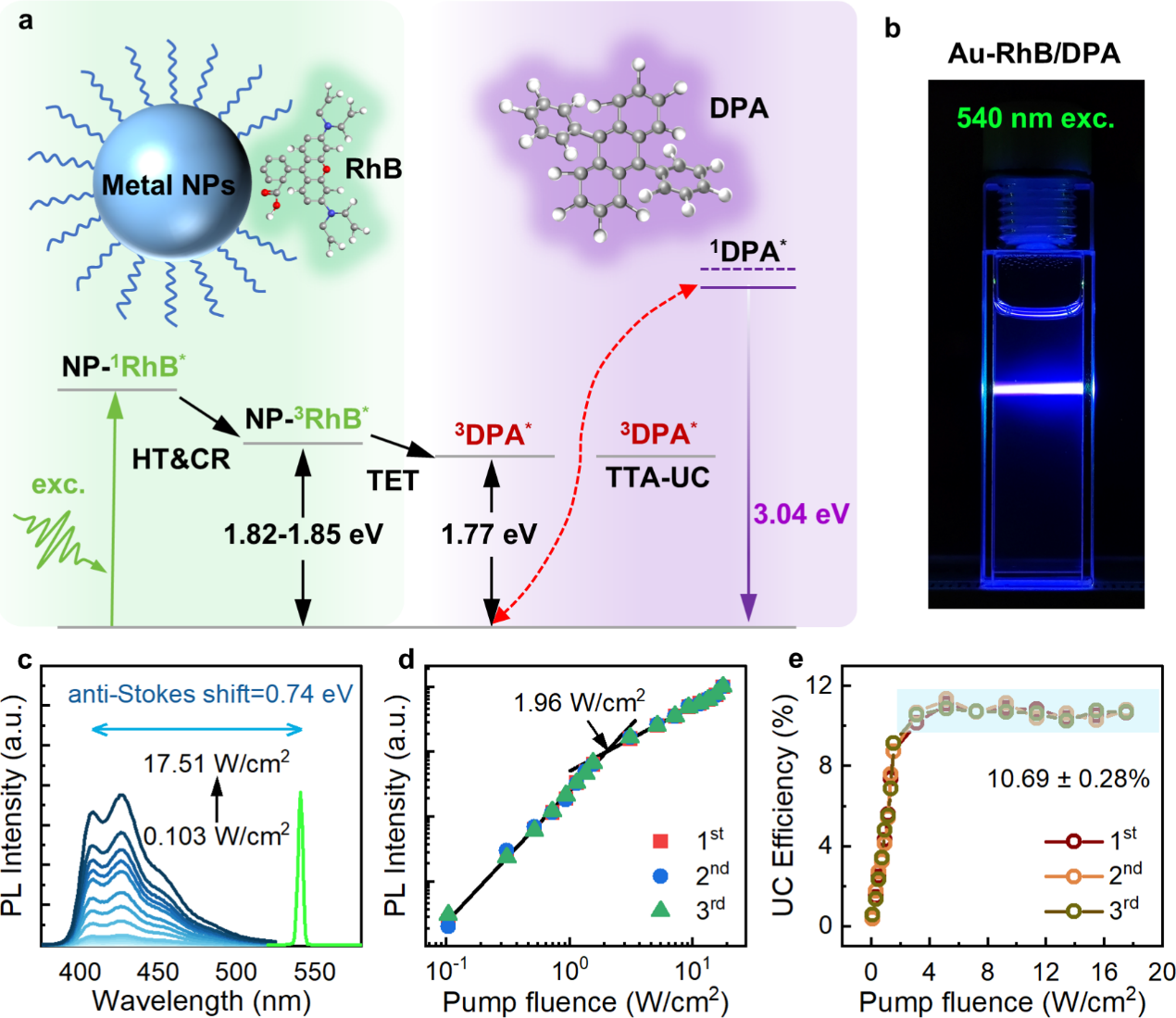
Figure 4. TTA-UC mechanism, blue light emission, and quantum yield of the metal nanoparticle-RhB/DPA system
This work links the formation of molecular triplets mediated by metal nanoparticles with the subsequent use of energy, offering new ideas for developing stable metal-organic hybrid photosensitizing systems, as well as photon upconversion, photodynamic antibacterial treatments, and related photochemical applications.
The research findings, titled “Metal Nanoparticle Sensitized Molecular Triplets for Efficient Photon Upconversion,” were published in Advanced Functional Materials. Zhanzhao LI and Ziwei XU, Master’s graduates from the Department of Materials Science and Engineering at SUSTech, are co-first authors, with Jinhui ZHONG as the corresponding author. SUSTech is the primary institution for the paper.
Advanced Materials link: https://advanced.onlinelibrary.wiley.com/doi/10.1002/adma.75696
Advanced Functional Materials link: https://advanced.onlinelibrary.wiley.com/doi/10.1002/adfm.79335
Proofread ByNoah Crockett, Junxi KE
Photo By