Associate Professors Haipeng LUO and Kejie CHEN from the Department of Earth and Space Sciences at the Southern University of Science and Technology (SUSTech), along with their collaborators, published new findings on the 2025 moment magnitude (Mw) 8.8 Kamchatka earthquake online in Science.
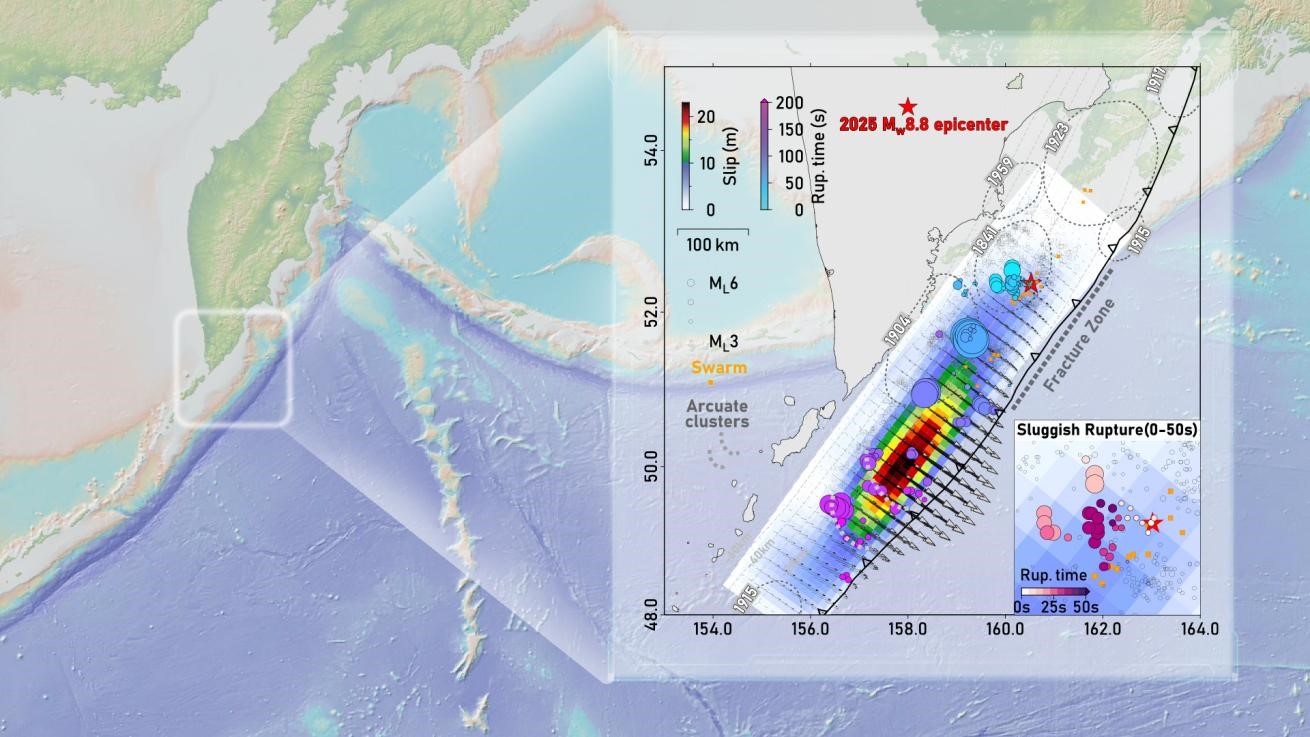
The 2025 Kamchatka earthquake occurred along the Kamchatka subduction zone and was one of the significant megathrust earthquakes recorded in the Pacific Rim subduction zones since modern records began. The quake ruptured over 300 kilometers along the subduction zone, causing more than 2 meters of horizontal land movement toward the ocean, and triggered a tsunami across the Pacific.
In the northern segment of the Kamchatka subduction zone, the Pacific Plate, carrying the Kruzenstern Fracture Zone, is subducted beneath the Okhotsk Plate. As a result, this northern segment is considered relatively rough, while the southern segment is comparatively smooth. Traditionally, it is believed that megathrust earthquakes in subduction zones mostly occur in smoother fault areas, and rough areas are less likely to generate great earthquakes. However, the 2025 Mw 8.8 earthquake spanned both the rough and smooth sections of the subduction zone faults. Researchers conducted multidisciplinary, cross-field studies on this earthquake, focusing on questions like: why does the mechanism of this earthquake differ from traditional understanding? And what implications does this have for identifying where megathrust earthquakes could occur?
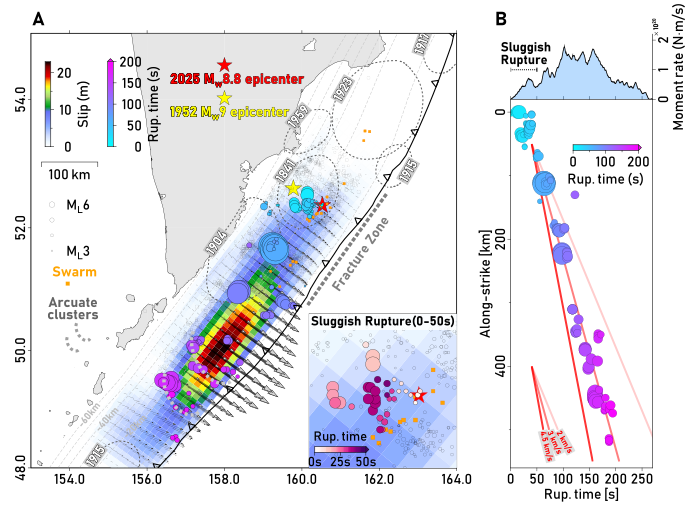
Figure 1. (a) Fault slip distribution of the Mw 8.8 Kamchatka earthquake; (b) (top) moment-rate-time plot of the earthquake; (bottom) time-distance plot of high-frequency seismic radiation sources.
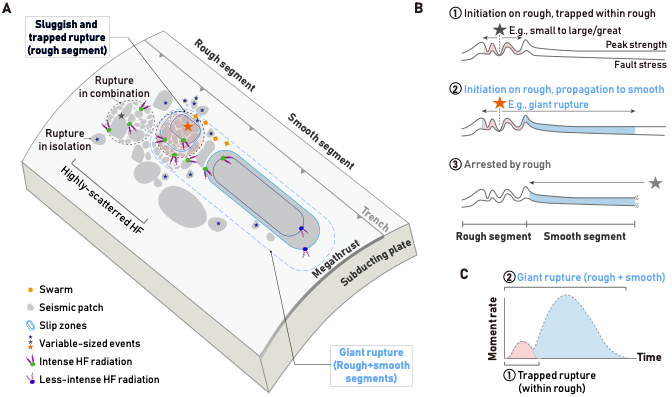
Figure 2. Mechanism of the 2025 Mw 8.8 Kamchatka Earthquake. (a) Illustration of earthquake slip zones in the Kamchatka subduction zone; the northern segment of the fault is rough, while the southern segment is smooth. The gray areas indicate the earthquake slip zones. Earthquakes start in the rough northern segment of the fault (star). (b) Rupture mechanism associated with the rough-smooth fault. (c) Moment rate-time (interpreted as energy-time) diagram for the scenario of adjacent smooth and rough fault segments.
Researchers combined multidisciplinary observational data, including Synthetic Aperture Radar (SAR) images, globally observed far-field seismic wave data, and Pacific tsunami observation records, to reveal the characteristics and mechanisms of this earthquake. Using teleseismic back-projection techniques, they found that at the start of the earthquake (around 0-50 seconds), the rupture only extended in localized areas of the rough fault, showing features such as concentrated high-frequency energy, limited low-frequency energy, and small seismic slip. Joint inversion of geodetic and seismic data showed that the earthquake rupture then propagated to the smoother southern fault area, producing over 20 meters of fault slip (Fig. 1) and triggering a global tsunami. This rupture evolution from rough to smooth fault surfaces indicates that a combination of rough and smooth fault planes can give rise to large earthquakes. During the energy accumulation phase before the earthquake, the rough fault areas, due to their strong heterogeneity in fault properties, tend to have local stress concentrations, leading to local instability and frequent small earthquakes.
In smooth fault areas, stress tends to accumulate over the long term and across a wide area. Once an earthquake rupture spreads into these areas with large energy accumulation, it can evolve into a big or even giant earthquake. The 2025 Mw 8.8 Kamchatka earthquake is an example of this phenomenon: the rupture started in the rough part of the fault, spread into the nearby smooth fault area, and eventually became an Mw 8.8 earthquake (Fig. 2). If the adjacent smooth fault areas haven’t accumulated enough energy, the rupture struggles to break through, resulting in a relatively smaller earthquake. Additionally, researchers analyzed M7-M8 magnitude earthquakes that occurred in the northern rough fault section, further supporting this conclusion.
This study reveals for the first time the “from rough to smooth” mechanism of earthquake rupture, suggesting that there is a potential risk for major earthquakes at the transition zones between rough and smooth areas in subduction zones. It provides new insights into where large earthquakes might occur and how earthquakes can propagate in cascades. Around the world’s subduction zones, topographical features like seamounts and ridges subduct into the plate interface, possibly causing spatial variations in roughness. Variations in sediment thickness along the strike could also affect the frictional properties and roughness of the subduction interface. As a result, there are often fault interfaces with rough-to-smooth transitions in subduction zones. Researchers point out that these areas are not only key regions for future earthquake monitoring but also important for reassessing earthquake and tsunami hazards. Additionally, analysis based on the Kamchatka earthquake shows that using observational data from the early stages of rupture to estimate the final magnitude still faces considerable challenges.
Haipeng LUO and Dr. Fengzhou TAN from the University of California are the co-first authors of the paper. Haipeng LUO, Dr. Zhangfeng MA from Nanyang Technological University, and Kejie CHEN are the co-corresponding authors. SUSTech is listed as the primary institution for the paper. Other collaborators include Senior Researcher Jian ZHANG and Associate Professor Shiqing XU from the Department of Earth and Space Sciences at SUSTech, Professors Xin WANG and Ling CHEN from the Institute of Geology and Geophysics at the Chinese Academy of Sciences, Professor Matías Carvajal from Pontifical Catholic University of Valparaíso in Chile, Dr. Hang XU from Peking University, and Associate Professor Sang-Ho Yun from Nanyang Technological University.
Paper Link: https://www.science.org/doi/10.1126/science.aef2089
Proofread ByNoah Crockett, Junxi KE
Photo ByYan QIU