Recently, the 9th CLE Annual Conference on Teaching and Learning, hosted by the Center for Language Education (CLE), was successfully held at Dacheng Auditorium in the College of Business. Scholars from multiple renowned universities and institutions gathered on-site for cross-institutional academic discussions and experience-sharing on technology-empowered teaching, curriculum reform and talent cultivation.
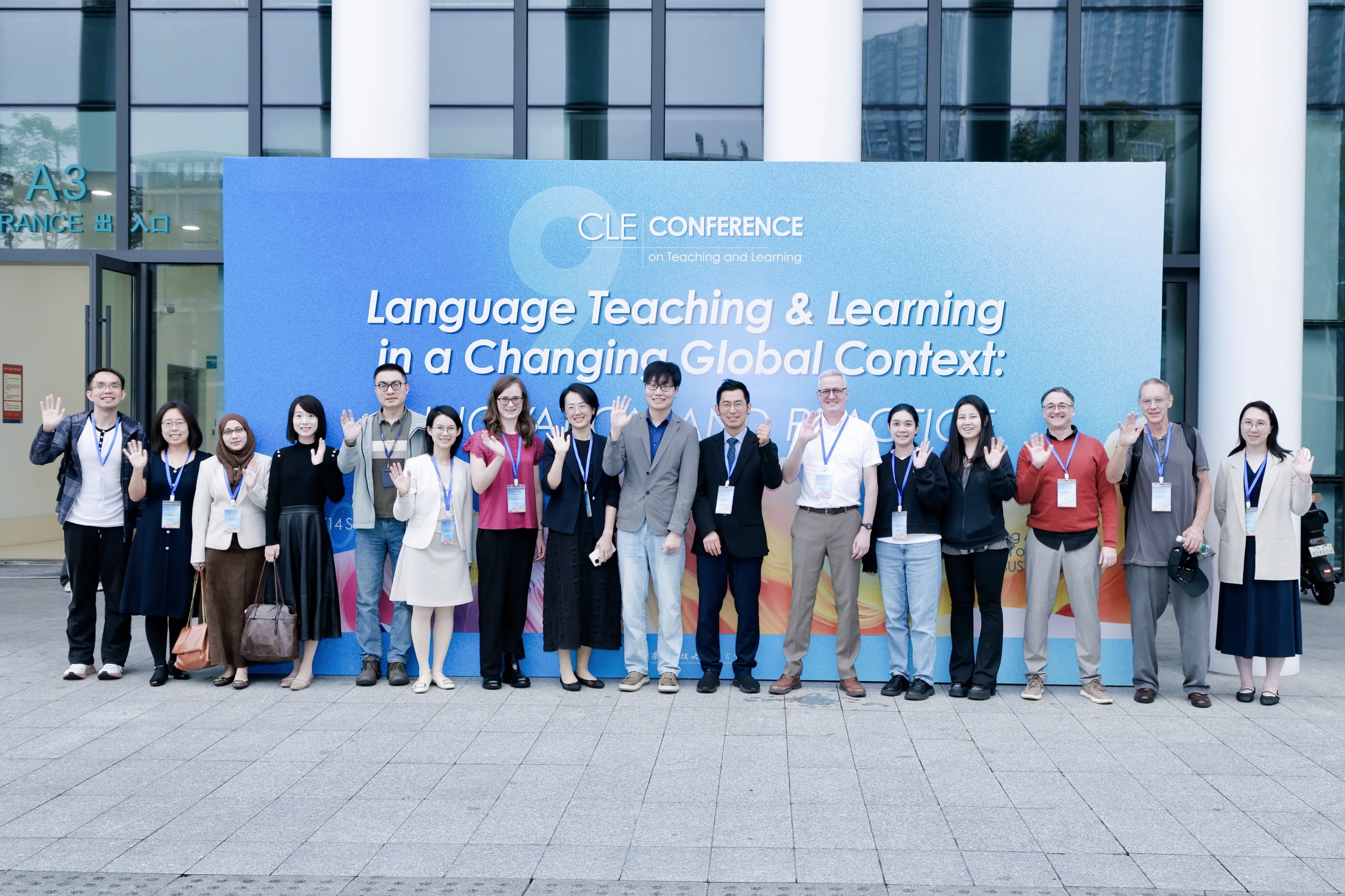
Under the theme “Language Teaching and Learning in a Changing Global Context: Innovation and Practice,” the symposium focused on the opportunities and challenges brought by artificial intelligence to language education. It brought together applied linguistics researchers and front-line language teachers from the Guangdong-Hong Kong-Macao Greater Bay Area and universities across China.
Three keynote speeches were delivered in the morning session. Professor Haomin ZHANG from City University of Macau shared insights on multilingual literacy in the AI era. Drawing upon theories of “translanguaging” and cross-linguistic transfer, he illustrated how teachers can mobilize learners’ diverse linguistic and cultural resources. He also demonstrated an AI-mediated dynamic assessment prototype and reaffirmed teachers’ central role in technology-enabled education. Associate Professor Ju Seong LEE from The Education University of Hong Kong presented findings from his long-term research into Informal Digital Learning of English (IDLE). He analyzed how AI expands opportunities for out-of-class language practice, introduced a human-AI coaching model, and shared practical teaching strategies adaptable to real classrooms. Drs. Rongrong DONG and Jinru LUO from SUSTech’s Center for Language Education presented two qualitative case studies exploring new issues arising from generative AI‑integrated L2 writing. They argued that tools themselves are not the decisive factor; learner identity, topic ownership, and human-AI interaction systems exert profound influences on learner agency, offering new perspectives for case‑study methodology in the AI age.
Five parallel panels ran concurrently in the afternoon. Presentations covered topics including LLM-enhanced writing instruction, critical AI literacy, intercultural competence-oriented curriculum reform, the development of teachers’ intercultural sensitivity, English for Academic Purposes instruction, and support for special-needs language learners. A special workshop was also organized for hands-on exchanges on AI-empowered Informal Digital Learning of English. Alongside the sessions, a student poster exhibition took place. SUSTech students enrolled in CLE English courses gave live poster presentations to participating guests, showcasing their reflections on their own learning journeys.
Balancing cutting-edge theoretical exploration with classroom-oriented practical transformation, the symposium enabled participants to exchange research outcomes and teaching experiences. It further strengthened the community of language‑education scholars and provided diverse ideas for university-level language teaching reform amid global shifts and the rise of artificial intelligence.
Proofread ByNoah Crockett, Junxi KE
Photo By