The results of the 2026 International Genetically Engineered Machine Competition (iGEM) global finals were announced. The undergraduate team from the School of Medicine at the Southern University of Science and Technology (SUSTech), SUSTech-MED, won the competition’s gold award for their project “FORGE: Functional Olfactory Recombinant Gut‑engineered Probiotics for Autism Intervention.”
iGEM was launched by MIT in 2003 and is one of the top competitions in the cutting-edge interdisciplinary field of synthetic biology. The competition places high demands on project innovation, scientific rigor, practical application, ethical standards, teamwork, and problem-solving. It has become a global platform for young people to exchange ideas and innovate in science and technology. This year’s grand final brings together over 440 teams from universities including MIT, Harvard, Cambridge, Tsinghua University, and Peking University, making it one of the largest editions yet.
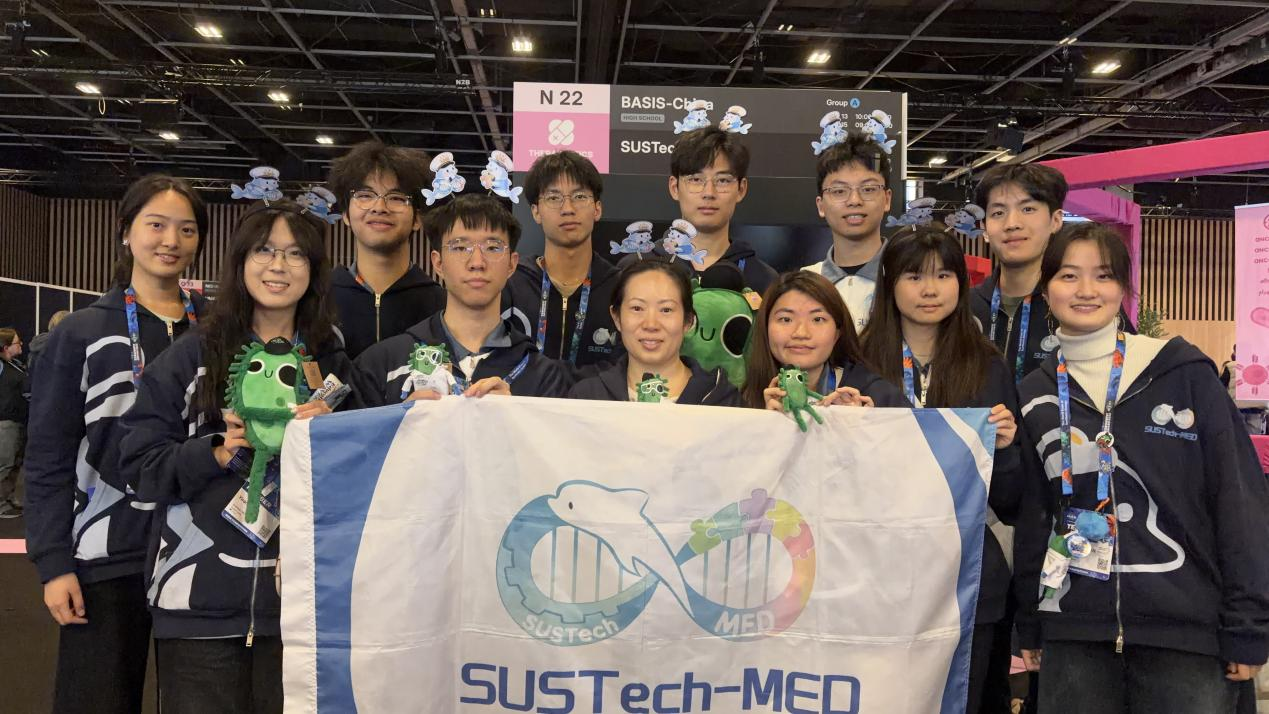
The SUSTech-MED team consists of 23 members, including Xiyu WANG (team leader), Ruichen XU, Wenling DUAN, Minghao LI, Haoyang JIANG, undergraduate students from the School of Medicine, Zhenhong CEN, and Yiran LI, undergraduate students from the SUSTech-King’s School of Medicine, and Xiang CHEN, an undergraduate student from the College of Engineering, among others. The competition project focuses on the challenge of limited clinical intervention methods for autism spectrum disorder and the lack of drugs targeting core symptoms. Using subtypes such as oxidative stress, neuroinflammation, and nitrogen metabolism disorder, the team constructs multi-module engineered probiotics based on Lactiplantibacillus plantarum L168. They adopt a nasal delivery approach combining lyophilized bacterial powder with substrates. The project incorporates an NAD⁺-dependent safety switch to achieve controllable biological containment; at the same time, they develop SynBioPilot AI drug screening software and the NasoTwin nasal simulation model. Combined with wet lab experimental validation, the team explores new safe and controllable auxiliary intervention pathways for autism.
Beyond scientific research, the team also organized the first Asia-Pacific iGEMer and Young Synthetic Biology Enthusiasts Exchange Conference (Grand APiC), creating an academic exchange platform across schools, regions, and fields; at the same time, they continuously carried out popular science education activities on autism, developing the “WAVE” education model and advocating respect for neurodiversity. The related innovative achievements were accepted by the 2026 IEEE International Conference on Bioinformatics and Biomedicine (BIBM).
Proofread ByLu LI, Junxi Ke
Photo BySchool of Medicine