The team led by Chair Professor Qihang LIU, affiliated with the Department of Physics and the State Key Laboratory of Quantum Functional Materials at the Southern University of Science and Technology (SUSTech), and the Quantum Science Center of Guangdong-Hong Kong-Macao Greater Bay Area, has made progress in predicting magnetic ground states using symmetry. The findings were published in Physical Review X under the title “Symmetry-Guided Prediction of Magnetic-Ordered Ground States.” The work was also featured in the American Physical Society’s Physics Magazine in an article entitled “Symmetry Guides the Search for Magnetic Order,” as part of its “Featured in Physics” coverage.
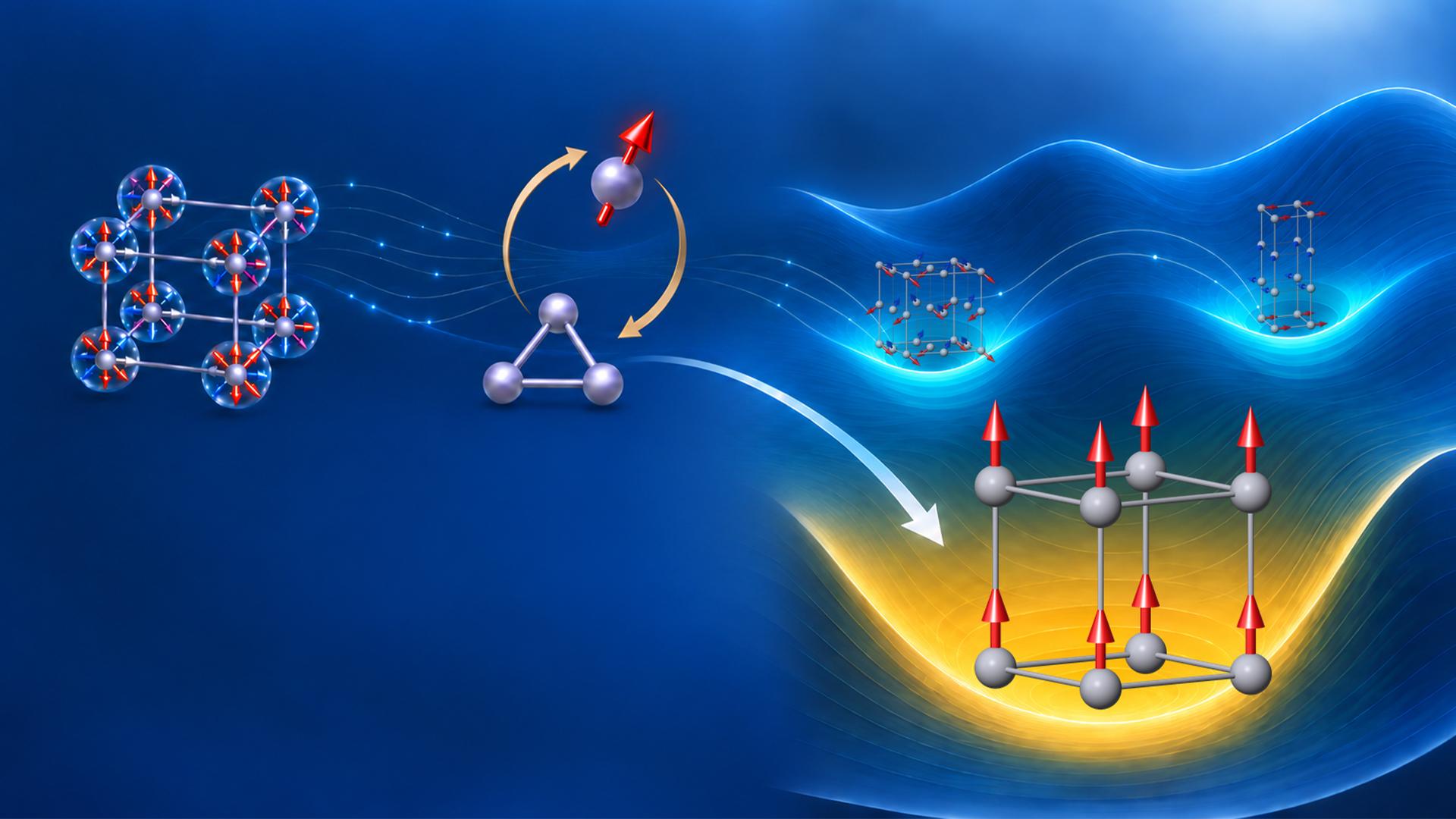
Symmetry is an essential theoretical tool for understanding magnetic materials. Conventional magnetic space groups treat magnetic moments as axial vectors in lattice space, with spin operations locked to lattice operations. This description, however, cannot capture all possible symmetry operations of a magnetic structure. Recent developments in spin space group theory decouple symmetry operations in spin and lattice spaces, allowing a richer set of operations than magnetic space groups. This provides a more complete description of magnetic symmetry and reveals phenomena such as spin splitting, quantum geometric effects, and topological magnons in unconventional magnets. In earlier work published in Nature, Professor LIU’s team introduced the concept of oriented spin space groups. By specifying the orientation of spin space relative to lattice space, the theory connects spin space groups with magnetic space groups and provides a symmetry framework for the unified description and systematic classification of magnetic structures.
Both using spin space groups to uncover the physical properties of known magnetic materials and using oriented spin space groups to classify known magnetic structures address the same forward problem: What symmetries does a given magnetic structure possess? This naturally raises a more challenging inverse problem: Can spin group symmetry be used to predict an undetermined magnetic structure starting from its crystal structure?
The present work answers this question affirmatively. The team extends oriented spin space group theory from describing and classifying known magnetic structures to predicting them. Using only the crystal structure and magnetic atomic sites as inputs, the framework systematically identifies symmetry-compatible magnetic configurations. It substantially reduces the magnetic configuration search space to a finite, representative set of candidates for determining the ground state.
The framework divides magnetic ground-state prediction into two stages (Fig. 1). First, it generates candidate magnetic geometries within the spin space group framework and ranks their energies through first-principles calculations without spin-orbit coupling. This identifies low-energy magnetic geometries governed by isotropic exchange interactions. Second, oriented spin space groups reduce the continuous space of spin orientations to a finite set of orientations that are inequivalent under magnetic group symmetry. First-principles calculations including spin-orbit coupling then determine the magnetic anisotropy energies and the final magnetic ground state. By treating exchange interactions and spin-orbit coupling in separate stages, the framework turns the search over a complex magnetic potential energy landscape into a systematically enumerable and computable set of candidate structures. Only a few dozen symmetry-selected configurations need to be evaluated.
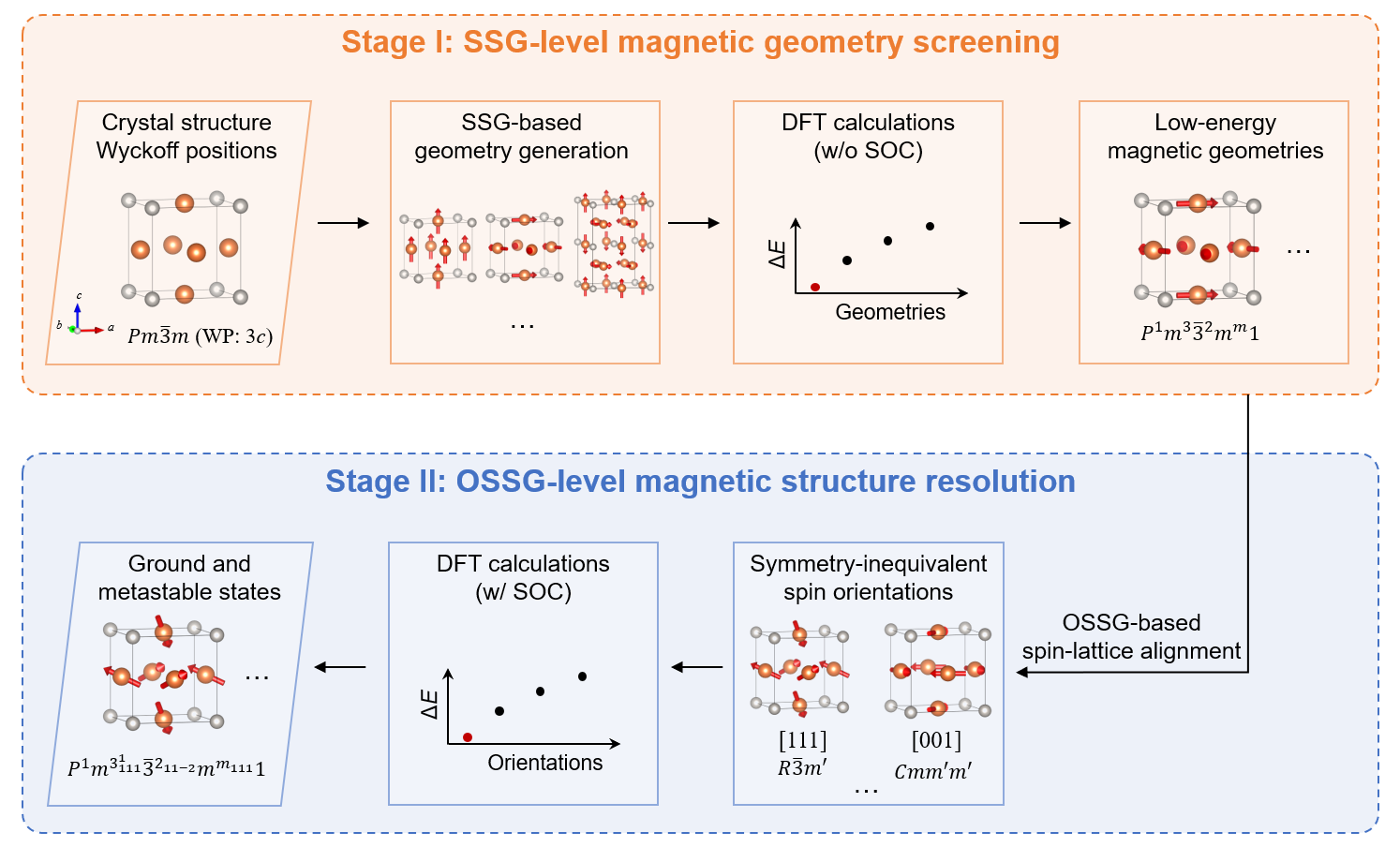
Figure 1. Framework for predicting magnetic ground states using oriented spin space group symmetry.
To assess the generality and reliability of the method, the team conducted large-scale tests using the experimental magnetic-structure database MAGNDATA. Across 1,178 crystal structures, the generated candidates successfully included 922 experimentally reported magnetic geometries, corresponding to a coverage of 78%. The team then performed high-throughput first-principles calculations for 305 magnetic compounds. For 82% of these compounds, the experimentally reported magnetic structure lay within 5 meV per magnetic atom above the computed ground state. These results demonstrate that the framework can effectively generate and screen physically reasonable candidate magnetic structures, providing a reliable and efficient route to high-throughput prediction of magnetic ground states. It also predicts a range of low-energy metastable magnetic phases with unusual physical properties. These phases can be tuned through external fields, strain, or temperature, offering additional candidate systems for exploring unconventional magnetism and its functional applications.
To support practical applications of the method, the team developed SPINGEN, an online program for magnetic structure generation, and integrated it into the open-source FINDSPINGROUP platform published in the National Science Review. Users upload a crystal structure, specify the magnetic atoms, and set the enumeration parameters to automatically obtain candidate magnetic structures satisfying oriented spin space group symmetry constraints. Based on the symmetries of the generated structures, the platform also provides preliminary assessments of physical properties such as spin splitting and the anomalous Hall effect. It exports crystallographic files containing magnetic-structure information, facilitating subsequent first-principles calculations and analysis of material properties.
This work extends spin group theory from the description and classification of magnetic structures to their generation and prediction. It establishes a systematic symmetry-based route to efficiently locating magnetic ground states on complex magnetic potential energy landscapes. In the future, the generated configurations could also be used to fit effective spin Hamiltonians, construct machine-learning potentials, and develop foundation models for magnetic materials, supporting large-scale prediction and design of complex magnetic structures and unconventional magnetic materials.
The co-first authors are Yuhui LI, a Postdoctoral researcher in the Department of Physics at SUSTech, and Sike ZENG, a Doctoral student at South China University of Technology. Chair Professor Qihang LIU of SUSTech and Associate Researcher Xiaobing CHEN of the Quantum Science Center of the Guangdong-Hong Kong-Macao Greater Bay Area are the co-corresponding authors. Collaborators include Professor Yu-Jun ZHAO of South China University of Technology. SUSTech is the first-listed affiliation.
Article Link: https://link.aps.org/doi/10.1103/8ftb-swx9
Physics Magazine: https://physics.aps.org/articles/v19/157
SPINGEN: https://spingen.findspingroup.com
National Science Review: https://doi.org/10.1093/nsr/nwag614
Proofread ByNoah Crockett, Junxi KE
Photo ByYuhui LI