A joint research team co-led by Professor Tzung-May FU, from the School of Environmental Science and Engineering at the Southern University of Science and Technology (SUSTech), and Professor Jianzhen YU, Chair Professor of the Department of Chemistry and the Division of Environment and Sustainability at the Hong Kong University of Science and Technology (HKUST), has quantified an important component of the global nitrogen cycle. The study, published in Science, was titled “Atmospheric Organic Nitrogen is a Major Nutrient Source to Global Oceans.” The study revealed previously underappreciated sources of oceanic nutrients, providing new evidence for understanding the global nitrogen cycle and its ecological effects.
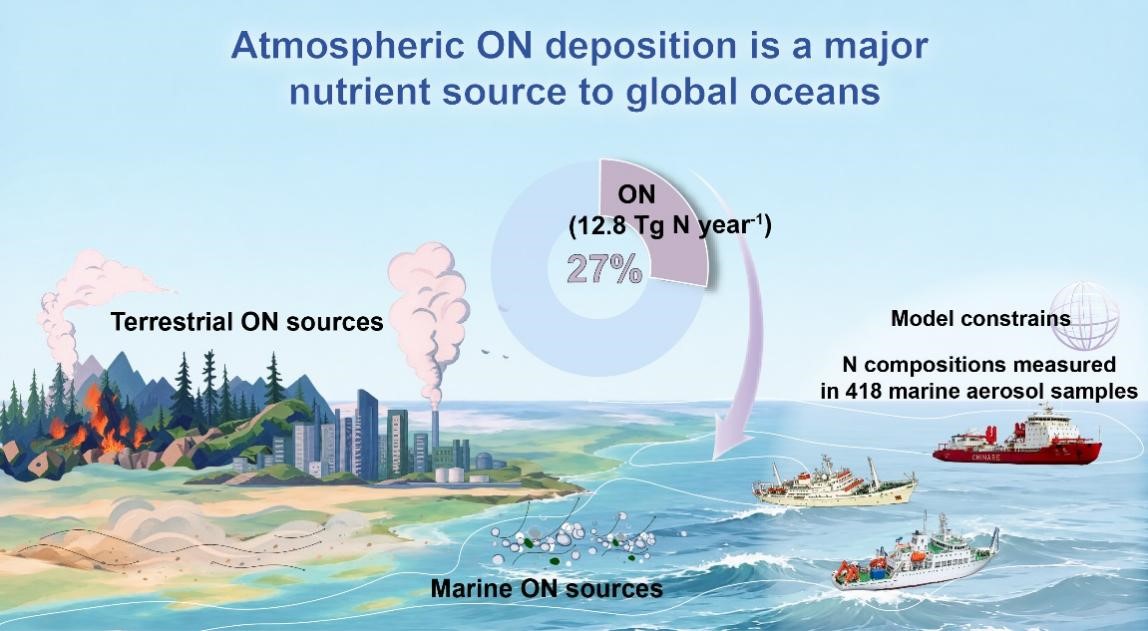
Figure 1. Integrating trans-latitude ocean atmospheric sample collection, new measurements, and new simulations, it is estimated that organic nitrogen (ON) deposition into the global ocean is about 12.8 TgN year-1, accounting for 27% of total atmospheric nitrogen deposition to the global ocean
Reactive nitrogenous species in the atmosphere, both in gas and particulate forms, provide nitrogen nutrients to the ocean through deposition, including both Inorganic Nitrogen (IN) and Organic Nitrogen (ON). ON, however, has complex chemical compositions and is difficult to measure, and there used to be a lack of systematic large-scale observations.
The team had previously developed a highly sensitive method to accurately measure ON and IN in aerosols simultaneously. In this study, the collaborative team of atmospheric chemistry and marine and polar science researchers analyzed 418 marine aerosol samples collected from 21 research cruises. The result is a marine atmospheric ON and IN dataset, measured consistently, spanning the tropics to the Arctic Ocean and Southern Ocean (Fig. 2).
The observations show that ON makes up approximately 30% of the total nitrogen in marine aerosols on average, and in some seas ON’s contribution exceeds 50%. This result indicates that ON is a significant component of reactive nitrogen in the marine atmosphere (Figure 3).
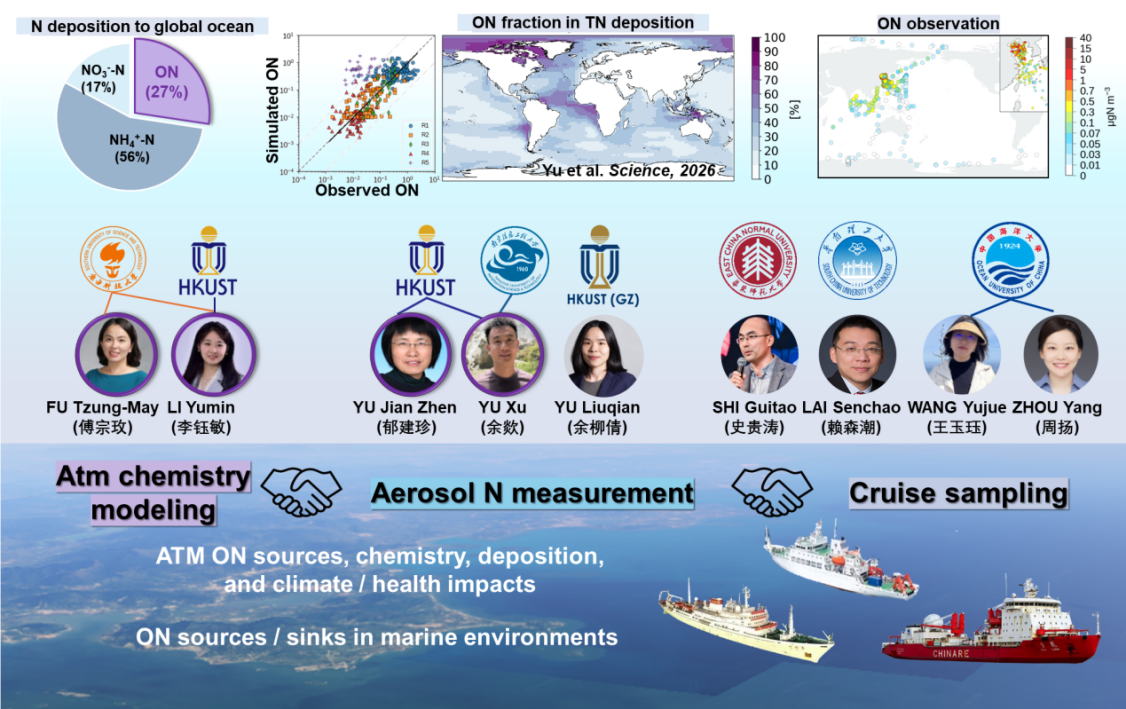
Figure 2. Research Collaboration Team
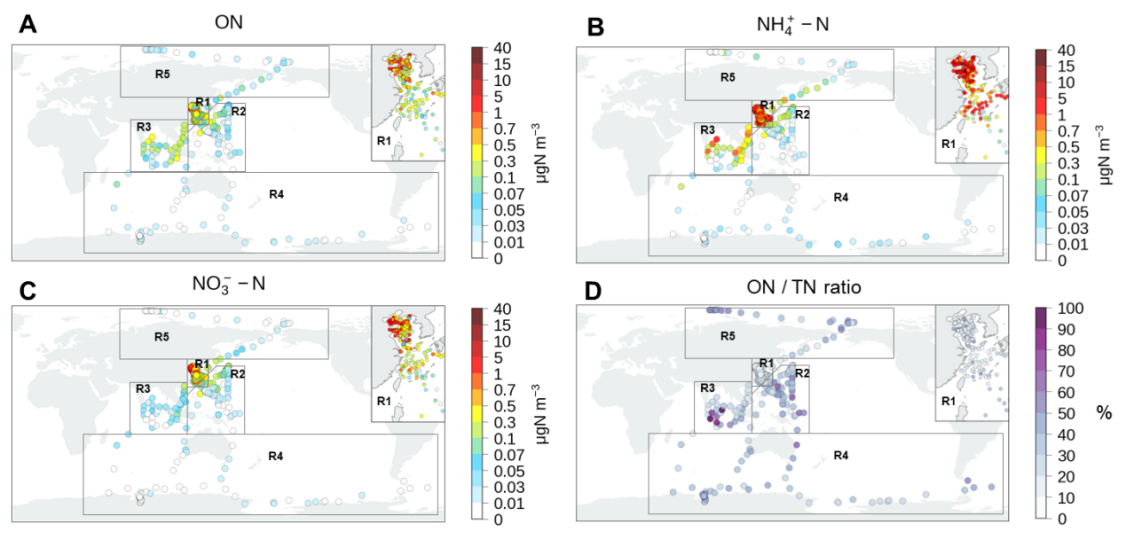
Figure 3. Observations of nitrogen component concentrations in 418 marine aerosol samples collected over 21 cruises. (A) ON; (B) NH4+-N; (C) NO3–-N; (D) ON/TN. R1-R5 are five marine atmospheric regions divided based on aerosol ON concentrations and coordinates.
Based on these new marine atmospheric observations, the team improved a global atmospheric ON chemistry model and evaluated the simulated results against observations. They found that the model accurately simulates the reactive nitrogen concentrations across marine atmospheric environments (Figure 4) and the global distribution of ON aerosol.
Using the global model, the team estimated that the world’s oceans receive about 12.8 million tons of atmospheric organic nitrogen each year (12.8 Tg N year-1). Organic nitrogen, ammonium nitrogen, and nitrate nitrogen account for 27%, 56%, and 17% of total nitrogen deposited to the global ocean, respectively (Figure 5). In some nitrogen-limited areas, roughly half of the nitrogen coming from the atmosphere is ON.
The ON that settles from the atmosphere into the ocean mainly comes from three sources: biomass burning, marine aerosol emissions, and secondary imine formed through atmospheric chemistry. Terrestrial ON makes up 70% of the ON deposited to the ocean surface, serving as an important external nutrient input for the ocean and boosting marine biological productivity.
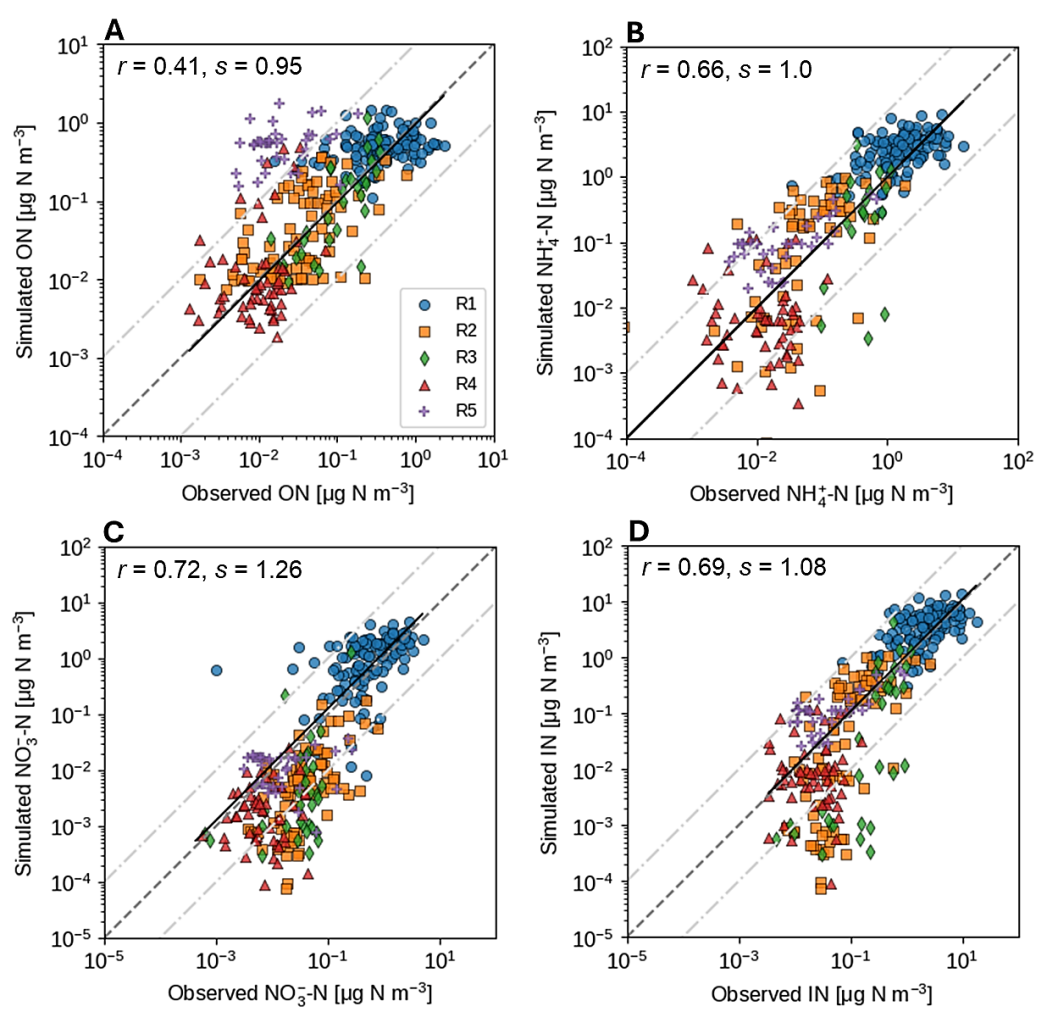
Figure 4. Comparison between observed and simulated components of marine aerosols ON and IN. (A) ON; (B) NH4+-N; (C) NO3–-N; (D) IN
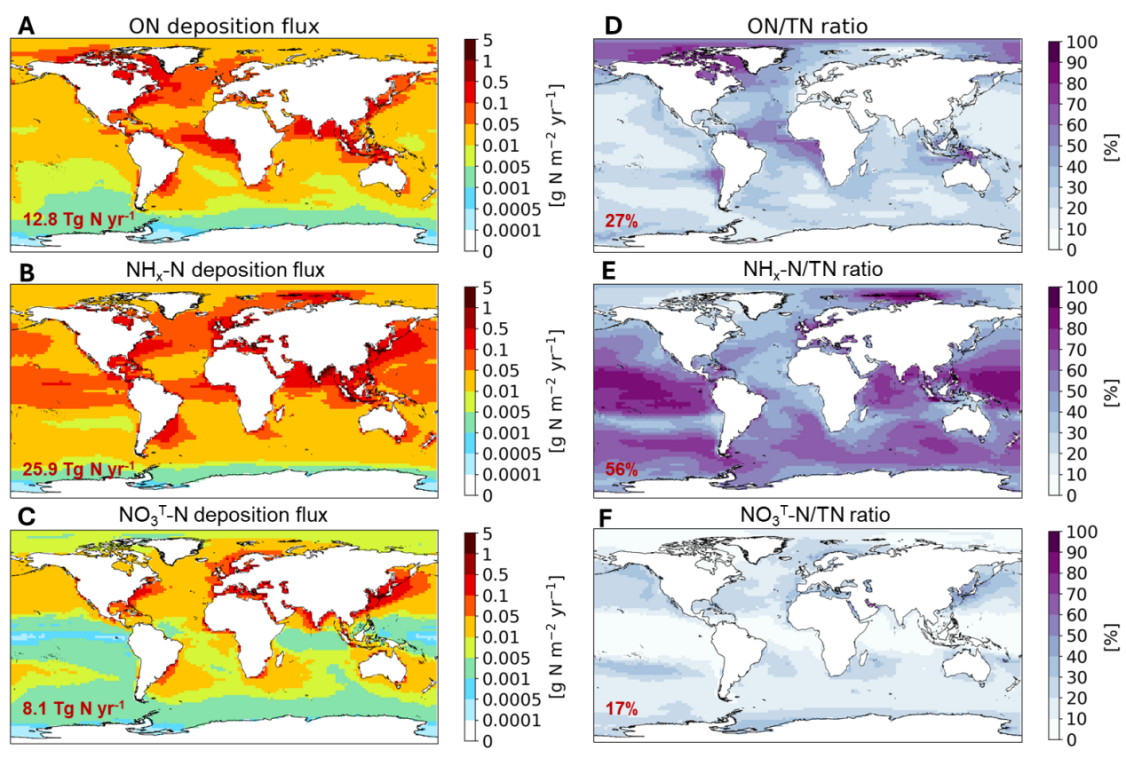
Figure 5. Simulated atmospheric deposition of ON, NHx-N, and NO3T-N to the ocean (A-C) and the proportion of each component in total nitrogen deposition (D-F)
This study combines large-scale ocean observations with global modeling, addressing a historical gap of systematic observations of ON in the marine atmosphere. The study deepens our understanding of the global nitrogen cycle and highlights the important role of interdisciplinary collaboration in pushing the limits of scientific knowledge. The study also points out that there is an abundance of gaseous organic nitrogen in the atmosphere, which could also deposit significantly, and its flux needs further assessment.
Professor Xu YU from Nanjing University of Information Science & Technology and Yumin LI, a joint Ph. D. student from SUSTech and HKUST (now a postdoctoral researcher at ETH Zurich), are the co-first authors of the paper. Tzung-May Fu and Jianzhen YU are the co-corresponding authors. The research was supported by the teams of Guitao SHI from East China Normal University, Senchao LAI from South China University of Technology, Yang ZHOU and Yujue WANG from Ocean University of China, and Liuqian YU from Hong Kong University of Science and Technology (Guangzhou).
Proofread ByNoah Crockett, Junxi KE
Photo ByYumin LI