For decades, amino acids have been widely used as excipients in protein formulations to extend shelf life and reduce aggregation risk. Proline and glycine, for example, are frequently employed in immunoglobulin products such as Cuvitru®, Privigen®, and Hizentra®. However, prior understanding of their stabilizing effects have largely remained empirical. Whether this effect arose from protein-specific biological interactions or from more general colloidal physical principles has long lacked a unified, quantitative explanation.
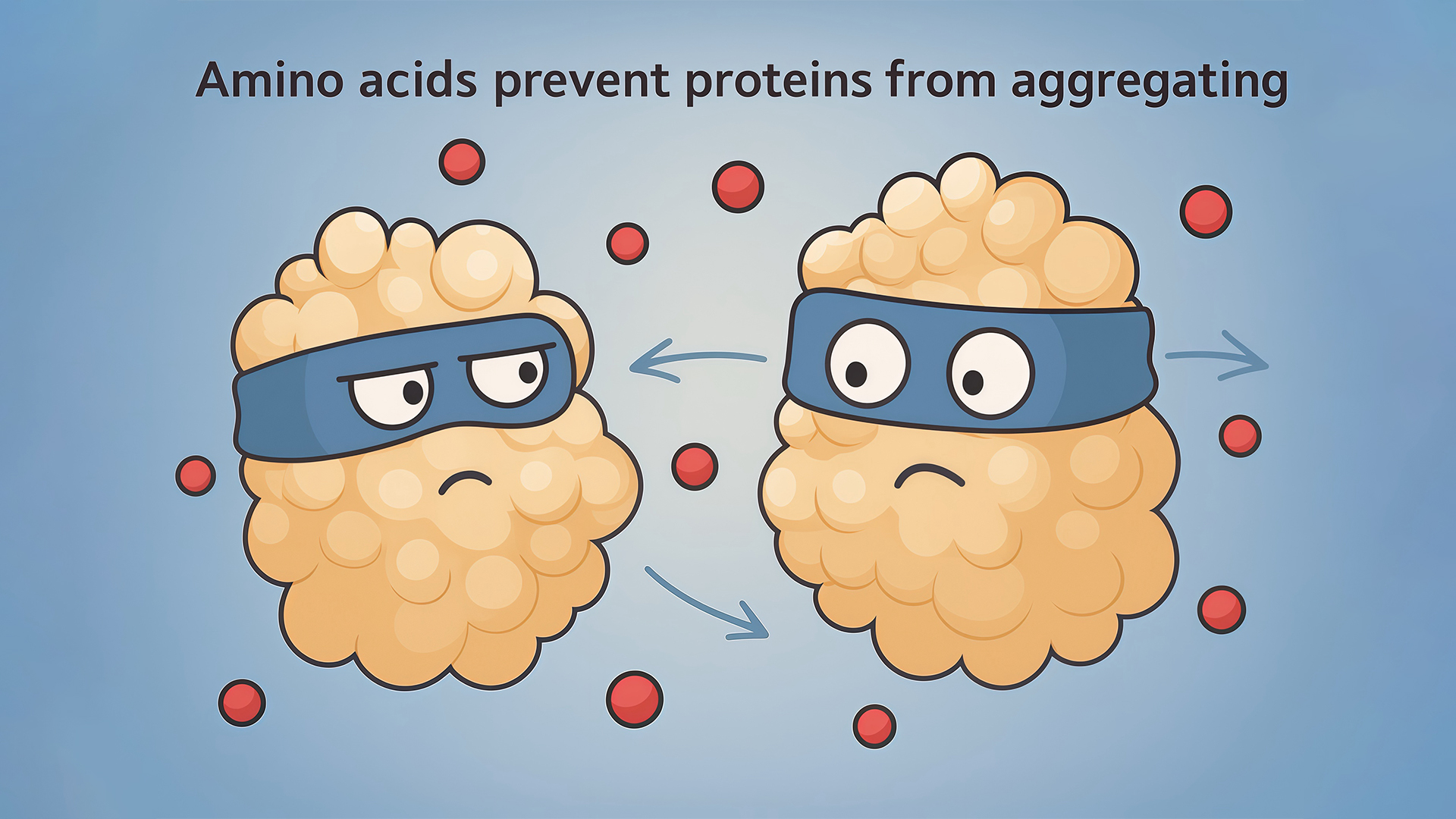
Associate Professor Zhi Luo’s team from the Department of Biomedical Engineering at the Southern University of Science and Technology (SUSTech), together with collaborators, has made significant progress in elucidating the role of amino acids in colloidal stability. Their study is the first to propose a new universal stabilization mechanism for biomacromolecules and to establish a quantitatively predictive theoretical model. This achievement provides a physical basis for optimizing protein- and nucleic acid–based formulations and is expected to drive the development of advanced drug formulations from “empirical addition” toward “predictive design.”
Their results have been published in Nature under the title “Stabilizing effect of amino acids on protein and colloidal dispersions.”
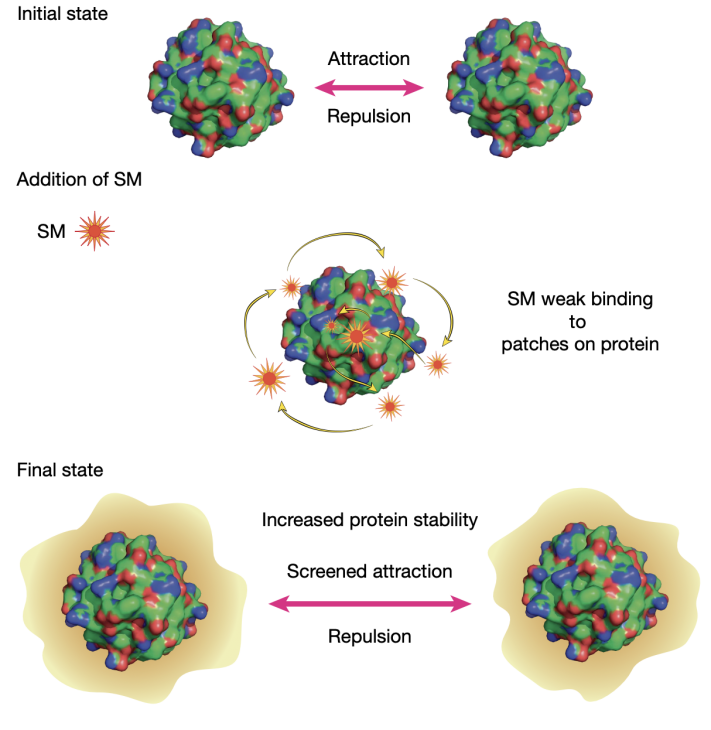
Figure 1. Theoretical framework of colloidal stabilization by small molecules
The team systematically evaluated the effects of amino acids on proteins, DNA, and nanoparticles by measuring the second osmotic virial coefficient (B22) and the potential of mean force (PMF). Results showed that the addition of amino acids significantly increased B22, enhanced repulsive interactions between particles, and thereby suppressed aggregation. This effect is opposite to that of salts, which reduce B22 by “screening repulsion,” making particles more prone to aggregation. Amino acids, by contrast, act through an “attraction screening” mechanism, weakening colloidal attractions and improving stability.

Figure 2. B22 universally increases in protein, DNA, and nanoparticle systems upon addition of amino acids
To further understand how small molecules stabilize macromolecules, the researchers proposed a new model in which colloidal particles were treated as “patchy” surfaces, with amino acids reversibly binding to these patches via Langmuir-type adsorption, thereby partially blocking attractive sites between particles. As amino acid concentration increased, fewer attractive patches remained exposed, leading to higher B22 values and greater system stability.
To validate the model’s pharmaceutical relevance, they applied it to insulin formulations. Sedimentation velocity ultracentrifugation revealed that proline reduced the fraction of insulin hexamers while increasing dimers and monomers. Pharmacokinetic studies in mice further demonstrated that insulin formulated with 1 M proline nearly doubled the area under the plasma concentration–time curve and significantly increased peak plasma concentration, indicating improved in vivo exposure and bioavailability.
For innovative drug formulations, this case illustrates how the model not only explains in vitro stability metrics but also extrapolates to improved in vivo pharmacokinetics, enabling consistency between preclinical design and clinical translation while reducing uncertainty.

Figure 3. Proline suppresses protein phase separation, reduces stress granule formation, and enhances insulin bioavailability
The first authors of the paper are Ting Mao, Xufeng Xu, and Pamina Winkler from École Polytechnique Fédérale de Lausanne (EPFL). Associate Professor Zhi Luo, Professor Alfredo Alexander-Katz from Massachusetts Institute of Technology (MIT), along with Dr. Quy Ong and Professor Francesco Stellacci from EPFL, are the corresponding authors. SUSTech is the corresponding institution for this work.
Paper link: https://www.nature.com/articles/s41586-025-09506-w
To read all stories about SUSTech science, subscribe to the monthly SUSTech Newsletter.
Proofread ByAdrian Cremin, Yifei REN
Photo ByDepartment of Biomedical Engineering